

UTILIZATION OF HONEYBEE (APIS MELLIFERA L.) FOR THE POLLINATION OF THE GREENHOUSE CULTIVATED STRAWBERRY
tekst: Zdzisław Wilkaniec, Monika Maciejewska
Pszczelnicze Zeszyty Naukowe, Rok XL, 1996 — Zdzisław Wilkaniec, Monika Maciejewska
strona 227PSZCZELNICZE ZESZYTY NAUKOWE Rok XL, Nr 2 1996
Zdzisław Wilkaniec, Monika Maciejewska
Department of Useful Insects Breeding, University of Agriculture, Wojska Polskiego 71C 60-625 Poznań, POLAND.
Summary
Two-year studies on the pollination of strawberry cultivated in an unheated greenhouse aimed at the utilization of the honeybee (Apis mellifera L.) and the evaluation of its pollinating effectivity in comperison with two other pollination methods, i.e. by blowing and by self-pollination.
On the basis of the obtained results, it has been found that the honey bee is an effective pollinator of strawberry and it can be utilized for the pollination of cultivations under cover (greenhouses, foil tunnels), having a particularly favourable effect on the quality of fruit. It limits the percentage of deformed fruits in the total yield and it increases the percentage of the highest quality fruit and the total mass of fruit obtained from one plant. Key words : honeybee, pollination, strawberry, greenhouse.
INTRODUCTION
Good pollination of strawberry flowers, apart from other factors, is a condition for obtaining a high yield of good quality fruit. The greatest predisposition for this work is shown by insects from the superfamily of bees (Apoidea) due to their morphological structure and way of life. In order to achieve a good pollination of the strawberry flower, the bee has to visit it many times. This is because of the specific flower structure of this species (Skowronek et al. 1985, Kakutani et al. 1993). The provision of good pollination is particularly important in the controlled cultivation of the strawberry since it has a very significant influence on the production of high quality fruit. It is obvious that only good quality fruit intended for consumption in fresh condition can insure the profitability of the plantation with the application of this modern cultivation technique (Radajewska, Staniczek 1994 ).
It was found that in the field cultivation of the strawberry, the honey bee constitutes 77% to 98% of all pollinating insects (Skowronek et al. 1985). However, it is believed that honey bee is maladapted to closed areas and great quantities of worker bees fall under these conditions (Szklanowska,
strona 228Dąbska 1991), therefore, the bee is regarded as unsuitable for the pollination of plants cultivated under cover (greenhouses, foil tunnels, isolators).
However, the utilization of both the wild bee and the honey bee for the pollination of strawberry cultivations in greenhouses and foil tunnels has recently become a common procedure (Kakutani et al. 1993:, Dag et al. 1994; Wilkaniec, Ruszczyński 1994; Gundia 1995).
The application of the honey bee for the pollination of strawberry in greenhouse cultivation has a favourable effect not only on the number and mass of fruits, but it also decreases the participation of deformed fruits in the total yield (Dag et al. 1994; Lieten 1993).
The purpose of the presented axperiments was the utilization of the honey bee (Apis mellifera L.) for the pollination of strawberry cultivated in an accelerated cultivation in an unheated greenhouse, and for the determination of the effectivity of the bee as a pollinator in comparison with two other pollination methods, i.e. by blowing and by self-pollination.
METHODS
In 1995, studies were carried out on a Dutch strawberry, Korona variety, with the application of frigo cuttings, and in 1996, with the use of frigo cuttings and fresh cuttings (overwintered in a foil tunnel) of the Canadian variety Kent. In a greenhouse of 272 m² area, plants were planted in beds, alternatively in 2 rows, with 30 cm x 30 cm spacing and 11 plants/m² density. In the period of plant growth, the necessary protective treatments and fertigations were applied. The experiment included 30 randomly chosen plants that were divided into three groups differing by pollination method : I – plants pollinated by bees, II – plants pollinated by blowing, III – plants subject to self-pollination.
In the particular experimental groups, five replications were established with two plants in each of them. Plants of the experimental groups II and III were shielded by isolators, while the access to the greenhouses plants from group I and to the remaining plants was free.
When the plants started blooming, bees were placed into the greenhouse. In 1995, we placed two one-frame hives with bees in the Wielkopolska frame (360mm x 260mm), and in 1996, we used one Wielkopolska hive with an average bee family. The small one-frame hives were settled with bees several hours before inserting them into the greenhouse. One frame settled with bees on both sides was taken from a bee family and placed in the small hive. The number of bees was increased by shaking additional bees into the hive from other combs.
It is known that bee families taken directly from the apiary and placed in a closed area (greenhouse, foil tunel, isolator) lose a great number
strona 229of bees since they get confused, they do not work the flowers but they try to get out of the enclosure and finally they fall or get crushed against the greenhouse walls. They are foraging bees that used to forage freely. Therefore, before the one-frame hives with bees were placed into the greenhouse, they were kept in the apiary at some distance from the mother families so that the foraging bees could fly away and return to their mother hives. The same was done with the bee family before placing it into the greenhouse so that the foraging bees could leave and return to a new hive that was placed in the same place from which the family hive was taken. Then, they were given combs with brood and young bees and they created a new family. These treatments were carried out on a warm sunny day. Bees designed for strawberry pollination were provided honey-and-sugar cake. After inserting them in the greenhouse, they behaved calmly, and in a short time they undertook their work on the blooming strawberries.
The blooming plants from the experimental group pollinated by blowing were blown every third day from a hair dryer through the shielding net of the isolators. The third experimental group pollinated by self-pollination was under the isolators during the whole time of blooming. The isolators were removed only for protective treatments.
The fruit was collected as it ripened, separately from each experimental group. The collected fruit was divided into four selections: extra (Ex)-fullshaped fruit with a width exceeding 3.0cm; first (I)-fullshaped fruits, width:1.5 – 3.0 cm, second (II)-fullshaped fruit, width below 1.5 cm, out of selection (PW)-not fully developed deformed fruit. Fruit selected in this way was counted and weighted exactly to 1.0 gram. Fruits of selection Ex and I were defined as the commercial yield, and fruit of selection II and PW was regarded as uncommercial yield.
The effectivities of the particular methods of pollination were determined on the basis of the following mean values: percentage of collected fruit from one plant in relation to the number of produced flowers, number and mass of fruit from one plant with division into the particular selections and on the basis of commercial and non – commercial yield from one plant, average mass of a single fruit, percentage of deformed fruit in relation to the total yield.
The results were subject to statistical analysis using Duncan’s test with significance level & =0.05. The particular methods of pollination within one variety and type of seedlings were compared.
RESULTS
Due to different varieties of strawberries and different types of seedlings in the particular years of studies, the results presented in tables
strona 230and in the drawing should be analysed separately both for the variety and for the types of seedlings applited in the experiments, comparing three different methods of pollination.
Table 1 The influence of strawberry pollination on the setting and guality of fruits and on the hight of yield. Wpływ sposobu zapylania truskawki na zawiązywanie i dorodnść owoców oraz na wysokość ich plonu.
| Invwstigated feature / Cecha badana | Year / Rok | Variety / Odmiana | Pollination method — Sposób zapylania: Bees / Pszczoły | Pollination method — Sposób zapylania: Blowing / Owiewanie | Pollination method — Sposób zapylania: Self-pollination / Samozapylanie |
|---|---|---|---|---|---|
| Number of fruit from 100 flowerws / Liczba owoców ze 100 kwiatów | 1995 | Korona | 55.8a | 72.0b | 71.0b |
| Number of fruit from 100 flowerws / Liczba owoców ze 100 kwiatów | 1996 | Kent-frigo | 71.9a | 77.6a | 67.7a |
| Number of fruit from 100 flowerws / Liczba owoców ze 100 kwiatów | 1996 | Kent-fresh | 68.8a | 76.0a | 73.5a |
| Number of fruit from 1 plant / Liczba owoców z 1 rośliny | 1995 | Korona | 11.6a | 15.1a | 12.9a |
| Number of fruit from 1 plant / Liczba owoców z 1 rośliny | 1996 | Kent-frigo | 13.1b | 8.3a | 7.9a |
| Number of fruit from 1 plant / Liczba owoców z 1 rośliny | 1996 | Kent-fresh | 11.0a | 8.9a | 8.3a |
| Mean mass of fruit in g / Średnia masa owocu w g | 1995 | Korona | 14.70b | 10.78a | 11.94ab |
| Mean mass of fruit in g / Średnia masa owocu w g | 1996 | Kent-frigo | 6.29b | 5.45b | 4.05a |
| Mean mass of fruit in g / Średnia masa owocu w g | 1996 | Kent-fresh | 6.35a | 4.94a | 6.04a |
| Yield of fruit from one plant in g / Plon owoców z jednej rośliny w g | 1995 | Korona | 164.9a | 162.6a | 152.3a |
| Yield of fruit from one plant in g / Plon owoców z jednej rośliny w g | 1996 | Kent-frigo | 82.5b | 45.2a | 31.9a |
| Yield of fruit from one plant in g / Plon owoców z jednej rośliny w g | 1996 | Kent-fresh | 69.9b | 44.0a | 50.3a |
fresh – overwintered in a foil tunnel świeże – sadzonki zimowane w tunelu foliowym
In 1995, the percentage of set fruit in relation to the flowers produced by the plants of the Dutch variety Korona was the lowest in the group of plants pollinated by bees (55.89%) and it differed significantly from the values obtained by the two remaining methods of pollination, i.e. by blowing and by self-pollination. The low percentage of set fruit in this group of plants is unknown and difficult to explain. The mean number of fruit
strona 231from one plant did not differ significantly in the particular groups of plants with the different methods of pollination. On the other hand, the greatest average mass of a single fruit was obtained in the group of plants pollinated by bees and it differed significantly from the analogical values obtained from plants pollinated by blowing. Although the total average mass of fruits was the highest in case of plants pollinated by bees, it did not differ significantly from the values obtained from plants pollinated by blowing and by self-pollination. In 1996, the mean percentage of set fruit on the plants of Kent variety oscillated between 67.7% and 77.6% for frigo seedlings, and between 68.8% to 76.0% for fresh seedlings, and it did not differ significantly in groups differentiated by the mathod of pollination both for the first and for the second type of seedlings.
Table 2 Percentage participation of commercial and non – commercial yield in the total yield depending on the method of pollination. Procentowy udział plonu handlowego i niehandlowego w plonie ogólnym w zależności od sposobu zapylania.
| Year / Rok | Variety / Odmiana | Pollination method — Sposób zapylania: Bees / Pszczoły — Pl. h. | Pollination method — Sposób zapylania: Bees / Pszczoły — Pl. nh. | Pollination method — Sposób zapylania: Blowing / Owiewanie — PL.h. | Pollination method — Sposób zapylania: Blowing / Owiewanie — Pl. nh. | Pollination method — Sposób zapylania: Self – pollination / Samozapylanie — Pl.h.. | Pollination method — Sposób zapylania: Self – pollination / Samozapylanie — Pl.nh |
|---|---|---|---|---|---|---|---|
| 1995 | Korona | 91.8 a | 8.02 a. | 84.3 a | 15.7 a | 90.0 a | 10.0 a |
| 1996 | Kent-frigo | 92.7 b | 7.3 a | 77.4 a | 22.6 b | 71.8 a | 28.2 b |
| 1996 | Kent-fresh | 92.1 b | 7.9 a | 76.4 a | 23.6 b | 81.9 a | 18.1 b |
| Mean value / Średnio | Mean value / Średnio | 92.2 | 7.8 | 79.4 | 20.6 | 81.2 | 18.8 |
PL.h. – plon handlowy – comercial yield Pl. nh. – plon niehandlowy – non-comercial yield
In the group of plants pollinated by bees, the mean number of fruit from one plant was the highest and in case of frigo seedlings it differed significantly from the values obtained in the remaining variants of the experiment. On the other hand, in case of fresh seedlings, the method of plant pollination had no significant influence on the mean number of fruit from one plant. The average mass of a single fruit for frigo seedlings did not differ in the groups of plants pollinated by bees and by blowing, but there was a significant difference in the mass of fruit from plants subject to self-pollination. In case of fresh seedlings, the average values of the mass of a
strona 232single fruit did not differ significantly in the particular methods of pollination. The mean total mass of fruit from one plant was significantly higher in the group of plants pollinated by bees in comparison with the remaining mathods of pollination and it was true both for the frigo seedlings and for the fresh seedlings. Table 2 presents the proportional participation in the total yield of the so called commercial yield that included fruit from Ex and I selections, and of the non-commercial yield including the II selection and Out of selection fruits. In 1995, the percentage participation of the commercial yield in the total yield of strawberry Korona variety fruits was high both in the group of plants pollinated by bees, by blowing and those subject to self-pollination, and it was 91.8%, 84.3% and 90.0% respectively. No statistically significant differences were found between these values. On the other hand, the values of the proportional participation of the commercial yield in the total yield in 1996 for the frigo seedlings and the fresh seedlings of Kent variety were very high for groups of plants pollinated by bees (above 92.0%) and they significantly differed from the values odtained in the remaining methods of pollination for both types of seedlings (table 2). In 1995, the percentage of deformed fruit was very low and it did not significantly differ in all methods of pollination, it was within 4.58% and 5.47% of the total yield. On the other hand, in 1996, the lowest percentage of deformed fruits was obtained from plants of Kent variety pollinated by bees; for frigo seedlings it was 5.0%, and for fresh seedlings 6.15% of the total yield. In both cases, these values were significantly lower from those obtained in the group of plants pollinated by blowing (frigo: 17.4%, fresh: 18.2% ) and by self-pollination (frigo: 17.3%, fresh: 14.1%) (fig.1).
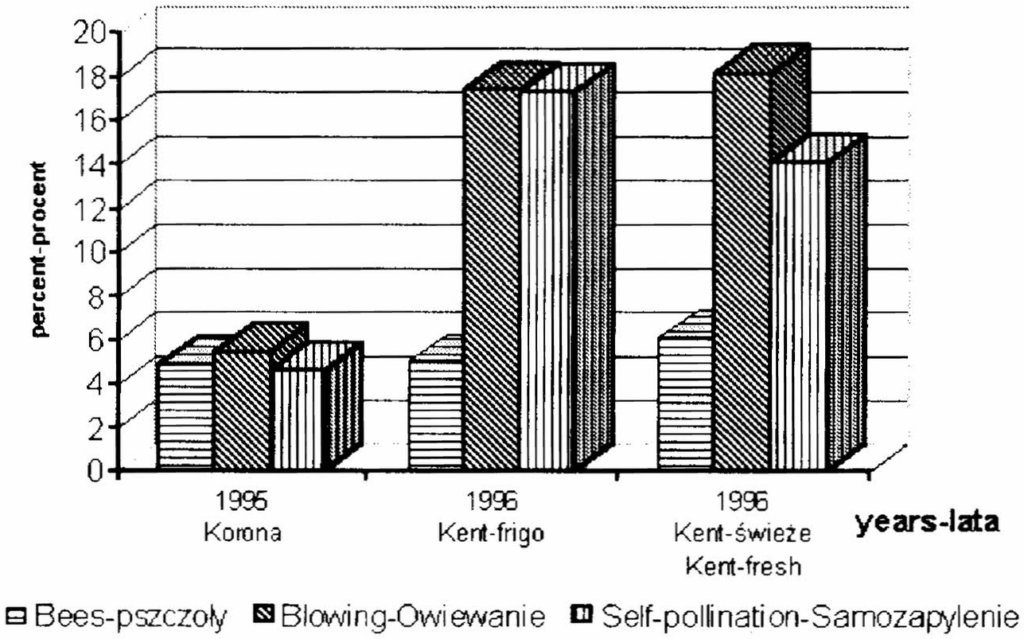
Fig. 1. Proportional participation of deformed fruit in the total yield Procentowy udział owoców zniekształconych w plonie ogólnym
strona 233CONCLUSIONS
- The honey bee is an effective pollinator of the strawberry and it can be utilized also for the pollination of this plant in greenhouse cultivation.
- Bee families designed for pollination, before they are placed in the greenhouse, must be freed of the foraging bees since this procedure decreases the number of fallen bees in the greenhouse.
- The utilization of the honey bee for strawberry pollination in an accelerated cultivation is particularly useful since it positively influences the obtaining of high quality fruit and thereby increases the profitability of the cultivation.
REFERENCES
Dag A., Dotan S., Abdul-Razek A. ( 1994 ) – Honeybee pollination of strawberry in green-house. Hassadeh 74(10)92:1068-1070
Gundia M.(1995) – The use of bumble bees, Bombus terrestris, for pollination of green-house strawberry. Hassadeh 75(9):49-50.
Kakutani T., Inoue T., Tezuka T., Maeta Y.(1993) – Pollination of strawberry by the sting-less bee, Trigona minangkabau and the honey bee, Apis mellifera: an experimental study of fertilization efficiency. Researches on Population Ecology 35(1):95-111.
Lieten F.(1993) – Fruit misshaping of strawberries: overvisiting. Fruitteelt 6(2):27-29.
Radajewska B., Staniczek M.(1994) – Plonowanie kilku odmian truskawki w uprawie przyspieszonej w tunelu foliowym. Mat.Konf. Poznań SITO-NOT:11-14
Skowronek J., Jabłoński B., Szklanowska K.(1985) – Wpływ owadów zapylających na owocowanie 6 odmian truskawki (Fragaria grandiflora Ehrah.). *Pszczeln.Zesz.Nauk.*29:205-229.
Szklanowska K., Dąbska B.(1991) – Zastosowanie pszczół do zapylania kwiatów jabłoni(Malus domestica Borkh.) w małych izolatorach. *Pszczeln.Zesz.Nauk.*35:97-102.
Wilkaniec Z., Ruszczyński W.(1994) – Wykorzystanie pszczoły murarki ogrodowej do zapylania truskawki w uprawie sterowanej i jej wpływ na plonowanie i jakość owoców. Mat,Konf. Poznań SITO-NOT:25-28.
WYKORZYSTANIE PSZCZOŁY MIODNEJ (APIS MELLIFERA L.) DO ZAPYLANIA SZKLARNIOWYCH UPRAW TRUSKAWKI
Z. Wilkaniec, M. Maciejewska
Streszczenie
Celem przeprowadzonych badań było wykorzystanie pszczoły miodnej do zapylania truskawki w uprawie przyspieszonej w szklarni nieogrzewanej i określenie jej pracy zapylającej w porównaniu z dwoma innymi sposobami zapylania -przez owiewanie i
strona 234samozapylenie.
W 1995 roku w doświadczeniu wykorzystano sadzonki frigo holenderskiej odmiany truskawki Korona, a pszczoły przeznaczone do zapylania wstawiono w dwóch jednoramkowych ulikach.Natomiast w 1996 roku badania przeprowadzono na dwóch rodzajach sadzonek (frigo i świeżych-zimowanych w tunelu foliowym) kanadyjskiej odmiany truskawki Kent.Owady zapylające pochodziły ze średnio silnej rodziny pszczelej wstawionej do szklarni w ulu Wielkopolskim. W celu uniknięcia padania pszczół w zamkniętej pszestrzeni szklarni, w obydwu latach badań, rodziny przed ich wstawieniem pozbawiono pszczół terenowych – zbieraczek. Efektywność pracy zapylającej pszczół określono na podastawie procentu zawiązanych owoców do wytworzonych kwiatów, średniej liczby owoców z rośliny, średniej masy jednego owocu,plonu owoców oraz procentowego udziału plonu handlowego (wybór Extra i Pierwszy) i niehandlowego ( wybór Drugi i Poza wyborem), jak również owoców niekształtnych w plonie ogólnym. Wyniki porównano z analogicznymi wynikami uzyskanymi w dwóch pozostałych grupach roślin doświadczalnych różniących się sposobem zapylania (przez owiewanie i samozapylenie). Wartości uzyskanych wyników w1995 roku są do siebie zbliżone , a różnice istotne w poszczególnych grupach doświadczalnych wykazują tylko w procencie zawiązanych owoców w stosunku do wytworzonych kwiatów, ( tabela 1 i 2, rycina 1).
W 1996 roku korzystny wpływ pszczół w grupie roślin zapylanych przez nie uwidocznił się przede wszystkim w najwyższych wartościach dla plonu owoców z jednej rośliny, w najwyższym procentowym udziale plonu handlowego w plonie ogólnym (ponad 92,% ) oraz w najniższym procencie owoców niekształtnych. Wielkości te różniły się istotnie od wartości uzyskanych dla pozostałych sposobów zapylania odmiany Kent i to zarówno w przypadku sadzonek frigo, jak i świeżych ( tabela1i2, rycina1).
Wyniki przeprowadzonych doświadczeń wskazują na celowość wykorzystywania pszczoły miodnej do zapylania szklarniowych upraw truskawki, gdyż wpływa ona szczególnie korzystnie na jakość pozyskiwanych owoców, pod warunkiem użycia odpowiednio silnych rodzin. Padaniu dużej liczby pszczół w przestrzeniach zamkniętych można zapobiegać pozbawiając rodziny pszczół terenowych – zbieraczek przed ich wstawieniem do szklarni. <u>Słowa kluczowe:</u> pszczoła miodna, zapylanie, truskawka, szklarnia.
Errata — błędy druku znalezione podczas digitalizacji
- s. 227: „comperison” → comparison
- s. 228: „axperiments” → experiments
- s. 228: „foil tunel” → foil tunnel
- s. 229: „weighted exactly” → weighed exactly
- s. 229: „level & =0.05″ → level α =0.05
- s. 230, tab. 1: „guality” → quality
- s. 230, tab. 1: „hight” → height
- s. 230, tab. 1: „dorodnść” → dorodność
- s. 230, tab. 1: „Invwstigated” → Investigated
- s. 230, tab. 1: „flowerws” → flowers
- s. 230: „applited” → applied
- s. 231: „mathod” → method
- s. 231, tab. 2: „8.02″ → 8.2
- s. 231, tab. 2, 2×: „comercial” → commercial
- s. 232: „mathods” → methods
- s. 232: „odtained” → obtained
- s. 233, piśmiennictwo: „Ehrah.” → Ehrh.
- s. 234, streszczenie: „pszestrzeni” → przestrzeni
- s. 234, streszczenie: „podastawie” → podstawie
- s. 234, streszczenie: „ulikach.Natomiast” → ulikach. Natomiast
- s. 234, streszczenie: „Kent.Owady” → Kent. Owady
- s. 234, streszczenie: „owocu,plonu” → owocu, plonu
- s. 234, streszczenie: „w1995″ → w 1995
- s. 234, streszczenie: „92,%” → 92,0%
- s. 234, streszczenie: „tabela1i2″ → tabela 1 i 2
- s. 234, streszczenie: „rycina1″ → rycina 1