

THE CONTENTS OF ELEMENTS IN THE BODY OF WINTERING WORKER HONEY — BEES FROM A CLUSTER AND A WINTER FALL I. THE CONTENTS OF CALCIUM, MAGNESIUM AND PHOSPHORUS
tekst: Barbara Leźnicka, Janina Muszyńska
Pszczelnicze Zeszyty Naukowe, Rok XXVIII, 1984 — Barbara Leźnicka, Janina Muszyńska
strona 49PSZCZELNICZE ZESZYTY NAUKOWE Rok XXVIII Puławy 1984
Barbara Leźnicka, Janina Muszyńska
Department of Zoology and Ecology, University of Warsaw Institute of Pomology Bee Department. Puławy
INTRODUCTION
Optimal temperature in a winter cluster, higher than the ambient temperature is maintained, among other reasons, due to the muscle work of the worker bees’ thorax (Roth, 1965). The amount of the heat energy produced during this process increases with the decrease of temperature in the external environment, and the sufficient impulse for the commencing of this process is already the temperature of +10°C prevailing outside the hive (Kronenberg, Heller, 1982). A suitable quantity of calcium, phosphorus and magnesium is an indispensable although not a sufficient factor which conditions the proper functioning of a muscular system. After combustion of an experimental sample, these elements enter inorganic substances (ashes), but in the bodies of live insects, they occur both in organic and inorganic compounds.
Investigations carried out so far (Leźnicka et. all., 1984 a) have shown that the content of organic substances and of water in the alimentary canals of wintering bees undergoes changes depending on thermic conditions. These changes are not observed in tissues (excluding the alimentary canal). It has also been noted, that bees in families wintering either well, moderately well, or poorly, will perish if the amount of water and inorganic substances contained in their bodies increases, while the organic substances decrease (Leźnicka et al., 1984 b). For these reasons we have decided to examine during the consecutive wintering months the contents of calcium, phosphorus and magnesium in the bodies of whole bees, in the alimentary canals alone, and in bodies of bees after the extraction of alimentary canals. It seemed also interesting to observe whether the range of changes in the concentrations of these elements has an effect on the survival of bees. To answer these questions
strona 50we have decided to find the contents of calcium, magnesium and phosphorus in bees which perish during the consecutive wintering months and to compare these with the amounts of the elements in the bodies of live bees taken from a cluster. We also wanted to check wheather there was anay relationship between the levels of calcium, magnesium and phosphorus, and the course of wintering.
MATERIALS AND METHODS
The experiment was performed in two stages. The first part was run in the years 1977/1978; 78/79 and the second in 1978/79 to 1980/81. The worker bees of the Caucasian race (Apis mellifica caucasica Gorb.) were used in the first experiment, and the Caucasian hybrids in the second. In each year the experimental group consisted of six bee families which were the property of the Honey Bee Department, the Institute of Pomology in Puławy, Poland. The bee families were placed in Dadant s type hives wich contained the detachable subframe plates (Muszyńska, Bornus, 1983 a) and they were prepared for the winter according to the recommendations of the Institute of Pomology, Honey-bee Dept. The bees began the wintering period with equally forceful body conditions. They were the same families which were sampled for the contents of water, and organic and inorganic substances (Leźnicka et al., 1984 a, 1984 b). Data about their wintering and the periods of sampling, and also about the number of analyses done, are shown in Table 1. Mean temperatures during the consecutive months of the wintering period are given in Table 2.
The first stage of investigation included two wintering periods (the years 1977/78 and 1978/79) during which, once a month, 80 worker bees were taken from the outer layer of a cluster. The concentrations of the elements were determined in three kinds of samples: in 40 whole bees,
Table 1 Data on the wintering of bees in the years 1977/78—1980/81 and on the sampling periods
| Winter period | Flights: last in autumn | Flights: first in spring | Final data of leaving the cluster | Length of wintering period in days | Sampling data: first sample | Sampling data: last sample | Total number of sampling periods: cluster bees | Total number of sampling periods: winter fall bees | Number of bees families studied | Number of analyses for Calcium, Magnesium, and Phosphorus |
|---|---|---|---|---|---|---|---|---|---|---|
| 1977/78 | 20.XI. | 9.III. | 15.IV. | 145 | 28.XI. | 10.IV. | — | 5 | 6 | 7920 |
| 1978/79 | 20.XI. | 9.III. | 29.IV. | 159 | 7.XII. | 10.IV. | 14 | 4 | 6 | 7053 |
| 1979/80 | 20.X. | 26.III. | 15.IV. | 171 | 2.VII. | 8.IV. | 19 | 4 | 6 | 8073 |
| 1980/81 | 15.X. | 10.III. | 10.III. | 157 | 2.XII. | 11.III. | 15 | 4 | 6 | 6092 |
in 40 alimentary canals and in 40 bees without alimentary canals. Consequently these samples were called: whole bees, alimentary canals, tissues.
Table2 Average air temperature in Puławy during the successive months of overwintering in 1977/78—1980/81
| Wintering period | Months: XII | Months: I | Months: II | Months: III |
|---|---|---|---|---|
| 1977/78 | —1,2 | —1,9 | —4,2 | +3,5 |
| 1978/79 | —3,8 | —5,7 | —5,4 | +2,5 |
| 1979/80 | +1,5 | —6,3 | —1,3 | +0,4 |
| 1980/81 | —1,0 | —3,9 | +1,1 | +4,0 |
The second stage of research was carried out in the years 1978/79 to 1980/81. The content of the elements was determined in the bodies of whole bees sampled from a cluster and a winter fall. Forty live worker bees taken once a month from the edge of a cluster. All dead insects were gathered from the subframe plate once a week. An assessment of the wintering period of bee families has been done based on the number of combs freed during spring. Families which wintered in a similar way have been grouped together, regardless of the season. It has been assumed, that the bee families wintered well, if dead bees had freed one comb, moderately well if they had left free two combs, and poorly if they left three combs.
Two criteria were used in the analysis of data obtained in the years 1978/79 to 1980/81. According to the first one, the changes in the contents of the elements were estimated in the bodies of live bees from a cluster, as well as in the bodies of dead bees from a winter fall during the successive months of the three wintering periods. According to the second criterion, the quality of the wintering success was considered in the evaluation of the changes in the concentrations of calcium, magensium and phosphorus.
All samples in both stages of investigations were dried at 65°C and grinded in a porcelain mortar. The material was dried again, then from each sample five 0.01 mg portions were weighed and burnt at 450°C during eight hours. The ashes thus obtained were dissolved in 1 ml 1 n HCl, vaporized and diluted in double distilled water. In these solutions calcium was determined colorimetrically in the presence of murex dye, manganese in the presence of eriochrome dye, and phosphorus according to the vanadium-molibdenum method of Marczenko (1979).
The results were statistically analysed with the variance method of R. A. Fisher, and the t-Duncan test was used to estimate the significant differences. The results are shown also graphically, however, only statistically significant differences found between the values obtained
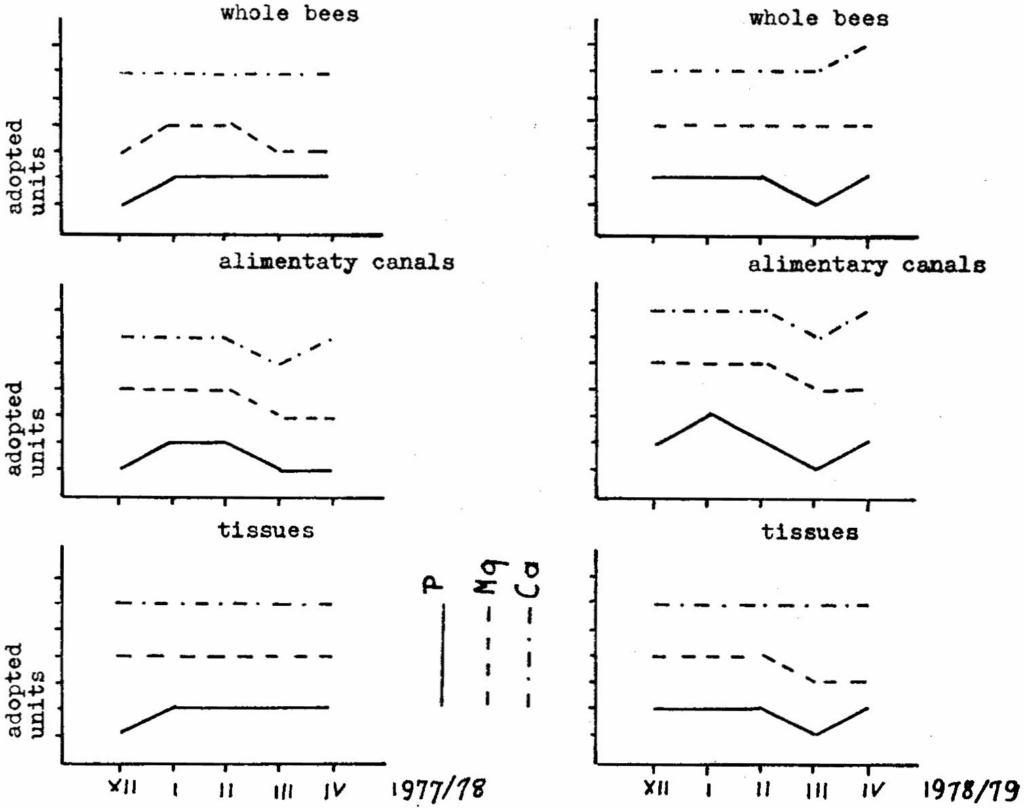
strona 52during neighbouring months of the wintering period, have been considered. The lack of any assential differences between the values of the investigated component has been ilustrated with a horizontal line. Any significant increase or decrease in the values has been marked by a rise or fall of the curve according to the adopted units (Figs. 1 and 2).
RESULTS AND DISCUSSION
Calcium
First stage of investigation. The content of calcium in the bodies of whole bees and separately in tissues.
In the consecutive months of both wintering periods until the first spring flight, the content of calcium did not change significantly (Table 3, Fig. 1). The changes which were observed in the alimentary canals
strona 53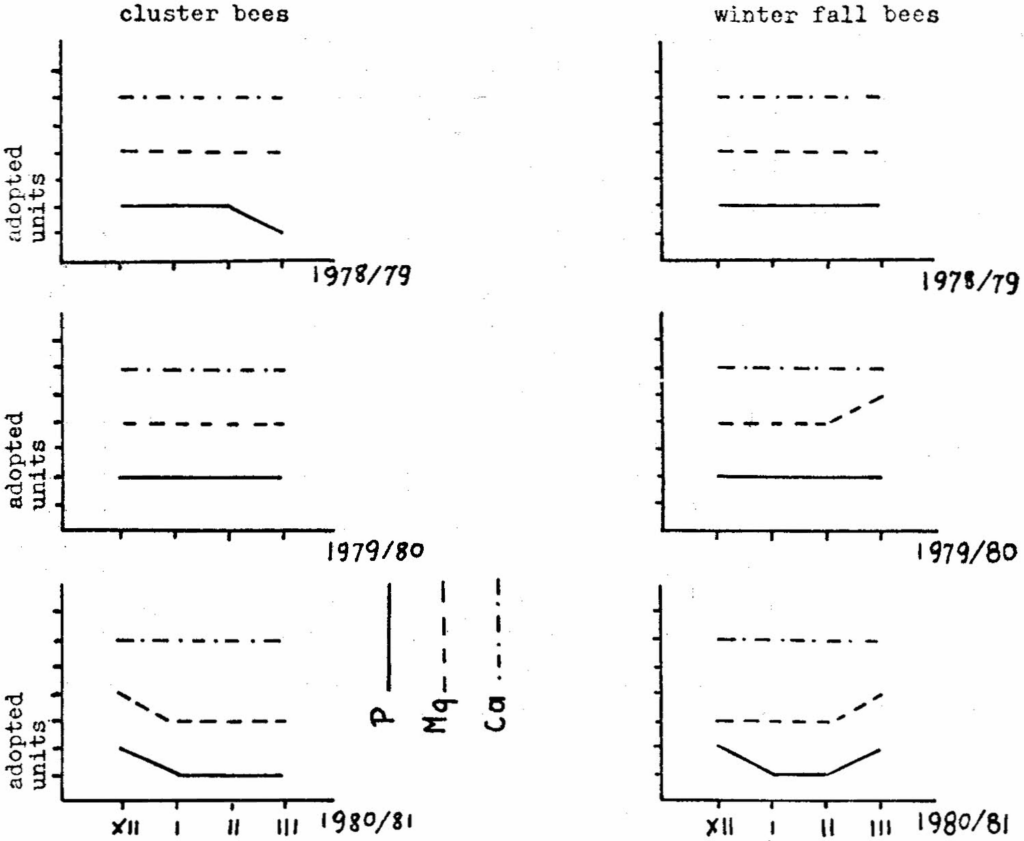
during the mild winter of 1977/78 (table 2) were similar to those noted during winter of 1978/79 characterized by low temperatures. This observations and the insignificant difference in the amounts of calcium in samples obtained during the same months of both wintering periods (Table 3), allow as to draw a conclusion, that the ambient temperature (in the given ragne) does not affect the content of calcium. The small changes in the calcium content of the research material are also shown by the values of statistically significant differences in its quantities contained in samples investigated during particular wintering month. According to this indicator, the relatively highest changes in the amounts of the element take place in the alimentary canal, and the minimal changes in tissues and bodies of whole bees (Table 4).
Second stage of investigation. The calcium content in the bodies of bees from a cluster and from a fall did not change during successive months of three, following each other, wintering periods (Table 5, Fig. 2).
There were no significant differences in the calcium content of live
strona 54Table 3 Average content of calcium, magnesium (mg/100 mg dry weight) in whole bees, alimentary canal and tissues (without alimentary canal)
| Component | Month | Whole bees: 1977/78 | Whole bees: 1978/79 | Alimentary canals: 1977/78 | Alimentary canals: 1978/79 | Tissues: 1977/78 | Tissues: 1978/79 |
|---|---|---|---|---|---|---|---|
| Calcium | XII | 0,03 a | 0,06 abc | 0,08 bc | 0,11 bcd | 0,04 ab | 0,05 ab |
| I | 0,08 abc | 0,09 bc | 0,13 cd | 0,16 d | 0,03 ab | 0,08 b | |
| II | 0,10 c | 0,07 abc | 0,15 d | 0,12 bcd | 0,07 ab | 0,07 ab | |
| III | 0,06 abc | 0,04 ab | 0,07 ab | 0,05 a | 0,04 ab | 0,02 a | |
| IV | 0,07 abc | 0,10 c | 0,13 cd | 0,08 bc | 0,08 b | 0,07 ab | |
| Magnesium | XII | 0,08 a | 0,08 abc | 0,08 ab | 0,10 bcd | 0,06 ab | 0,06 abc |
| I | 0,13 e | 0,11 cde | 0,10 bcd | 0,13 cd | 0,09 abc | 0,10 bc | |
| II | 0,13 de | 0,09 bcd | 0,13 cd | 0,13 d | 0,09 abc | 0,10 c | |
| III | 0,08 abc | 0,07 ab | 0,07 ab | 0,06 a | 0,07 abc | 0,05 a | |
| IV | 0,07 ab | 0,10 be | 0,09 bc | 0,08 ab | 0,07 abc | 0,09 abc | |
| Phosphorus | XII | 0,04 a | 0,18 cd | 0,10 ab | 0,15 bcd | 0,05 a | 0,18 bcd |
| I | 0,15 bc | 0,19 cd | 0,19 de | 0,29 f | 0,16 bc | 0 23 d | |
| II | 0,19 cd | 0,20 cd | 0,19 de | 0,23 e | 0,17 bcd | 0,21 cd | |
| III | 0,18 bcd | 0,13 b | 0,12 bc | 0,07 a | 0,16 bc | 0,13 b | |
| IV | 0,13 b | 0,22 d | 0,11 ab | 0,17 cde | 0,17 bcd | 0,20 cd |
Numbers marked with the different letters differ significantly.
Table 4 Numbers of the statistically significant differences between the concentrations of the elements contained in bees. Number of significat differences between consecutive months is given in parethesis (based on data in Table 3)
| Component studied | Wintering period | Whole bees | Alimentary canal | Tissues |
|---|---|---|---|---|
| Calcium | 1977/78 | 1 (—) | 4 (2) | — (—) |
| 1978/79 | 1 (1) | 4 (2) | 1 (—) | |
| Magnesium | 1977/78 | 6 (2) | 2 (1) | — (—) |
| 1978/79 | 1 (—) | 5 (1) | 2 (1) | |
| Phosphorus | 1977/78 | 5 (1) | 6 (2) | 4 (1) |
| 1978/79 | 4 (2) | 7 (4) | 3 (3) |
bees that belonged to families which overwintered either well, moderately well, or poorly. There were no differences between the perishing bess of these families, either (Table 6). Except for two isolated cases, there were no differences in this respect between bees from a cluster or from a fall, in families with either high, moderate, or poor wintering success. The exceptions were worker bees investigated in February and sampled from families which overwintered poorly, and also in March, from families overwintering with moderate success (Table 6, horizontal arrows).
strona 55Table 5 Average content of calcium, magnesium and phosphorus (mg/100 mg dry weight) in the bodies of bees from a cluster and a winter fall during successive wintering periods
| Wintering period | Month | Calcium: bees from a cluster | Calcium: bees from a winter fall | Magnesium: bees from a cluster | Magnesium: bees from a winter fall | Phosphorus: bees from a cluster | Phosphorus: bees ftom a winter fall |
|---|---|---|---|---|---|---|---|
| 1978/79 | XII | 0,06 a | 0,07 ab | 0,09 abc | 0,09 bc | 0,18 ab | 0,19 ab |
| I | 0,09 abc | 0,10 bc | 0,11 cd | 0,10 bc | 0,19 ab | 0,22 bc | |
| II | 0,07 ab ↔ | 0,13 c | 0,09 abc | 0,12 cd | 0,20 b ↔ | 0,27 c | |
| III | 0,04 a | 0,10 bc | 0,07 ab ↔ | 0,11 cd | 0,13 a ↔ | 0,22 bc | |
| 1979/80 | XII | 0,05 a | 0,07 ab | 0,07 ab | 0,06 a | 0,24 a | 0,24 a |
| I | 0,08 ab | 0,06 a | 0,08 ab | 0,07 ab | 0,28 a | 0,25 a | |
| II | 0,06 a | 0,08 ab | 0,08 ab | 0,07 ab | 0,23 a | 0,27 a | |
| III | 0,09 ab | 0,12 b | 0,10 bc | 0,12 cd | 0,25 a | 0,28 a | |
| 1980/81 | XII | 0,11 a | 0,10 a | 0,10 cd | 0,09 cd | 0,26 bc | 0,26 bc |
| I | 0,10 a | 0,10 a | 0,05 ab | 0,06 a | 0,16 a | 0,17 a | |
| II | 0,09 ab | 0,09 ab | 0,07 abc | 0,07 ab | 0,19 a | 0,21 ab | |
| III | 0,07 a | 0,09 ab | 0,07 abc ↔ | 0,12 d | 0,17 a ↔ | 0,19 c |
Table 6 Average content of calcium, magnesium and phosphorus (mg/100 mg dry weight) in the bodies of bees from a cluster and a winter fall in families overwintering well, moderately well, and poorly
| Month | Wintering success | Calcium: bees from a cluster | Calcium: bees from a winter fall | Phosphorus: bees from a cluster | Phosphorus: bees from a winter fall | Magnesium: bees from a cluster | Magnesium: bees from a winter fall |
|---|---|---|---|---|---|---|---|
| XII | well | 0,09 ab | 0,09 a | 0,09 ab | 0,09 ab | 0,23 ab | 0,25 ac |
| moderate | 0,06 ab | 0,09 a | 0,09 ab | 0,08 ab | 0,19 a | 0,20 ac | |
| poorly | 0,06 ab | 0,06 a | 0,07 ab | 0,07 ab | 0,26 bc | 0,23 ac | |
| I | well | 0,09 ab | 0,08 a | 0,06 ab | 0,06 ab | 0,17 a | 0,17 ac |
| moderate | 0,09 ab | 0,08 a | 0,10 ab | 0,09 ab | 0,23 b | 0,23 abc | |
| poorly | 0,10 ab | 0,09 a | 0,10 ab | 0,09 ab | 0,27 b | 0,26 bc | |
| II | well | 0,09 ab | 0,10 a | 0,08 ab | 0,08 ab | 0,21 ab | 0,22 ac |
| moderate | 0,09 ab | 0,11 a | 0,09 abd | 0,11 cd | 0,24 ab | 0,28 bc | |
| poorly | 0,3 b ↔ | 0,10 a | 0,09 ab | 0,09 abc | 0,20 ab | 0,26 abc | |
| III | well | 0,06 ab | 0,09 a | 0,07 b ↔ | 0,12 a | 0,16 a ↔ | 0,27 c |
| moderate | 0,05 b | 0,10 a | 0,08 ab | 0,12 ab | 0,16 a | 0,23 ac | |
| poorly | 0,08 ab | 0,12 a | 0,09 ab | 0,11 ab | 0,26 bc | 0,26 ac |
— results for a given month designated with the same letter do not significantly differ — horizontal arrows show significant differences between healthy and persihing bees (from cluster and winter fall).
strona 56It is likely, that during winter bees possess a defined and constant concentration of total calcium. The content of this element in the bodies of bees (within the investigated range) is not related to the course of overwintering. Nation and Robinson (1971) call attention to the relatively small calcium content in the bodies of summer bees as well.
Magnesium
First stage of research. The content of magnesium in the bodies of whole bees, in alimentary canals and in tissues.
The magnesium content in the bodies of whole bees changes in a way which is characteristic for a given wintereing season. Substantial changes were observed in the samples examined during the successive months of the winter 1977/78. During the next winter such changes did not occur (Table 3, Fig. 1). In both seasons, the magnesium content of the alimentary canal diminished only following the spring flight (Table 3, Fig. 1). In the same way had changed the magnesium content in tissues, but only during the period 1978/79, while in the season 1977/78 between autumn and spring, it had remained at the same level (Fig. 1). Although the changes related here in the magnesium content of tissues and bodies of whole bees had taken a different form during the seasons compared, it appears that they were not related to the thermal conditions of the environment. The lack of such a relationship is shown by the similar amounts of magnesium in tissues, alimentary canals and in bodies of whole bees which have been studied during the same months of the different wintering periods (Table 2 and 3).
The changes in the magnesium content estimated from the number of statistically significant differences in its amounts in samples from individual months have been found to be the lowest in tissues. No such conclusion could be drawn for the remaining kinds of sampels (Table 4).
Nation and Robinson (1971) emphasize, that the amount of magnesium in the bodies of worker bees studied during summer remains unvariable. They suggest also; that magnesium can be regulated only within a very narrow range of changes. Our results obtained in experimental conditions described here show, that in winter, the magnesium content in the bodies of whole bees, in alimentary canals, and in tissues undergoes only slight changes. The observed changes are not related to the temperature of the external environment.
Second stage of investigation. The magnesium content in the bodies of bees from a cluster and from a winter fall.
The results on the studies of magnesium content in the bodies of live bees in the periods 1978/80 and 1980/81, are in agreement with the suggestion that the ambient temperature does not influence the noticable changes of this element. During the consecutive month of the warm, although long season of 1979/80 and of the cold period of 1978/79 the
strona 57magnesium contents in the bodies of live bees remained at the same level (Tables 2 and 5, Fig. 2).
The amount of magnesium in the organisms of bees from a winter fall did not change (winter 1978/79), or increased later in March (winters of 1979/80 and 1980/81). Differences in the magnesium content between the bodies of live and dead bees had been noted only in March of both periods (Table 5, horizontal arrows). These results suggest the lack of relationship between the amount of magnesium and the survival of insects.
Data summarized according to the criterion of wintering success suggest, that the amount of magnesium contained in live bees is unchangable. Unvariable is also the magnesium content in perishing bees of families which had overwintered poorly, moderately or well. An exception are only bees from a winter fall, which had been studied in February and were the members of families which overwintered well or moderately well (Table 6).
No differences were found in the magnesium content of bees from a cluster and from a fall which had similar wintering conditions. The observed changes in the contents of magnesium in bees within the range studies seem not to be related to the survival of the insects.
Phosphorus
First stage of research. Phospshorus content in the body of whole bees, in alimentary canals and in tissues.
The phosphorus content in bodies of whole bees and in tissues changes in a characteristic way similar for all wintering periods (Table 3, Fig. 1). The main difference between these results and that for alimentary canal is that in the latter case, the amount of phosphorus during the mild winter of 1977/78 had decreased only in March, while in January and February it had remained at the same level. However, during the severe winter of 1978/79, from January until March, there was a decrease of the amount of phosphorus in the alimentary canals, while its content in the tissues and in the bodies remained stable. Only following a cold winter and the first spring flight, the level of phosphorus decreased, both in the tissues and bodies of the worker bees (Table 2, 3; Fig. 1).
During the same months of the periods compared, significant differences in the phosphorus content of alimentary canals had occurred. Such relationship was not found in the case of whole bees (Table 3).
The changes in the phosphorus content estimated from all the statistically significant differences in its amount in the samples studied during various months of wintering(Table 4), have been found to be the highest in the alimentary canals. The number of these differences is lowest in tissues.
strona 58Two years of studies are not enough to derive a final conclusion, however, some inference can be drawn. The same amount of phosphorus in the alimentary canals noted at the beginning of both wintering periods (Table 3), might be the consequence of using up the same kind of food in similar quantities. It is likely, that the increase of phosphorus content in alimentary canals observed in January, is a nature-controlled event. It might be the evidence of a possible supplement intake of this element by bees which get their food inside the hive. It is characteristis, that during harsh winter this increase is greater and amounts to 0.14 mg/100 mg dry weight, while during mild winter it is only 0.08 mg/100 mg dry weight (Table 3). At the same time the amount of phosphorus in tissues diminishes (mild winter) or remains at same level (severe winter), and it does not change until February. However, in alimentary canals of bees overwintering in severe climatic conditions, the amount of phosphorus in February, does decrease. It is possible, that phosphorus which disappears from the alimentary canals is being used up for the maintenance of this element in tissues at some required level. A phosphorus decrease in the alimentary canal observed after a heavy winter is considerable enough, that following the flight, its amount in the tissues also diminishes. This phenomenon does not occur during a mild winter.
Second stage of studies. The phosphorus content in the bodies of bees from a cluster and a winter fall.
In the consecutive months of the wintering period 1978/79—1980/81, the amount of phosphorus in the bodies of live bees did not change in any essential way. Only in March of 1978/79 and in January 1980/81 its content decreased compared to the amounts observed in samples studied one month earlier (Table 5, Fig. 2).
Also the insects of the winter fall are characterized by a stable phosphorus content. Exception are the bees of the wintering period 1980/81.
In sporadic cases, differences occurred between bees from a cluster and from a fall (Table 5).
No essential differences have been found between the phosphorus content in dead bees sampled from families which overwintered either well, moderately well, or poorly. Also in the case of live bees, in most cases, no such differences have been found with regard to this criterion (Table 6).
The amount of phosphorus in the bodies of bees from a cluster or from a fall is similar in families which overwinter well, moderately, well, or poorly. In the case of successful overwintering, only the bees which die in March, contain more phosphorus than healthy bees.
These results, which show a similar phosphorus content in the bodies of live and dead bees in families which overwinter well, sufficiently well, or poorly, indicate that the amount of phosphorus (within the range studied) is not related to the course of wintering.
strona 59CONCLUSIONS
- It has been observed that in winter bees are characterized by stable contents of calcium and magnesium. Slight changes in the amounts of these elements could only be noted in alimentary canals.
- Neither the temperature of the external environment, nor the quality of overwintering (within the ranges investigated) have a significant effect on the levels of these elements.
- The amount of phosphorus is not related to the overwintering period. It seems, however, that its content in alimentary canal depends on the temperature of the external environment and it decreases with the lowering of temperature.
REFERENCES
Kronenberg F., Heller H. C. (1982) — Colonial thermoregulation in honey-bees (Apis mellifera). J. Comp. Physiol. 148(1):65—76.
Leźnicka B., et al. (1984) — Changes in the content of water, organic and inorganic substances in the wintering worker honey-bees (Apis mellifica caucasica Gorb.). Pszczeln. Zesz. Nauk. XXVIII: 29—38.
Leźnicka B., et al. (1984) — Changes in the water and organic and inorganic contents in the worktr honey-bee hybrids of Apis mellifica caucasice Gorb. from a cluster er and a winter fall. Pszczeln. Zesz. Nauk. XXVIII: 39—48.
Muszyńska J., Bornus L. (1983) — Studies on the physiology in bee families. I. Assessment of wintering success in bee families from observation of their winter fall. Pszczeln. Zesz. Nauk. XXVII:1 3—21.
Muszyńska J., Bornus L. (1983 b) — Studies on the physiology in bee families. II. A comparison of surviving bees from the cluster and dying bees from the winter fall. Pszczeln. Zesz. Nauk. XXVII:23—31.
Marczenko Z. (1979) — Spektrofotometryczne oznaczanie pierwiastków. PWN Warszawa: 758.
Nation J. L., Robinson F. A. (1971) — Concentration of some major and trace elements in honey-bees, royal jelly and pollens, determined by atomic absorption spectrofotometry. J. Apic. Res. 10(11):35—43.
Roth M. (1965) — La production de chaleur chez Apis mellifica L. Ann. Abeille 8(1):5—77.
ZAWARTOŚĆ WAPNIA, MAGNEZU I FOSFORU W CIELE ZIMUJĄCYCH PSZCZÓŁ ROBOTNIC Z KŁĘBU I OSYPU
Barbara Leźnicka, Janina Muszyńska
Streszczenie
Badano zawartość wapnia, magnezu i fosforu u zimujących pszczół robotnic. Doświadczenie prowadzono w dwóch etapach. W pierwszym, który przypadał na lata 1977/78 i 1978/79 zawartość wymienionych pierwiastków oznaczano w całych pszczołach, w przewodach pokarmowych oraz w pszczołach, z których wypreparowano przewody pokarmowe (tkankach). W każdym roku do analiz pszczoły rasy
strona 60kaukaskiej pobierano ze skraju kłębu, z sześciu rodzin pszczelich. W drugim etapie badań, który przypadał na lata 1978/79—1980/81 zawartość wymienionych pierwiastków określano w ciele całych pszczół, mieszańców kaukaskich, pobranych raz w miesiącu ze skraju kłębu oraz spadłych w ciągu tygodnia do osypu. W drugim etapie badań, w każdym terminie, pszczoły pobierano także z sześciu rodzin.
Wszystkie próby (zarówno w pierwszym jak i w drugim etapie badań) suszono w temperaturze 65°C i ucierano w moździerzu porcelanowym. Materiał suszono ponownie, poczym z każdej próby z dokładnością do 0.01 mg przygotowywano naważki, które spalano w temperaturze 450°C przez osiem godzin. Uzyskany popiół rozpuszczano w 1N HCL, odparowywano i rozcieńczano w wodzie podwójnie destylowanej. Pierwiastki oznaczano kolorymetrycznie: wapń metodą mureksydową, magnez metodą czerni erichromowej, a fosfor metodą wanadowo-molibdenową. Przy opracowywaniu wyników drugiego etapu badań, zależnie od liczby plastrów odebranych podczas pierwszego wiosennego przeglądu, wyróżniono rodziny zimujące dobrze (jeden plaster), średnio (dwa plastry) i źle (trzy i więcej plastrów).
Stwierdzono, iż zimą pszczoły charakteryzują się stałą zawartością wapnia i magnezu. Niewielkie zmiany w zawartości tych pierwiastków można jedynie zauważyć w przewodach pokarmowych. Ani temperatura środowiska zewnętrznego, ani jakość zimowania (w badanym zakresie) nie wpływają w znaczącym stopniu na poziom tych pierwiastków. Ilość fosforu również nie jest związana z przebiegiem zimowania. Wydaje się jednak, że jego zawartość w przewodzie pokarmowym zależy od temperatury środowiska zewnętrznego i wraz z jej obniżeniem zmniejsza się.
СОДЕРЖАНИЕ КАЛЬЦИЯ, МАГНИЯ И ФОСФОРА В ТЕЛЕ ЗИМУЮЩИХ РАБОЧИХ ПЧЕЛ ИЗ КЛУБА И ПОДМОРА
Б. Лезьницка, Я. Мушиньска
Резюме
Исследовано содержание кальция, магния и фосфора у зимующих рабочих пчел. Опыты велись в двух этапах. В первом (1977/78 и 1978/79) — содержание перечисленных элементов определено в целых пчелах, в желудочно-кишечных трактах, а также в пчелах, из которых выпрепарировано желудочно-кишечные тракты (в тканях). В каждом году для анализов отбирано пчелы кавказской породы из края клуба, у шести пчелиных семьей. Во втором этапе исследований (1978/79—1980/81) содержание перечисленных элементов определено в теле целых пчел, кавказских гибридов, отобранных раз в месяц из края клуба, а также пчел, которые за неделю упали в подмор. Во втором этапе исследований, в каждом сроке, пчелы отбирано также из шести семьей.
Все образцы (как в первом, так и во втором этапах исследований) высушено в температуре 65°C и утирано в фарфоровой ступе. Материал опять подвергался сушению, затем из каждого образца с точностью до 0,1 мг подготовлено навешки, которые сжигано в температуре 450°C восемь часов. Полученную золу, растворено в 1 N HCI, испарено и разбавлено в воде, вдвойне дистиллированной. Элементы определено колориметрически: кальций по мурексидовому методу, магний по методу эрихромовой черни, а фосфор по ванадиево-молибденовому методу. При разработке результатов второго этапа исследований в зависимости от числа сотов, отобранных во время первого весеннего обзора, выделено семьи хорошо зимующие (одни соты), в среднем (двое сотов) и плохо (три и больше сотов) зимующие.
strona 61Констатировано, что зимой пчелы отличаются постоянным содержанием кальция и магния. Небольшие изменения в содержании этих элементов можно только заметить в желудочно-кишечных трактах. Ни температура окружающей среды, ни качество зимовки (в исследуемом пределе) не влияют значительно на уровень этих элементов. Количество фосфора также не связано с ходом зимовки. Однако кажется, что его содержание в желудочно-кишечном тракте зависит от температуры окружающей среды и вместе с ее понижением — уменьшается.
Errata — błędy druku znalezione podczas digitalizacji
- s. 49: „et. all., 1984 a” → et al., 1984 a
- s. 50: „wheather” → whether
- s. 50: „anay” → any
- s. 50: „wich” → which
- s. 50, tab. 1: „Final data of leaving” → Final date of leaving
- s. 50, tab. 1: „Sampling data” → Sampling dates
- s. 51: „magensium” → magnesium
- s. 51: „vanadium-molibdenum” → vanadium-molybdenum
- s. 51: „manganese in the presence of eriochrome” → magnesium in the presence of eriochrome
- s. 52: „assential” → essential
- s. 52: „ilustrated” → illustrated
- s. 52, ryc. 1: „alimentaty canals” → alimentary canals
- s. 52, ryc. 1: „phosporus” → phosphorus
- s. 53: „This observations” → These observations
- s. 53: „allow as to draw” → allow us to draw
- s. 53: „ragne” → range
- s. 54, tab. 4: „significat” → significant
- s. 54, tab. 4: „parethesis” → parenthesis
- s. 54: „perishing bess” → perishing bees
- s. 55, tab. 5: „bees ftom” → bees from
- s. 55, tab. 6: „persihing” → perishing
- s. 56: „wintereing” → wintering
- s. 56: „sampels” → samples
- s. 56: „noticable” → noticeable
- s. 57: „unchangable” → unchangeable
- s. 57: „range studies” → range studied
- s. 57: „Phospshorus” → Phosphorus
- s. 58: „characteristis” → characteristic
- s. 59, piśmiennictwo: „worktr” → worker
- s. 59, piśmiennictwo: „caucasice” → caucasica
- s. 59, piśmiennictwo: „cluster er and” → cluster and
- s. 59, piśmiennictwo: „XXVII:1 3—21″ → XXVII:13—21
- s. 59, piśmiennictwo: „spectrofotometry” → spectrophotometry
- s. 60, streszczenie: „erichromowej” → eriochromowej
- s. 60, streszczenie: „1N HCL” → 1N HCl
- s. 60, streszczenie: „poczym” → po czym
- s. 60, streszczenie 2×: „семьей” → семей
- s. 60, streszczenie: „1 N HCI” → 1 N HCl