

CHANGES IN THE WATER AND ORGANIC AND INORGANIC SUBSTANCES CONTENTS IN THE WORKER HONEY-BEE HYBRIDS OF APIS MELLIFICA CAUCASICA GORB. FROM A CLUSTER AND A WINTER FALL
tekst: Barbara Leźnicka, Janina Muszyńska, Mirosława Kwiecińska, Anna Szczuka
Pszczelnicze Zeszyty Naukowe, Rok XXVIII, 1984 — Barbara Leźnicka, Janina Muszyńska, Mirosława Kwiecińska, Anna Szczuka
strona 39PSZCZELNICZE ZESZYTY NAUKOWE Rok XXVIII Puławy 1984
1. Barbara Leźnicka, 2. Janina Muszyńska, 3. Mirosława Kwiecińska, 4. Anna Szczuka
1.3.4. Department of Zoology and Ecology, University of Warsaw
- Institute of Pomology Bee Department, Puławy
INTRODUCTION
The studies of the content of water and organic and inorganic substances carried out in the successive months of two wintering periods have shown, that the quantities of these components have undergone changes in the alimentary canals of bees. These variations in the bodies of bees (without alimentary canals) were relatively small and independent of the temperatures in the external environment. In addition to this a direct relationship was ascertained between low temperatures of the external environment and relatively large quantities of mineral salts and water, and a low organic substance content in the alimentary canals of bees (Leźnicka et al., 1984). These observations suggest that the changes in the proportions of organic and inorganic substances and of water in the alimentary canal are the normal reactions of a healthy organism to variations in thermal conditions. In the present work we were interested to check whether or not the range of variations in these components was related to the winter survival of bees. Our purpose has been to determine the quantities of water and organic and inorganic substances contained in bees from a winter fall, during the consecutive months of the wintering period, and to compare these results with appropriate data for living organisms. We also wanted to check whether there was a relationship between the amounts of these components in the bodies of bees from a cluster, and in dead bees from a winter fall, and between the course of overwintering.
strona 40
MATERIAL AND METHODS
The investigations were carried out during three winter seasons of 1978/79 to 1980/81, in the experimental apiary of the Honey-bee Department, at the Institute of Pomology in Puławy. Table 1 shows the climatic data for these seasons. Six families of the hybrid bees Apis mellifica caucasica Gorb. were used in the experiments. They were placed in the Dadant type hives containing the detachable subframe plate. The construction of the plates has been described by Muszyńska and Bornus (1983a). The families were characterized by equal strength and on the average, they gathered on six combs.
Bees from the edge of a cluster and a winter fall were used in the studies. Forty live bees were sampled from the cluster’s outer layer once a month. This sample size has been thought sufficient for the statistical analysis of the content of fresh and dry weight of bees studied during summer (Muszyńska and Konopacka, 1974). All dead worker bees were collected once a week from the subframe plate. Observations in the latter case had shown, thet more frequent sampling would not be advisable for reasons of disturbing the insects. Preliminary results had indicated that seven days were the longest time which allowed sampling without causing significant losses of water in bees. Data on bee wintering and on sampling dates are summarized in Table 2.
The course of wintering of the bee families has been assessed on the basis of the number of combs collected in spring. Families which had wintered in a similar way, have been included in the same groups, regardless of the research year. It has been assumed that bee families have overwintered well, if it had been necessary to remove one comb during spring checking; the removal of two or three combs had indicated moderate, or poor wintering success.
Water content was calculated from the difference between fresh and dry weight of each bee. Fresh weight was determined directly after sampling, and dry weight after drying in a vacuum drier at 65°C. Dried bees were ground in a porcelain mortar, then were dried again, and weighed once more with the accuracy to 0.01 mg. The material thus prepared was burnt during eight hours at 450°C. The ash was weighed. The organic substance content was obtained from the difference between the dry weight and weight of ash.
The analysis of the results was based on two kinds of criteria. According to the first one, the variations in the contents of the substances studied were estimated during successive months of three wintering periods. According to the second criterion the quality of the overwintering period was considered in the analysis of the changes in the components. The results were statistically analysed with the variance method of R. A. Fisher, and the significant differences were assessed with the t-Duncan test. Graphical representation of the results includes only these significant differences which have been found between the values
strona 41obtained during neighbouring months of a wintering period. The lack of significant differences between the values of a given component is indicated by a horizontal line. A significant increase or a decrease in the values is marked by one unit rise, or lowering of the curve according to an adopted scale (Fig. 1).
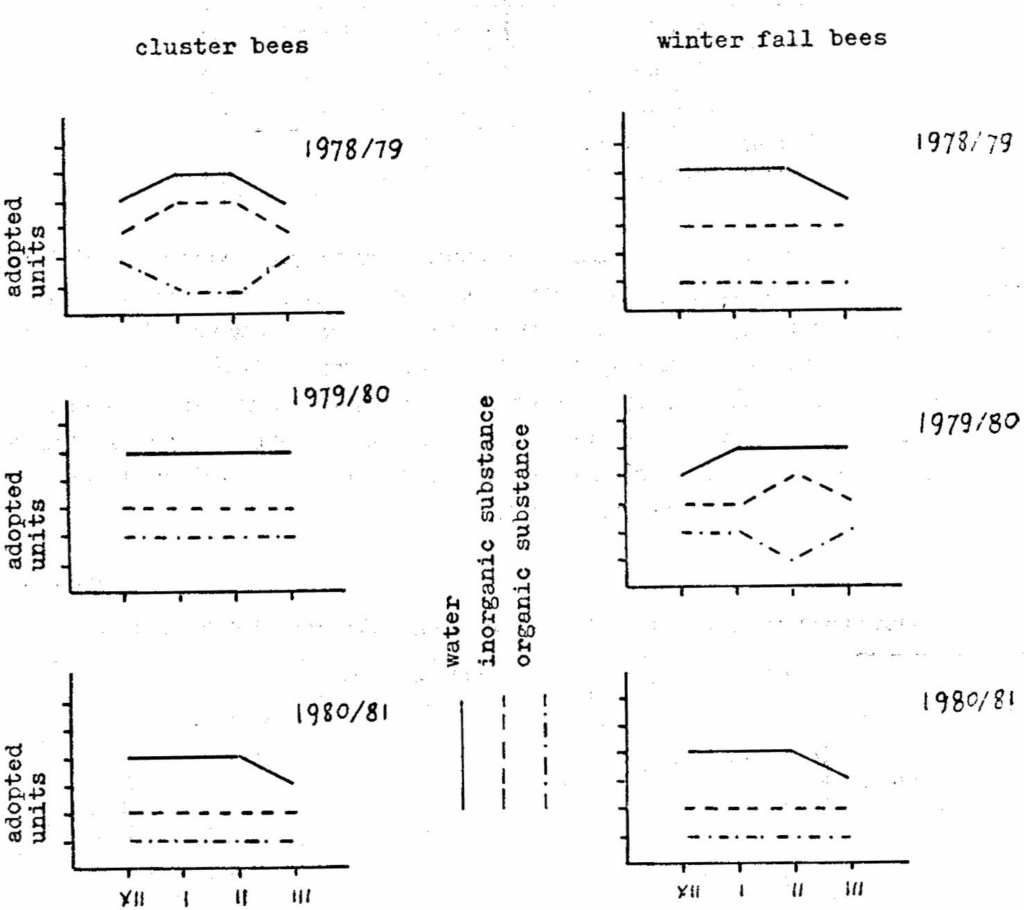
Fig. 1. Occurrence of statistically significant differences with regard to the contents of water, organic and inorganic substance in bees from a culster and a winter wall, during successive months of the wintering periods 1978/79 to 1980/81
RESULTS AND DISCUSSION
The contents of water and organic and inorganic substances during three consecutiwe wintering periods.
In the three wintering seasons studied, one can distinguish two types of changes in the quantities of water, and of organic substances contained in the bodies of live bees. One type was observed in the winter of 1978/79 characterized by long lasting periods of low air temperatures. The second type of changes was noted during the much milder winters of 1979/80 and 1980/81 (Tables 1 and 2).
In the winter of 1978/79, between December and January, the amount of water increased (Table 3 — vertical columns). Its content remained
strona 42Table 1 Average air temperatures (°C) in Pulawy during successive months of wintering period in the years 1978/79—1980/81
| Wintering period | Month: XII | Month: I | Month: II | Month: III |
|---|---|---|---|---|
| 1978/79 | −3,8 | −5,7 | −5,4 | +2,6 |
| 1979/80 | +1,5 | −5,3 | −1,3 | +0,4 |
| 1980/81 | −1,0 | −3,9 | +1,1 | +4,0 |
| Average temperature for three wintering periods | −1,1 | −5,3 | −1,9 | +2,3 |
at this level, the highest during the whole wintering season, until February, that means during the period of lowest temperatures. In March, following the spring flight, the water content was lowest. The content of inorganic substance changed in the same way (Table 3 — vertical columns); On the other hand, the amount of organic substances was lowest at the time of lowest temperatures (January, February); it increased in March to the value characteristic for samples collected in December (Table 3 — vertical columns).
Table 2 Data on wintering of bees and dates of sampling in the years 1978/79—1980/81
| Wintering period | Flights: Last in autumn | Flights: First in spring | Data of last leaving the cluster the cluster | Length of wintering period in days | Sampling dates: First sample | Sampling dates: Last sample | Total number of sampling periods: vinter fall bees | Total number of sampling periods: Cluster bees | Total number of families studied | Total number of analyses |
|---|---|---|---|---|---|---|---|---|---|---|
| 78/79 | 20.XI | 9.III. | 29.IV. | 159 | 7.XII. | 10.IV. | 14 | 4 | 6 | 2351 |
| 79/80 | 20.X. | 26.III. | 15.IV. | 171 | 2.XII. | 8.IV. | 19 | 4 | 6 | 2691 |
| 80/81 | 15.X. | 10.III. | 10.III. | 157 | 2.XII. | 11.III. | 15 | 4 | 6 | 2024 |
In the winters of 1979/80 and 1980/81 the water content in the bodies of bees did not change; it decreased only in March of 1981 after the spring flight. The contents of organic and inorganic substances did not change during the entire time (Table 3).
In the bodies of bees collected from the winter fall, the amount of water remained at almost the same level, regardless of the temperatures outside the hive (Table 3). No relationship could be found between the thermic conditions prevailing in the external environment and the organic and inorganic substances content. The concentrations of these components did not vary (Table 3) both during the mildest and the coldest winters (Table 1).
strona 43Table 3 Mean contents of water (% fresh weight), organic substance and inorganic substance (mg/100 mg dry weight) in the organisms of bees from a cluster and a winter fall during succesive wintering periods
| Wintering period | Month | Water: Cluster bees | Water: Winter fall bees | Organic substance: Cluster bees | Organic substance: Winter fall bees | Jnorganic substance: Cluster bees | Jnorganic substance: Winter fall bees |
|---|---|---|---|---|---|---|---|
| 1978/79 | XII | 67,6 b | 69,7 bc | 96,97 c | 96,45 bc | 3,03 f | 3,55 ef |
| I | 71,7 c | 70,4 bc | 95,31 ab | 96,38 bc | 4,69 de | 3,62 ef | |
| II | 70,8 bc | 78,4 c | 94,70 a | 96,61 c | 5,30 d | 3,33 f | |
| III | 62,9 a | 68,0 b | 96,44 bc | 96,22 bc | 3,56 ef | 3,78 ef | |
| 1979/80 | XII | 71,1 ab | 70,9 ab | 95,79 bc | 94,79 ab | 4,21 ef | 5,22 de |
| I | 72,9 bc | 75,3 c | 95,15 bc | 95,71 bc | 4,50 ef | 4,29 ef | |
| II | 71,1 ab | 73,0 c | 96,43 c | 93,84 a | 3,57 f | 6,16 d | |
| III | 68,4 a | 74,2 c | 96,33 c | 95,04 b | 3,66 f | 4,96 e | |
| 1980/81 | XII | 70,0 b | 70,1 bc | 97,45 ab | 96,81 ab | 2,55 de | 3,19 de |
| I | 68,0 b | 71,5 c | 97,54 b | 96,73 ab | 2,46 e | 3,27 de | |
| II | 69,4 bc | 71,8 c | 96,77 ab | 96,21 a | 3,23 de | 3,79 d | |
| III | 61,4 a | 67,2 b | 97,46 ab | 96,78 ab | 2,54 de | 3,13 de |
Data marked with the different letter differ significantly
The water contents in live bees and dead bees from a winter fall were similar during the same months of the consecutive wintering periods. In cases of statistically determined significant differences, the lower water content was characteristic for the cluster bees. In all the years in March dead bees were more hydrated than live bees (Table 3).
In the winter 1980/81 the live bees and bees from a fall did not differ with regard either to the content of organic or inorganic matter. These differences which were observed between the cluster bees and the winter fall bees in the years 1978/79 and 1979/80 did not allow us to make a statement that the concentration of the investigated component was greater in any particular kind of samples (Table 3). It appears that the problem does not concern only the different quantities of the discussed components. It is rather that the course of the changes in these components contained in the bodies of live and dead insects during the entire wintering period is the essential matter. If the data obtained are shown in such a way that only the significant differences in the components content during the successive winter months, are indicated, it turns out, that the quantities of inorganic substance and water in the bodies of live bees increase with the low ambient temperature, as that in 1978/79. At the same time, the amount of organic substance decreases (Fig. 1). Such changes are not observed when the climatic conditions are mild (1980/81). Neither they can be observed in bees from a winter fall during the successive years of studies.
In the long lasting winter of 1979/80, those insects died, which have
strona 44probably excessively utilized the organic substance; this consequently could have led to their weakening (Table 3, Fig. 1). The simultaneous increase of the inorganic substance in the bodies of these bees, without a corresponding increase in the water content may have caused an increase in osmotic concentration (Fig. 1).
Contrary to what was observed in live worker bees, in the severe winter of 1978/79, the contents of water and organic and inorganic substances in dead bees did not vary during the consecutive months of investigations. This lack of variation in the quantities of these components may incate an incapability of the utilization of organic substance in the processes which are indispensable for the maintenance of suitable temperatures. It may also indicate the inability of keeping the osmotic concentration at a required level (Roth 1965; Kronenberg, Heller 1982).
A review of the changes occurring only during three consecutive seasons, shows the complexity of the problem. It is possible however, that severe climatic conditions will increase the probability of disturbing the metabolic processes which involve the management of organic and inorganic substances and of water; this in turn will cause an increase in bees mortality.
The contents of water, and organic and inorganic substances in bee families which wintered well, moderately well, and poorly.
An analysis of the results with regard to the course of overwintering, which means that the bee sample in any given month included worker bees inhabiting clusters of differing living conditions, has pointed out the differences in the components studied, between live bees from families wintering well, and wintering poorly. Thus the worker bees of families with moderate wintering success, gave often reacted by the changes of the components studied in such a way, which was characteristic for the bees of families wintering well. In the other cases their reactions were characteristic of the insects from poorly wintering families.
At the beginning of the wintering period all live bees were equally hydrated, but during the next months more water was contained in the worker bees sampled from populations wintering poorly. These observations are consistent with the reslts of Muszyńska and Konopacka (1981). Important differences in the quantities of inorganic substance occurred in the same samples, in which substantial differences in the organic substance content were found. However greater values of organic substance corresponded to lower values of inorganic substance. Contrary to the bees of families wintering well, the worker bees of families with poor wintering success, contained less organic substance and more inorganic substance (Table 4).
The bees from a winter fall in families wintering well, were much less hydrated than the dead worker bees from families wintering poorly.
strona 45Table 4 Mean contents of water (% fresh weight), organic substance, and inorganic substance (mg/100 mg dry weight) in cluster bees and winter fall bees from families wintering well, moderately well and poorly
| Month | Quality of wintering | Water: Cluster bees | Water: Winter fall bees | Organic substance: Cluster bees | Organic substance: Winter fall bees | Inorganic substance: Cluster bees | Inorganic substance: Winter fall bees |
|---|---|---|---|---|---|---|---|
| XII | Well | 69,3 a | 69,2 a | 97,46 e | 96,60 a | 2,54 a | 4,40 a |
| Moderately | 68,9 a | 69,3 a | 96,74 ab | 96,02 a | 3,26 ab | 3,98 a | |
| Poorly | 70,5 a | 73,8 b | 95,57 b | 95,42 a | 4,43 b | 4,58 a | |
| I | Well | 68,8 a | 70,8 a | 97,60 a | 97,16 a | 2,40 a | 2,84 a |
| Moderately | 72,1 b | 71,1 a | 95,00 b | 95,78 b | 5,00 b | 4,22 b | |
| Poorly | 73,3 b | 74,5 b | 95,24 b | 95,95 b | 4,76 b | 4,05 b | |
| II | Well | 69,6 a | 70,8 a | 96,69 a | 96,20 a | 3,31 a | 3,80 a |
| Moderately | 70,4 ab ↔ | 73,2 b | 95,09 a | 95,53 a | 4,91 a | 4,47 a | |
| Poorly | 71,8 b | 73,2 b | 96,32 a ↔ | 95,00 a | 4,13 a ↔ | 5,00 a | |
| III | Well | 60,7 a ↔ | 66,0 a | 97,28 a | 96,84 a | 2,72 a | 3,16 a |
| Moderately | 63,8 a ↔ | 71,7 b | 96,82 ab ↔ | 95,46 b | 3,18 ab ↔ | 4,54 b | |
| Poorly | 70,0 b ↔ | 74,1 b | 95,87 b | 95,43 b | 4,23 b | 4,57 b |
— results for a given month designated with the different latter differ significantly -significant differences between healthy and perishing bees are indicated with a horizontal arrows.
The insects of the families wintering moderately well, were characterized, during the first two months, by the same level of hydration as the insects of families wintering well, while during the next two months, by the level of hydration in bees from families wintering poorly (Table 4). All bees which perished in December contained the same quantity of organic substance. In the remaining months (except for February), smaller amounts of this component were found in bees of families wintering poorly, or moderately well. As in the case of water and organic substance, also the inorganic substance content was the same in all bees dying in December. Its amount in worker bees from families wintering poorly and moderately, increased in January and March, while it decreased in bees of families wintering well (Table 4).
Differences in hydration of live and dead bees from families wintering moderately well, were only observed in February, while in all the other family groups they were noted in March (Table 4).
Significant differences in the organic and inorganic substances contents between bees from a cluster and a winter fall, were only evident in February in the group of families wintering poorly; they were only noted in March in the family group of bees wintering moderately well.
On the basis of these observations, we would like to propose the following explanation of the changes ascertained in the components studied. At the beginning of the wintering period all live bees are equal ally hydrated. Bees forming families which wintering poorly contain, however, more inorganic substance and less organic substance than the
strona 46insects of families wintering well (Table 4). Thus the bees of families which later on turn out to have poor abilities for overwintering, contain, already at the start of the wintering season, lesser resources of organic substance, which in the case of unfavourable conditions, are used for the maintenance of suitable temperature inside the cluster. A greater content of inorganic substance induces an increase in osmotic concentration which after exceeding a certain threshold, unknown at the present, might be unfavourable.
The difference between the organic substance content in live bees from populations witering well and wintering poorly, increased in January; in well wintering bees this content remained unvariable, while it decreased in bees wintering poorly. At the same time, the contents of water and of inorganic substance increased in bodies of bees wintering poorly. It is possible, that it is a defense against a change in osmotic concentration.
February was the month, when the cluster bees of families wintering poorly had reached a certain physiological equilibrium: the decrease in the organic substance content had been stopped. One could even observe its increase (Table 4) which had been probably the result of a natural selection. At the same period, a tendency towards a decrease in the organic substance content was noted in bees from families wintering well. As a consequence no significant difference with regard to this feature was found between the worker bees of the compared family groups.
Again in March there was a pronounced difference between the insects of families wintering well and poorly. It may had been caused by the effort during the first flight, which was felt stronger by the weaker insects.
If data of the organic substance content are compared with the mean temperatures for the three sampling years, it becomes evident, that the decrease in the organic substance content corresponds to the lowest temperatures in January (Table 1). It appears then, that the bees which will perish first, are these in which there is an excessive increase in the content of water and inorganic substance, and a decrease in the quantity of organic substance. It seems also that the disturbance of the equilibrium in the proportions of these components in bees, is related to the poor success in overwintering.
CONCLUSIONS
It has been observed, that an increase in the water and inorganic substance content and a simultaneous decrease in the quantity of organic substance in the bodies of cluster bees, had coincided with low temperatures (within the range studied) of the external environment. Such changes have not been noted during mild climatic conditions. These relationship
strona 47could not be ascertained for bees from a winter fall. An attempt was made to explain the relatively unvariable contents of water and of organic and inorganic substances in the dead bodies of bees. It appears, that the perishing bees are these which are unable to maintain an appropriate internal body temperature, and are characterized by an incapability of keeping the osmotic concentration of body fluids at an optimal level. However, these speculations need an experimental evidence.
It appears also that the families which have the least success in overwintering, are those in which the worker bees contain much water and inorganic substance, but contain relatively little of organic substance. Low temperature of the external environment increase the probability of inducing the processes which would contribute to poor overwintering.
REFERENCES
Kronenberg F., Heller H. C. (1982) — Colonial thermoregulation in Honey-Bees (Apis mellifera). J. Comp. Physiol. B. 148(1):65—76.
Leźnicka B., Muszyńska J., Banucha K., Stachera Z. (1984) — Changes in the content of water, and organic and inorganic substances in the wintering worker honey-bees (Apis mellifica caucasica Gorb.). Pszczeln. Zesz. Nauk. XXVII: 29—38.
Muszyńska J., Konopacka Z. (1974) — Badania nad wielkością reprezentatywnej próby pszczół do analiz fizykochemicznych. Pszczeln. Zesz. Nauk. 18:183—193.
Muszyńska J., Konopacka Z. (1981) — Zmiany w kondycji pszczół różnych ras w związku z zimowlą. Pszczeln. Zesz. Nauk. 25:31—42.
Muszyńska J., Bornus L. (1983 a) — Studies on the physiology of wintering in bee families. I. Assessement of wintering success in bee families from observation of their winter fall. Pszczeln. Zesz. Nauk. XXVII:13—21.
Muszyńska J., Bornus L. (1983 b) — Studies on the physiology of wintering in bee families. II. A comparison of surviving bees from the cluster and dying bees from the winter fall. Pszczeln. Zesz. Nauk. XXVII:23—31.
Roth M. (1965) — La production de chaleur chez Apis mellifica L. Ann. Abeille 8(1):5—77.
ZMIANY ZAWARTOŚCI WODY, SUBSTANCJI ORGANICZNEJ I NIEORGANICZNEJ U PSZCZÓŁ ROBOTNIC MIESZAŃCÓW APIS MELLIFICA CAUCASICA GORB. Z KŁĘBU I OSYPU ZIMOWEGO
Barbara Leźnicka, Janina Muszyńska, Mirosława Kwiecińska, Anna Szczuka
Streszczenie
W trzech kolejnych okresach zimowania badano zawartość wody, substancji organicznej i nieorganicznej w ciele pszczół robotnic mieszańców Apis mellifica caucasica Gorb. z kłębu i z osypu. Wyniki analizowano stosując dwa kryteria. Według pierwszego, oceniono zawartość badanych składników w kolejnych miesiącach
strona 48porównywanych lat. Według drugiego — brano pod uwagę jakość zimowania, którą określano na podstawie liczby nie obsadzonych plastrów zabieranych wiosną z ula podczas przeglądu zimowego.
Zaobserwowano zbieżność między niskimi temperaturami środowiska zewnętrznego (w badanych granicach) a zwiększeniem się ilości wody i substancji nieorganicznej oraz równoczesnym zmniejszeniem się ilości substancji organicznej w ciele pszczół z kłębu. Zmiany takie nie są obserwowane, gdy warunki klimatyczne są łagodne. Powyższych prawidłowości nie można stwierdzić u pszczół z osypu. Podjęto próbę wyjaśnienia stosunkowo stałej zawartości wody, substancji organicznej i nieorganicznej w ciele pszczół martwych. Wydaje się, że giną te robotnice, które są niezdolne do utrzymania odpowiedniej temperatury i cechują się niemożnością zachowania na określonym poziomie stężenia osmotycznego płynów ustrojowych. Są to jednakże sugestie wymagające dowodów eksperymentalnych.
Nasuwa się również przypuszczenie, że najgorzej zimują te rodziny, których robotnice charakteryzują się dużą zawartością wody i substancji nieorganicznej, a także stosunkowo niewielką zawartością substancji organicznej. Niskie temperatury środowiska zewnętrznego zwiększają prawdopodobieństwo tych procesów, które przyczyniają się do złego zimowania.
ИЗМЕНЕНИЯ СОДЕРЖАНИЯ ВОДЫ, ОРГАНИЧЕСКОГО И НЕОРГАНИЧЕСКОГО ВЕЩЕСТВ У РАБОЧИХ ПЧЕЛ ГИБРИДОВ APIS MELLIFICA CAUCASICA GORB. ИЗ КЛУБА И ЗИМНЕГО ПОДМОРА
Б. Лезьницка, Я. Мушиньска, М. Квециньска, А. Щука
Резюме
Исследования велись в течение трех зимних сезонов 1978/79—1980/81 на пчелах гибридах Apis mellifica caucasica Gorb., отбираемых из пчелных семьей, принадлежащих к Отделу пчеловодства ИСЦ в Пулавах. Для анализов отбирано живые пчелы из края клуба, один раз в месяц, мертвые пчелы — раз в неделю из выдвигаемых подрамочных вкладок, на которых нагромождался, вместо на дне, зимний подмор. Оценку полученных результатов проведено на основании двух критериев: наблюдано ход изменений содержания исследованных веществ в очередных месяцах трех разных периодов зимовки (табл. 1 и 2), а также проведено анализ изменений исследуемых веществ в связи с качеством зимовки семьей.
Обнаружено зависимость между низкими температурами окружающей (в исследованных пределах) и увеличением количества воды и неорганического вещества, а также одновременным уменьшением количества органического вещества в теле пчел из клуба. Таких изменений не обнаружено в мягких климатических условиях. Вышеприведенных правильностей не обнаружено у пчел из подмора. Попытались выяснить сравнительно постоянное содержание воды, органического и неорганического веществ в теле мертвых пчел. Кажется, что погибают рабочие пчелы, которые не могут сохранить определенную температуру и отличаются невозможностью сохранения на определенном уровне осмотической концентрации органических растворов. Это однако внушения, требующие экспериментальных доказательств. Предпологается, что хуже всего зимуют эти семьи, которых рабочие пчелы отличаются большим содержанием органического вещества. Низкие температуры окружающей среды увеличивают правдоподобие этих процессов, которые являются причиной плохой зимовки.
Errata — błędy druku znalezione podczas digitalizacji
- s. 40: „thet more frequent” → that more frequent
- s. 41: „consecutiwe” → consecutive
- s. 41, ryc. 1: „culster” → cluster
- s. 41, ryc. 1: „a winter wall” → a winter fall
- s. 42, tab. 1: „in Pulawy” → in Puławy
- s. 42, tab. 2: „Data of last leaving the cluster the cluster” → Date of last leaving the cluster
- s. 42, tab. 2: „vinter fall bees” → winter fall bees
- s. 43, tab. 3: „succesive” → successive
- s. 43, tab. 3: „Jnorganic” → Inorganic
- s. 44: „incate” → indicate
- s. 44: „reslts” → results
- s. 45, tab. 4: „different latter” → different letter
- s. 45: „equal ally” → equally
- s. 46: „witering” → wintering
- s. 47, piśmiennictwo: „Assessement” → Assessment
- s. 47, piśmiennictwo: „XXVII: 29—38″ → XXVIII: 29—38
- s. 48, streszczenie: „пчелных семьей” → пчелиных семей
- s. 48, streszczenie: „Предпологается” → Предполагается