

BIOLOGICAL EFFECTS OF FEEDING OF CTENOGLYPHUS PLUMIGER (KOCH) (ACARI: CTENOGLYPHIDAE) ON BEE BREAD
tekst: Wit Chmielewski
Pszczelnicze Zeszyty Naukowe, Rok XLIV, 2000 — Wit Chmielewski
strona 223PSZCZELNICZE ZESZYTY NAUKOWE Rok XLIV 2000
Wit Chmielewski
Department of Bee Products, Apiculture Division, Research Institute of Pomology and Floriculture, Kazimierska 2, 24-100 Pulawy
Received – 2 June 2000
Summary
Living adult mites of Ctenoglyphus plumiger (Koch) were found in hay stored in barn (Białowieża National Park, Poland). They were used as initial material for laboratory monocultures of the species.
Mite cultures and experiments were conducted in the laboratory under controlled temperature (about 20°C) and RH (about 85%). The main life parameters (average) were as follows: development cycle – 26.6 days, mortality of preimaginal instars – 25.3%, percentage of females – 57.2%, longevity of male – 54.5 days, longevity of female – 59.4 days, oviposition period – 45.4 days, fecundity – 104.8 eggs per female lifetime.
Complete development and sufficient productivity of C. plumiger fed bee bread give evidence that this kind of food is accepted by them. Results show that these mites are potential pests of bee products.
Bee bread might be recommended as an effective medium for rearing them and mass production of acarological material for experimental purposes.
Keywords: Acarina, Ctenoglyphus plumiger, pests, biology, bee bread.
INTRODUCTION
Ctenoglyphus plumiger (Koch) is listed among stored product mites occurring in haystacks, barns and other farm buildings and infesting hay, grain, chaff, straw, various kinds of fodder and dried plant materials (Fain 1967, Griffiths 1960, Hughes 1976, Tűrk, Tűrk 1957, Zachvatkin 1941, Vitzthum 1929). After other reports (O’Farrell, Butler 1948) it has been recorded also from fishmeal. Author found this species in the nest material of birds (Passer domesticus L.), rodents (Mus musculus L.) and bumble-bees (Bombus lapidarius L.) (Chmielewski 1975). Sweepings and litter in sheep-folds, cow-sheds and stables (mangers) are often occupied by this mite. Recently it was observed also in hay sweepings from feeding racks for wild forests animals (e.g. bisons)
strona 224(Chmielewski 1998) and in buckwheat sweepings (leaves, straw) taken from barns (Chmielewski, unpulished data).
Geographical distribution of the species registered up to the present: England, Australia, France, Netherlands, Northern Ireland, Germany, Poland, Italy, Russia and some countries of former U.S.S.R., e.g. Armenia, Georgia.
In Poland, this species was found for the first time in 1971, in the Wolin National Park (Kołczewo, Wolin Island) (Chmielewski 1975) and later in other regions of this country (Białowieża National Park, Chęciny near Kielce, Kościelisko near Zakopane, Puławy).
In the literature there are some reports that C. plumiger was also found in apiaries as an associate of bees, colonizing hive debris and honeycombs (Michael 1901-3, Hughes 1976, Grobov 1991, Zachvatkin 1941). Bee products, especially their mouldy debris, are infested with this acarid; the mites feed willingly on mycelia of saprophagous fungi.
As the biology of C. plumiger is almost unknown, the purpose of this study was to determine its life history parameters and possibility of reproduction on bee bread as potential pest of provisions of bees.
MATERIAL AND METHODS
Live specimens of C. plumiger for initiation of its laboratory cultures were isolated from some samples of hay sweepings collected in barn localised in the Polish part of the Białowieża Forest area during the spring of 1998 (Chmielewski 1998).
The stock cultures were maintained in rearing cages, under controlled laboratory conditions (temperature ca. +20°C, RH – ca. 85%) and provided with bee bread as food. Biological experiments were conducted under the same conditions.
Inert deutonymphs just before transformation into adults were selected from stock cultures and placed in separate cages. On the day following emergence, the adult were sexed and paired (female + male). Twenty five pairs were formed; mite pairs were put separately into cages and observed until their death. Every 1-2 days the laid eggs were counted and removed from the cages. Fecundity and longevity of mites were recorded.
An ontogenic study was based on 500 specimens. One-day-old eggs were put into cages supplied with small pieces of bee bread (5 cages x 100 eggs). Viability and advances of mite development cycle were observed and registered daily or every second day.
strona 225RESULTS
Some more important bionomics (average results) of C. plumiger were found to be as follows: development cycle (without hypopus instar) – 26.6 (14-30) days, mortality of preimaginal instars – 25.3 (17-50)%, percentage of females – 57.2 (40-76)%, longevity of males – 54.5 (35-86) days, longevity of females – 59.4 (46-120) days, unfecundity before oviposition – 4.1 (2-8) days, oviposition period – 45.4 (31-59) days, unfecundity after oviposition period – 11.4 (0-44) days, fecundity of female – 104.8 (57-175) eggs per female lifetime, productivity per fecundity day – 2.3 (1-10) eggs.
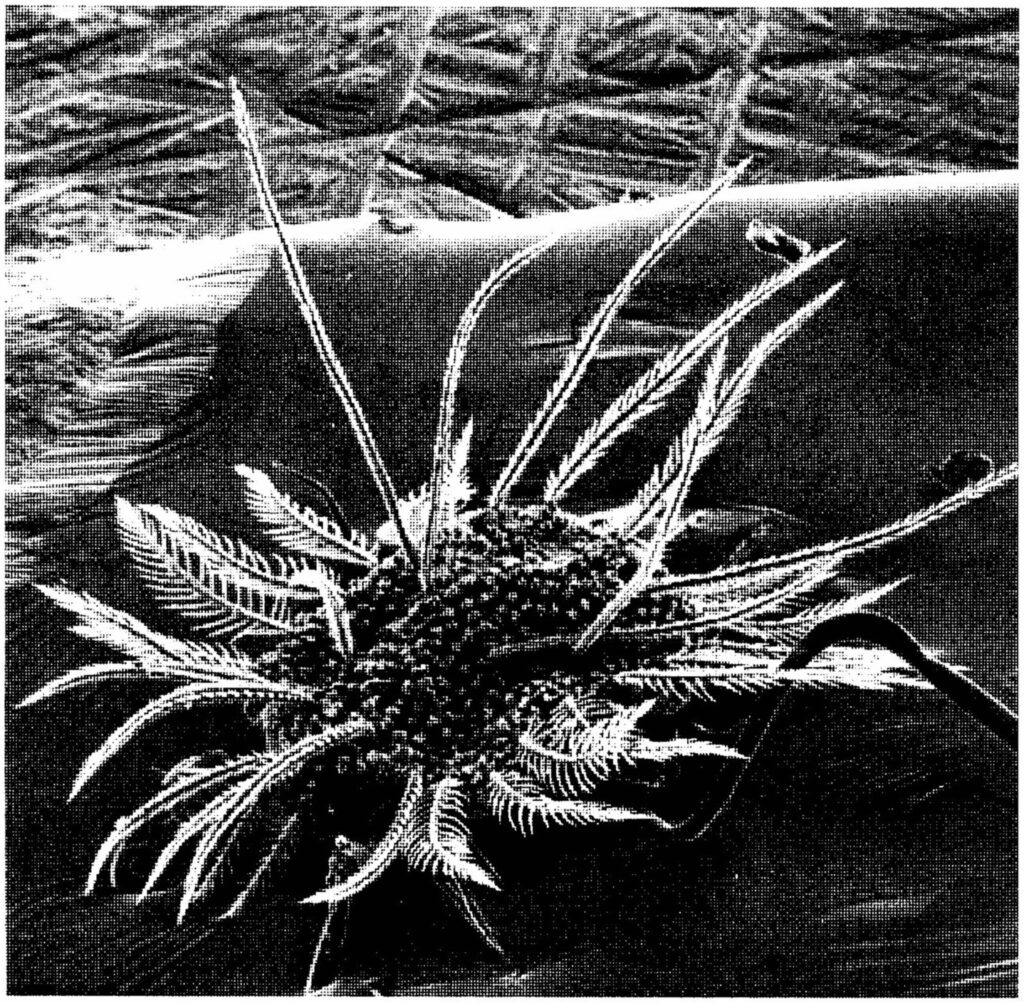
Ctenoglyphus plumiger (Koch), samica – widok od strony grzbietowej; skaningowy mikroskop elektronowy (fot. Dr. D. A. Griffiths, Slough Laboratory, Ministry of Agriculture, Fisheries and Food, UK)
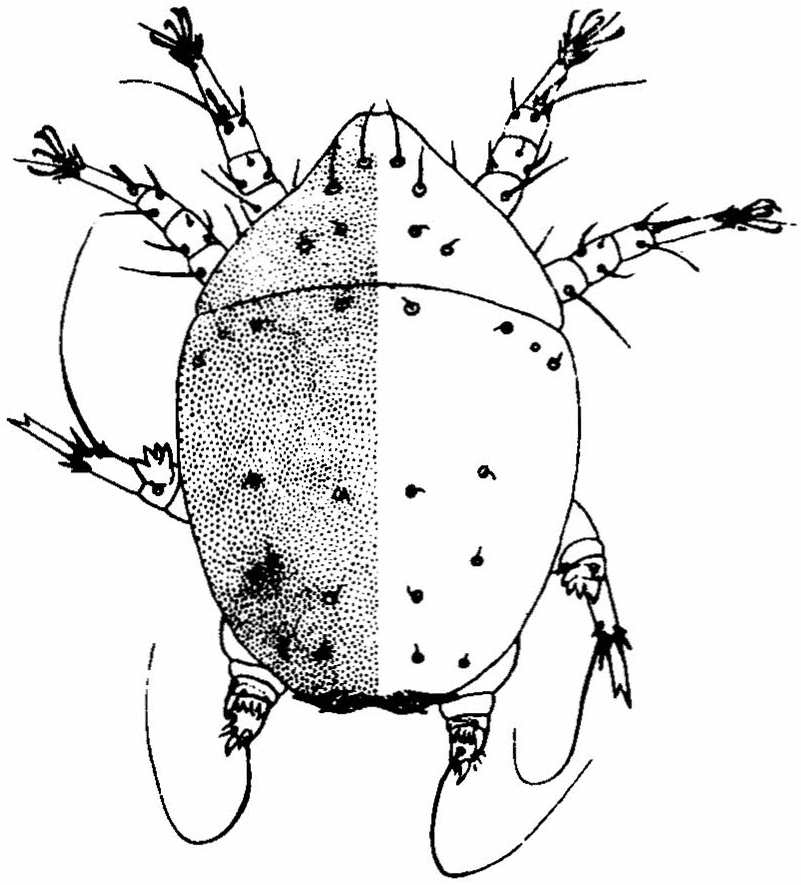
Ctenoglyphus plumiger (Koch), hypopus – strona grzbietowa (Chmielewski 1975)
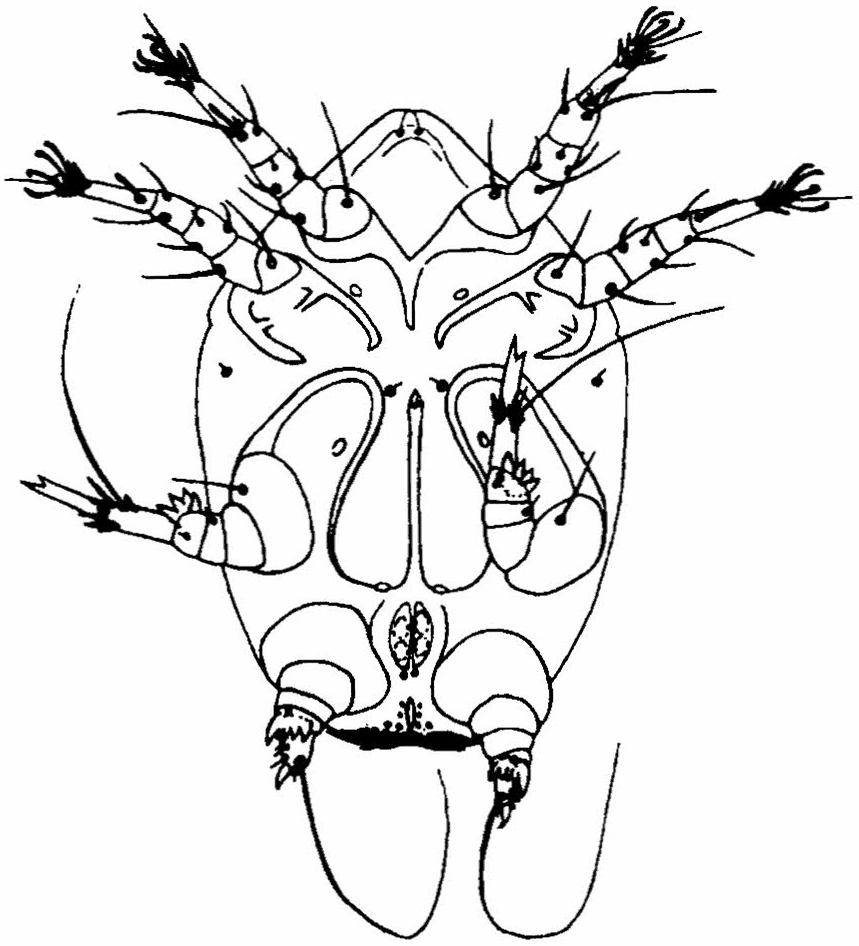
Ctenoglyphus plumiger (Koch), hypopus – strona brzuszna (Chmielewski 1975)
Females start to lay eggs about 4 days after copulation, which is obligatory condition of oviposition process. Copulation take place soon after eclosion of imagines and usually is repeated many times during male and female lifespans or even during the same day. After oviposition, females reach an unfecund oldery age before their natural death.
C. plumiger form hypopi (hypopus instar or heteromorphic deutonymph), which differ in behaviour and morphology from adults and other development stages and were observed in mass cultures of the species from time to time (Figs. 1-3) (Chmielewski 1975). But in ontogenesis experiments presented herein, when the mite were placed in the containers for individual rearing, hypopi were never found.
DISCUSSION AND CONCLUSIONS
Biological characters of C. plumiger, namely: fairly high fecundity, longevity and vitality of mites fed bee bread show that this product is accepted by them as food and explain their occurrence in bee hives.
Colonizing of hive debris with these mites, their feeding and development on mouldy products (pollen, bee bread, dead bees) are circumstances conducive to spreading of air born fungi.
It suggests the need for initiation of research studies on hygienic and sanitary importance of these mites, especially on their role as vectors of saprofagous microorganisms and infestation of hive products with them.
Bee bread might be recommended as an effective natural medium for use in laboratory monocultures of the species and production of biological material for experimental purposes and teaching acarology.
REFERENCES
Chmielewski W. (1975)- Nowo stwierdzone stadium rozwojowe roztoczy z rodzaju Ctenoglyphus – C. plumiger (Koch, 1835) (Acarina, Glycyphagidae). Zesz. problem. Post Nauk Roln., 171: 261-268.
Chmielewski W. (1998)- Wyniki wstępnych badań Acaroidea i Psoroptoidea (Acari: Acaridida) kilku wybranych siedlisk polskiej części Puszczy Białowieskiej. Parki Nar. Rez. Przyr., 17.3 (supl.): 137-143.
Fain A. (1967)- Les deutonymphes hypopiales vivant en association phoretique sur les mammiferes. Bull. Inst. r. Sci. Nat., Belge, 45: 1-262.
Griffiths D. A. (1960)- Some field habitats of mites of stored food products. Ann. appl. Biol., 48: 134-144.
Grobov O. F. (1991)- Klešči: parazity pčel i vrediteli ich produkcii. Rosagropromizdat, Moskva, 96pp.
strona 228Hughes A. M. (1976)- The mites of stored food and houses. Tech. Bull. Minist. Agric. Fish. and Food, London, No 9, 400pp.
Michael A. D. (1901-3)- British Tyroglyphidae. Ray Soc. London, 1-2, 474pp.
O’Farrell A. F., Butler A. M. (1948)- Insects and mites associated with the storage and manufacture of foodstuffs in Nothern Ireland. Econ. Proc. Roy. Dublin Soc., 3(22): 343-407.
Tűrk E., Tűrk F. (1957)- Systematik und Ökologie der Tyroglyphidae den Mitteleoropas. Zool. Inst. Friedrich-Alex. Univ. Erlangen, Akad. Verlagsges. Leipzig, Bd. 1, Teil 1, Abschn. 1, 231pp.
Vitzthum H. (1929)- Acari (in:) Brohmer, Tierwelt Mitteleuropas, 3, Teil 7
Zachvatkin A. A. (1941)- Paukoobraznyje, Tiroglifoidnyje klešči (Tyroglyphoidea). Akad. Nauk SSSR. Moskva-Leningrad, 6, 375pp.
BIOLOGICZNE EFEKTY ŻEROWANIA CTENOGLYPHUS PLUMIGER (KOCH) (ACARI: CTENOGLYPHIDAE) NA PIERZDZE PSZCZELEJ
W. Chmielewski
Streszczenie
Ctenoglyphus plumiger (Koch) należy do roztoczy magazynowych występujących w stogach siana, stodołach i innych budynkach gospodarczych. W Polsce gatunek ten był znaleziony po raz pierwszy w 1971 w Wolińskim Parku Narodowym (Kołczewo, Wyspa Wolin) (Chmielewski 1975), a później w innych rejonach kraju. Był spotykany także w pasiekach, gdzie kolonizował osyp w ulach pszczelich i plastry pszczele. Produkty pasieczne, szczególnie ich pleśniejące resztki są porażane przez te rozkruszki, które żerują chętnie na grzybni grzybów saprofitycznych.
Ponieważ roztocze te uważane są za potencjalne szkodniki zapasów pokarmowych pszczół, celem obecnych badań jest poznanie możliwości ich rozmnażania się i parametrów biologicznych na pierzdze.
Żywe osobniki C. plumiger do założenia hodowli laboratoryjnych zostały wyizolowane ze zmiotków siana zebranych w stodole na terenie Puszczy Białowieskiej. Hodowle masowe prowadzono w naczynkach hodowlanych, w ok. +20°C, w wilgotności względnej powietrza ok. 85% i zaopatrywanych w pierzgę pszczelą jako pokarm. Doświadczenia biologiczne prowadzono w tych samych warunkach.
Deutonimfy w stanie znieruchomienia przed przeobrażeniem się w imagines wybierano z hodowli masowych i umieszczano w osobnych klateczkach. Następnego dnia, po wylęgu roztoczy dorosłych określano ich płeć i łączono w pary (samica + samiec). Utworzono łącznie 25 par; każdą z nich umieszczono w oddzielnej klateczce i obserwowano aż do śmierci. Co 1-2 dni liczono i usuwano złożone jaja. Ustalano płodność i długość życia roztoczy.
strona 229Badanie rozwoju prowadzono na 500 osobnikach. Jednodniowe jaja umieszczano w klateczkach zaopatrzonych w kawałeczki pierzgi (5 klateczek x 100 jaj). Żywotność i zaawansowanie rozwoju obserwowano i rejestrowano codziennie lub co drugi dzień.
A oto niektóre ważniejsze dane biologiczne (średnie wyniki) uzyskane w tych doświadczeniach: cykl rozwojowy – 26.6 dni, śmiertelność osobników w stadiach przedimaginalnych – 25.3%, udział samic – 57.2%, długość życia: samców – 54.5 dni, samic – 59.4 dni, okres składania jaj – 45.4 dni, płodność samicy – 104.8 jaj w ciągu całego życia.
Słowa kluczowe: Acarina, Ctenoglyphus plumiger, szkodniki, biologia, pierzga.
Errata — błędy druku znalezione podczas digitalizacji
- s. 223, 2×: „Tűrk” → Türk
- s. 224: „unpulished” → unpublished
- s. 227: „saprofagous” → saprophagous
- s. 228, piśmiennictwo: „Nothern” → Northern
- s. 228, piśmiennictwo, 2×: „Tűrk” → Türk
- s. 228, piśmiennictwo: „Mitteleoropas” → Mitteleuropas