

MICROSCOPICAL ANALYSIS OF HONEY AS A MEAN OF QUANTITATIVE EVALUATION OF THE RELATIONSHIP BETWEEN APIS MELLIFICA AND TRIFOLIUM PRATENSE
tekst: G. Vorwohl
Pszczelnicze Zeszyty Naukowe, Rok XXI, 1977 — G. Vorwohl
strona 243BEE RESEARCH COPIES V.XXI DECEMBER 1977
G. Vorwohl
Landesanstalt für Biennenkunde, Universität Hohenheim, BR Deutschland
Microscopical analysis of honey is one of the means to find out if bees visit a certain plant in order to gather pollen or nectar and to what extent.
Prior condition is that the plant under discussion produces pollen grains with sufficient morphological characteristics, allowing to differenciate the pollen from those of related species. This is possible with red clover. In Europe, if we exclude the mediterranean region, similar pollen grains are only produced by Trifolium alpestre, T. alexandrinum and T. incarnatum. Pollen of Trifolium alpestre and T. alexandrinum are apparently smaller than pollen of T. pratense. In the average pollen grains of Trifolium incarnatum are bigger than those of T. pratense but if distribution curves are designed for the length of the polar axis the two curves will overlapp. Nevertheless a differention is possible. The collumela in the exine of Trifolium incarnatum are more distinct than those of T. pratense, and the pollen grains are more elongated in lateral view.
In the mediterranean region at least two Trifolium species (T. angustifolium and T. stellatum) produce pollen belonging to the „Pratense group”. But this does not influence the analysis of honey samples for instance from South West Germany.
strona 244List 1: Length of polar axis of five Trifolium species in um
| Species | |||
|---|---|---|---|
| T. alexandrinum | 27 | 30—34 | 36 |
| T. pratense | 35 | 38—43 | 51 |
| T. incarnatum | 38 | 40—44 | 49 |
| T. angustifolium | 35 | 36—40 | 43 |
| T. stellatum | 34 | 39—43 | 46 |
We analysed microscopically 1217 honey samples produced in Baden-Württemberg. We used the methods described by the International Commission of Bee Botany (1970) *.
Baden-Württemberg is the southwestern state of the Federal Republic of Germany. The region comprises low lands and mountains up to 1400 m. Climatical conditions and the geological structure show a rich variety. Wild flora, agricultural use and forestry show a corresponding diversity.
Bees in Baden-Württemberg belong to the Carnica race but the influence of the old local nigra bee is still detectable.
The honey samples evaluated by us were comming from all parts of the country. The honey analysed were extracted by centrifugation. Most of the pollen grains found in extracted honey originate in the nectar which contributed to the honey. The nectaries and the anthers are usually close together in the flower and some pollen grains fall into the nectar and are sucked together with the nectar by the bees.
Demianowicz called this the „primäre Einstäubung”. I use the German term because I cannot find an appropriate translation. There is a „sekundäre Einstäubung” by pollen collected by the bees and formed to pellets or sticking to the hairs covering the bees. The „sekundäre Einstäubung” is usually less important than the „primäre Einstäubung”. A „tertiäre Einstäubung” is possible when honey is harvested. Due to the fact that some of the stored pollen (beebread) may be loosened by the manipulations necessary to get the honey out of the combs. In honey extracted by centrifugation the amount of pollen grains incorporated from beebread is usually low. During centrifugation the stored pollen remains in the combs.
There are always pollen grains floating in the air. Some of them may be incorporated in the honey, in the hive or later after extraction. Airborne pollen grains of red clover are apparently very rare. Most of the pollen floating in the air is produced by windpollinated plants. Spe-
- International Commision of Bee Botany. Methods of Melissopalynology Bee World 51, 125—138, 1970 (english), Apidologie 1, 193—209, 211—227 (german and french).
cialists like Wodhouse * or Hyde and Adams** do not mention Trifolium pratense.
Of the 1217 honey samples analysed 86% contain pollen of red clover. In 14% of the honeys of Southwest Germany there was a negative result. This does not mean that the samples were absolutely free from red clover pollen, but it was not found during analysis. With other words the frequency of red clover pollen, if present, will be in the order of promille or less.
Very frequent (more than 45%) red clover pollen was found in 2% of the samples. This means most of honey, so far it was not produced from honeydew, is comming from Trifolium pratense. Monofloral red clover honeys are known to be produced from time to time in the mountains of the Schwäbische Alb, a ridge of jurassique limestone. These red clover honeys are produced in summer after the first cut of the meadows. An especially good crop of red clever honey was in 1969 in the time of the International Beekeeper Congress in Munich.
In 16% of the samples red clover pollen was found frequently (16—45%).
It was rare (3—15%) in 37% of the samples and isolated (below 3%) in 31% of the honeys.
Another evaluation was made on 290 German honeys from all parts of the Federal Republic. The pollen found in the honeys were arranged with falling index of frequency. The result is given in list 2.
List 2:
| 1. Cruciferae R | Index | 2.12 |
| 2. Pyrus-group | „ | 1.66 |
| 3. Trifolium repens-group | „ | 1.60 |
| 4. Salix | „ | 1.21 |
| 5. Compositae T | „ | 0.99 |
| 6. Prunus-group | „ | 0.96 |
| 7. Trifolium pratense | „ | 0.91 |
| 8. Lotus | „ | 0.88 |
| 9. Compositae A | „ | 0.86 |
The method of establishing the index is as follows:
Every pollen found in the samples get 4 points, if it es very frequent, 3 points, if it is frequent, 2 points, if it is rare and so on. The points are added and divided through the number of samples evaluated. Highest theoretical value of index is 4. This would mean that the pollen variety is dominant in all honeys analysed.
- Wodhouse, R. P.: Hayfever plants. Hafner, New York, 1971.
** Hyde, H. A. and Adams, K. F.: An atlas of airborne pollen grains. Macmillan, London, 1958.
strona 246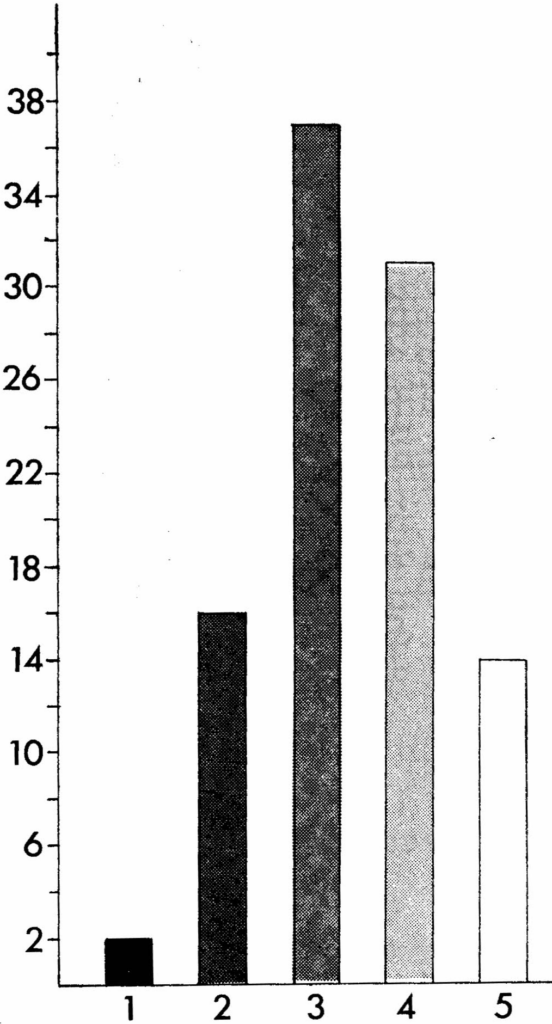
Fig. 1 Frequency of pollen of Trifolium pratense in 1217 honeys from Southwest Germany (Baden-Württemberg) Ordinate: Number of honey samples in % Abscissa: Frequency of red clover pollen in the samples 1 very frequent (more than 45%) 2 frequent (16—45%) 3 rare (3—15%) 4 isolated (below 3%) 5 not found
strona 247Trifolium comes to the seventh place in this list. It should be taken in consideration that all the varieties with better places are units comprising several genera as in the case of Cruciferae R and Compositae T or at least a genus as in the case of Pyrus or Prunus or some species in the case of Trifolium repens.
Notwithstanding the fact that honeybees find an obstacle in the corolla length of the red clover flower Trifolium pratense proofs to be an important bee plant. Under certain conditions it provides monofloral honeys.
MIKROSKOPOWA ANALIZA MIODU JAKO WSKAŹNIK ILOŚCIOWEJ OCENY ZALEŻNOŚCI MIĘDZY PSZCZOŁĄ MIODNĄ A KONICZYNĄ CZERWONĄ
G. Vorwohl, Uniwersytet Hohenhein, RFN
Streszczenie
Mikroskopowa analiza miodu może być wykorzystana do określenia zależności między pszczołą a określonymi gatunkami roślin. Stosunkowo łatwo oznacza się pyłek koniczyny czerwonej w miodzie z krajów Europy o klimacie umiarkowanym. Ponad 1200 próbek miodu z południowo-zachodnich Niemiec zbadano mikroskopowo. Bardzo wysoki procent tych próbek posiadał pyłek koniczyny czerwonej. Zawartość pyłku tego przekraczała 45%.
W podanych warunkach koniczyna czerwona okazała się jako dobre źródło pyłku i nektaru mimo pewnych trudności korzystania z tego źródła przez pszczoły z krótkim języczkiem.
strona 248Errata — błędy druku znalezione podczas digitalizacji
- s. 243: „Biennenkunde” → Bienenkunde
- s. 243: „differenciate” → differentiate
- s. 243: „overlapp” → overlap
- s. 243: „differention” → differentiation
- s. 243: „collumela” → columellae
- s. 244, 245: „comming” → coming
- s. 244, przypis: „Commision” → Commission
- s. 245: „red clever honey” → red clover honey
- s. 245: „it es very” → it is very
- s. 247: „proofs to be” → proves to be
- s. 247, streszczenie: „Hohenhein” → Hohenheim