

INFLUENCE OF KEEPING BEES (APIS MELLIFERA CARNICA POLLM.) IN COLONIES OR CAGED ON THE FORMATION OF CONDITIONED REFLEX ON THE QUEEN BEE PHEROMONES
tekst: Algirdas Skirkevicius, Laima Blažyte, Zuzana Skirkevičiene
Pszczelnicze Zeszyty Naukowe, Rok XLIV, 2000 — Algirdas Skirkevičius, Laima Blažyte, Zuzana Skirkevičiene
strona 43PSZCZELNICZE ZESZYTY NAUKOWE
Algirdas Skirkevičius^1,2, Laima Blažyte^1, Zuzana Skirkevičiene^1
^1 Institute of Ecology, Akademijos g. 2, LT-2600 Vilnius, Lithuania, ^2 Vilnius Pedagogical University, Studentu g. 39, LT-2034 Vilnius, Lithuania
Summary
Worker honeybees (Apis mellifera carnica Pollm.) were investigated. They were kept in a bee colony or in small cages in a thermostat from 0.5 to 3.0 h without food until the beginning of conditioning trials. Ethanol extract of mated bee queens (1·10^-3 Qeq) was used as a conditioning stimulus and 50% sugar solution as reward. The ability of a bee to respond to queen extract (from 1·10^-12 to 1·10^-3 Qeq) calibrated according to (E)-9-oxo-2-decenoic acid was investigated.
The results revealed that conditions, under which worker honeybees were kept prior to conditioning, influenced the formation of the reflexes to the pheromones of the bee queen. They affected not only the ability to form this reflex, but the course of its formation as well:
a) the conditioned reflex to queen extract can be successfully formed in 93.2% of worker honeybees kept without food for 0.5 h after they have been taken away from a colony (the stimulus and reward have to be delivered on average 2.9±0.44 times, bees responded on average to 5.7±0.11 queen extract doses).
b) the formation of the olfactory reflex to queen extract in worker honeybees taken from the colony and kept in a thermostat depends on the length of their existence without food: if they were kept without food for 0.5 h, the conditioned reflex was trained only in 10.0% of the individuals; if they were kept without food for an hour, the percentage of the individuals in which conditioned reflex occurred reached 59.1% (the stimulus and reward have to be delivered on average 4.1±0.07 times, bees responded on average to 4.3±0.01 queen extract doses), if 2.0 h – the number of individuals in which we managed to form the conditioned reflex grew up to 82.8% (the stimulus and reward should be offered on average 2.3±0.50 times, bees responded on average to 5.3±0.20 queen extract doses). If the bees were kept without food for 3.0 h, the conditioned reflex was trained in 0.0 % of them, because they were very weak or dead.
Keywords. Apis mellifera carnica Poll., olfactory reflex, conditioning, conditioned stimulus, reward.
strona 44INTRODUCTION
It is well known that keeping conditions, age and species are important factors in the formation of a conditioned reflex (Mac-Farlend, 1988). While studying the mechanisms of pheromone perception in worker honeybees, experiments are carried out with individuals kept under various conditions (bee colonies, cages kept in a thermostat, etc.). However, usually neither bee keeping conditions nor a possible effect of these conditions on study results are mentioned.
Living conditions in a cage differ from those in a bee colony. First of all, a worker bee living in a cage is isolated from bee colony’s life and cannot participate in it; besides, it’s feeding also changes greatly. These changes are reflected in its honey bag. The honey bag of a worker bee living in a hive usually does not weigh much (about 0.6 mg), while in an isolated worker bee it considerably increases. For instance, the honey bag of a worker bee kept in a cage for 4 days weighs on average 13.9 mg and for 9 days about 9.3 mg (Eskov, 1995). These facts show that before applying the method of a conditioned reflex in determining worker bee sensitivity to queen’s pheromone, the conditions of worker bee keeping should be accounted for.
METHODS
Worker bees Apis mellifera carnica Pollm. were studied. They were kept: a) in a bee colony, and in small cages in a thermostat; b) without feeding for 0.5, 1, 2, 3 hours before starting their training for the conditioned reflex.
Because of bad weather conditions, the bee colony was fed 50% sugar solution. In the thermostat, the temperature was +30°C, the bees were fed candy and given water all the time. In one cage were kept 30 – 50 bees.
The bees taken away from the hive or the thermostat were kept starving for a definite period of time (0.5 – 3 h). Then they were put in a refrigerator (0°C) and were cooled to immobilise them. In motionless bees, the wings were squeezed with special clips, on which they were hung in a test stand. The bees warmed up in 30 min. Then the conditioned reflex was started to train (Skirkevičius, Blažyte, 1999).
As a conditioning stimulus, a spirit extract of mated bee queens was used, and 50% sugar solution was used as a reward. When training a bee, to its antennae a glass rod was brought, onto which 0.01 ml of queen extract (0.001 Qeq) and a drop of sugar solution were placed with the aid of a micropipette (Fig. 1).
strona 45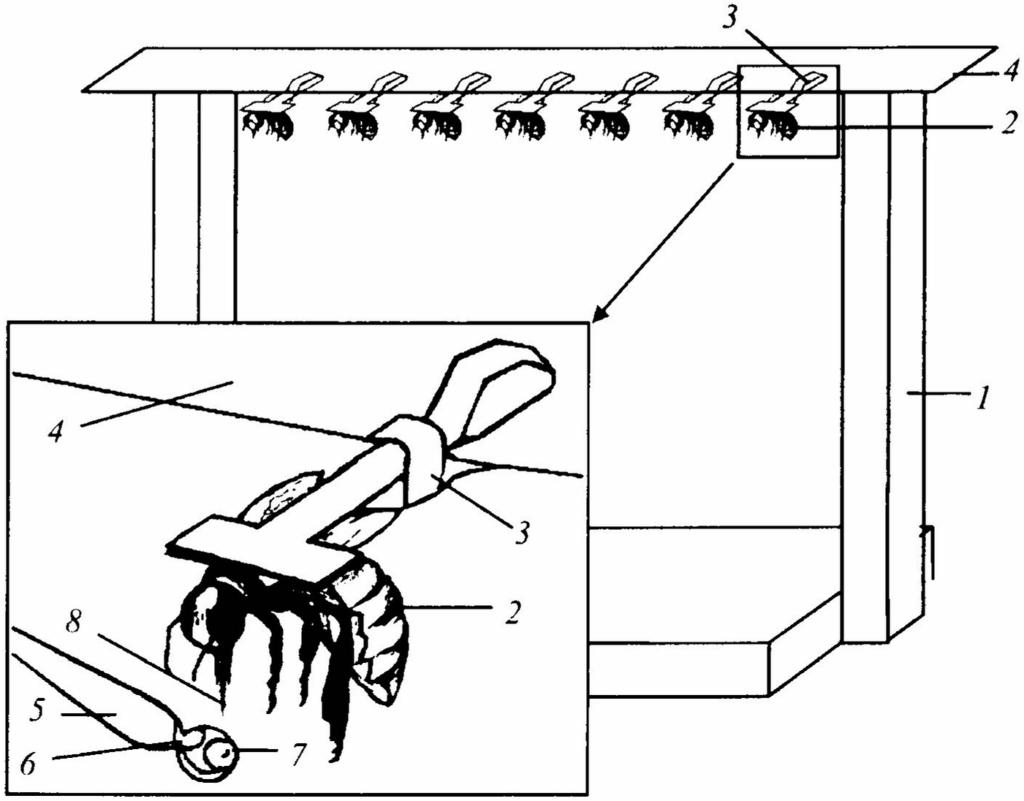
For a bee to smell the extract, the stick was kept close to the antennae for 5 s. Then the bee’s antennae were touched with sugar solution, for the bee to put out reflectorily its proboscis. Such unconditioned reward lasted no more than 1 s. When a bee put out its proboscis just to smell the queen extract (a conditioning stimulus), the conditioned reflex was considered to be formed. The number of conditioning events was such as was necessary to form the conditioned reflex (it was 1 – 10).
Upon this reflex being formed, we checked the bees responding to queen extract solutions calibrated by (E)-9-oxo-2-decenoic acid from 1·10^-12 to 1·10^-3 Qeq. Fifteen individuals could be trained and tested simultaneously.
The study was performed in July – August 1998. All in all, 144 worker bees (58 taken directly from a bee colony and 86 kept in a thermostat) were studied. The obtained results were statistically evaluated.
strona 46RESULTS AND DISCUSSION
Worker bees from a bee colony and from a thermostat showed a different behaviour when kept without food for 0.5 h (Fig. 2).
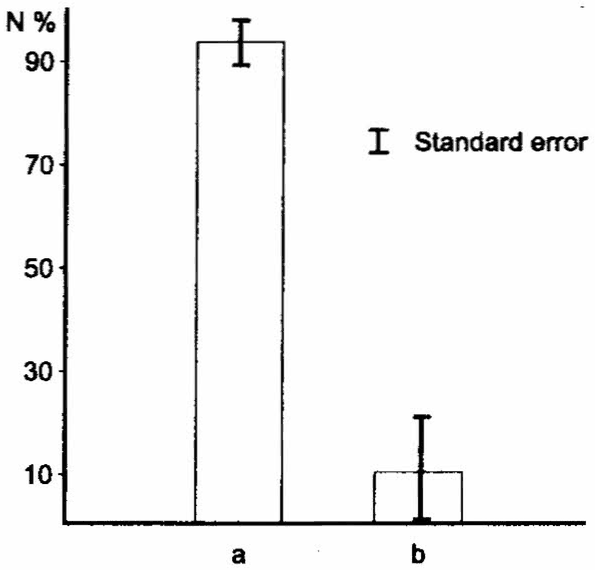
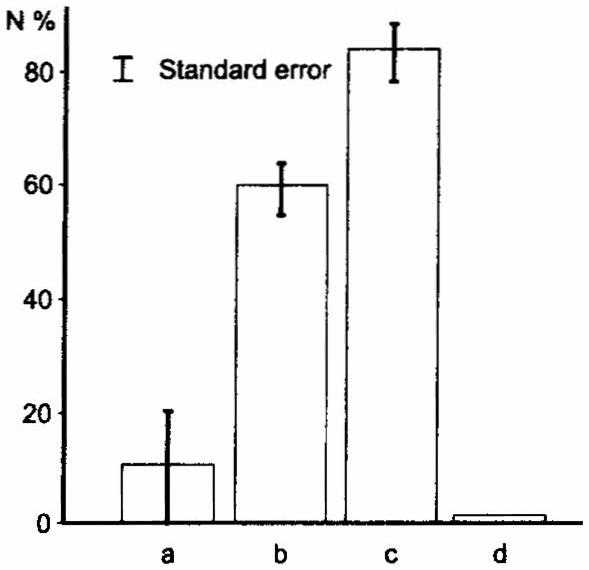
The conditional reflex to queen extract was successfully formed in 93.2±4.38% of worker bees from a bee colony and only in 10% of those from a thermostat, i. e. by 83.2±10.92% less. If worker bees from a thermostat were kept starving for 1 h, the number of individuals that developed the conditioned reflex to queen extract increased to 59.1±4.54%, it was by 49.1±10.98% higher than those starved for 30 min. (P=0.070)
The number of individuals that developed the conditioned reflex to queen’s pheromone in the worker bees taken from a thermostat and starving for 2 h was 82.8±5.02%, which increase of 23.7±6.77% was again significantly higher then those starved for 1h. (P=0.152) (Fig. 3)
Thus, worker bees from a thermostat kept starving for 2 h and those from a bee colony kept starving for 0.5 h were very similar in their ability to develop the conditioned reflex to bee queen extract (Figs. 2, 3).
Worker bees from a thermostat that were kept starving for 3 h were impossible to study, for they grew weak and soon died (Fig. 3).
The time course of developing a conditioned reflex to bee queen extract in worker bees kept under different conditions was also different in respect to the number of conditioned and unconditioned stimuli offered.
When worker bees from a bee colony were kept starving for 0. 5 h, to develop a conditioned reflex the stimulus with reward had to be offered to them on average 2.9±0.44 times (n = 58). Among them, there were about 55.2% of individuals to whom 1-2 times were enough to develop the reflex (Fig. 4, a). About 37.9% of individuals needed 3-7 times for this reflex to be developed. The remaining part of individuals failed to develop the conditioned reflex even after 8-10 times of the stimulus and reward being offered to them.
To develop the conditioned reflex, worker bees from a thermostat (n = 22) and kept starving for 1 h had to be offered the stimulus and reward on average 4.1±0.07 times. In this case, the distribution of worker bees with regard to the formation of conditioned reflex is different. To develop the conditioned reflex, 50% of the individuals had to be offered the stimulus and reward 1-6 times. In about 10% of individuals the conditioned reflex was developed only after even 8 times (Fig. 4., b).
Worker bees from a thermostat kept starving for 2 h had to be offered the stimulus and reward on average 2.3±0.50 times (n = 32). Thus, in such a situation the development of the conditioned reflex to bee queen extract took least time. This is clearly demonstrated also by the worker bee distribution depending on the course of its formation (Fig. 4, c). Upon offering the stimulus and reward 1-3 times, the conditioned reflex was formed even in 88.9 % of individuals.
strona 48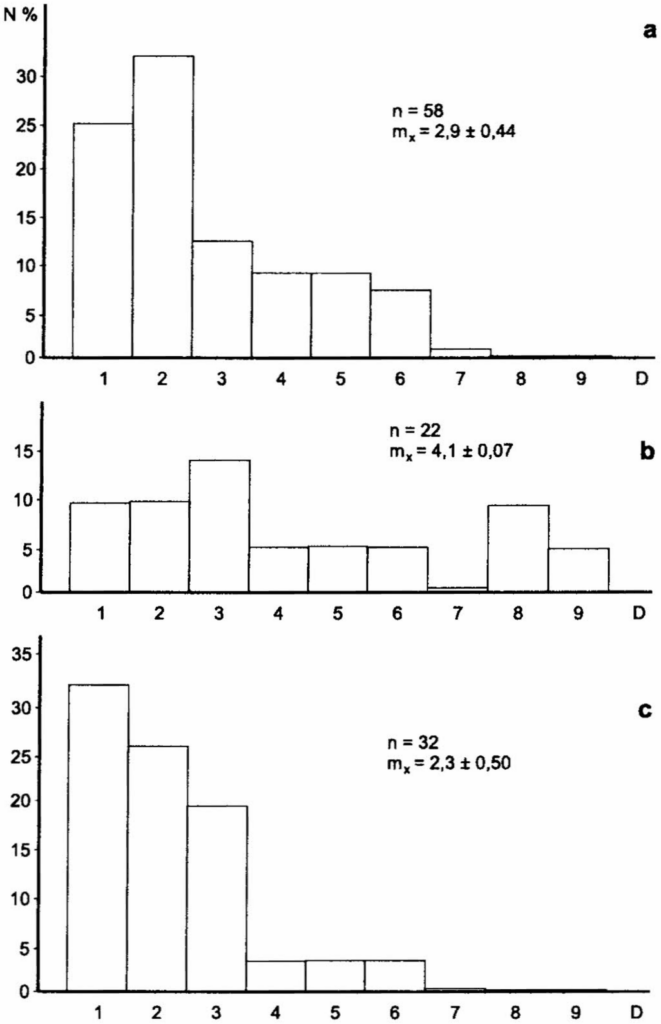
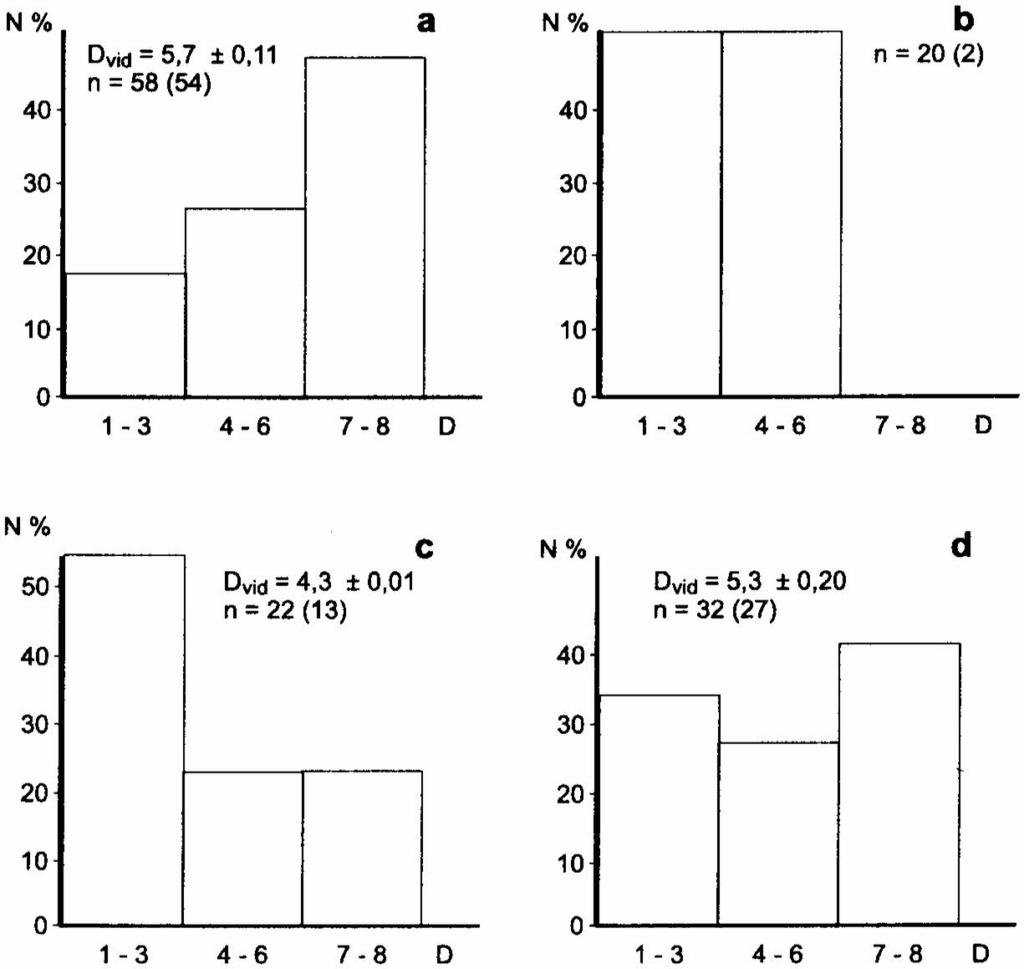
The study results show also that bees kept under different conditions differed in their ability to respond to bee queen extract doses. Bees from a colony kept starving for 0.5 h respond on average to 5.7±0.10 bee queen extract doses (n = 58). About half of individuals responded to 7-8 doses (Table, Fig. 5, a).
When worker bees from a thermostat were kept starving for 0.5 h, only two of them developed the conditioned reflex (n = 20): one of them responded to two and the other to six queen extract doses (Table, Fig. 5, b). The behaviour of bees changed when they were kept starving for 1 h: they responded on average to 4.3±0.01 queen extract doses (n = 22). In this case more than 50% of individuals responded only to 1-3 doses (Table, Fig. 5, c).
Table Extract doses (queen equivalents) responded by worker bees (Apis mellifera carnica Pollm.) kept under different conditions and kept starving for different times Wielkość dawki ekstraktu (odpowiednik matki) na którą reagowały robotnice przetrzymywane w różnych warunkach i głodzone przez różny okres
| Bees kept starving until the development of conditioning reflex / Czas głodzenia pszczół (h) | Extract doses studied (Quq) / Wielkość dawki ekstraktu | Number of bees studied / Liczba badanych pszczół | Extract doses responded by worker bees (Qeq) / Wielkość dawki ekstraktu — minimum | Extract doses responded by worker bees (Qeq) / Wielkość dawki ekstraktu — maxsimum | Number of differentiated doses / Liczba odróżnianych dawek — mean ±SE / średnio | Number of differentiated doses / Liczba odróżnianych dawek — most frequent / najczęściej |
|---|---|---|---|---|---|---|
| Bees kept in colony – Pszczoły przetrzymywane w rodzinie | ||||||
| 0,5 | 1·10^-12-1·10^-3 | 58 | 1·10^-11 | 1·10^-3 | 5,7±0,11 | 7 – 8 |
| Bees kept in cages in a thermostat – Pszczoły przetrzymywane w cieplarce | ||||||
| 0,5^1) | 1·10^-12-1·10^-3 | 20 | 1·10^-8 | 1·10^-3 | – | 2 and 6 |
| 1,0 | 1·10^-12-1·10^-3 | 22 | 1·10^-11 | 1·10^-3 | 4,3±0,01 | 1 – 3 |
| 2,0 | 1·10^-12-1·10^-3 | 32 | 1·10^-11 | 1·10^-3 | 5,3±0,20 | 7 – 9 |
| 3,0^2) | 1·10^-12-1·10^-3 | 12 | – | – | – | – |
Notes:
- conditioned reflex developed in 2 bees only, 2) did not recover after chilling.
- odruch warunkowy występował tylko u 2 pszczół, 2) nie wykazywały oznak życia
Bees from a thermostat that were kept starving for 2 h responded on average to 5.3±0.20 queen extract doses. About half of individuals responded to 5-9 doses (Table, Fig. 5, d).
The analysis of the obtained results shows- that only the worker bees from a thermostat kept starving for 2 h and those from a bee colony starved for 0.5 h display a similar behaviour regarding the possibility and course of the
strona 50formation of the conditioned reflex and the number of queen extract that elicited response from the bees.
Thus, the results of our study disagree with the results of the other authors (Menzel, Bitterman, 1983) that artificial conditions do not influence the
strona 51formation of conditioned reflex in bees. The reasons for such contradictory results are difficult to explain as yet. Possibly that discrepancy was caused by the different conditions in which the experimental animals were kept before the conditioning. The mentioned authors caught bees from a bee-entrance late in the afternoon, then chilled them at the laboratory, fixed into special tubes, fed and kept in the dark for a night.
The bees were tested only next morning. Perhaps the behaviour of these bees did not differ from that of worker bees just taken away from the bee colony in our study, because of a rather short period following their separation from the bee colony, those bees were kept starving overnight and they were hungry. As to our tests, bees were kept in a thermostat with ad. lib. feeding for 2-4 days. Their feeding possibilities were limited only for 0.5 to 3 h. Before training the conditioned reflex, bees were kept starving for different periods of time. According to our results, worker bees kept in a thermostat and starved for 2 h behaved in a similar way as those studied by Menzel and Bitterman (1983). Additional studies are needed to elucidate the reasons for discrepancies of the conclusions drawn by us and by the mentioned authors.
CONCLUSIONS
Conditions of keeping worker bees influence the development of their conditioned reflex to queen extract. They are of significance not only for the possibility of developing this reflex, but also for the course of its formation and bees’ reaction to different doses of queen extract:
a) the conditioned reflex to queen extract is possible to develop, on average, in 93.2% of worker bees that upon being taken away from bee colony are kept starving for 0.5 h (the stimulus and reward have to be delivered on average 2.9±0.44 times, bees responded on average to 5.7±0.11 queen extract doses);
b) the development of the conditioned reflex to bee queen extract in worker bees separated from a bee colony and kept in a thermostat depends on the duration of their starving: if it lasts 0.5 h, the conditioned reflex is possible to develop in only 10.0% of individuals, starving for 1 h raises this number to 59.1% (the stimulus and reward have to be delivered on average 4.1±0.07 times, bees responded, on average, to 4.3±0.01 queen extract doses); among the worker bees kept starving for 2 h, 82.8% develop this reflex (the stimulus and reward should be offered on average 2.3±0.50 times, bees responded on average to 5.3±0.20 queen extract doses). Bees kept starving for 3 h grew weak and died.
strona 52ACKNOWLEDGEMENT
Authors address their warmest thanks to Dr. V. Apšegaite, Senior Researcher of the Chemoreception Laboratory of the Institute of Ecology, for determining the content of (E)-9-oxo-2-decenoic acid in bee queen extract, and to Dr. J. Račys, Head of the Agriculture Department of the Lithuanian Agricultural Institute, for the Apis mellifera carnica Pollm. bee colony used in the present study.
REFERENCES
Eskov A. K. (1995)- Ecology of the honeybee. Rezan (In Russian).
Mac-Farlend J. (1988)- Behaviour of the animal. Moscow (In Russian).
Menzel R., Bitterman M. E. (1983)- Learning by Honeybees in an Unnatural Situation. In: Huber F., Markl H. (ed.) Neuroethology and Behavioural Physiology. Berlin – Heidelberg – New York – Tokyo, p. 206 – 215.
Skirkevičius A., Blažyte L. (1999)- The effect of keeping conditions on the formation of conditioned reflex to queen bee pheromones in worker honeybees Apis mellifera carnica Pollm. Pheromones. 6: 33-38.
WPŁYW POZOSTAWANIA GŁODZONYCH PSZCZÓŁ (APIS MELLIFERA CARNICA) W RODZINACH LUB KLATECZKACH NA POWSTAWANIE U NICH ODRUCHU WARUNKOWEGO NA FEROMONY MATKI
Skirkevičius A., Blažyte L.,Skirkevičiene Z.
Streszczenie
Obserwacje prowadzono na pszczołach robotnicach rasy kraińskiej (Apis mellifera carnica) . Znajdowały się one w rodzinach pszczelich lub małych klateczkach przetrzymywanych w cieplarce bez pokarmu przez 0.5 do 3 godz. Po tym czasie działano na nie ekstraktem etanolowym z unasienionych matek (1×10^-3 Qeq), który stosowano jako bodziec uzależniający i dodatkowo karmiono 50% roztworem sacharozy. Badano zdolność pszczół do reakcji na kwas 9-oxo-2-decenowy znajdujący się w ekstrakcie z matek.
Wyniki ujawniły, że warunki w jakich pszczoły były przetrzymywane w decydującym stopniu kształtowały odruchy na feromony matki:
a) odruch warunkowy na ekstrakt z matek może z powodzeniem wystąpić u 93.2% robotnic przetrzymywanych bez pokarmu przez 0.5 godz., później są one wyrzucane z rodziny.
b) tworzenie się odruchu zapachowego na ekstrakt z matek u pszczół robotnic zabranych z rodziny i przetrzymywanych w cieplarce zależy od czasu pozostawania bez pokarmu. Jeśli były one przetrzymywane bez pokarmu przez 0.5 godz. odruch warunkowy następował tylko u 10% osobników, jeśli przetrzymywano je bez pokarmu przez godzinę procent osobników, u których występował odruch warunkowy wzrastał do
strona 5359.1%, a po 2 godz. u 82,8% osobników. Przetrzymywanie pszczół bez pokarmu przez 3 godz nie wywoływało już żadnej reakcji gdyż pszczoły były zbyt słabe albo martwe.
Słowa kluczowe: Apis mellifera carnica, feromony matki, bodziec węchowy, odruch warunkowy.
Errata — błędy druku znalezione podczas digitalizacji
- s. 47: „higher then” → higher than
- s. 49: „5.7±0.10″ → 5.7±0.11
- s. 49, tab., główka kol. 2: „Quq” → Qeq
- s. 49, tab., główka kol. 4: „maxsimum” → maximum