

STUDIES ON THE BEHAVIOUR OF WORKER HONEYBEES ON THE RECAPPING OF ARTIFICIALLY DECAPPED BROOD
tekst: Adrian Siceanu
Pszczelnicze Zeszyty Naukowe, Rok XLIV, Nr 2, 2000 — Adrian Siceanu
strona 35PSZCZELNICZE ZESZYTY NAUKOWE Rok XLIV, Nr 2 2000
Adrian Siceanu
Institute for Beekeeping Research & Development, 71544 Bucharest 1, 42 Ficusului Blv., Romania
Summary
Artificial decapping of honeybee brood in post capping stage proved to be an useful tool in controlling specific brood diseases.
During the interval between decapping and recapping, treatments may be applied in order to control Varroa jacobsoni, when the entire mite population is exposed to the treatment. In case of American foul brood and chalkbrood, this operation favours the cleaning behaviour, the dead brood being easily identified and removed from the cells.
- This study has been carried out in 1999, the following parameters being observed:
- the time period when the brood is recapped depending on its developmental stage (age); this parameter was studied in correlation to the decapping technique used;
- the capping pattern (convex, even or slightly concave) and the repeatability of the initial pattern in case of recapping.
Our study confirms the previous researches, namely, that after artificial decapping of brood bees recapped more rapidly the younger brood (9 to 12 days old) than the older one while the brood around to emerge was not recapped.
The analysis of variance showed highly significant differences between the rhythm of recapping of brood under the first days of the post capping stage and the brood around to emerge. This is clear evidence that the secretion of the stimulus substance (involved in promoting capping and recapping of the artificially decapped brood) decreases progressively. Towards the end of metamorphosis the level of secretion is found under the normal level at the moment of natural capping so that around emerging period the brood is no longer capped.
Keywords: honeybees, artificial decapping of brood, recapping by bees.
INTRODUCTION
The capped brood stage was and still is subject to many studies meant to find new solutions ready to be applied in treating specific brood diseases. Rothenbuhler (1964) explained the genetic mechanism in transmitting the nest cleaning behaviour. Many researchers studied the improvement of cleaning (hygienic) behaviour correlated to the natural resistance of the brood to the occurrence of AFB when special selection programs have been applied with positive results (Spivak and Gillian, 1998).
strona 36Another research direction that offered positive results consists in reducing the post-capping period correlated to the resistance to Varroa jacobsoni (Siuda, Wilde, Koeniger 1996).
In a previous study a new method as well as a new equipment used for artificial decapping of bee brood to prevent and to facilitate the administration of several drugs in the treatment of specific bee diseases were tested in the research laboratory of the Institute for Beekeeping Research and Development in Bucharest. (Siceanu, 1996, 1997).
MATERIALS AND METHODS
These studies consisted of two experiments carried out with honeybee colonies of Apis mellifera carpathica during the summer season of 1999.
Experiment no.1 (rhythm of brood recapping depending on age)
A number of 10 honeybee colonies was randomly selected form a total number of 100 colonies. Out of each colony a comb with capped brood (as compact as possible) was taken. The surface of the brood ellipse was around 6 sdm.
The selected combs were artificially decapped on one side using the method of caps removal by soldering with melted beeswax and snatching. The method is as follows:
The comb is placed in a horizontal position. A piece of cloth (decapping element) is introduced in melted beeswax. The decapping element is applied over the respective brood area. The cloth is than slightly rubbed with a sponge introduced into a plastic bag and dipped into melted beeswax. The beeswax film on the cloth melts the caps and incorporates them. After cooling, the cloth is snatched, removing thus the caps and leaving the brood decapped.
After decapping the brood areas were measured using a 1 cm2 mesh net with meshes superposed over the ellipse. The structure of the ellipses was determined according to the developmental stage of the brood (age in days):
- 8/9 days up to 11 days old
- 12 – 20 days
- 21 days (almost imago stage)
the surfaces were measured in cm2 ( Table 1).
After decapping the combs were reintroduced into the colonies noting:
a) the rhythm of brood recapping (meaurements carried out every 3, 6, 12 and 24 hours);
b) reccapping behaviour of the honeybees.
Experiment no.2 (rhythm of recapping depending on the applied method)
From the same population which numbered 100 colonies, 10 colonies were selected. The brood pattern was convex with middle dimples. As in the
strona 37first experiment, 1 comb of each colony, showing the above mentioned pattern was used in the experiment. One ellipse on each comb was measured using the net, before artificial decapping.
A comparison between the speed of brood recapping using the two decapping techniques was applied on the same ellipsoidal brood area on both sides of the median line, respectively:
On the left side the decapping with melted beeswax and snatching was applied while on the right side of the median line, the decapping was done by scraping off the caps with a hive tool.
Caps removal by scraping off with the hive tool offers satisfactory results only when convex capped brood is present. The movements of the hive tool from top towards the bottom of the comb causes the detaching of the superior and side edges of the caps and the together sticking of the wax on the inferior edge of each cell.
As with the first experiment, after decapping, the combs were reintroduced into the colonies noting the following parameters:
a) the percentage of brood decapping
b) the rhythm of recapping of both brood areas, measurements being done every 3, 6, 12 and 24 hours and comparing the results;
c) recapping behaviour of the worker bees.
RESULTS AND DISCUSSIONS
Experiment no. 1.
The cumulative results regarding the rhythm of decapping of the brood of various ages are shown in table 1 and Fig.1.
Table 1 Cumulative values on the recapping rhythm of brood of various ages Dynamika powtórnego zasklepienia komórek z czerwiem różnego wieku
| Brood age (days) / Wiek czerwiu (dni) | Surface / Powierzchnia (cm2) | 3 hours – 3 godz.: Averag. / średnia | 3 hours – 3 godz.: Min-Max (%) | 6 hours – 6 godz.: Averag. / średnia | 6 hours – 6 godz.: Min-Max (%) | 12 hours – 12 godz.: Averag. / średnia | 12 hours – 12 godz.: Min-Max (%) | 24 hours – 24 godz.: Averag. / średnia | 24 hours – 24 godz.: Min-Max (%) |
|---|---|---|---|---|---|---|---|---|---|
| 8/9-11 | 1470 (100%) | 928 (63,1%) | 48,1- 72% | 1180 (80,2%) | 63-98% | 1320 (81,8%) | 68-100% | 1412 (96%) | 92-100% |
| 12-20 | 3675 (100%) | 312 (8,5%) | 0 -15% | 1470 (40%) | 28-70% | 1800 (49%) | 32-98% | 3428 (93,3%) | 87-100% |
| 21 | 370 (100%) | Emerg. wygryza się | Emerg. wygryza się | Emerg. wygryza się | Emerg. wygryza się |
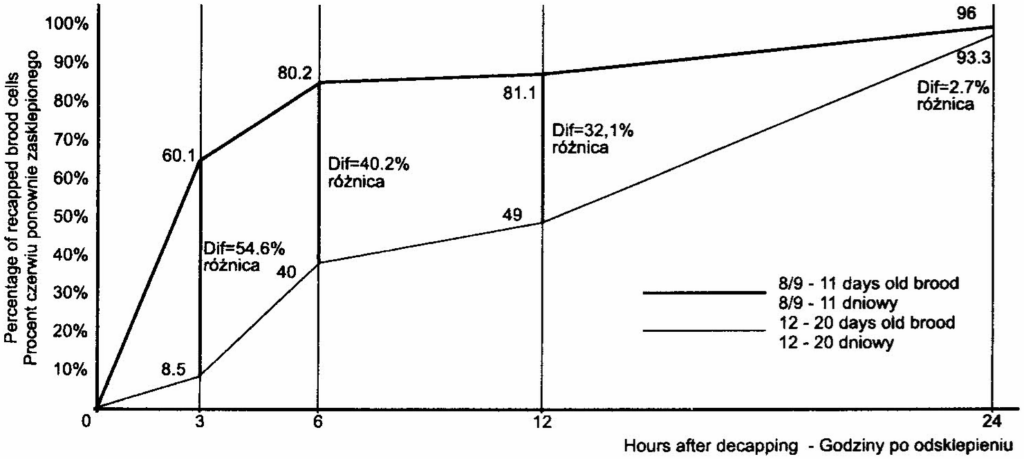
As seen, the recapping rhythm for 8/9 – 11 days old brood is much faster than for the 12 – 20 days old brood, especially during the first 6 hours. The highest difference is noted after 3 hours – 54.6% when the first age category was recapped in a 63.1% ratio as compared to 8.5% noted with the 12 – 20 days old brood. Observations have clearly shown that the highest recapping rhythm is noted with the 9-10 days old brood, immediately after the larva gets its vertical position into the cell and begins the specific movements for cocooning.
Checked in the laboratory, about 10 minutes after decapping, the brood falls down from the cells when the cap and the worker bees are absent. The percentage of falling is always 100%. However, immediately after reintroducing the decapped brood into the colonies, the worker honeybees are readily caring for the brood found in this stage and thus, the partially existing larvae are reintroduced in their cells by specific touching movements with the bees anterior legs. Afterwards, the brood is naturally recapped.
A relatively uniform recapping is also seen with the 11 days old brood as well as with the 12 – 20 days old brood.
After 24 hours almost the entire brood surface was recapped – the average percentages being 96% (92 – 100%) at 8/9-11 day-old brood, and 93.3% (87 – 100%) respectively for that 12 – 20 days old.
The 21 day-old brood (moulting of the pupa to adult stage) was not interfered with by the worker honeybees so that the imago stage was reached without capping. The resulting adults were generally showing an incomplete development, lighter colour and a thinner chitin layer. However, these bees could emerge under natural conditions.
It seems possible that certain stimuli substances are present at the level of the developing brood, in higher amounts than under natural capping stage.
strona 39However, after moulting of the pupae to adult stage, these stimuli substances are highly reduced, since the imago stage is no longer recapped by the worker bees.
Experiment no. 2
It was noted that the efficiency of decapping in case of convex brood pattern was 96% when applying the soldering and snatching method and 82% with the erasing with hive tool method.
Table 2 Comparison on the recapping rhythm of the brood decapped by the two different methods Porównanie szybkości ponownego zasklepienia czerwiu po odsklepieniu dwoma różnymi metodami
| Decapping method / Metoda odsklepienia | Decapped brood areas / Powierzchnia odsklepionego czerwiu (cm2) | Efficiency of decapping / Skuteczność odsklepienia | 3 hours / 3 godz.: Avrg. / średnia | 3 hours / 3 godz.: Min-max | 6 hours / 6 godz.: Avrg. / średnia | 6 hours / 6 godz.: Min-max | 12 hours / 12 godz.: Avrg. / średnia | 12 hours / 12 godz.: Min-max | 24 hours / 24 godz.: Avrg. / średnia | 24 hours / 24 godz.: Min-max |
|---|---|---|---|---|---|---|---|---|---|---|
| Method 1 (soldering and snatching) | 2380 (100%) | 2285 (96%) | 137 (6%) | 0-17% | 864 (37,8%) | 18-45% | 1896 (83%) | 72-98% | 2063 (90,3%) | 80-100% |
| Method 2 (erasing with the hive tool) | 2690 (100%) | 2200 (82%) | 842 (38,2%) | 25-70% | 1716 (78%) | 53-95% | 2007 (91,2%) | 85-100% | 2068 (94%) | 90-100% |
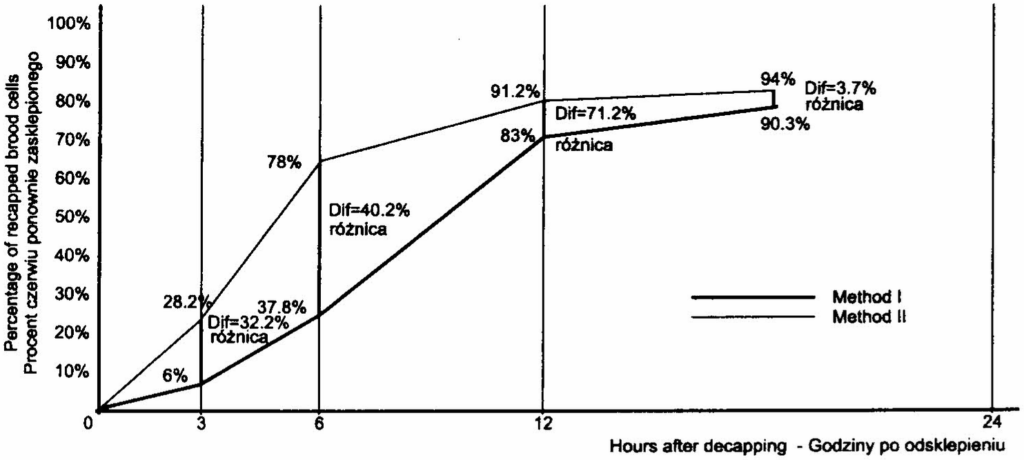
The recapping rhythm is clearly higher in case of the second decapping method (erasing). The highest deifference – 40.2% was noted 6 hours after decapping, the erased brood being recapped in a 78% ratio as compared to 37.8% in case of the first decapping method ( soldering and snatching).
strona 40This difference is clearly explained by the fact that by erasing the wax is not completely removed as it still remains stuck to the edges of the cells. The bees are remodelling the caps following a similar pattern to the previously existing one, but some areas with flat capping or less convex one can be seen.
Decapping in the case of the first method (soldering with beeswax and snatching) completely removes the caps and a part of the cell walls so that less wax is still available for the bees to recap the brood. In this case of decapping the recapping pattern is less uniform and the flat pattern is more frequently appearing.
After 24 hours, the recapping ratio was 90.3% with the first decapping method and 94% with the second one, so that with both methods it was possible to get the natural recapping of the brood.
All along the experiments the hygienic behaviour of the bees within the colonies was also observed. Thus, the brood that had suffered injuries during the decapping process or the brood that accidentally had been found dead under the caps, was fast identified and removed from the cells by the bees.
CONCLUSIONS
An important role in recapping rhythm of the artificial decapped brood is played by the age (stage of development) of the brood.
As seen in the first experiment, the younger brood is recapped by worker more easily honeybees than the brood in its last stage (before emerging period). The best results were obtained with the 8/9-11 day-old brood, followed by the 12-20 day-old brood.
The recapping rhythm depends on the method applied. Brood cells decapped using the method of soldering with beeswax and snatching were recapped later and at lower rate than brood cells decapped with the hive tool. With the first method all the wax layer in the caps is removed and, partially, even wax from the side walls of the cells. It makes the recapping more difficult for the worker bees because of wax shortage.
The second decapping technique, easily applicable for convex brood pattern permits the reutilization of the wax that is not removed so that it is again easily available to the worker honeybees involved in natural recapping.
REFERENCES
Rothenbuhler, W.C., (1964 a)- Behaviour genetics in nest cleaning in honeybees. IV. – Am.Zool., 4:111 – 123
Siuda, M., Wilde, J., Koeniger, N., (1996)- Further researches on honeybee breeding with short post-capping periods, Pszczeln. Zesz. Nauk., 40(2):135-142
strona 41Spivak Martha, Gilliam, Martha, (1998)- The honeybee hygienic behaviour to control brood diseases, Bee World, No.4
Siceanu A., (1996)- The artificial decapping of honeybee brood for the control of Varroa jacobsoni Oud., parasite., Apiacta 31:45-50
Siceanu A., (1997)- Effect of artificial decapping of brood on the quality of bees (Apis mellifera L.) – Pszczeln. Zesz. Nauk., 41:109 – 112.
BADANIA NAD BEHAWIOREM ROBOTNIC PSZCZOŁY MIODNEJ W CZASIE PONOWNEGO ZASKLEPIANIA SZTUCZNIE ODSKLEPIONEGO CZERWIU
Siceanu A.
Streszczenie
Sztuczne odsklepianie czerwiu pszczelego okazało się skuteczną metodą zwalczania chorób czerwiu. W przypadku zgnilca złośliwego i grzybicy wapiennej zabieg ten wspomaga behawior higieniczny pszczół, gdyż dzięki niemu martwy czerw jest łatwo wykrywany i usuwany z komórek. W czasie między odsklepieniem a ponownym zasklepieniem czerwiu można zastosować zabiegi chemiczne przeciw warrozie, wysoko skuteczne dzięki temu, że preparaty docierają do całej populacji pasożyta .
Badania prowadzono w 1999r., stosując 2 metody odsklepiania czerwiu.
Metoda I polegała na zanurzaniu płótna w roztopionym wosku, położeniu go na zasklepionym plastrze i zdarciu razem z zasklepami po zestaleniu się wosku.
Metoda II polegała na zeskrobywaniu zasklepów dłutem pasiecznym.
Wykazano, że pszczoły wolniej zasklepiały czerw odsklepiony metodą I. a nowe zasklepy często były cieńsze. Przyczyna: przy stosowaniu tej metody zdzierane są nie tylko zasklepy lecz również górna część ścian komórkowych, w skutek czego pszczołom ponownie zasklepiającym komórki może brakować budulca. Metoda II pozwala na dokładne odsklepienie komórek (szczególnie gdy zasklep jest wypukły) i nie powoduje ubytków wosku.
Szybkość powtórnego zasklepienia komórek zależy od wieku czerwiu. Czerw młodszy (9 do 12-dniowy) po 12 godzinach został ponownie zasklepiony w 63-100%, czerw starszy (12 do 20-dniowy) w 28 – 70%, czerw odsklepiony w dniu wychodzenia z komórek nie był zasklepiany. Analiza statystyczna wykazała wysoko istotną różnicę w zasklepianiu czerwiu młodszego i czerwiu na krótko przed ostatnią wylinką. Można to uznać za dowód, że ilość wydzielanej przez czerw substancji stymulującej zasklepianie komórek maleje wraz z wiekiem larw i w dniu przed ostatnią wylinką jej poziom jest tak mały, że nie stymuluje robotnic do ponownego zasklepienia komórek.
Słowa kluczowe: pszczoła miodna, odsklepianie czerwiu, ponowne zasklepianie.
Errata — błędy druku znalezione podczas digitalizacji
- s. 35: „Gillian” → Gilliam
- s. 36: „selected form” → selected from
- s. 36: „is than slightly” → is then slightly
- s. 36: „meaurements” → measurements
- s. 36: „reccapping” → recapping
- s. 38, ryc. 1: „60.1 (3 h)” → 63.1 (3 h)
- s. 38, ryc. 1: „odskiepieniu” → odsklepieniu
- s. 39: „deifference” → difference
- s. 39, ryc. 2: „28.2% (3 h)” → 38.2% (3 h)
- s. 39, ryc. 2: „Dif=71.2%” → Dif=8.2%
- s. 40: „by worker more easily honeybees” → more easily by worker honeybees
- s. 41, streszczenie: „w skutek” → wskutek