

STUDIES ON THE PHYSIOLOGY OF WINTERING IN BEE FAMILIES I. ASSESSMENT OF WINTERING SUCCESS IN BEE FAMILIES FROM OBSERVATION OF THEIR WINTER FALL
tekst: Janina Muszyńska, Leon Bornus
Pszczelnicze Zeszyty Naukowe, Rok XXVII, 1983 — Janina Muszyńska, Leon Bornus
strona 13PSZCZELNICZE ZESZYTY NAUKOWE Year XXVII 1983
Janina Muszyńska, and Leon Bornus
Institute of Pomology Bee Dpt.
INTRODUCTION
Studies on the changes occurring in wintering bee families are not numerous. The relationship between cluster temperature and ambient temperature was analysed by Khorchenko (1980) by means of thermocouples. Brood production in wintering families was estimated by Jeffree (1956). To conduct his observations, this author disrupted wintering clusters of several families on successive dates, and this procedure eliminated them from the experiment. Changes occurring in the bodies of wintering workers were examined by Muszyńska and Bornus (1981), who sampled bees from the outer layer of a cluster, without disturbing it. These authors suggest a need for comparison between bees from wintering clusters and those from the winter fall.
So far no method has been developed to observe changes occurring in the cluster, and to sample dead bees without disturbing the wintering family.
The purpose of the present paper is to examine the usefulness of the subframe plate in the study on the physiology of wintering bee families.
MATERIAL AND METHODS
The study was carried out in the period from the formation of wintering clusters to their disapearance in the years 1978—1981. This period has been called the period of bee wintering, and subdivided into the actual wintering period and the transition period. The principle of this division has been described elsewhers (Muszyńska and Bornus 1981).
In each of the study years, six bee families inhabiting hives of the
strona 14Dadant system were tested. The bees were hybrids of the Caucasian race (Apis mellifica Gorb.). Every year the families entered the wintering period with equal strength, which was determined from the number of occupied combs. The wintering success was evaluated from the number of combs that had to be removed at the first spring survey (one comb removed indicates good, two — moderate, and three or more — poor wintering success).
Over the study period, the subframe plates put into all the hives with experimental families were carefully observed. The plates were made according to the pattern designed by Demianowicz, Gromisz and Bornus (personal communication) in the 1950s and 1960s. The plate was put through a side wall on the hive bottom so that bees from the shifting cluster could fall to it. The plates were painted black and divided into ten compartments. Black colour facilitated the spotting of eggs, and the numbered compartments allowed a precisa location of the traces left by the shifting cluster.
The subframe plate was removed from each experimental hive once a week over the study period, and examined in the laboratory. Such elements were counted as wax scales, dead bees, and eggs. Also the projection of the cluster was determined from the distribution of uncappings. The shape of the cluster projection is described by the proportion between its diameter in the plane connecting side walls of the hive, this diameter being denoted by a, and the diameter in the plane connecting the front and back walls, denoted by b. When the cluster projection is circular, a/b equals to one; when this is an ellipse elongated towards side walls of the hive, a/b is greater than one; when the ellipse is elongated towards front and back walls, a/b is les than one. The surface area of the cluster projection on the subframe plate was calculated from the appropriate equation.
RESULLTS
At the beginning of the wintering period of 1978/79, bees occupied five or six combs. At the first spring survey, one, two, or four combs were removed. In 1979/80, bees occupied six combs in autumn, of which one, two, or three were removed at the first survey in spring. In 1980/81, bees occupied five combs when they entered the wintering period, and in spring one comb was removed from each family that survived. In 1978/79 one family had a high wintering success, five families overwintered moderately well, and one family poorly. In 1979/80, one family overwintered well, two moderately, and three poorly. In 1980/81, five families overwintered well, and one family died. foll. The wintering success was highest in 1980/81 and lowest in 1979/80. Data in Table 1 give detailed characteristics of wintering in successive study years.
strona 15Table 1 Data on bee wintering in 1979—1981
| Wintering year | Date of play flight: last | Date of play flight: first | Date of final cluster disappearrance | Duration of wintering in days | Duration ogf wintering period | Period of sampling from cluster and winter fall: Date of first sampling | Period of sampling from cluster and winter fall: Date of last sampling | Total numbetr of sampling days: Winter fall | Total numbetr of sampling days: cluster |
|---|---|---|---|---|---|---|---|---|---|
| 1978/79 | 20 Nov. | 9 Mar. | 29 Apr. | 108 | 159 | 7 Dec. | 10 Apr. | 14 | 6 |
| 1979/80 | 20 Oct. | 26 Mar. | 15 Apr. | 125 | 145 | 20 Nov. | 8 Apr. | 19 | 5 |
| 1980/81 | 15 Oct. | 10 Mar. | 1 Apr. | 115 | 136 | 2 Dec. | 11 Mar. | 15 | 4 |
It has been found that bee families loose a certain number of bees over winter, and this number changes from year to year. The number of bees falling to the subframe plate can vary from week to week, or from month to month. In 1978/79 and 1979/80, the lowest number of bees fell in December, while in 1980/81 in March (Tab. 2). A relationship was found between the wintering success and the number of bees fonud dead. In successfully wintering families, the number of dead bees was lower than in those wintering moderately and poorly. The difference was statistically significant only in March, but this tendency can be seen from the beginning of the wintering period (Tab. 3).
The number of wax scales on the subframe plate increased towards the end of the wintering period. The same pattern was recorded each year, although there were differences in the number of scales found from year to year (Tab. 2), No relationship was found, however, between the wintering success and the number of scales on the subframe plate.
In addition to uncappings, dead bees, and wax scales, also eggs were found on the subframe plates. They were not numerous, nor found every week, but in each family they were recorded at least once a month. In poorly wintering families they were clearly more abundant than in well wintering families. The differences were statistically significant in February and March (Tab. 3).
Occasionally, freshly emerged bees were found on the subframe plate. In poorly wintering families they appeared most frequently in January, while in well wintering families in February.
The shape and size of the cluster projection on the subframe plate has appeared to be an important index of the wintering in bees (Fig. 1 and 2). It has been found that the shape and the surface area of the cluster projection can vary over the wintering period. But independent of this, the projection of the cluster in families moderately and poorly wintering is usually an ellipse with the longer diameter paralleling the
strona 16Table 2 Mean number of dead bees and wax scales found on subframe plates on successive sampling dates in 1979—1981
| month | week | dead bees: study year: 1978/79 | dead bees: study year: 1979/80 | dead bees: study year: 1980/81 | scales: 1978/79 | scales: 1979/80 | scales: 1980/81 |
|---|---|---|---|---|---|---|---|
| XII | 1 | — | 52 | 106 | 5 | 13 | 16 |
| 2 | 54 | 61 | 90 | 6 | 9 | 24 | |
| 3 | 63 | 69 | 42 | 9 | 7 | 15 | |
| 4 | 64 | 76 | 95 | 11 | 23 | 29 | |
| 181 | 258 | 333 | 31 | 52 | 84 | ||
| I | 1 | 80 | 80 | 68 | 27 | 21 | 17 |
| 2 | 84 | 128 | 65 | 15 | 45 | 23 | |
| 3 | 88 | 133 | 112 | 26 | 26 | 16 | |
| 4 | 85 | 128 | 46 | 37 | 39 | 12 | |
| 337 | 469 | 291 | 105 | 131 | 68 | ||
| II | 1 | 90 | 88 | 81 | 30 | 43 | 11 |
| 2 | 81 | 65 | 55 | 27 | 48 | 13 | |
| 3 | 108 | 81 | 39 | 38 | 30 | 20 | |
| 4 | 115 | 90 | 95 | 47 | 44 | 23 | |
| 394 | 324 | 270 | 142 | 165 | 67 | ||
| III | 1 | 108 | 96 | 51 | 56 | 37 | 22 |
| 2 | 78 | 84 | 61 | 48 | 30 | 62 | |
| 3 | 101 | 140 | 25 | 47 | 66 | 28 | |
| 4 | 90 | 162 | — | 227 | 35 | — | |
| 377 | 482 | 137 | 378 | 168 | 112 | ||
| IV | 1 | 88 | 141 | — | 61 | 240 | — |
| 2 | 37 | — | — | 46 | 106 | — | |
| 3 | 40 | — | — | 109 | 59 | — | |
| 165 | 141 | — | 216 | 405 | — | ||
| Σ | 1.454 | 1.674 | 907 | 872 | 921 | 331 |
Table 3 The number of dead bees and eggs on subframe plates and the wintering success of bee families
| Variable | Wintering success | month of sampling: XII | month of sampling: I | month of sampling: II | month of sampling: III | Total |
|---|---|---|---|---|---|---|
| Number of dead bees | good | 309 a | 317 a | 279 a | 162 a | 1213 |
| moderate | 219 a | 382 a | 351 a | 387 b | 1339 | |
| poor | 351 a | 526 a | 391 a | 641 b | 1899 | |
| Number of eggs | good | 0.4 a | 3.2 a | 1.0 a | 1.3 a | 5.9 |
| moderate | 2.9 a | 5.5 a | 6.2 a | 2.8 a | 17.4 | |
| poor | 4.5 a | 4.8 a | 22.1 b | 33.8 b | 65.2 |
beeway of the nest. For the well wintering families in in December and January (the firt period of wintering) the longer diameter of the cluster projection went across the combs, that is, along the longitudinal axis of the hive (Fig. 1). The surface area of the cluster projection in poorly
strona 17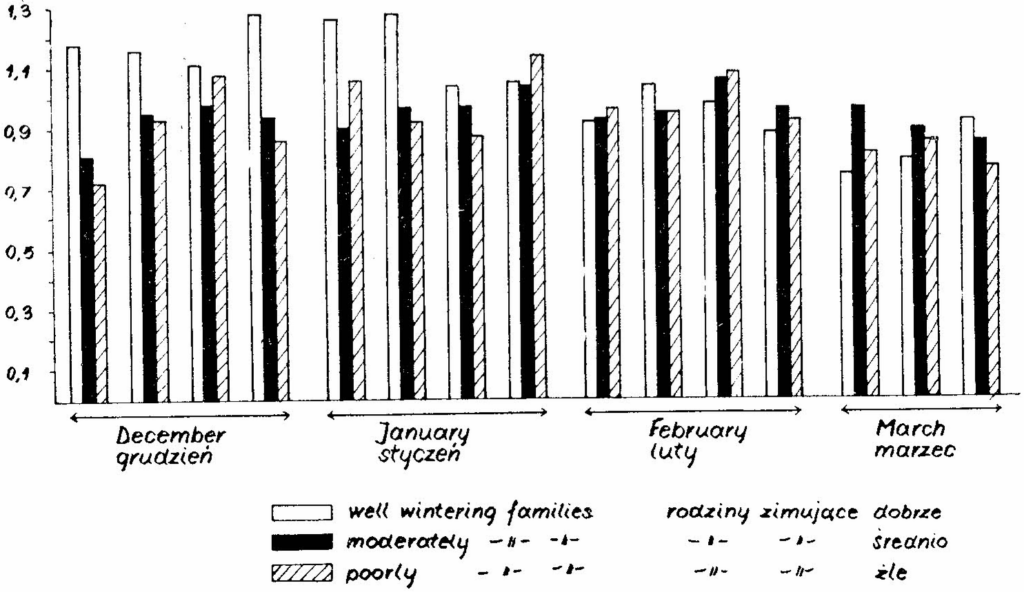
Fig. 1. Proportions of the diameters of cluster projection, a/b, and the wintering success of bee families (mean values for 1979—1981): 1 — well wintering families, 2 — moderately wintering families, 3 — poorly wintering families Proporcja średnich rzutu kłębu a przebieg zimowania rodzin (średnie z 1979—1981)
wintering families is usually markedly smaller than that recorded for moderately or well wintering families, independent of changes occurring over the wintering period (Fig. 2).
DISCUSSION
The application of the subframe plate enabled us to develop a new method for the observation of wintering bee families. In the present study, the total number of bees un able to survive winter was less for each study year than that found by Jeffree (1955). This may be due to differences in climatic conditions and also to the methods of measuring the losses in bees. Jeffree did not determine the relation between losses and wintering success in bees. The present data provide evidence that losses are higher in poorly wintering families. These differences are particularly pronounced at the end of the wintering period.
The earlier data (Jeffree 1956, Avitabile 1979) show that brood can be present in bee families throughout the wintering period. It is worth noting that particular families can differ from each other with respect to the number of larvae and the continuity of their emergence. According to Jeffree (1956), in some colonies there is a break, sometimes covering several months, while in others, sucessive generations of workers emerge throughout the wintering period. Avitabile (1978) noticed that the number of larvae drastically increased early in
strona 18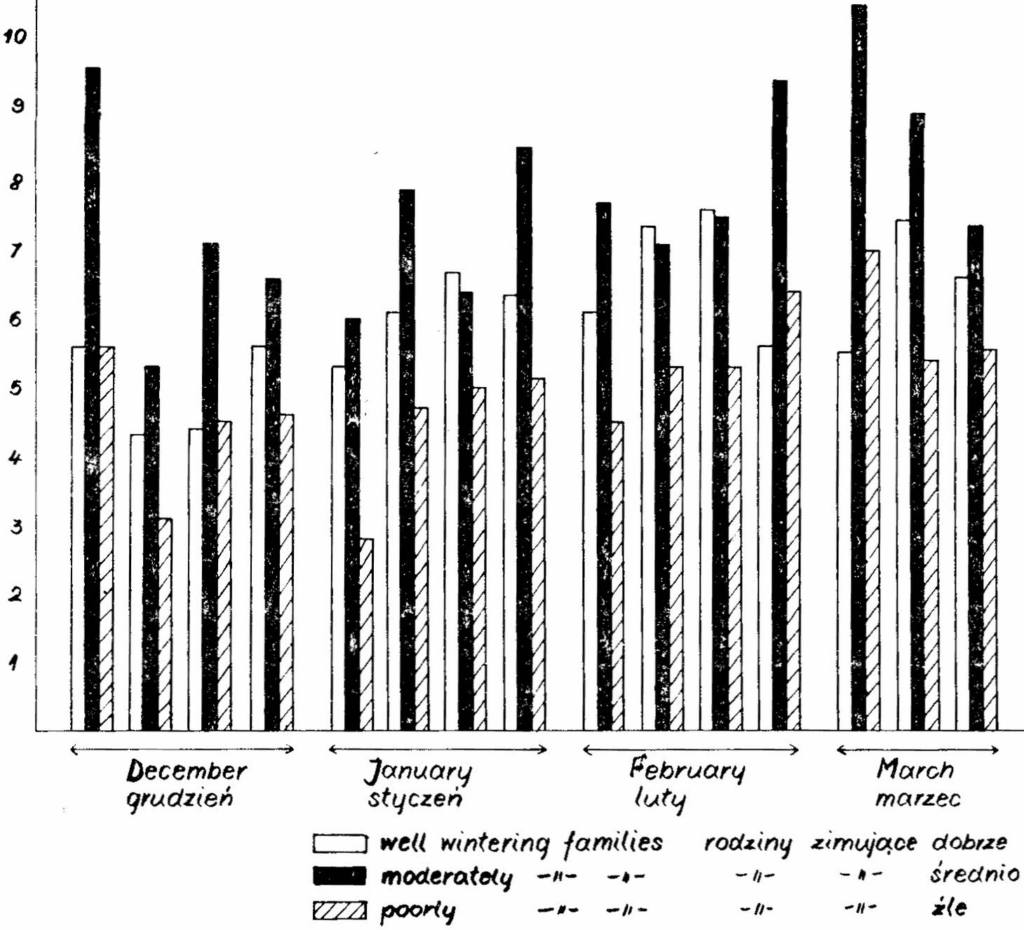
Fig. 2. Mean surface area of the cluster projection on the subframe plate (in 1979—1981) Średnia powierzchnia rzutu kłębu na wkładkę podramkową (lata 1979—1981)
January. This, however, was not analysed in relation to the wintering success. The present study confirms the view that the queen is able to produce eggs throughout the wintering period. This is indicated by the presence of eggs on the subframe plate. It is possible that the presence of eggs on the subframe plate is an outcome of a condradiction between the ability of the queen to lay eggs and the abbility of the family to rear the brood. This. contradiction is better pronounced in poorly wintering families.
The wintering cluster changes its location in the hive. It moves not only vertically but also horizontally (Kharchenko 1980). The present study also shows that under specific climatic conditions, the families with different wintering success exhibit differences in the size and position of the cluster. At present it is difficult to tell whether these differences are only an effect or a cause of differences in the wintering success between various families. These regularities allow however, an early prediction, of the wintering success.
There are no literature data indicating that wintering bees are able
strona 19to produce wax. The present results show that some wintering bees produce wax throughout winter. The number of bees producing wax, or maybe the rate of wax production per worker, increases at the end of the wintering period, before wax is needed for constructing combs. It is possible that this is related to the increassing number of larvae that need to be capped at that time. No relationship was found between the number of wax scales (lost during the wintering period) and the wintering success of a family.
CONCLUSIONS
The size and shape of the cluster projection, the number of dead bees, as well as the presence and number of eggs on the subframe plate are shown to be indices of the wintering success in bee families. Due to this, the subframe plate is particularly useful in the studies on physiology of bee families. It allows the assessment of wintering success and the sampling of dead bees without opening the hive and disturbing the cluster.
LITERATURA
Avitabile A. (1978) — Brood rearing in honeybee colonies from the late autumn to early spring. J. of Apic. Res. 17(2) : 69—79.
Khorchenko G. I. (1980) — Usłovia sodierzania i razmiery kłuba. Pčelovodstwo no. 3 : 20—21.
Jeffree E. P. (1955) — Observations on the decline and growth of honeybee colonies. J. econ. Ent. 48( ) : 723—726.
Jefree E. P. (1956) — Winter brood and pollen in honeybee colonies. Ins. Soc. 3(3) : 417—422.
Muszyńska J., Bornus L. (1981) — Niektóre zmiany w organizmie pszczół robotnic z zimowego kłębu. Pszczeln. Zesz. Nauk: XXV: 15—30.
BADANIA NAD FIZJOLOGIĄ ZIMOWANIA RODZIN PSZCZELICH I. OCENA ZIMOWANIA RODZIN PSZCZELICH NA PODSTAWIE OBSERWACJI ICH OSYPU ZIMOWEGO
J. Muszyńska, L. Bornus
Streszczenie
Badania prowadzono w latach 1978—1981 w okresie od zawiązania do ostatecznego wyjścia rodzin z kłębu zimowego. W każdym roku obserwacjami objęto 6 rodzin pszczelich w ulach systemu Dadant, które do zimowania przystępowały z wyrównaną siłą. O jakości zimowania wnioskowano na podstawie liczby plastrów wycofanych przy pierwszym przeglądzie wiosennym (jeden — dobre zimowanie, dwa — średnie, trzy lub więcej — złe).
W ciągu całego okresu badań wkładkę podramkową wymieniano raz w tygodniu. Określano na niej wielkość i kształt rzutu kłębu wyznaczonego przez
strona 20osyp zimowy. W osypie liczono łuseczki woskowe, martwe pszczoły i jajeczka.
Przebieg zimowania rodzin był w kolejnych latach badań odmienny (tab. 1).
Kształt i wielkość rzutu kłębu na wkładkę podramkową jest ważnym wskaźnikiem zimowania rodzin pszczelich. W rodzinach zimujących źle i średnio rzut kłębu przez cały okres zimowania ma najczęściej kształt elipsy z dłuższą średnicą wzdłuż uliczek a w rodzinach zimujących dobrze w pierwszym okresie zimowania dłuższa średnica skierowana jest w poprzek plastrów. Powierzchnia rzutu kłębu jest w rodzinach zimujących źle wyraźnie mniejsza od tej jaką stwierdzono w rodzinach zimujących dobrze (wykres 1 i 2). Liczba pszczół i jajeczek znaleziona w osypie zimowym pozostaje również w związku z przebiegiem zimowania rodzin. W osypie rodzin zimujących źle martwe pszczoły są najliczniejsze. Także najliczniejsze są jajeczka (tab. 3). Liczba łuseczek woskowych w osypie wzrasta z końcem okresu zimowania pomimo, iż w poszczególnych latach bezwzględne liczby łuseczek są odmienne (tab. 2). Nie stwierdzono zależności pomiędzy przebiegiem zimowania a obecnością łuseczek woskowych w osypie.
Wkładka podramkowa okazała się bardzo przydatna do badań nad fizjologią zimowania rodzin pszczelich. Jej zastosowanie pozwala na kontrolę przebiegu zimowania oraz na pobieranie pszczół z osypu bez otwierani aula i naruszania kłębu. Jedynym warunkiem jest przystosowanie konstrukcji ula tak, aby swobodnie można było manipulować wkładką podramkową z zewnątrz, bez podnoszenia daszka i rozsuwania ramek.
ИССЛЕДОВАНИЯ ФИЗИОЛОГИИ ЗИМОВКИ ПЧЕЛNНЫХ СЕМЬЕЙ. I. ОЦЕНКА ЗИМОВКИ ПЧЕЛИНЫХ СЕМЬЕЙ НА ОСНОВАНИИ НАБЛЮДЕНNЙ ИХ ЗИМНЕГО ПОДМОРА
Я. Мушиньска, Л. Борнус
Резюме
Исследования велись в годах 1978—1981 в периоде от завязания до последнего выхода семьей из зимнего клуба. В каждом году наблюдано 6 пчелиных семьей в ульях системы Dadant, которые к зимовке подходили с возмещенной силой.Качество зимовки определено на основании числа сотов, исключенных во время первого весенного обзора (один — хорошая зимовка, два — средняя, три или четыре — хорошая).
Во время всего периода исследований, вкладку под рамкой выменено раз в неделю. На ней определено величину и форму наброска клуба, определенного зимним подмором. В подморе вычислено восковые пластники, мертвые пчелы и яичка.
Ход зимовки семьей был в очередных годах исследований разный (табл. 1).
Форма и величина наброска клуба на вкладку под рамкой являются важным показателем зимовки пчелиных семьей. В семьях, плохо и посредственно зимующих, набросок клуба в течение всего периода зимовки чаще всего в форме эллипса с более длинным диаметром вдоль улочек, а в хорошо зимующих семьях, в первом периоде зимовки — более длинный диаметр, направленный пеперек сотов. Поверхность наброска клуба в плохо зимующих семях, значино меньшая, чем поверхность в хорошо зимующих семьях (рис. 1 и 2).
Число пчел и яичек в зимнем подморе связано также с ходом зимовки семьей. В подморе плох зимующих семьей, самое большое число мертвых пчел. Также самое большое число яичек (табл. 3). Число восковых пластинок в подморе увеличивается вместе с окончанием периода зимовки, несмотря на то, что в отдельные годы обсолютные числа восковых пластинок различные (табл. 2).
strona 21Не обнаружено зависимости между ходом зимовки и наличием восковых пластинок в подморе.
Вкладка под рамкой оказалась очень пригодной для исследований по физиологии зимовки пчелиных семьей. Её применение способствует контролю хода зимовки, а также отбору пчел из подмора без открывания улья и нарушения клуба. Единственным условием является приспособление конструкции улья так, чтобы можно было свободно манипулировать вкладкой под рамкой снаружи, без поднимания крушки и развигания рамок.
Errata — błędy druku znalezione podczas digitalizacji
- s. 13: „disapearance” → disappearance
- s. 13: „elsewhers” → elsewhere
- s. 14: „precisa” → precise
- s. 14: „les than” → less than
- s. 14: „RESULLTS” → RESULTS
- s. 15, tab. 1: „disappearrance” → disappearance
- s. 15, tab. 1: „ogf wintering” → of wintering
- s. 15, tab. 1: „numbetr” → number
- s. 15: „families loose” → families lose
- s. 15: „fonud” → found
- s. 16: „in in December” → in December
- s. 16: „firt” → first
- s. 17: „un able” → unable
- s. 17: „Avitabile 1979″ → Avitabile 1978
- s. 17: „sucessive” → successive
- s. 18: „condradiction” → contradiction
- s. 18: „abbility” → ability
- s. 19: „increassing” → increasing
- s. 19, literatura: „Jefree” → Jeffree
- s. 20, streszczenie: „otwierani aula” → otwierania ula
- s. 20, streszczenie: „ПЧЕЛNНЫХ” → ПЧЕЛИНЫХ
- s. 20, streszczenie: „НАБЛЮДЕНNЙ” → НАБЛЮДЕНИЙ
- s. 20, streszczenie: „весенного” → весеннего
- s. 20, streszczenie: „три или четыре — хорошая” → три или четыре — плохая
- s. 20, streszczenie: „пластники” → пластинки
- s. 20, streszczenie: „пеперек” → поперек
- s. 20, streszczenie: „семях” → семьях
- s. 20, streszczenie: „значино” → значительно
- s. 20, streszczenie: „плох зимующих” → плохо зимующих
- s. 20, streszczenie: „обсолютные” → абсолютные
- s. 21, streszczenie: „крушки” → крышки