

EFFECTS OF BROOD AND EXTRACTIONS PREPARED FROM IT ON THE FLIGHT ACTIVITY AND BIOLOGICAL QUALITY OF QUEENLESS HONEYBEE GROUPS
tekst: Sylvie Kubišovà, Hana Haslbachovà
Pszczelnicze Zeszyty Naukowe, Rok XXIX, 1985 — Sylvie Kubišovà, Hana Haslbachovà
strona 21PSZCZELNICZE ZESZYTY NAUKOWE Rok XXIX 1985
Sylvie Kubišovà and Hana Haslbachovà
Departament of Zoology and Small Animal Husbandry, University of Agricultural, Brno, Czechoslovakia
In our earlier papers (Kubišovà and Haslbachovà 1978, Kubišovà, Haslbachovà and Vrkoč 1982) we demonstrated the existence of substances of the pheromone type, which are produced by honeybee larvae and show inhibitory effects on the development of worker bee ovaries in cage experiments.
The results of our experiments with caged bees were used to form single-purpose queenless pollinating units. We verified both the effect of extractions prepared from honeybee larvae and pupae and the direct effect of honeybee brood on the development of worker bee ovaries and hence also on the biological unity (coherence) of a bee colony, and on the flight activity of such single-purpose pollinating units. The results are presented in this paper.
METHODS AND MATERIAL
All experiments were carried out in 1980—1984 at Žabčice in southern Moravia (Czechoslovakia) and involved Apis mellifera carnica. For the experiments we used nuclei with 3 farmes 37×30 cm. Each nucleus was provided with a comb with stored honey and pollen and an empty comb (in the case of variants receiving extractions, and controls) or a comb containing brood (in the cases of variants with young larvae —OP, or sealed brood —ZP). The combs were inserted together with bees sitting on them and, furthermore, bees were added from two or three brood combs so that each nucleus cantained approximately 500 g of bees.
Experimental groups of bees were formed and provided with larval extractions. The extractants used to prepare them included acetone (variant A, 1980, 1981, 1984), ethyl alcohol (variant E, 1981, 1983, 1984) or dichloromethane (variant D, 1981, 1983). In 1983, an ethyl alcohol
strona 22extraction prepared from pupae was also tested (variant EK). The extractions were prepared in the manner as for our earlier experiments (Kubišovà and Haslbachovà 1978). The extraction was supplied to the experimental bee groups either on plastic discs 30 mm in diameter and renewed daily (1980 and 1981), or once for all at the beginning of the experiments, by spreading the extraction over the whole inner surface of an empty comb (1983 and 1984).
In 1980, 1981 and 1984 a variant was included, involving unsealed brood (variant OP), which was supplied with a comb containing eggs and young larvae at the beginning of the experiments. After a week, the comb was replaced by a new one also containing eggs and young larvae. In 1983 and 1984, we tested a variant with sealed brood (variant ZP) which was also replaced halfway through the experiments. Each of the groups of these two variants was supplied with 8—12 m² of brood on an average.
Variants with bee groups without brood and without any interference served as controls. In each variant and year there were four groups of bees.
COURSE OF EXPERIMENTS
On the first day of the experiments, 60—100 marked bees 0—1 day old, emerged from combs kept in thermostats, were added to each of the experimental and control groups.
From the second day on, the flight activity of bees was observed at hive entrances by recording the numbers of bees coming with and without pollen loads. The observations were made three times a day between 10 and 16 h, always for 3 minutes at each nucleus.
On exchanging brood in the OP and ZP groups halfway through the experiments, we examined not only these but all other groups, recording the decrease of population, amounts of stored honey and pollen, and incidental egg-laying by workers. The same was done when the experiments were ended.
The expermiments lasted 14 days. Then all remaining marked bees were removed from each nucleus together with additional 30 unmarked bees (i.e. bees of different age but older than 14 days, except from variant ZP where part of the bees may have emerged from the sealed brood which had been added).
The samples of bees were fixed in Carnoy solution and preserved in a 75 per cent solution of ethyl alcohol. Under a dissection microscope the bees were then dissected and the degree of development of their ovaries was assessed. Degree I comprised ovaries showing no sings of development; degree II, those with differentiated occytes and nourishing chambres, etc.; degree V, those with ova in oviducts (i.e. those of egg-laying workers). This is a modification of the method of Paine (1954).
strona 23For statistical evaluation, the degree of ovarial development was assigned a point value, using the methcd of Kropàčkovà, Haslbachovà and Novàk (1968). According to this method, each ovary showing degree I of development is assigned one point, at degree II two points, etc., degree V five points.
In evaluating the experiments, we examined the effects of the extractions prepared from larvae and pupae and the direct effects of brood on worker bee ovarial development and on the flight activity and pollinating activity of bees in the different variants. All results were tested by the usual statistical tests.
RESULTS AND DISCUSSION
I. OVARIAL DEVELOPMENT IN WORKER BEES
During four years of experiments we dissected and examined almost 5000 bees from different experimental variants.
The results are illustrated in Figs. 1—4. Each column of the diagrams represents the percentage of a certain degree of ovarial development observed in 120 bees in any one experimental or control group. The diagrams show that variant OP (receiving eggs and young larvae) invariably showed less developed ovaries than the control one. In all cases there were more bees with virtually undeveloped ovaries (degree I) and fewer bees with completely developed ovaries (degree IV) or directly with ova in oviducts (degree V).
Tab. 1 contains the results of statistical evaluation of ovarial development in individual variants in which the point value of the ovaries was determined separately for each bee group of the same variant and pooled to forma a statistical unit. The lower degree of ovarial development in variants OP against that of the controls has been confirmed for both marked and unmarked bees in all years of study at the 5 per cent level.
Sealed brood (variant ZP) also showed an inhibitory efffect on worker bee ovarial development which, however, is not so distinct from the diagrams and was statistically significant only in bees of different age in 1983.
Extractions prepared from larvae and pupae also showed inhibitory effects on worker ovarial development but the effects were statistically significant in 8 out of 18 cases (i.e. in 42 per cent). A tendency towards higher ovarial development was observed in two of the variants receiving extractions, and in another two cases the development of ovaries was the same in the experimental and control groups. On the whole, worker ovarial development was inhibited by extractions supplied in 14 out of 18 cases (i.e. in 78 per cent), although the effect was statistically significant in less than a half of the cases due to rather wide variation. The inhibitory effects of the extractions are also confirmed by the graphic
strona 24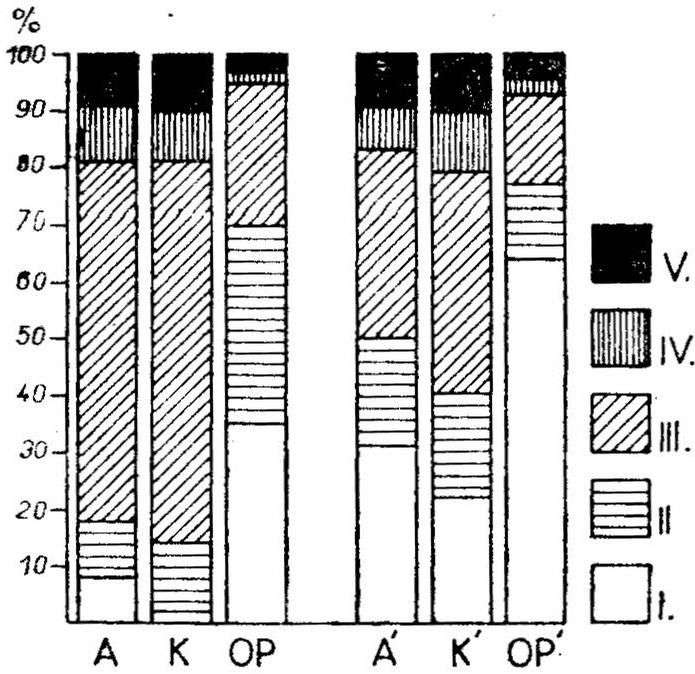
Fig. 1. Diagram showing worker bee ovarial development in 1980 experiments. Abscissa: A, acetone extractions, marked bees (A), unmarked bees (A’); K, control lacking queen and brood, marked bees (K), unmarked bees (K’); OP, unsealed brood, marked bees (OP), unmarked bees (OP’); ordinate: percentages of ovarial developmental degrees I—V, the different degrees indicated by different hatching
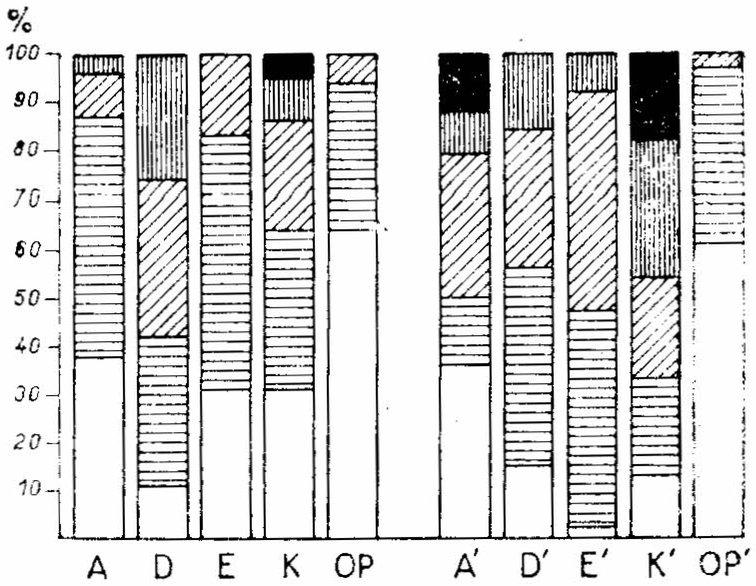
Fig. 2. Diagram showing worker bee ovarial development in 1981 experiments. Abscissa: D, dichloromethane extraction, marked bees (D), unmarked bees (D’); E, ethyl alcohol extraction, marked bees (E). unmarked bees (E’). Other explanations as in Fig. 1
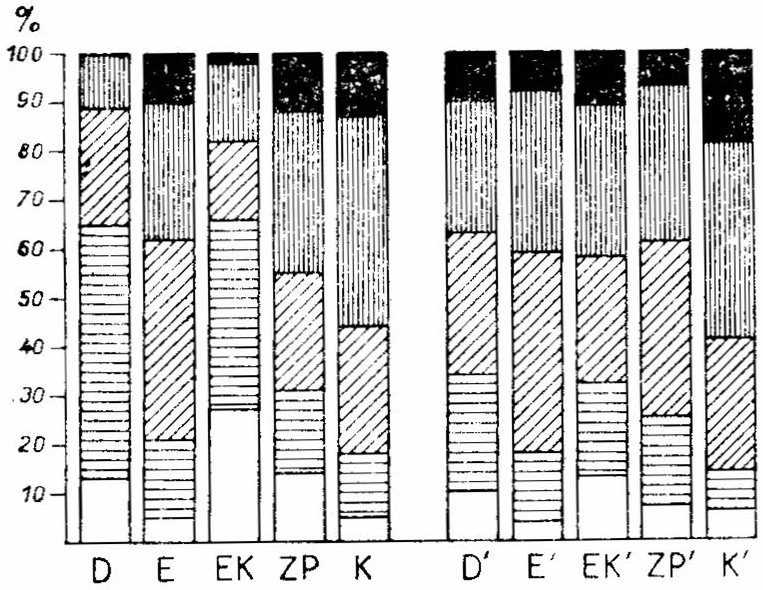
Fig. 3. Diagram showing worker bee ovarial development in 1983 experiments. Abscissa: EK, ethyl alcohol extraction from pupae, marked bees (EK) unmarked bees (EK’); ZP, sealed brood, marked bees (ZP), unmarked bees (ZP’). Other explanations as in Fig. 1 and Fig. 2
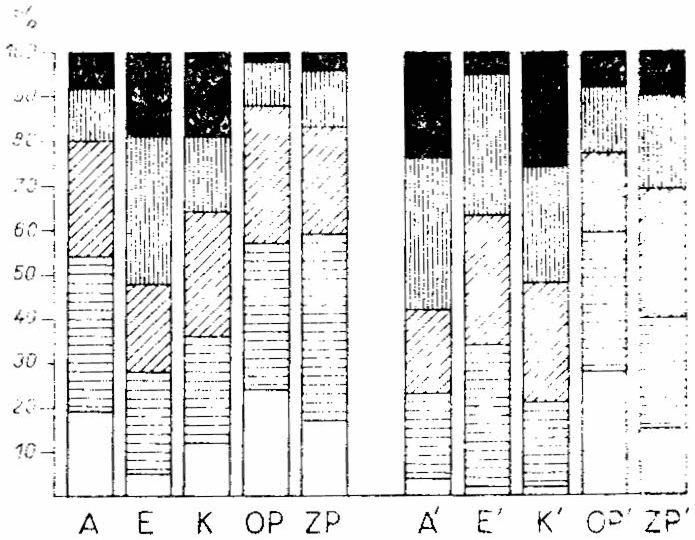
Fig. 4. Diagram showing worker bee ovarial development in 1984 experiments. Explanations as in Figs. 1, 2 and 3
representation of percentages of the total numbers of ovaries showing a certain degree of development in any of the variants. Here, however, the differential degrees of ovarial development in the four replications of each variant are not considered and, consequently, some of the distinct differences in ovarial development shown in the diagrams are not statistically significant due to the wide variation and, on the contrary, smaller differences are significant due to a narrow variation range.
strona 25Table 1 Worker bee ovarial development Significance of differences between experimental and control groups
| Bees | Variant | Mean point value of ovarial development in years: 1980: x̄ | Mean point value of ovarial development in years: 1980: P | Mean point value of ovarial development in years: 1981: x̄ | Mean point value of ovarial development in years: 1981: P | Mean point value of ovarial development in years: 1983: x̄ | Mean point value of ovarial development in years: 1983: P | Mean point value of ovarial development in years: 1984: x̄ | Mean point value of ovarial development in years: 1984: P |
|---|---|---|---|---|---|---|---|---|---|
| marked | K | 3,13 | 2,27 | 3,23 | 3,03 | ||||
| OP | 1.93 | xx | 1.39 | xx | — | 2.34 | x | ||
| ZP | — | — | 3.11 | — | 2.45 | — | |||
| A | 3.03 | — | 1.79 | — | — | 2.55 | — | ||
| D | — | 2.75 | — | 2.42 | x | — | |||
| E | — | 1.86 | — | 3.21 | — | 3.41 | — | ||
| EK | — | — | 2.25 | x | — | ||||
| unmarked | K | 2.61 | 3.16 | 3.59 | 3.57 | ||||
| OP | 1.61 | xx | 1.42 | xx | — | 2.51 | x | ||
| ZP | — | — | 3.17 | x | 2.86 | — | |||
| A | 2.43 | — | 2.47 | x | — | 3.55 | — | ||
| D | — | 2.46 | x | 3.02 | x | — | |||
| E | — | 2.57 | x | 3.26 | x | 3.03 | — | ||
| EK | — | — | 3.07 | x | — |
In conclusion, it may be stated that even these field experiments demonstrated inhibitory effects of brood on worker ovarial development. This holds not only for larvae, in which case a trophic bais could be assumed (in the absence of larvae the workers swallow royal jelly which they produce), but even for pupae which do not ingest food.
The assumed effect of substances of the pheromone type was then confirmed in experiments with extractions prepared from honeybee larvae and pupae.
The presence of pheromones in male pupae was confirmed by Königer and Veith (1983, 1984) who verified the effect of one of its components, prepared synthetically, on bees gathering round an experimental mating cage.
II. FLIGHT ACTIVITY OF BEES
The flight activity of bees was observed on days 2—14 of the experiments, except when it rained, 11 days on an annual average. In all, an average of 132 observations was made each year in any experimental variant.
The evaluation is based on daily averages of arrivals with or without pollen loads per minute, calculated from three daily observations in each nucleus. Data for the four replications were pooled and the differences between the averages tested for statistical significance.
Since the flight activity of bees is greatly affected by weather conditions, almost all of the data are characterised by high variation coeffi-
strona 26Table 2 Flight activity of worker bees significant of differences between experimental and control groups
| Bees arriving | Variant | Mean numbers of bees arriving per minute: 1980: x̄ | Mean numbers of bees arriving per minute: 1980: P | Mean numbers of bees arriving per minute: 1981: x̄ | Mean numbers of bees arriving per minute: 1981: P | Mean numbers of bees arriving per minute: 1983: x̄ | Mean numbers of bees arriving per minute: 1983: P | Mean numbers of bees arriving per minute: 1984: x̄ | Mean numbers of bees arriving per minute: 1984: P |
|---|---|---|---|---|---|---|---|---|---|
| without pollen loads | K | 12.9 | 10.3 | 3.1 | 4.8 | ||||
| OP | 16.1 | — | 7.3 | x | — | 7.6 | xx | ||
| ZP | 2.7 | — | 7.4 | x | |||||
| A | 15.0 | — | 19.5 | x | — | 4.7 | — | ||
| D | — | 10.0 | — | 3.1 | — | — | |||
| E | — | 9.5 | — | 3.0 | — | 6.0 | — | ||
| EK | — | — | 3.4 | — | — | ||||
| with pollen loads | K | 2.9 | 2.9 | 1.0 | 0.6 | ||||
| OP | 7.6 | xx | 1.8 | — | — | 2.9 | xx | ||
| ZP | — | — | 2.4 | x | 3.8 | xx | |||
| A | 3.9 | — | 3.9 | — | — | 0.3 | x | ||
| D | — | 1.3 | — | 1.0 | — | — | |||
| E | — | 0.4 | — | 1.5 | — | 1.3 | x | ||
| EK | — | — | 1.2 | — | — |
cients and hence some of the differences between the variants, though appearing as great, are statistically non-significant.
It is evident from Tab. 2 that the presence of young larvae (variant OP) affected positively and significantly the import of pollen to the nuclei in two of the three years of study. In the third year, on the contrary, a higher pollen import was observed in the control group. This seemingly paradoxical effect was probably caused by the fact that very soon in that year worker bees started laying eggs and their youngest brood then stimulated increased pollen import in the latter half of the experiments.
The effect of youngest brood on nectar import was statistically significant in 1984 only. This observations is in accordance with the observation of Jaycox (1970) that nectar colection is more affected by the presence of a queen, whereas pollen collection by the presence of brood.
In both years, even sealed brood (varaint ZP) showed a significantly positive effect on pollen import, although it could be motivated by direct pollen consumption, as it could be with the larvae. Here, too, it was the effect of pheromones produced by the brood.
The flight activity was, however, not affected in the same way in variants supplied with extractions prepared from the brood. In only two out of 18 cases was this effect significantly positive; in one case it was negative; and in the remaining cases it was impossible to detect any uniform tendency.
Thus the flight activity of the bees was apparently not affected by substances obtained from the brood by the extraction methods described
strona 27above, although it was probably affected by other extrinsic (weather) as well as intrinsic factors (e.g. weaking of some of the experimental bee groups in the course of the experiments).
ABSTRACT
In field experiments carried out in 1980—1984, the effect of the presence of bee larvae and pupae and of acetone, ethyl alcohol dichloromethane extractions from them was tested on worker bee ovarial development and flight activity in groups containing about 500 g of bees each.
Both the presence of the brood and its extractions inhibited worker ovarial development, whereby the existence of a brood pheromone has been confirmed. In addition, evidence has been obtained of stimulatory effects of the presence of bee larvae and pupae on the flight activity of workers, especially in collecting pollen. No such effects, however, have been demonstrated by using extractions prepared from bee larvae and pupae as above.
LITERATURE
- Jaycox, E. R., 1970: Honeybee foraging behaviour: responses to queens. larvae and extracts of larvae. Ann. Ent. Soc. Am. 63, 1689—1694.
- Koeniger, N., Veith, H. J., 1983: Indentification of a triglyceride (glyceryl-1,2-dioleate-3-palmitate) as a brood pheromone of the honeybee (Apis mellifera L.) Apidologie, 14 (1), 59.
- Koeniger, N., Veith, H. J., 1984: Spezialität eines Brutpheromones und Bruterkennung bei der Honigbiene (Apis mellifera L.) Apidologie, 15 (2), 205—210.
- Kropáčová, S., Haslbachová, H., Novák, V., 1968: Development of honeybee ovaries as affected by narcosis and injections of certain substances. Acta Univ. Agric. (Brno), (Ř.A) Fac. agron., 16, 537—543.
- Kubišova, S., Haslbachová, H., 1978: Effects of larval extracts on the development of ovaries in caged worker honeybees. Acta ent. bohemoslov., 75, 9—14.
- Kubišová, S., Haslbachová, H., Vrkoč, J., 1982: Effects of fractions of larval extracts on the development of ovaries in caged worker honeybees. Acta ent. bohemoslov., 79, 334—340.
- Pain, J.: 1954: La substance de fécondité dans le développment des ovaries des ouvriès d’abeilles (Apis mellifica L.). Critique des travaux de Mussibichler. Insectes soc., 1, 59—70.
WPŁYW CZERWIU I JEGO RÓŻNYCH EKSTRAKTÓW NA LOTY I BIOLOGICZNY ROZWÓJ ROBOTNIC W BEZMATECZNYCH RODZINKACH
S. Kubišova i H. Haslbachová
Streszczenie
W doświadczeniach pasiecznych przeprowadzonych w latach 1980—84 badano obecność czerwiu i jego ekstraktów (acetonowego, alkoholowego i dichlorometanowego) w bezmatecznych rodzinkach o wadze 500 g na rozwój jajników i loty robotnic.
Zarówno obecność czerwiu jak i jego ekstrakty hamowały rozwój jajników u robotnic, a ponadto potwierdzono obecność feromonu czerwiu w tych rodzinkach. Dodatkowo stwierdzono stymulacyjny wpływ obecności czerwiu na loty pszczół robotnic, a zwłaszcza na zbiór pyłku. Niestety takiego wpływu nie stwierdzono przy użyciu w/w ekstraktów z czerwiu pszczelego.
ВЛИЯНИЕ ЧЕРВЫ И ЕГО РАЗНЫХ ЭКСТРАКТОВ НА ПОЛЁТЫ И БИОЛОГИЧЕСКОЕ РАЗВИТИЕ РАБОЧИХ ПЧЕЛ В БЕЗМАТОЧНЫХ СЕМЬЯХ
S. Kubišowa, H. Haslbachova
Резюме
В пасечных опытах, проведенных в годах 1980 – 1984, исследовано наличие червы и его экстрактов (ацетонового, алкогольного и дихлорометанового) в безматеринских семьях весом 500 г на развитие яичников и полеты рабочих пчел.
Как наличие червы, так и его экстракты замедляли развитие яичников у рабочих пчел. Кроме того подтверждено наличие феромона червы в этих семьях. Обнаружено также стимуляционное влияние наличия червы на полеты рабочих пчел, а особенно на собирание пыльцы. К сожалению, такого влияния не обнаружено при помощи вышеупомянутых экстрактов из пчелиной червы.
Errata — błędy druku znalezione podczas digitalizacji
- s. 21–22: „Kubišovà” → Kubišová
- s. 21–23: „Haslbachovà” → Haslbachová
- s. 21: „Departament” → Department
- s. 21: „3 farmes” → 3 frames
- s. 21: „cantained” → contained
- s. 22: „expermiments” → experiments
- s. 22: „no sings” → no signs
- s. 22: „occytes” → oocytes
- s. 22: „chambres” → chambers
- s. 22: „Paine (1954)” → Pain (1954)
- s. 23: „methcd” → method
- s. 23: „to forma a” → to form a
- s. 23: „efffect” → effect
- s. 23: „42 per cent” → 44 per cent
- s. 23: „Novàk” → Novák
- s. 25: „trophic bais” → trophic basis
- s. 26, tab. 2: „significant of differences” → significance of differences
- s. 26: „colection” → collection
- s. 26: „varaint” → variant
- s. 27: „weaking” → weakening
- s. 27, piśmiennictwo: „Indentification” → Identification
- s. 27, piśmiennictwo: „développment” → développement
- s. 27, piśmiennictwo: „ouvriès” → ouvrières