

BIOLOGY OF FLOWERING, NECTAR SECRETION AND POLLEN PRODUCTIVITY OF LAVATERA TRIMESTRIS L.
tekst: Anna Wróblewska
Pszczelnicze Zeszyty Naukowe, Rok XL, 1996 — Anna Wróblewska
strona 81PSZCZELNICZE ZESZYTY NAUKOWE Rok XL, Nr 2 1996
Anna Wróblewska
Botany Department, University of Agriculture, Akademicka 15, 20-950 Lublin, POLAND
Summary
The research of Lavatera trimestris L. was carried out between 1990-1993. It concerned the biology of flowering, abundance of nectar secretion, sugar and pollen productivity. Besides, seed set was examined under the conditions of free access by pollinating insects and when flowers were protected against insect visitation.
The flowering period of Lavatera trimestris began, in Lublin climatic conditions, in the first part of July and lasted, in dependence on weather conditions, till late September or early October, single flower bloomed about 3 days. During vegetation seasons one plant developed on average 126-296 flowers on the main and side stalks.
Nectaries consist of secretory hairs, located at the base of the inner side of sepals. Single flower secreted 2.0-9.8 mg of nectar containing 0.75-1.48 mg of sugar. The average concentration of sugar in nectar reached 22.5-37.5 %. Sugar efficiency for one plant was 0.17-0.34 g and for 1 m2 1.02-2.04 g. Honey yield from 1 m2 was estimated to be 1.3-2.5 g
Lavatera pollen grains are round, with spiked exine. Pollen releasing begins simultanously with the begining of nectar secretion. One flower produced on average 5.49-9.32 mg of pollen, i.e. 1.27-2.15 g per plant and 7.6-12.9 g per 1 m2.
Pollinators of Lavatera flowers are mainly honeybees and bumblebees, which highly increased seed yield. Under the conditions of free access by insects, plants set on average 94.2 % of seeds, whereas 33.3 % when flowers were isolated.
Keywords: Lavatera, flowering, nectar, pollen, seed set
INTRODUCTION
The genus Lavatera from Malvaceae family includes about 20 species of herbal plants and shrubs occuring mainly in the Mediterranean region. Lavatera trimestris L., an annual species, has been cultivated in Poland in gardens and borders as a popular, ornamental plant. During blooming period Lavatera flowers are often visited by numerous insects for nectar collection (Demianowicz et al. 1963, Howes 1979).
The aim of the studies was to examine a biology and abundance of flowering of Lavatera trimestris as well as abundance of nectar secretion and pollen productivity. The research also concerned an influence of pollinating insects on seed set.
strona 82MATERIAL AND METHODS
The studies of Lavatera trimestris L. were conducted on a experimental patch, at the Botany Department of the Agricultural University in Lublin during the vegetation seasons 1990 – 1993.
The attractiveness of flowers for pollinating insects was determined by investigations of nectar secretion and pollen productivity. Volume of nectar was tested by means of the commonly used pipette method (Demianowicz at al. 1960) and sugar content with the Abbe refractometer. Pollen efficiency was determined by means of Warakomska’s ether modificated method (1972). The studies of the biology and abundance of flowering were carried out (Krotoska 1958) in order to estimate the nectar sugar and pollen yield per plant and area unit. Detailed observations of the blooming dynamics were made during the 1993 vegetation season. Besides, whole flowers were collected, then morphological structure of the nectaries determined and pollen grains measured (Andrejev 1926).
Seed set was investigated under the conditions of free access by pollinating insects and when flowers were isolated. In the years 1990-1991 several flowers’ stalks were covered, whereas in 1992-1993 only single flowers. Set seed was calculated in relation to fourteenfold number of flowers due to Lavatera multiple pistil develope on average 14 carpels.
RESULTS
The flowering period of Lavatera trimestris lasted in Lublin climatic conditions from mid July till late September or first days of October. Seasonal dynamics of flowering in 1993 shows figure 1. The highest number of fully developed flowers was reported between July 31st and August 18th, when the mean numbers of flowers opening on one plant reached 15-19 (fig. 1). The blooming rythm was highly dependant on daily minimum and maximum temperatures and rainfalls. Each plant formed central stem and several side stalks. Total number of flowers developed by one plant was determined by numerous factors, it hesitated between 126 and 296 and reached on average 231.
The Lavatera flower is protandrous, typical of the Malvaceae family. It consists of five sepals, five pink petals and numerous (69-80) stamens constitute a staminal tube enclosing the pistil, which ovary contains 13-15 carpels.
Nectaries consist of multicelled secretory hairs, located at the inner side of sepals. Nectar secretion starts at the early stage of flower development (loose bud stage) and lasts 3 days, depending on the weather conditions. Insects have easy access to nectar and they collect it from
strona 83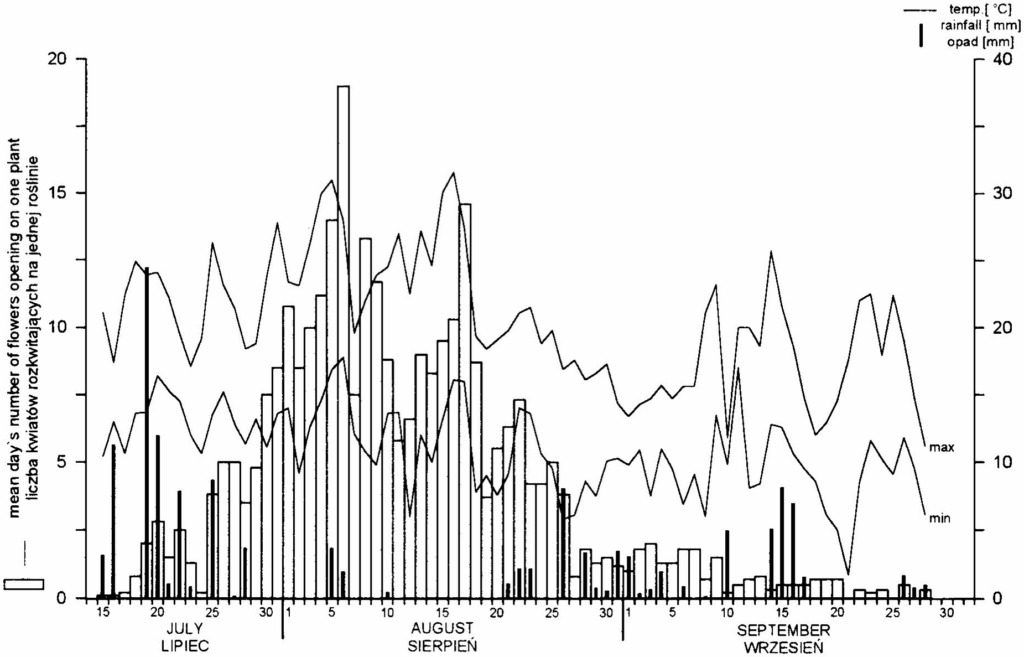
between the sepals and the petals. Ten flowers secreted 20-97 mg of nectar containing 7.5-14.8 mg of sugar (fig. 2). The average concentration of sugar in nectar reached 22.5-37.5 %. The sugar efficiency strictly depended on abundance of nectar secretion and number of flowers per plant and reached on average 0.17-0.34 g for one plant and 1.02-2.04 g for 1 m2. Honey yield per 1 m2 reached 1.3-2.5 g.
In Lavatera flowers pollen releasing begins simultanously with the begining of nectar secretion. The pollen grains are round, 115.09-117.26 mm in diameter, with spiked exine coated with a viscid material, which causes them to adhere to each other. Ten flowers produced on average 54.9-93.2 mg of pollen (fig. 2), which equals 1.27-2.15 g per plant and 7.62-13.00g per 1 m2.
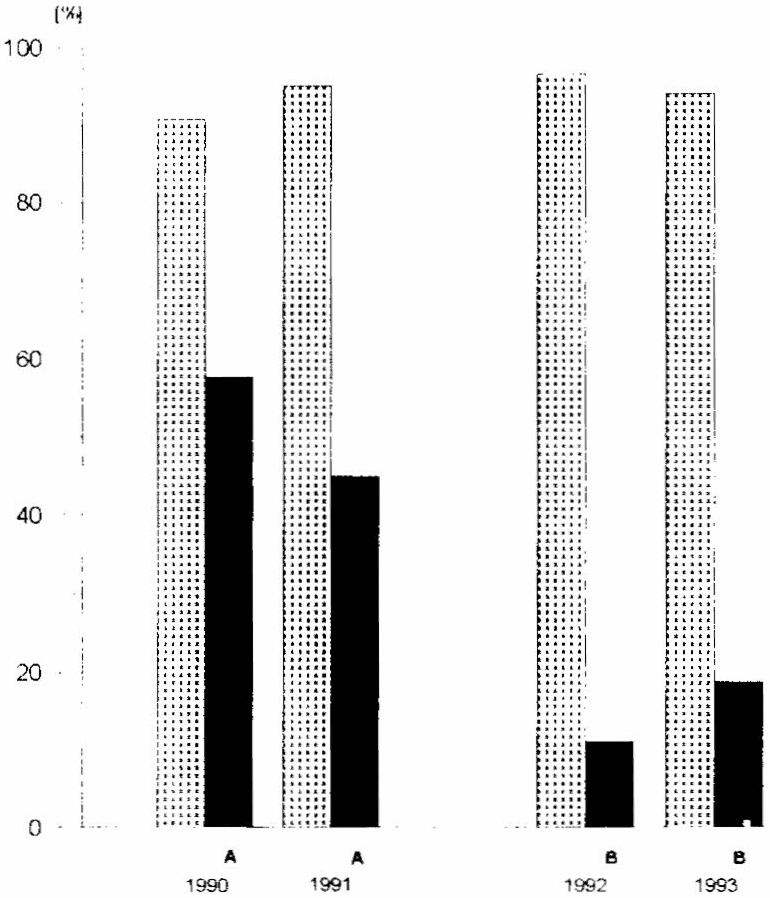
Under good weather conditions Lavatera plants are often visited by various insects mainly honeybees and bumblebees, which work on flowers from early morning untill evening with the most intensive visitation at noon hours. Research data have shown , that isolation of flowers from the pollinators considerably reduced seed production (fig.3). In the years 1990-1991 plants set on average 90.9-95.2 % of seeds under the conditions of free accesss by insects, whereas 45.0-57.8 % when flowers were isolated, in the years 1992-1993 seed set reached 94.2-96.9 % and 11.1-18.8 % respectively. Under the isolation conditions, seed set was about twice higher in the two first years of investigations, when several flowers’ stalks were covered and neighborly pollination took place under the isolators.
Lavatera trimestris L., an attractive ornamental species cultivated in gardens, improves bee flows from mid summer till late autumn.
DISCUSSION
The results of investigations have shown that Lavatera trimestris L. started its blooming in mid July, which is in agreement with data obtained by Jabłoński (1961, 1968), however in Lublin conditions it bloomed 2 to 3 weeks longer.
The amount of sugar secreted by 10 flowers reached 7.5-14.8 mg and could be compared with results presented by Demianowicz et al. (1963). The average sugar concentration in nectar hesitated between 22.5 and 37.5 % and was higher than obtained by mentioned authors. Lavatera trimestris produced on average 54.9-93.2 mg of pollen per 10 flowers and 1.27-2.15 g per plant.
Lavatera pollinators were mainly honeybees and bumblebees, which increased seed production twice to four times. In literature, there can be found no data concerning pollen productivity and seed set of this species .
strona 85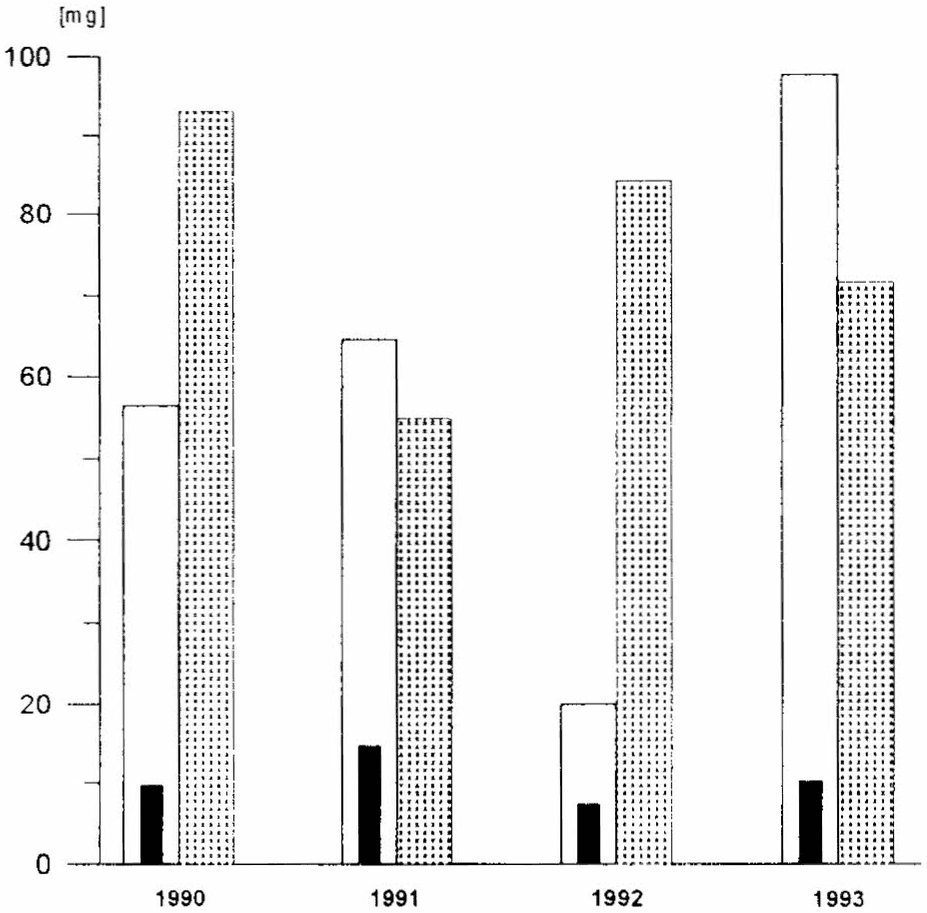
CONCLUSIONS
Lavatera trimestris L. blooms in Lublin climatic conditions from mid July through 6-9 weeks, producing 126-296 flowers on one plant and 756-1776 on 1 m2. Mass of sugar in nectar reached 0.17-0.34 g for one plant and 1.02-2.04 for 1 m2., whereas pollen efficiency 1.27-2.15 g and 7.62-13.00 g respectively. Seed set of Lavatera is strictly dependant on good pollination. Under the conditions of free access by insects, seed yield was two to several times higher than in isolation conditions.
REFERENCES
Andrejev W.N. (1926) – Pylca rastienij sobierajemaja pćołami (k metodikie izuczenija piergi), Charków.
Demianowicz Z., Hłyń M. , Jabłoński B ,Maksymiuk I., Podgórska J., Ruszkowska B. Szklanowska K., Zimna J. (1960) – Wydajność miodowa ważniejszych rośli miododajnych w warunkach Polski. Część I. Pszczel. Zesz. Nauk. 4(2): 87-103.
Demianowicz Z., Jabłoński B., Ostrowska W., Szybowski S., (1963) – Wydajność miodowa ważniejszych roślin miododajnych w warunkach Polski. Część II. Pszczel. Zesz. Nauk. 2: 95-111.
Hoves F.N. (1979) – Plants and Beekeeping. An account of those plants, wild and cultivated, of value to the hive bee, and for honey production in the British Isles. London.
Jabłoński B. (1961) – O wartości pszczelarskiej niektórych roślin z rodziny ślazowatych Pszczelarstwo 7: 10-12.
Jabłoński B. (1968) – Wydajność miodowa ważniejszych roślin miododajnych w warunkach Polski. Część IV. Pszczel. Zesz. Nauk., 3: 117-126.
Krotoska T. (1958) – Pory roku w życiu roślin. Obserwacje fenologiczne w zespołach roślinnych. PWN, Poznań.
Warakomska Z. (1972) – Badania nad wydajnością pyłkową roślin. Pszczel. Zesz. Nauk.,16: 63-90.
BIOLOGIA KWITNIENIA, NEKTAROWANIE I WYDAJNOŚĆ PYŁKOWA LAVATERA TRIMESTRIS L.
A. Wróblewska
Streszczenie
Badania Lavatera trimestris L. prowadzono w latach 1990-1993. Dotyczyły one biologii kwitnienia, obfitości nektarowania kwiatów oraz wydajności cukrowej i pyłkowej roślin. Zbadano też zawiązywanie nasion w warunkach swobodnego oblotu roślin przez owady zapylające oraz w warunkach izolowania.
Okres kwitnienia Lavatera trimestris rozpoczynał się w warunkach klimatycznych
strona 87Lublina w pierwszej połowie lipca i trwał, w zależności od warunków pogody, do końca września lub pierwszych dni października. Jeden kwiat kwitł około 3 dni. W okresach wegetacyjnych jedna roślina wytwarzała na pędzie głównym i pędach bocznych średnio 126-296 kwiatów.
Nektarniki, w postaci włosków wydzielniczych, znajdują się u podstawy wewnętrznej strony działek kielicha. Jeden kwiat wydzielał 2,0-9,8 mg nektaru zawierającego 0,75-1,48 mg cukrów. Średnia koncentracja cukrów w nektarze wynosiła 22,5-37,5 %. Wydajność cukrowa wyniosła: dla jednej rośliny 0,17-0,34 g, dla 1 m2 1,02-2,04 g.
Ziarna pyłku Lavatera są okrągłe, z kolczastą egzyną. Pylenie rozpoczyna się równocześnie z początkiem nektarowania. Jeden kwiat wytwarzał średnio 5,49-9,32 mg pyłku, co w przeliczeniu na jedną roślinę wyniosło 1,27-2,16 g, a na 1 m2 7,6-12,9 g.
Zapylaczami kwiatów Lavatera były głównie pszczoły miodne i trzmiele. Owady te zwiększyły plon nasion, bowiem w warunkach swobodnego oblotu rośliny wytworzyły średnio 94,2 % nasion, podczas gdy izolowane 33,3 %.
Słowa kluczowe: Lavatera, kwitnienie, nektar, pyłek, zawiązywanie nasion
Errata — błędy druku znalezione podczas digitalizacji
- s. 81, 84: „simultanously” → simultaneously
- s. 81, 84: „begining” → beginning
- s. 81: „occuring” → occurring
- s. 82: „at al.” → et al.
- s. 82: „rythm” → rhythm
- s. 84: „115.09-117.26 mm” → 115.09-117.26 µm
- s. 84: „untill” → until
- s. 84: „accesss” → access
- s. 86, piśmiennictwo: „Hoves” → Howes
- s. 86, piśmiennictwo: „ważniejszych rośli” → ważniejszych roślin