

POLLEN CONTENTS OF SOME HONEYS ORIGINATING FROM WIELKOPOLSKA REGION
tekst: Zofia Warakomska
Pszczelnicze Zeszyty Naukowe, Rok XL, 1996 — Zofia Warakomska
strona 89PSZCZELNICZE ZESZYTY NAUKOWE Rok XL, Nr 2 1996
Zofia Warakomska
Botany Department, University of Agriculture, Akademicka 15, 20-950 Lublin, POLAND
Summary
Twenty honey samples originating from different localities of the Wielkopolska region were analysed. Pollen analysis were made under the rules of the International Commission for Bee Botany – IUSB, (1970). Basic on the Polish Standard, the honeys were specified as containing predominantly pollens of heather, rape, acacia, and lime. Apart from the Polish Standard willow, clover and serradella as well as multifloral honeys were specified. Wielkopolska is very diversified regarding its areas where honey flow occurs, for the most part on farm fields, meadows and in afforestations.
Key words: honey, pollen analyse,Wielkopolska
INTRODUCTION
The pollen analysis of honey is of a cognitive value as well as of a practical one. The analysis enables identyfying bee plants, geographical regions and periods of collecting pollen or honey. The pollen analysis serves the beekeeping economy to distingiush specific honeys of higher trade values as well as to discover admixtures of cheaper honeys originating from other countries differing in regard to their main flows.
Wielkopolska is a part of West Poland. Geographically it spreads from the Trzebnica Ridge (Wał Trzebnicki) in the south, throughout theWielkopolska Lowland (Nizina Wielkopolska), the Wielkopolska Lake District (Pojezierze Wielkopolskie) up to the Pomeranian Lake District (Pojezierze Pomorskie) to the north. According to the geobotanical classification, Wielkopolska belongs to the Baltic Division (Dział Bałtycki) and comprises western parts of Subdivisions (Poddziały) throughout the Belts of Central Uplands (Pasy Wyżyn Środkowych), Submontane Valleys (Kotliny Podgórskie), Great Lowlands (Wielkie Doliny) and a southern fragment of the Pomeranian Transition Belt (Pomorski Pas Przejściowy). In these regions the honeybee finds its main flows on farm fields, meadows, heathers and in orchards and afforestations.
Within the Baltic Division honeys of several countries: Belgium, (Martens et all. 1964), the Netherlands (Kerkvliet et al. 1975),
strona 90Finland (Varis et al. 1982) were worked out by means of pollen analysis. In West European honeys, as opposed to Polish honeys, pollens of Castanea sativa and Erica occur.
In Poland the pollen analysis was applied in order to work out different honeys: buckwheat honeys by Demianowicz et al. (1966), rape honeys by the same authors (1981), rape and buckwheat honeys from the Warsaw District by Poszwiński and Warakomska (1969), honeys flows from the Jelenia Góra Valley (Kotlina Jeleniogórska) by Warakomska (1985), honeydew honeys from the Roztocze Upland by Warakomska and Jaroszyńska (1992) and sources of bee flows from the southern part of the Podlasie Plain by Wróblewska (1995). The present paper aims to make a survey of the honeys produced in Wielkopolska regarding their botanical origins.
MATERIAL AND METHODS
Twenty honey samples collected at apiaries in six districts of Wielkopolska during 1974-1994 were examined. They were supplied by the District Beekeepers Co-operative in Poznań and by some private beekeepers. A part of the samples was collected by apprentices from the State Beekeeper Trade School in Pszczela Wola. Detailed data concerning the honey samples are presented in tab. 1 and fig. 2.
Pollen analysis of honey sampes were made under the rules of the International Commission for Bee Botany (Louveaux et al. 1970) whereas their palynological classification was based on Zander’ s publications (1935-1951). Also while identifying pollen grains, the publications of Sawyer (1981, 1988) were used. Specific honeys were distingished in agreement with the recommendations of the Polish Standard (PN-88). Microscopic images of the honeys permitted separation of nectar plants from those wanting in nectaries, among the latter anemophilous plants as well as entomophilous pollen plants are included, e.g. Papaver, Lupinus, Hypericum, Filipendula. In a single preparation slide, over 300 pollen grains were counted (Dyakowska 1959, Moar 1958) and determined for either group of the plants separately. Proportions of nectar plants participating in specific honeys are shown graphically in centrograms. In those graphs only the plants participating at more than 4 per cent rates are demonstrated whereas the plants participating at lower per cent rates are taken jointly as „the others”. Multifloral honeys are demonstrated in tab. 2, where they are classified according to the participation of plant pollens (predominant, secondary, important minor, minor pollen). The plants wanting in nectaries are demonstrated separately. All the plants originated from very different bee flow conditions, and therefore the frequency of their species in the sum of honey samples could not be ascertained. Such calculations are justifiable only in case of similar bee forages.
strona 91T a b l e 1 Origin of investigated samples of honeys Pochodzenie zbadanych próbek miodów
| No L.p. | Voivodeship Województwo | Locality Miejscowość | Year Rok | Sort of honey Rodzaj miodu |
|---|---|---|---|---|
| 1 | Gorzów Wielkopolski | Strzelce Krajeńskie | 1974 | clover honey koniczynowy |
| 2 | Grotów gm. Rąpin | 1977 | willow honey wierzbowy | |
| 3 | Jelenia Góra | Lubań PGR Olszyna | 1976 | multifloral honey wielokwiatowy |
| 4 | Koszalin | Połczyn Zdrój | 1987 | willow honey wierzbowy |
| 5 | Czaplinek | 1989 | heather honey wrzosowy | |
| 6 | Czaplinek | 1989 | heather honey wrzosowy | |
| 7 | Czaplinek | 1989 | heather honey wrzosowy | |
| 8 | Piła | Ninino gm.Ryczywół | 1986 | rape honey rzepakowy |
| 9 | Gościejewo gm. Rogoźno | 1986 | rape honey rzepakowy | |
| 10 | Poznań | Węgorzewo n/rz Wełną | 1984 | lime honey lipowy |
| 11 | Trzek gm. Kostrzyń Wlk. | 1986 | acacia honey akacjowy | |
| 12 | Rujsca gm. Kostrzyń Wlk. | 1986 | multifloral honey wielokwiatowy | |
| 13 | Strzeszynek gm. Poznań | 1986 | multifloral honey wielokwiatowy | |
| 14 | Rokietnica | 1986 | multifloral honey wielokwiatowy | |
| 15 | Turek | 1994 | acacia honey akacjowy | |
| 16 | Turek | 1994 | serradela honey seradelowy |
| No L.p. | Voivodeship Województwo | Locality Miejscowość | Year Rok | Sort of honey Rodzaj miodu |
|---|---|---|---|---|
| 17 | Zielona Góra | Zielona Góra | 1985 | acacia honey akacjowy |
| 18 | Szprotawa | 1989 | heather honey wrzosowy | |
| 19 | Zielona Góra | 1993 | multifloral honey wielokwiatowy | |
| 20 | Zielona Góra | 1993 | multifloral honey wielokwiatowy |
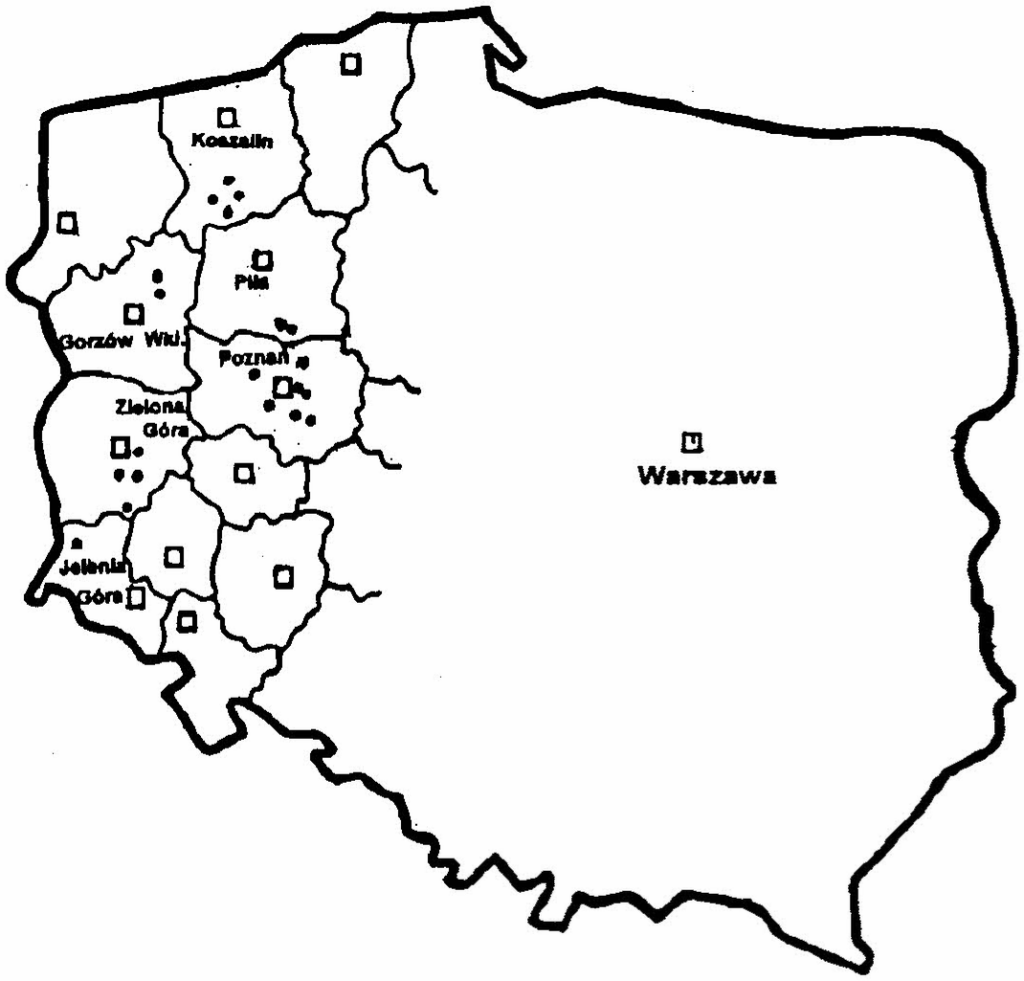
Fig.1. Map of honey’s samples locality Mapa rozmieszczenia próbek miodów
strona 93Table 2 Pollen spectrum of multifloral honeys Obraz pyłkowy miodów wielokwiatowych
| No of sample in tab.1 — Nr próbki wg tab.1 | Pollen (%) — Pyłek (%) |
|---|---|
| N-nectarious plants – roślin nektarodajnych BN-no-nectarious plants – roślin beznektarnikowych T-secondary pollen 16-45% – towarzyszący P-important minor pollen 3-15%-pojedynczy S-minor pollen<3% – sporadyczny I- others total<1% – inne łącznie |
|
| 3. | N: T-Lotus(19), Rubus(19), Trifolium repens (18). P-Salix(8), Frangula(5), Brassica(4), Trifolium pratense(3), Acer pseudoplatanus(3) S-Centaurea cyanus(2), Sinapis(2), Ononis(2), Achillea typ(1), Aesculus(1). I-4 species – gatunki. BN:Rumex(45), Filipendula(22), Plantago(8),Ulmus(6), Pteridophyta(6) Quercus(6), Gramineae(3), Galium(2). |
| 12 | N: T-Cruciferae(19), Achillea typ(18). P-Tilia(13), Trifolium repens(9), Vicia typ(7), Melilotus(6), Trifolium pratense(4),Salix(3), Anthriscus typ(30, Lotus(3). S-Rubus typ(2), Ornithopus(1), Robinia(1), Taraxacum typ(1). I-8 species – gatunków BN:Artemisia(28), Sambucus(15), Lupinus(11), Hypericum(10), Rumex(9), Gramineae(8), Filipendula(7), Plantago(6), Galium(3), Urtica(2), Alnus(1), Juglans(1), Zea(1). |
| 13. | N: T-Cruciferae(31). P-Fagopyrum(15), Achillea typ(13), Trifolium repens(10), Centaurea cyanus(7), Salix (5), Lotus(3), Melilotus(3). S-Cirsium typ(1), Mentha typ(1). I-12 species – gatunków BN: Rumex(45),Filipendula(11), Sanguisorba(11), Gramineae(9), Artemisia(8), Lupinus(8), Hypericum(6), Betula(2). |
| 14. | N: Cruciferae(30),. P-Achillea typ(11), Centaurea cyanus(11), Vicia typ(8), Trifolium repens(6), Salix(6), Heracleum typ(3), Cirsium typ(3), Lotus(3). S-Fagopyrum(2), Tilia(2), Rubus typ(2), Anthriscus typ(2), Trifolium pratense(2), Robinia(1),Frangula(1), Arctium(1), Malus typ(1), Taraxacum typ(1). I-7 species – gatunków |
| No of sample in tab.1 — Nr próbki wg tab.1 | Pollen (%) — Pyłek (%) |
|---|---|
| 19. | N: T-Salix(25), Robinia(24). P-Brassica(10), Malus typ(8), Lychnis(6), Rubus typ(5), Cornus(4), Centaurea cyanus(3). S-Scrophulariaceae(2), Frangula(2), Tilia(1), Polygonum bistorta(1). I-6 species – gatunków BN: Galium(29), Lupinus(18), Gramineae(14), Filipendula(12), Rumex(7), Artemisia(2), Betula(2),Plantago(2), Alnus(1), Secale(1). I-6 species – gatunków |
| 20. | N: T-Salix(31), Robinia(24). P-Cruciferae(11), Malus typ(9), Crataegus(5), Lychnis(4), Rubus typ(4), Frangula(3). S-Cornus(2), Scrophulariaceae(1), Achillea typ(1), Centaurea cyanus(1), Polygonum bistorta(1). I-3 species – gatunki BN: Lupinus(24), Gramineae(19), Ranunculus(17), Rumex(13), Quercus(8), Filipendula(7), Betula(3), Pinus(3), Galium(2), Artemisia(1), Nuphar(1), Secale(1), Urtica(1). |
RESULTS
Fourteen specific honeys compatible with the Polish Standard occured. There were 4 heather honeys, 3 acacia honeys, 2 rape honeys and lime honey. The participation of predominant pollens corresponded with the requirements settled for Calluna and Brassica at 45%, for Robinia at 30% and for Tilia at 20%. Specific honeys not suited to the Polish Standard were as follows: 2 willow honeys, one clover honey and one serradella honey. The clover honey was determined by coupling the percentage of pollen of Trifolium pratense with that of T. repens which resulted in 67%. In Wielkopolska common serradella is grown on seed plantations which are visited by honeybees. Its pollen present in the honey at the rate of 32% was accepted as predominant, as in the „acacia” honey. Robinia and Ornithopus belong to the family Papilionaceae and both have a similar structure of androecium, thus they can produce their nectars similary dusted with their own pollens. So far, among the one species honeys the pollen index was determined only for Robinia and that suggestion not yet proved experimentally. Pollen contents of the examined honeys are presented in tab. 2 and fig. 2.
Honey flow utilized from different plant communities is characterized by the pollen specific for a given community, so called index pollen. Meadow flows are manifested by the pollen of Polygonum bistorta accompanied by pollens of Cirsium type, Filipendula, Lotus, Rumex, and Sanquisorba. The pollen of Cirsium type can belong to Cirsium rivulare or
strona 95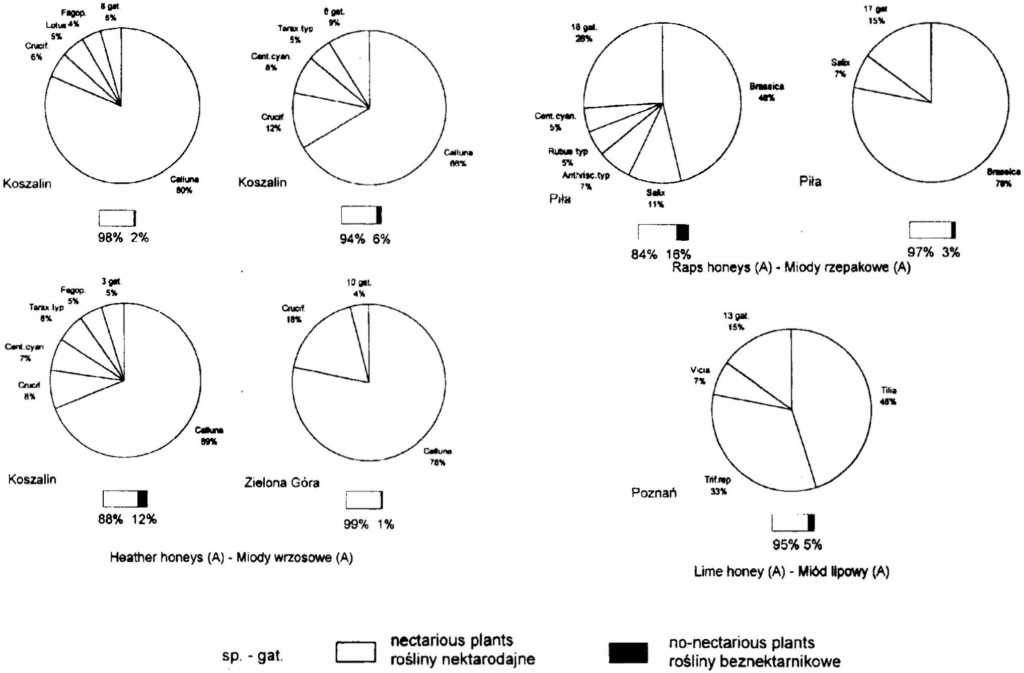
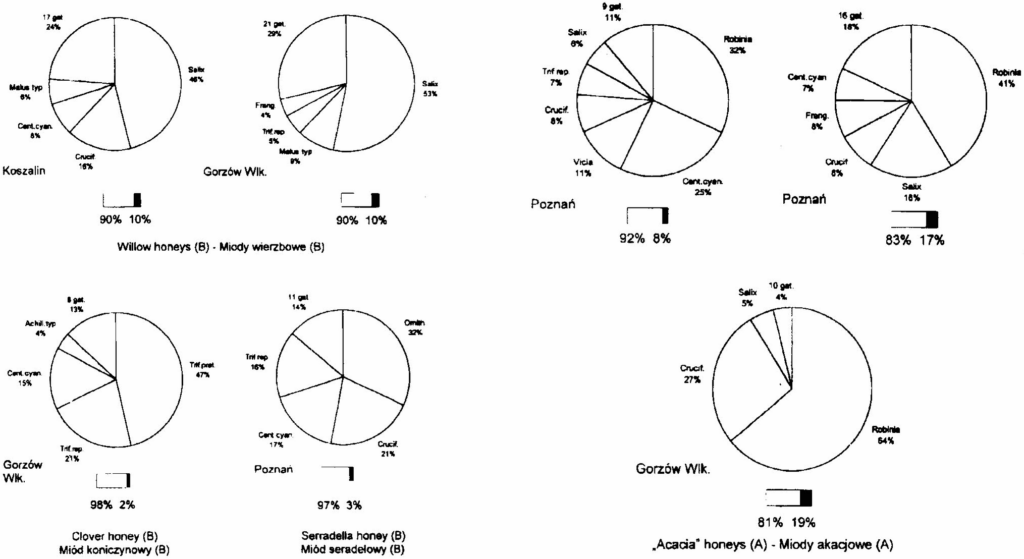
A – according to Polish standard (PN-88) – zgodny z Polską normą (PN-88) B- outside of Polish standard (PN-88) – poza Polską normą (PN-88)
Fig.2. Pollen spectrum of sort honey Obraz pyłkowy miodów odmianowych
strona 97C. oleraceum. Pollens of Fagopyrum, Brassica, Vicia type and Ornithopus indicate play flights on farm fields. They are usually accompanied by weed pollens of Centaurea cyanus, Sinapis and Achillea type: the latter may comprise Anthemis as well as Tripleurospermum inodorum. Both weed species are visited by honeybees and have an identical structure of pollen grains established by Zander as Achillea type.
Pollens of Salix and Frangula give information about afforestations on mois ground. The pollen of Artemisia provides evidence of ruderal plant communities and waste land, similarly does the pollen of Arctium. Multifloral honeys compose as good as „a bunch” of flowering local bee plants which illustrates tab. 2. Pollen contents in the examined honeys coincide with the geographical situations and geobotanical classification of Wielkopolska described. Valuable heather honeys were produced by apiaries carried out on abandoned military testing grounds growing heather. One species and multifloral honeys characterized by manifold contents of plant pollens and looked for on the market can be obtained from the Wielkopolska territory.
REFERENCES
Demianowicz Z., Lecewicz W., Warakomska Z.(1966) – Beitrag zur quantitativen Pollenanalyse der Buchweizenhonige. Z. Binenforsch., 8 (5): 148-161.
Demianowicz Z., Lecewicz W., Warakomska Z. (1981) – Miody rzepakowe Żuław, Wisły i Krainy Mazowieckiej. Pszczeln. Zesz. Nauk., 25: 155 – 162.
Kerkvliet J. D., Van der Putten A. P. (1975) – Das Pollenbild einiger niederländischer Honige. Apidologie, 6 (3): 195-206.
Louveaux J., Maurizio A., Vorwohl G. (1970) – Les méthodes de la mélisso-palynologie. Apidologie, 1(2): 211-117.
Martens N., Van Laere O., Pelerents C. (1964) – Studie van de bijenflora in Belgie door pollenanalyse. Biol. Jaarb., I-XXV: 292-323.
Moar N. T. (1985) – Pollen analysis of New Zealand honeys. N. Z. Journ. of Agric. Res., 28: 39-70.
Poszwiński L., Warakomska Z. (1969)-Analiza pyłkowa miodów rzepakowych i wrzosowych województwa warszawskiego. Pszczeln. Zesz. Nauk., 13 (1-2-3): 147-158.
Sawyer R. (1981 – Pollen identification for beekeepers. Colleg. Card. Press, 111 pp.
Sawyer R. (1988) – Honey identification. Colleg. Card. Press, 115 pp.
Varis A., Helenius J., Koivulehto K. ( 1982) – Pollenspectrum Finnish honey. Journ. of the Sc. Agric. Soc. of Finland, 54: 406-420.
Warakomska Z. (1985) – Obraz pyłkowy miodów i pierzgi Kotliny Jeleniogórskiej. Pszczel. Zesz. Nauk., 29: 253-263.
Warakomska Z., Jaroszyńska T. (1992) – Obraz pyłkowy miodów spadziowych Roztocza. Pszczeln. Zesz. Nauk., 36: 149-156.
Wróblewska A. (1995) – Sources of bee flows in pollen analysis of honeys of Biała Podlaska neighbourhood. Pszczeln. Zesz. Nauk., 39: 37-47.
Zander E. (1935-1951) – Beitrage zur Herkunftsbestimmung bei Honig. I-V, Berlin-Leipzig, 343-44 pp.
strona 98OBRAZ PYŁKOWY NIEKTÓRYCH MIODÓW WIELKOPOLSKI
Z. Warakomska
Katedra Botaniki, Akademia Rolnicza, ul. Akademicka 15, 20-950 Lublin
Streszczenie
Poddano analizie pyłkowej 20 miodów pochodzących z różnych regionów Wielkopolski. Metodę analizy oparto na ustaleniach Międzynarodowej Komisji Botaniki Pszczelarskiej (1970). Wyróżniono miody odmianowe zgodne z Polską Normą: wrzosowy, rzepakowy, akacjowy i lipowy. Poza Normą wierzbowy, koniczynowy i seradelowy oraz miody wielokwiatowe. W Wielkopolsce występują bardzo zróżnicowane tereny pożytkowe oparte głównie na uprawach rolnych, łąkach i zalesieniach.
Słowa kluczowe: miód, analiza pyłkowa, Wielkopolska.
Errata — błędy druku znalezione podczas digitalizacji
- s. 89, streszczenie: „Basic on” → Based on
- s. 89: „identyfying” → identifying
- s. 89: „distingiush” → distinguish
- s. 89: „theWielkopolska” → the Wielkopolska
- s. 89: „et all.” → et al.
- s. 90: „sampes” → samples
- s. 90: „distingished” → distinguished
- s. 93, tab. 2: „Anthriscus typ(30,” → Anthriscus typ(3),
- s. 94: „occured” → occurred
- s. 94: „similary” → similarly
- s. 94: „Sanquisorba” → Sanguisorba
- s. 97: „mois ground” → moist ground
- s. 97, piśmiennictwo: „Binenforsch.” → Bienenforsch.
- s. 97, piśmiennictwo: „Belgie” → België
- s. 97, piśmiennictwo: „Beitrage” → Beiträge