

WORKER EGG LAYING PATTERN WITH RELATION TO WORKER’S GENETIC DIVERSITY IN QUEENLESS COLONIES OF THE HONEY BEE (APIS MELLIFERA)
tekst: Michał Woyciechowski
Pszczelnicze Zeszyty Naukowe, Rok XXXVIII, 1994 — Michał Woyciechowski
strona 17PSZCZELNICZE ZESZYTY NAUKOWE Rok XXXVIII 1994
Michał Woyciechowski
Bee Research Department, Agricultural University, Al. 29 Listopada 52, 31-425 Kraków, Poland
Summary
Honey bee colonies containing workers of different genetic relatedness were created: only full-sisters, full- and half-sisters, and bees of different parentages. After they were orphaned, laying workers began oviposition. Both the number of cells with eggs and of eggs per cell were counted. This has show that: (1) egg number on both sides of the same comb is more strongly correlated than egg number on the faces of adjacent combs; (2) the number of cells to which eggs were deposited increases with genetic diversity of workers, although about the same number of eggs are laid. This result suggests that workers can perceive their genetic diversity, which in natural conditions results from multiple mating by their queen. Despite this, the practice of orphaned workers to lay more than one egg per cell is not a simple result of competition between different patrilinies but rather a consequence of worker aggregation in the nest, dependent on their genetic relatedness.
Keywords: kin recognition, laying workers, genetic diversity, Apis mellifera.
INTRODUCTION
Before the honey bee (Apis mellifera) queen lays her first eggs, she mates with many drones (Woyke 1955, 1964; Adams et al. 1977) storing their mixed sperm in her spermatheca (Taber 1955; Woyke 1955; Page and Metcalf 1982). Consequently, her colony is composed of several patriline groups of workers being full-sisters. Relatedness of full-sisters (r = ¾) is thrice that of half-sisters (r = ¼) in haplodiploids. Therefore regular multiple mating of the queen requires additional assumptions to Hamilton’s theory (1964), which explains the origin and existence of eusociality.
When no replacement queen can be reared, the typical worker behaviour is to begin laying her own male-determinated eggs. A queenless colony with functional laying workers is easily recognized. Workers lay eggs more chaotically than do queens, very often several eggs in one cell. It might be expected that the genotypes of laying workers, which cannot distinguish whether they lay their eggs in a cell containing an egg or an empty one, should be
strona 18eliminated by natural selection because nurse workers tend to allow only one larva per cell (Page, Erickson 1988). As this has not happened, then can laying several eggs in one cell result from competition between different patriline workers? The investigation of this phenomenon was the primary aim of the present study. In order to answer the questions above, observations have been conducted on dequeened colonies consisting of workers of a single or many parentages.
METHODS
Seven honey bee colonies differed in genetic diversity of workers. Five queens (colonies marked 1A through 5A) were artificially inseminated each with the semen of one drone, while two queens (colonies 6B and 7B) with mixed semen of six drones from one colony. All queens (wild Carnica line) were inseminated with the same volume, of 1 mm³, of semen (Italian line drones), in the autumn preceding the year of the experiment.
The experiment was commenced 3th August 1988 by dequeening all colonies. No less than four combs with brood and workers were then taken from each of them and four new nucleus colonies were created (8C – 11C). Each of these colonies contained workers of the seven initial colonies. Immediately after their formation, the new nucleus colonies were moved about 12 km to prevent the return of foragers to their parent hive. As a result, a total of 11 queenless colonies with workers of similar age structure and similar number of brood have been obtained. The symbols of colonies marked a different genetic diversity of the workers containing: only full-sisters (A), full- and half-sisters (B), workers of different parentages (C).
All colonies were placed in single boxes of the hives containing frames (360 x 260 mm) with combs of worker-size cells only. The colonies were regularly checked and any appearing queen cells were destroyed. Three or four days after the appearance of the first workers’ eggs, when hatching larvae began to be nursed, all combs with more than 10 eggs were removed. Both the number of cells with eggs and of eggs per cell were counted on both sides of each comb. No discrimination was made between eggs and young larvae. All cells without eggs bordering on full ones in a row of comb cells were also counted. Cells were counted as empty irrespective of their containing food reserves.
RESULTS
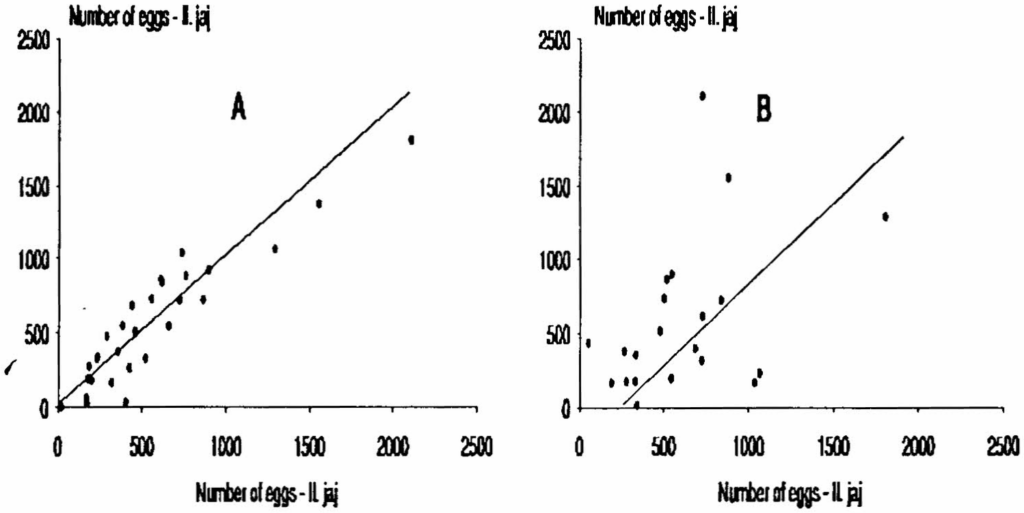
In queenless colonies, eggs were laid in central combs almost simultaneously on both sides of a comb. Only in one comb out of 32, the eggs were laid on one side only. A stronger correlation was found between the number of eggs on both sides of the same comb (Spearman test: r_s = 0.908,
strona 19t = 11.676, df = 29, P < 0.01; Fig. 1A) than between the faces of adjacent combs (r_s = 0.392, t = 1.859, df = 19, 0.05 < P < 0.10; Fig. 1B).
One comb side usually has about 3000 cells. The area in which the eggs were laid in one side, was defined by the outmost eggs in a cell row and covered an average of 530 cells, with 412 cells containing eggs. More than three eggs were found in queen-cells, enlarged by the workers from worker-cells for rearing emergency queens.
Table 1 shows that the shortest period from dequeening to hatching of the first drone larvae was 23 days (C10), while the longest was 71 days (B7). No distinct relation has been noticed between the time of the beginning of oviposition by workers and genetic diversity of the workers in a colony. Workers in the four colonies (group C) composed of individuals originating from the same several nests, began laying eggs after different periods. Moreover, in only one of these colonies, oviposition by laying workers started earlier than in their parent colonies of A and B group (Tab. 1).
Table 1 Number of cells containing eggs in colonies of small (A), intermediate (B) and high (C) genetic diversity of workers. The eggs were counted on the presented number of days after orphaning the colonies Liczba komórek plastra zawierających określoną liczbę jaj w rodzinach o małej (A), średniej (B) i dużej genetycznej zmienności robotnic. Jaja liczono w podaną liczbę dni po osieroceniu rodzin
| Colony / Rodzina | Number of days / Liczba dni | Number of cells with the following egg number / Liczba komórek z określoną liczbą jaj: 0 | Number of cells with the following egg number / Liczba komórek z określoną liczbą jaj: 1 | Number of cells with the following egg number / Liczba komórek z określoną liczbą jaj: 2 | Number of cells with the following egg number / Liczba komórek z określoną liczbą jaj: 3 | Number of cells with the following egg number / Liczba komórek z określoną liczbą jaj: 4 | Number of cells with the following egg number / Liczba komórek z określoną liczbą jaj: 5-9 | Total eggs / Suma jaj | Average of eggs in cell with at least one egg / Średnia liczba jaj w komórkach zawierających co najmniej jedno jajo |
|---|---|---|---|---|---|---|---|---|---|
| A1 | 32 | 108 | 458 | 89 | 7 | 1 | 1 | 666 | 1.198 |
| A2 | 40 | 2546 | 1521 | 190 | 26 | 4 | 1 | 2000 | 1.148 |
| A3 | 28 | 1260 | 3625 | 1728 | 298 | 38 | 6 | 8157 | 1.432 |
| A4 | 41 | 1241 | 1481 | 507 | 112 | 18 | 8 | 2947 | 1.386 |
| A5 | 26 | 712 | 1081 | 155 | 20 | 1 | 2 | 1470 | 1.168 |
| B6 | 27 | 1562 | 2512 | 835 | 106 | 11 | 3 | 4568 | 1.314 |
| B7 | 71 | 573 | 1154 | 197 | 18 | 2 | 1 | 1615 | 1.177 |
| C8 | 32 | 370 | 1913 | 459 | 51 | 4 | 3 | 3019 | 1.242 |
| C9 | 30 | 583 | 972 | 96 | 1 | 0 | 0 | 1167 | 1.092 |
| C10 | 23 | 1489 | 3439 | 1006 | 136 | 15 | 5 | 5953 | 1.294 |
| C11 | 30 | 2208 | 1806 | 233 | 17 | 1 | 4 | 2349 | 1.140 |
The area of one comb side limited by outmost eggs was examined to see whether the distribution of the number of eggs per cell differed from a random one. The distribution of egg numbers was compared with a theoretical Poisson
strona 20distribution, calculated from the average egg number in cells for the 11 experimental colonies. The real distributions (Tab. 1) significantly differed in all cases from the theoretical ones, tending towards greater regularity (chi-square test: P < 0.001).
Dependence of egg number per cell distribution on workers’ genetic diversity is not obvious when results from individual colonies are compared. The greater the total number of eggs in a colony, the greater the average number of eggs in cell with at least one egg (Tab. 1). An analysis of covariance (ANCOVA) was performed in order to check whether egg number per cell varies less within a group of colonies with particular genetic diversities than between them. The total number of eggs in a nest was taken as the independent variable and the number of egg-containing cells as the dependent variable. Because of the small number of colonies investigated, two types of them were compared: that of small (5 colonies from group A) and great (6 families from groups B and C) genetic diversity. ANCOVA has not shown differences in the slope of the two regression lines (F = 3.191, P > 0.05), but significant differences in the elevation (F = 6.574, 0.05 > P > 0.01). The use of ANCOVA is fully justified by the very high coefficient of determination r² (group A – r² = 0.997; group B + C – r² = 0.997). It might be then anticipated that, for the same number of worker eggs in a nest, colonies with slight worker genetic diversity (A) would occupy less cells than those with greater worker diversity (B + C).
DISCUSSION
Laying workers behaviour. Workers’ oviposition is the only way to replicate their genes in queenless colonies with no possibility of raising a replacement queen. This is the reason why all behaviours that increase the reproductive success of laying workers are justified. These include the selection of optimum conditions for brood rearing. It is probably for this that the workers begin their oviposition in the central part of the hive, almost simultaneously on both sides of the same comb. This is why egg numbers on both sides of the same comb are similar and much more strongly correlated than those on two faces of adjacent combs (Fig. 1). This suggests that favorable conditions for nursing larvae are easiest to ensure in one comb rather than on two faces of adjacent combs.
Drone brood rearing time is highly synchronous within a colony (Page, Erickson 1988), as confirmed by these results. There has been no proof, however, that this time should depend on worker genetic diversity (Tab. 1).
It seems obvious that each subsequent egg laid in the same comb cell has a diminishing chance for survival. Therefore laying workers distribute their eggs in a regular way rather than at random. The results showing that the average number of eggs per cell increases with the number of eggs in particular hives (Tab. 1) permit to conclude that the area suitable to brood rearing is limited.
Consequences of genetic diversity. Orphaned workers behave differently depending on genetic diversity of the workers in a colony. It was confirmed by ANCOVA that the number of cells to which eggs were deposited increases with genetic diversity of workers, although about the same number of eggs are laid. This behaviour could be a result of the workers’ interactions in the colony. It has been observed that, if functional laying workers are present in an orphaned colony, aggressive behaviour (Sakagami 1954, Velthius 1976), occurs more frequently between half-sisters than between full-sisters (Evers, Seeley 1986).
The variation in the distribution of worker eggs in comb cells according to the genetic diversity of the workers supports the statement that workers in a nest perceive their genetic diversity. This is not synonymous with kin recognition, although, of course, diversity perception might be its result. There exist theoretical grounds pointing to the fact that, in the evolution of eusociality in Hymenoptera, the ability of the workers to recognize if the colony members are only full-sisters or full and half-sisters, could be of considerable significance for workers’ reproduction (Woyciechowski, Łomnicki 1987, 1989).
Page and Erickson (1988) did not find the direct reproduction competition among subfamily members in one colony. Also in this experiment workers laid more than one egg per cell probably not as a consequence of
strona 22reproductive competition among different patrilines, for it was more frequent in the nests containing only full-sisters. Thus the diversity perception among workers in one nest, as described here, is not univocally justified by the benefits resulting from such an adaptation.
ACKNOWLEDGEMENTS
I am indebted to Andrzej Zawilski and Łucja Zawilska for insemination of queens for experiment. I am also grateful to Graham Elmes, Elżbieta Król, Jan Rybicki and January Weiner for their help in preparing the manuscript.
REFERENCES
Adams J., Rothmsn E. D., Kerr W. E., Paulino Z. L. (1977) – Estimation of number of sex alleles and queen mating from diploid male frequencies in population of Apis mellifera. Genetics, 86:583-596.
Evers C. E., Seeley T. D. (1986) – Kin discrimination and aggression in honey bee colonies with laying workers. Anim.Behav., 34:924-925.
Hamilton W. D. (1964) – The genetical evolution of social behaviour. I and II. J.Theor. Biol., 7:1-52.
Page R. E., Erickson E. H. (1988) – Reproduction by worker honey bees (Apis mellifera L.). Behav.Ecol.Sociobiol., 23:117-126.
Page R. E., Metcalf R. A. (1982) – Multiple mating, sperm utilization, and social evolution. Am.Nat., 119:263-281.
Sakagami S. R. (1954) – Occurrence of aggressive behaviour in queenless hives, with considerations on the social organization of the honeybee. Insectes Soc. 1:331-343.
Seeley T. H. (1985) – Honeybee Ecology a study of adaptation in social life. Princeton University Prewss, Princeton New York.
Velthuis H. H. (1976) – Egg laying, aggression and dominance in bees. Proc. XV Int. Congr. Entmol, Washington: 436-449.
Woyciechowski M., Łomnicki A. (1987) – Multiple mating of queens and sterility of workers among eusocial Hymenoptera. J.Theor.Biol., 128:317-327.
Woyciechowski M., Łomnicki A. (1989) – Worker reproduction in social insects. Trends Ecol.Evol., 9:146.
Woyke J. (1955) – Multiple mating of the honeybee queen (Apis mellifera L.) in one nuptial flight. Bul.Acad.Polon.Sci.Cl. II, 3:175-180.
Woyke J. (1964) – Causes of repeated mating flights in queen honeybees. J.Apic.Res., 8:65-74.
strona 23WPŁYW ZMIENNOŚCI GENETYCZNEJ ROBOTNIC NA ROZMIESZCZENIE JAJ SKŁADANYCH PRZEZ TRUTÓWKI W RODZINACH PSZCZELICH (APIS MELLIFERA)
M. Woyciechowski
Streszczenie
W eksperymencie użyto 11 rodzin pszczelich o różnej zmienności genetycznej robotnic. Pięć rodzin pochodziło od matek unasienionych nasieniem jednego trutnia (rodziny oznaczone 1A do 5A), dwie od matek unasienionych spermą trutni pochodzących z jednej rodziny (6B i 7B), cztery rodziny posiadały robotnice pochodzące od kilku niespokrewnionych matek i trutni (8C-11C). Po osieroceniu rodziny pozostawiono bez możliwości wychowania matek ratunkowych tak długo, aż pojawiły się jaja składane przez trutówki. Liczono jaja w poszczególnych komórkach i na całych plastrach, badając jednocześnie ich rozmieszczenie na plastrze (Tab. 1).
Stwierdzono, że liczby jaj składanych przez trutówki po obu stronach jednego plastra są ze sobą silniej skorelowane (test Spearmana: r_s = 0,908; Fig. 1A) niż liczby jaj składanych na przeciwległych stronach sąsiednich plastrów (r_s = 0,392; Fig 1B). We wszystkich rodzinach liczba zajmowanych komórek plastra była skorelowana linjowo z liczbą jaj trutówek (rodziny z grupy A: współczynnik determinacji r² = 0,997, z grupy B + C: r² = 0.997), jednak w rodzinach o mniejszej genetycznej zmienności robotnice składały swe jaja do mniejszej liczby komórek plastra, niż w rodzinach o większej genetycznej zmienności (analiza kowariancji: współczynniki nachylenia regresji – F = 3,191, P > 0,05; współczynniki początkowe – F = 6,574; 0,05 > P > 0,01).
Uzyskane wyniki pozwalają przypuszczać, że robotnice w rodzinie pszczelej percepują swą zmienność genetyczną, która w naturalnych warunkach jest efektem wielokrotnej kopulacji matki. Nie wykazano jednocześnie by typowe zachowanie trutówek, polegające na składaniu kilku jaj do jednej komórki plastra było przejawem konkurencji robotnic pochodzących od różnych trutni.
Słowa kluczowe: rozpoznawanie pokrewieństwa, trutówki, różnorodność genetyczna, Apis mellifera.
Errata — błędy druku znalezione podczas digitalizacji
- s. 17, streszczenie: „patrilinies” → patrilines
- s. 20, ryc. 1: „realtionship” → relationship
- s. 21: „Velthius” → Velthuis
- s. 22, piśmiennictwo: „Rothmsn” → Rothman
- s. 22, piśmiennictwo: „Prewss” → Press
- s. 22, piśmiennictwo: „Entmol” → Entomol.
- s. 22, piśmiennictwo: „Seeley T. H.” → Seeley T. D.
- s. 23, streszczenie: „linjowo” → liniowo