

VISITATION OF RED CLOVER BY POLLINATOR INSECTS
tekst: Mieczysław Biliński
Pszczelnicze Zeszyty Naukowe, Rok XXI, 1977 — Mieczysław Biliński
strona 229BEE RESEARCH COPIES V.XXI DECEMBER 1977
Mieczysław Biliński
I.S. at Puławy, Poland
Studies on the visiting of red clover by pollinator insects have been undertaken by many scientists (Ruszkowski and Biliński 1968). They were confined, however, to some observations on existing pollinator species, to determining their effectiveness, measured by the number of flowers visited per time unit (usually per 1 minute), and to defining the density of population per area unit. In Poland such systematic observations were made by Honczarenko (1965), Wójtowski (1965), Góral (1969), and elsewhere, by Hänninen (1962), Haas (1966), Dennis and Haas (1967). Only the studies made by Honczarenko, Dennis and Haas deal with the dynamics of the visitation of red clover throughout the whole period of its flowering. The „time observations” recorded by Honczarenko, however, cannot be related to area unit (Dylewska et al. 1970) the investigations of Dennis and Haas, on the other hand, deal with a single crop variety of red clover.
The aim of the present paper is to report on systematic observations on daily visitation of first and second red clover crop which would enable us to understand the seasonal dynamics of insect visits and to define the number of particular pollinator species on first and second crops in 1968—1971. The daily dynamics of bumblebee and honey bee visits on red clover flowers was recorded and the effectiveness of these insects determined.
strona 230
METHODS
On each crop (cut) strips 1 meter wide and 100–-200 m long were demarcated with staves and cord. Observations on the seasonal dynamics of insect visits on first and second clover crop consisted in a single every day walk along the demarcated strips, recording all working insects and defining their sex and species. Individuals which were difficult to specify directly on the flowers were captured in a net and determined in laboratory. In 1969 and 1970 such observations were made on some specific days during the peak of first and second crop flowering. They were repeated every hour, from 5 a. m. to 8 p. m. The density of the population per hectare was defined and presented graphically with reference to the weather conditions accompanying the observations as well as to the degree of bloomings in clover fields. Bearing in mind the fact that both male and female bumblebees, cuckoobumblebees and solitary bees visit clover flowers the population of a particular insect species was treated in the mass without distinguishing sex, which also improved the readability of the diagrams. On the basis of daily observations, the average density population on the first and second crop each year was defined. The average number of flowers visited by individuals per 1 minute was assumed to define the effectiveness of a particular species.
The weather in 1968—1971 generally speaking favoured the visitation of red clover by pollinators, an exception being 1968 when the wet and cold summer caused a considerable decrease in the number of pollinators.
RESULTS
The course of the daily dynamics of bumblebee and honey bee visits on first and second crop clover (Fig. 1), generally speaking, is connected both with the temperatures and with the daily dynamics of flowering. The beginning of the visitation though it fell at the outset of the daily blooming largely depended, however, on the temperature rising above 14—15°C; at a lower temperature no bumblebees were observed on red clover in summer. The evening drop in the quantity of bumblebees was, in turn, rather independent of temperature (still reaching 20—24°C) and of the decreasing amount of clover flowers starting to bloom. These two things should be viewed rather as a corollary of sunset. Between 8—9 a.m. and 4—5 p.m. the density of bumblebees and honey bee was more or less constant. The bumblebee daily work would start before 6 a.m. and end about 7 p.m. on the first and at 6 p.m. on the second crop; honey bee worked a crrespondigly shorter (by one hour).
strona 231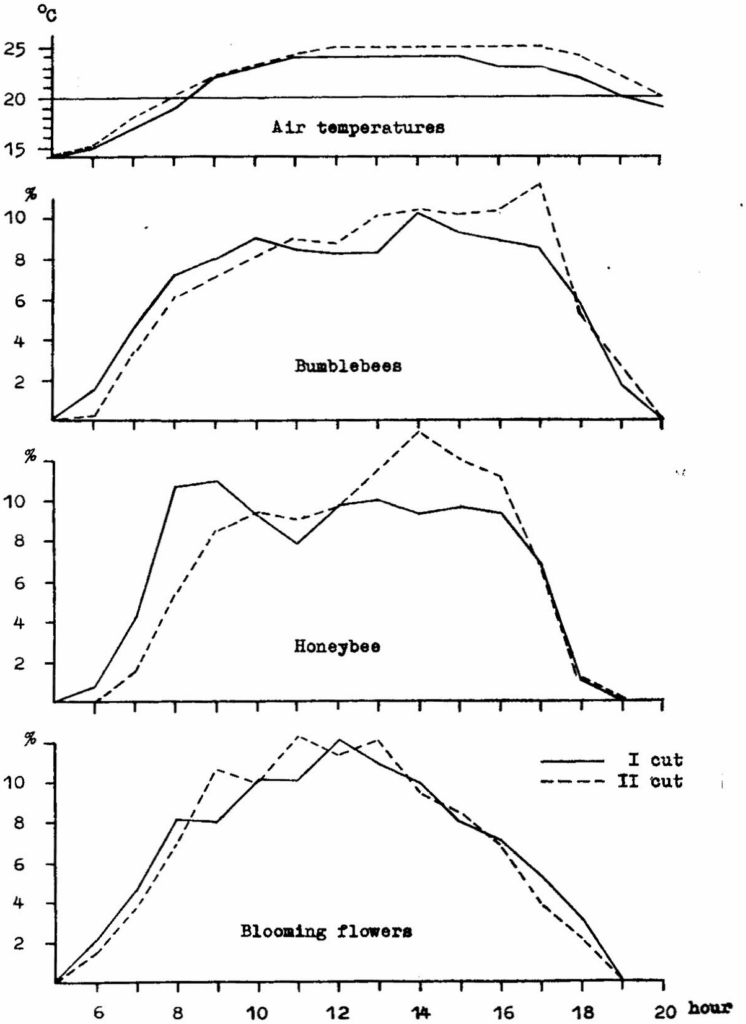
Finally we are going to discuss the seasonal dynamics of visits to first and second red clover crop observed in 1969. It was conditioned (Fig. 2) by the course of clover field blooming and by the actual weather. As far as solitary bees are concerned their seasonal dynamics were largely influenced by the period their appearance. Hence the peak of their concentration preceded the peak period of flowering (e.g. Eucera in 1969 on the first crop) or was late.
Honey bee and bumblebees (Tab. 1) were insects to appear in greatest number in Puławy. Both of these species were seen in larger groups on
strona 232the second crop, exception being the wet summer 1968. In 1970 and 1971 the number of bumblebees was smaller on second cut which was due to taking a greather number their colony (located earlier on I crops) away of Puławy. In the group at 13 species (including B. humilis Ill. captured beyond the strip) the most numerous were B. ruderarius, B. agrorum, B. hortorum, B. lapidarius and B. terrestris with B. lucorum: the species considered common in Poland (Dylewska 1977). Solitary bees were more numerous on the first crop, Andrena gelriae, Eucera longicornis, Melitta leporina and Rhophitoides canus prevailing. The fourth group of pollinators to be observed most frequently on the first crop were cuckoobumblebees (Psithyrus), mainly females Ps. rupestris and Ps. vestalis.
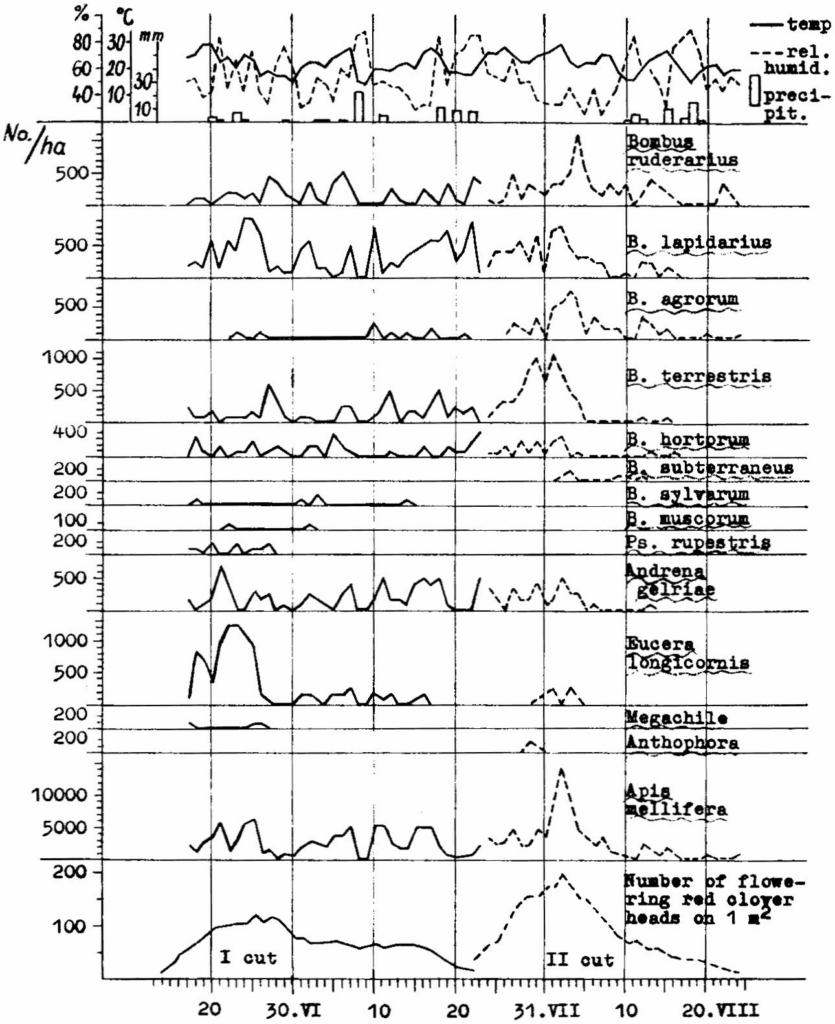
Table 1 Density of pollinators per 1 ha of red clover
| Species | Years and cuts: 1968 I | Years and cuts: 1968 II | Years and cuts: 1969 I | Years and cuts: 1969 II | Years and cuts: 1970 I | Years and cuts: 1970 II | Years and cuts: 1971 I | Years and cuts: 1971 II |
|---|---|---|---|---|---|---|---|---|
| Bombus agrorum (F.) | 56 | 3 | 28 | 194 | 358 | 177 | 163 | 218 |
| B. ruderarius (Müll.) | 128 | 5 | 148 | 265 | 655 | 379 | 300 | 168 |
| B. hortorum (L.) | 100 | — | 100 | 68 | 186 | 13 | 182 | 105 |
| B. terrestris (L. | ||||||||
| B. lucorum (L.) | 369 | 13 | 157 | 256 | 155 | 601 | 307 | 195 |
| B. lapidarius (L.) | 213 | 37 | 376 | 263 | 413 | 383 | 82 | 55 |
| B. muscorum (F.) | 22 | 5 | 5 | — | 1 | — | 4 | — |
| B. distinguendus Mor. | 9 | — | — | — | 1 | — | 4 | — |
| B. sylvarum (L.) | 38 | 3 | 10 | — | 35 | 3 | 11 | 9 |
| B. subterraneus (L.) | — | — | — | 19 | 203 | 5 | 44 | 14 |
| B. confusus Schenck | — | — | — | — | 3 | — | 4 | — |
| B. hypnorum (L.) | — | — | — | — | — | 3 | — | — |
| Total bumblebees | 935 | 66 | 824 | 1065 | 2010 | 1564* | 1101 | 764* |
| Andrena gelriae Vecht. | 63 | 47 | 200 | 114 | 352 | 182 | 33 | 141 |
| Eucera longicornis (L.) | 6 | — | 264 | 31 | 98 | — | — | 14 |
| Halictus Latr. | 3 | 5 | — | — | 7 | — | — | — |
| Melitta leporina Pz. | 19 | — | — | — | 16 | 15 | 15 | — |
| Rhophitoides canus Ev. | — | 3 | — | — | 1 | 13 | — | — |
| Megachile Latr. | — | — | 7 | — | 4 | — | 4 | — |
| Amegilla quadrifasciata (Vill.) | — | — | — | 9 | 7 | — | — | — |
| Anthophora Latr. | — | — | — | — | — | — | 7 | 9 |
| Anthophora parietina var. Schencki D. T. | — | — | — | — | 12 | — | — | — |
| Total solitary bees | 91 | 55 | 471 | 154 | 497 | 210 | 70 | 164 |
| Psithyrus Lep. | 22 | — | 24 | — | 8 | — | 33 | 5 |
| Apis mellifera L. | 4194 | 2367 | 2817 | 3096 | 2119 | 9619 | 2159 | 3582 |
- Lower number of bumblebees on second cuts in 1970 and 1971 was due by taking a greater part of their colonies located on I cuts away of fields
The insects which are largely responsible for red clover seed yiels are bumblebees (Gurr 1962, Sowa et al. 1976). In order to obtain maximum crop the number of these insects per ha should, according to different authors, amount to 700 by flowers visited once, 1500 by flowers visited twice and from 2000 to 7000 by flowers visited three times (Zapletal 1963, Honczarenko 1965, Jabłoński 1975). The issue requires further studies. The number of bumblebees and other insects observed in Puławy made it possible to obtain about 60 kg of seed from the second crop in 1968 and 200—300 kg in the following years.
strona 234Table 2 Effectiveness of bumblebee and honey bee workers on diploid and tetraploid red clover
| Species | Average number of flowers positively visited per 1 minute: diploid (2n) | Average number of flowers positively visited per 1 minute: tetraploid (4n) |
|---|---|---|
| Bombus agrorum (F.) | 27,9 | 28,3 |
| B. ruderarius (Müll.) | 24,0 | 22,5 |
| B. lapidarius (L.) | 25,1 | 20,5 |
| B. terrestris (L.) | 23,0 | 20,3 |
| B. hortorum (L.) | — | 22,8 |
| Apis mellifera L. | 10,1 | 15,6 |
The observations on the bumblebees ‘and honey bees‘ effectiveness measured by the number of flowers visited per 1 minute are presented in Table 2. On the whole, a decreasing effectiveness of bumbleebes found on tetraploid clover which longer tube flower was observed, one notable exception being here B. agrorum (contrary to observations recorded by Dennis and Haas 1967). However, such correlation was not established for B. hortorum since it visited tetraploid clover only without paying attention to diploid clover growing nearby. The effectiveness of the B. hortorum worker, which has a markedly longer tongue, was no different from the effectiveness of other species. According observations to cite by Holm (1966), there exists a correlation between the length of the tongue and the number of flowers visited per 1 minute. However the observations of honey bee workers on red clover are at variance with this opinion. Honey bee workers with markedly shorter tongues are more effective on tetraploid, which proves that they were in search for pollen only (Gurr 1962, Dennis and Haas 1967).
In the group of bumblebees B. lucorum workers and partly B. terrestris workers (30%—40%) bit flower tubes. The behaviour of some females Megachile was similar. Female Andrena gelriae, in turn, ripped with its head flower tubes to reach nectar. It was Jabłoński (1974) who showed that the biting of flowers by bumblebees did not have any detrimental effects on red clover. Incidently, the perforated tube attracts honeybees which pick up nectar. From the fact that B. terrestris is to be found everywhere and from the reasons presented above follows that its significance in red clover seed production should not be underestimated. This opinion is consonant with the studies on red clover pollination carried out in Poland (Sowa et al. 1976).
strona 235CONCLUSIONS
- The daily dynamics of the visitation of red clover by bumblebees and honeybees is connected with temperature and the daily dynamics of clover field blooming. The beginning of the visitation depended on the temperature rising above 14—15°C; the visitation was coming to an end at sunset. Between 9 a.m. and 4 p.m. bumblebees and honey bee were greatest in number and that is why during that time the number of pollinator insects on each red clover plantation should be determined. The daily work of bumblebees started before 6 a.m. and was coming to a close about 7 p.m. on the first crop (cut) and about 6 p.m. on the second crop. Honey bee would work for a shorter time than bumblebees (shorter by one hour).
- The seasonal dynamics of the visitation of the first and second crop by various species of pollinators depended on the actual clover field bloomings, on the actual weather conditions and on the seasonal appearance of particular species. First crop of red clover was usually visited by a greater number of bumblebee species and solitary bees. The quantity of bumblebees and honey bee was, as a rule, greater on the second crop. It is advisable than, to put it aside for seed production.
- The effectiveness of bumblebees was higher on diploid clover, and that of honey bee on tetraploid variety. It was observed that B. lucorum workers and a number of B. terrestris workers as well as females Megachile bit flowers. The ripping of flowers by Andrena gelriae was also seen.
LITERATURE
Dennis, B. A., H. Haas, 1967, Pollination and seed-setting in diploid and tetraploid red clover (Trifolium pratense L.) under Danish conditions, Roy. Vet. and Agr. Coll., Yearbook; 93—133.
Dylewska M., 1957, Zarys rozsiedlenia gatunków z rodzaju Bombus Latr. na obszarze Polski, Acta Zool. Cracov., 2: 259—273.
Dylewska M., A. Ruszkowski, B. Jabłoński, M. Biliński, S. Sowa, S. Wrona, 1970, Badania nad metodami określania liczebności owadów zapylających na plantacjach lucerny nasiennej, Wiad. Ekol., 16, 1: 232—245.
Góral S., 1969, Wpływ nektarowania i oblotu owadów na osadzanie nasion u di- i tetraploidalnej koniczyny czerwonej (Trifolium pratense L.), Cz. II, Zapylanie i osadzanie nasion, Rocz. Nauk Roln., 95-A-1: 113—137.
Gurr L., 1962, The role of insects as pollinators of forage crops in New Zealand, Sheepfarm. Ann.: 67—74.
Haas H., 1966, Preliminary investigations on pollination, seed setting and seed yield in 2n and 4n red clover throughout the complete flowering period, Bee Wrld, 47, 1, suppl.: 71—82.
Hänninen P., 1962, Bumblebee species on red clover in central Finland, Valt. Maatal. Koetoim. Julk., 197: 1—21.
strona 236Holm S. N., 1966, The utilization and management of bumble bees for red clover and alfalfa seed production, Ann. Rev. of Entomol., 11: 155—182.
Honczarenko J., 1965, Trzmiele (Bombus Latr.) zapylające koniczynę czerwoną (Trifolium pratense L.) w okolicach Szczecina, Szczec. Tow. Nauk., Wydz. Nauk Przyr.-Rol., 20, 1: 1—60.
Jabłoński B., 1974, Wpływ przegryzania przez trzmiele kwiatów koniczyny czerwonej na zawiązywanie nasion, Pszczel. Zesz. Nauk., 18: 229—235.
Jabłoński B., 1975, Zagęszczenie owadów pszczołowatych na koniczynie czerwonej potrzebne do dobrego jej zapylenia, Pszczel. Zesz. Nauk., 18: 13—29.
Sowa S., A. Ruszkowski, S. Bawolski, M. Biliński, 1976, Liczebność owadów zapylających a zawiązywanie nasion koniczyny czerwonej w różnych rejonach Polski. Międz. Konfer. Zap. Koniczyny Czerw., Puławy.
Ruszkowski A., M. Biliński, 1968, Oblot koniczyny czerwonej przez trzmiele, Pam. Puł., 31: 201—219.
Wójtowski F., 1965, Zastosowanie błonkówek pszczołowatych z rodzaju Bombus Latr. oraz Anthophora Latr. (Hymenoptera, Apidae) do zapylania plantacji nasiennych roślin motylkowych, Rocz. WSR Poznań, 24: 223—274.
Zapletal F., 1963, Vyzkumy k zachrane a rozsireni cmelaku, Ved. Prace Vyzk. Ust. Vcel. v Dole: 215—247.
OBLOT KONICZYNY CZERWONEJ PRZEZ OWADY ZAPYLAJĄCE
Mieczysław Biliński, Puławy, Polska
Streszczenie
W latach 1968—1971 prowadzono w Puławach systematyczne obserwacje nad oblotem koniczyny czerwonej przez owady. Badania wykonywano metodą „przemarszu” na pasach szerokości 1 m i długości 100—200 m. Obserwacje sezonowej dynamiki oblotu wykonywano codziennie w godzinach południowych przez cały okres kwitnienia koniczyny. Poza tym w kilku dniach w czasie pełni kwitnienia I i II pokosu obserwacje takie powtarzano co godzinę, od 6 do 20, dzięki czemu prześledzono dzienną dynamikę oblotu. Stwierdzone zagęszczenie owadów (przeliczone na powierzchnię 1 ha) przedstawiono graficznie w powiązaniu z niektórymi warunkami pogody i stanem kwitnienia koniczyny. Obserwowano również wydajność pracy trzmieli i pszczoły miodnej na koniczynie di- i tetraploidalnej oraz sposób pracy różnych gatunków owadów na kwiatach.
Dzienna dynamika oblotu koniczyny czerwonej przez trzmiele i pszczołę miodną związana była z temperaturą i dynamiką rozkwitania kwiatów. Początek oblotu zależał od wzrostu temperatury powyżej 14—15°C; koniec następował wraz z zachodem słońca. Między godziną 9 a 16 zagęszczenie trzmieli i pszczoły miodnej było najwyższe i dlatego w tym czasie powinna być oceniana liczebność zapylaczy na kwitnących plantacjach. Sezonowa dynamika oblotu koniczyny zależała od aktualnego stanu kwitnienia łanu i warunków pogody, a zarazem od okresu pojawu danego gatunku owada. Liczebność trzmieli i pszczoły miodnej była z reguły wyższa na II pokosie, co potwierdza celowość pozostawiania go na nasiona. Wydajność pracy trzmieli była wyższa na koniczynie diploidalnej, a pszczoły miodnej — na tetraploidalnej. Obserwowano przegryzanie kwiatów przez część robotnic B. terrestris i B. lucorum oraz przez niektóre samice Megachile, a także prucie kwiatów przez samice Andrena gelriae.
Errata — błędy druku znalezione podczas digitalizacji
- s. 230: „crrespondigly” → correspondingly
- s. 232: „greather” → greater
- s. 233: „seed yiels” → seed yields
- s. 234: „bumbleebes” → bumblebees
- s. 234: „Incidently” → Incidentally
- s. 235: „advisable than” → advisable then
- s. 235, piśmiennictwo: „Bee Wrld” → Bee World