

THE RESULTS OF PRELIMINARY STUDIES ON FLOWERING AND NECTAR PRODUCTION IN SOME REPRESENTATIVES OF THE GENUS SEDUM L.
tekst: Beata Żuraw
Pszczelnicze Zeszyty Naukowe, Rok XLIV, Nr 2, 2000 — Beata Żuraw
strona 285PSZCZELNICZE ZESZYTY NAUKOWE Rok XLIV, Nr 2 2000
Beata Żuraw
Department of Botany, Agricultural Academy, Akademicka 15, 20-950 Lublin
Summary
In this paper the preliminary results of studies on the flowering and nectar production in 21 representatives of the genus Sedum L. are presented. Nectar was collected from flowers using pipettes and sugars content in nectar (in %) was measured with the Abbe refractometer. In 1999 the flowering period of studied species lasted from the first days of June till the end of September. The length of flowering period of observed representatives was from 15 to 47 days. Honey bees as well as wild Apoidea readily foraged on flowers of all Sedum. The nectar amount secreted throughout a lifetime per 10 flowers ranged from 0.2 to 6.0 mg. Sugars content of nectar was 60-80%. The amount of sugars secreted in nectar ranged from 0.12 mg (Sedum album L.) to 4.65 mg (Sedum reflexum L.). Among all 21 studied species, the highest amount of sugars produced in nectar per 1 inflorescence (0.24 g) as well as per 1 m2 of crop (7.1g) were found for Sedum spectabile 'Carmen’. The preliminary results of these studies indicate that Sedum plants are worth cultivating in beekeeping gardens. These succulent plants supply food flow for honey bees as well as for wild pollinators throughout the summer.
Keywords: Sedum L., stonecrops, flowering, nectar production, insects’ visits.
INTRODUCTION
Species of stonecrops (Sedum L.), grown in gardens differ significantly in their morphology, abundance of flowering and geographical origin. All of them are very decorative. Stonecrops can be planted particularly on beds, borders, rockeries, slopes, stone walls as well as in pots and containers. The big advantage of these species is an easy way in which they can be grown and propagated – by portioning, seedlings and seeds.
In the beekeeping literature, Sedum species are mentioned as melliferous plants, attractive for honey bees (Rawski 1947a,b; Lipiński 1976, D’albore 1998) and for wild Apoidea (Ruszkowski and Biliński 1986, Ruszkowski et al. 1993, Ruszkowski et al. 1994a,b). Stephenson (1994) reported that characteristic guide-marks on the corolla of Sedum flowers attracted pollinators, showing the way to nectar. Honey yield of various Sedum species was studied by Simidczijev (1962), Dąbska (1977) and Jabłoński (1995). In 1973, Warakomska performed
strona 286analysis of honey samples, collected in Popowo, and described one of analysed honeys as specific stonecrops honey (quoted by Dąbska 1977).
Considering so many advantages of representatives of the genus Sedum, I decided to determine time, length and abundance of flowering thereof as well as to study the nectar production in conditions of Poland.
MATERIAL AND METHODS
For investigations, started in 1999, the following 21 Sedum species were chosen: Sedum acre L., S. acre L. var. calcigenum, S. aizoon L., S. album L., S. album f. murale Praeg., S. caucasicum (Gras.) Bor., S. ewersii Ledeb. var. ewersii, S. telephium ssp. fabaria Koch, S. hispanicum L., S. kamtschaticum F.&M., S. kamtschaticum (F.& M.) Praeg. var. floriferum 'Weihenstephaner Gold’, S. kamtschaticum F.&M. f. variegatum, S. selskianum Regel & Maack, S. sexangulare L., S. spectabile Boreau 'Brilliant’, S. spectabile Boreau 'Carmen’, S. spurium M. Bieb., S. spurium M. Bieb. 'Purpurteppich’, S. spurium M. Bieb. 'Tricolor’, S. stoloniferum Gmel, S. reflexum L. All plants were cultivated in various sections of the Botanical Garden UMCS in Lublin. They grew on a loamy soil and formed patches of different densities and sizes. Insolation was similar in all situations. Fertilisers were not applied and the plants were weeded by hand only. Nectar was collected from isolated flowers with the Jabłoński pipettes (Demianowicz et al. 1960) according to the Jabłoński and Szklanowska method (1979). For each studied species, amount of sugars secreted in nectar was estimated per 1 inflorescence as well as per area of 1 m2 of experimental plot.
RESULTS
Flowering and foraging by insects. In 1999, as first among all observed species plants of Sedum hispanicum started to flower (31st May) while as the latest, Sedum telephium ssp. fabaria began to bloom (22nd August) (Table 1). The flowering periods of studied stonecrops coupled, so throughout 4 months Sedum species continuously supplied food flow for pollinating insects. Twelve of observed species flowered from the beginning of June until the end of July, while the other 9 species bloomed mainly in August and September. The length of flowering period of particular species plants depended mainly on the number of developed flowers and ranged from 15 days (S. reflexum, S. kamtschaticum) to 47 days (S. spectabile 'Carmen’, S. spectabile 'Brilliant’). The diurnal rhythm of flower opening did not differ between Sedum species. The first flower buds started to open at approximately 06:00 h. The opening of new flowers finished definitely at 17:00(18:00). During sunny days with fine weather, the peak of flower opening occurred between 10:00 and 12:00 E.E.T. At the same time pollinating insects foraged on flowers of all studied Sedum
strona 287most readily. Besides honey bees, bumblebees, solitary bees and butterflies were observed on stonecrops flowers. Honey bees visited flowers of S. spectabile 'Carmen’, S. spurium, S. spurium 'Purpurteppich’, S. telephium ssp. fabaria particularly abundantly while bumblebees and solitary bees were mainly found on S. acre, S. sexangulare, S. album and S. album f. murale.
Table 1 The flowering period and abundance of flowering of studied Sedum species in 1999 – Pora i obfitość kwitnienia badanych gatunków Sedum w roku 1999
| No. / Nr | Studied species / Badana roślina | The length of flowering period (days) / Długość okresu kwitnienia (dni) | Flowering number in an inflorescence / Liczba kwiatów w kwiatostanie | The number per 1 m2 area of / Liczba na 1 m2 powierzchni: Inflorescences / Kwiatostanów | The number per 1 m2 area of / Liczba na 1 m2 powierzchni: Flowers (thousands) / Kwiatów w tys. |
|---|---|---|---|---|---|
| 1. | S. hispanicum | 31.05.-10.07. (41) | 18 | 234 | 4.3 |
| 2. | S. kamtschaticum var. floriferum 'Weihenstephaner Gold’ | 4.06.-4.07. (31) | 26 | 152 | 3.9 |
| 3. | S. acre var. calcigenum | 8.06.-9.07. (32) | 10 | 960 | 9.5 |
| 4. | S. acre | 9.06.-4.07. (26) | 6 | 800 | 14.8 |
| 5. | S. stoloniferum | 11.06-5.07. (25) | 13 | 200 | 2.5 |
| 6. | S. kamtschaticum f. variegatum | 15.06.-22.07. (38) | 14 | 88 | 1.2 |
| 7. | S. album | 17.06.-3.07. (17) | 150 | 100 | 15.0 |
| 8. | S. selskianum | 21.06-19.07. (29) | 46 | 145 | 6.6 |
| 9. | S. sexangulare | 22.06.-23.07. (32) | 25 | 492 | 12.3 |
| 10. | S. reflexum | 24.06.-8.07. (15) | 58 | 36 | 2.1 |
| 11. | S. album f. murale | 26.06-20.07. (25) | 76 | 200 | 15.3 |
| 12. | S. kamtschaticum | 28.06.-26.07. (15) | 13 | 80 | 1.1 |
| 13. | S. aizoon | 1.07.-21.07. (29) | 80 | 67 | 5.4 |
| 14. | S. spurium 'Tricolor’ | 4.07.-20.07. (16) | 35 | 200 | 7.0 |
| 15. | S. spurium 'Purpurteppich’ | 4.07.-26.07. (22) | 36 | 200 | 7.2 |
| 16. | S. spurium | 5.07.-28.07. (24) | 30 | 290 | 8.8 |
| 17. | S. caucasicum | 10.08.-5.09. (26) | 106 | 27 | 2.8 |
| 18. | S. spectabile 'Carmen’ | 13.08.-28.09. (47) | 1968 | 30 | 59.0 |
| 19. | S. telephium ssp. fabaria | 13.08.-28.09. (47) | 640 | 15 | 9.6 |
| 20. | S. ewersii ssp. ewersii | 14.08.-22.08. (21) | 57 | 125 | 7.2 |
| 21. | S. spectabile 'Brilliant’ | 22.08.-20.09. (30) | 698 | 28 | 19.5 |
Nectar production and amount of sugars secreted in nectar. The quantities of nectar produced in the stonecrops’ flowers depended on weather conditions. On cloudy and chilly days the secretion of nectar was low while during sunny and warm days the process was quite intensive. The amount of nectar collected from 10 flowers over their lifetime ranged from 0.18 mg to 5.87 mg.
strona 288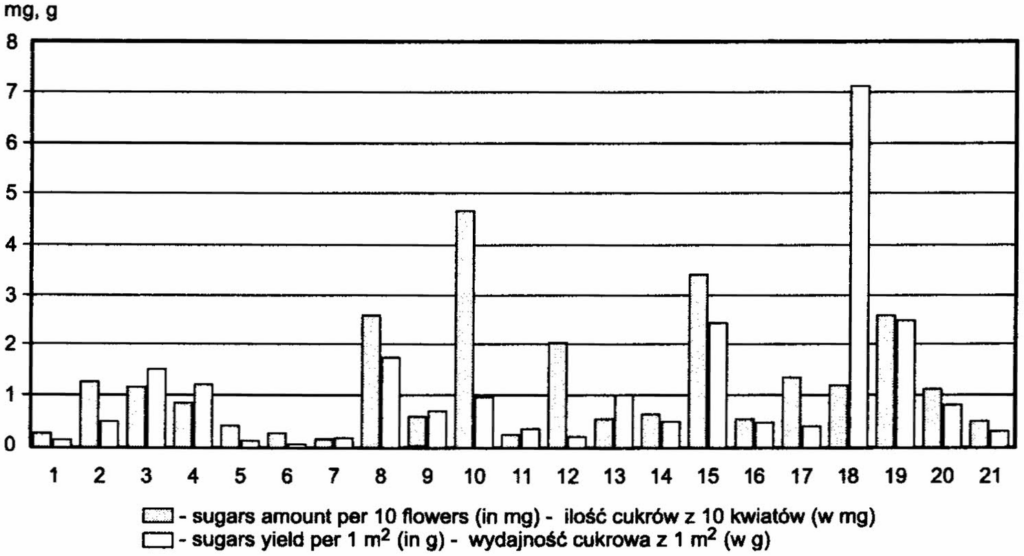
- S. hispanicum
- S. kamtschaticum var. floriferum 'Weihenstephaner Gold’
- S. acre var. calcigenum
- S. acre
- S. stoloniferum
- S. kamtschaticum f. variegatum
- S. album
- S. selskianum
- S. sexangulare
- S. reflexum
- S. album f. murale
- S. kamtschaticum
- S. aizoon
- S. spurium 'Tricolor
- S. spurium 'Purpurteppich’
- S. spurium
- S. caucasicum
- S. spectabile 'Carmen’
- S. telephium ssp. fabaria
- S. ewersii ssp. ewersii
- S. spectabile 'Brilliant’
Also the amounts of sugars secreted in nectar per 10 flowers significantly differed between species. For the most of investigated Sedum (11 species) the value of this feature was low – up to 1 mg/10 flowers. In the case of 5 species, amounts of sugars secreted in nectar were from 1 to 2 mg/10 flowers. Three species supplied 2-3 mg of sugars in nectar per 10 flowers. The highest amounts of sugars were secreted by 10 flowers of S. spurium 'Purpurteppich’ (3.4 mg) and S. reflexum (4.6 mg). Depending on the number of flowers, the amounts of sugars in nectar per 1 inflorescence were from 0.36 mg (S. kamtschaticum) to 238.13 mg (S. spectabile 'Carmen’). The amounts of secreted sugars estimated per 1 m2 of crop ranged from 0.03 g (S. kamtschaticum) to 7.1 g (S. spectabile 'Carmen’) (Fig.1). The concentration of sugars in nectar was high for all studied species and ranged from 60 to 80%.
strona 289DISCUSSION
It was found that sugars yield estimated per 1 ha of crop reached 70 kg for Sedum spectabile 'Carmen’. This value is half the amount reported by Dąbska (1977). The difference may be connected with the fact that her studies concerned representatives of “pure“ species but not the cultivar. The amount of nectar secreted by 10 flowers of S. kamtschaticum F. and M. (3.16 mg) was significantly higher (by over 1/3) than values found for this species by Simidczijev (1962) in Bulgaria conditions. The observations concerning attractiveness of Sedum flowers for pollinators and insects visits on them, are in agreement with results of many investigators studying food sources for honey bees (Rawski 1947a,b, Lipiński 1976, Jabłoński 1995, D’albore 1998) as well as for wild Apoidea (Ruszkowski, Biliński 1986, Ruszkowski et al. 1993, 1994 a,b).
CONCLUSIONS
The stonecrops species (Sedum L.) significantly differ not only in an appearance of plants but also in a time of flowering (June – September), length of flowering period (15-47 days), number of developed flowers (ranged from 1.000 to 59.000 per 1 m2 of plot area) as well as in an abundance of produced nectar (0.2-4.6 mg of sugars secreted in nectar per 10 flowers) and sugars yield per unit of area (1-71 kg/1 ha).
All Sedum are readily visited by honey bees and wild Apoidea (bumblebees and solitary bees), gathering from the flowers both pollen and nectar. Under good weather conditions, insects worked on flowers throughout the day. Pollinators are most numerous on plants in the middle of the day when also flower buds open most abundantly.
The most nectariferous seven species of Sedum can be recommended to cultivate in beekeeping gardens. They are as follow: Sedum acre, S. selskianum, S. reflexum, S. aizoon, S. spurium, S. spectabile, S. telephium. These species can secrete 10 and more kilograms of sugars in nectar per 1 ha of crop during their flowering period and supply continuous food flow for pollinating insects from approximately 10th June till the end of September.
REFERENCES
D’albore G.R. (1998)- Mediterranean Melisopalynology. Institute of Apicultural Entomology, University of Perugia, Italy,: 376.
Dąbska B. (1977)- Wartość pożytkowa rodzaju Sedum. Pszczelarstwo 10: 3-4.
Demianowicz Z., Hłyń M., Jabłoński B., Maksymiuk I., Podgórska J., Ruszkowska B., Szklanowska K., Zimna J. (1960)- Wydajność miodowa ważniejszych roślin miododajnych w warunkach Polski. Cz. I. Pszczeln. Zesz. Nauk. 4(2): 87-103.
strona 290Jabłoński B., Szklanowska K. (1979).- Propozycje zmiany metody badań nektarowania roślin. Pszczeln. Zesz. Nauk., 23: 105-165.
Jabłoński B. (1995)- Rozchodnik amurski – miododajna roślina ozdobna. Pszczelarstwo, 46(1):9.
Lipiński M. (1976)- Pożytki pszczele, zapylanie i miododajność roślin. PWRiL, Warszawa,: 173, 272.
Rawski W. (1947)- Pożytek pszczeli cz. I Miododajne rośliny uprawne. Wydawnictwo Ex Libris, Warszawa,: 175.
Rawski W. (1947)- Pożytek pszczeli cz. II. Rośliny miododajne dzikie. Wydawnictwo Ex Libris, Warszawa,: 59-60.
Ruszkowski A., Biliński M. (1986)- Rośliny pokarmowe oraz znaczenie pokarmowe murarek (Osmia Pz., Hoplitis Klug, Anthocopa Lep. – Hymenoptera, Megahilidae). Pszczeln. Zesz. Nauk. 30: 63-88.
Ruszkowski A., Gosek J., Wojdaszka J. (1993)- Rośliny pokarmowe samotki pospolitej – Hylaeus communis Nylander (Hymenoptera, Apoidea, Collectidae) Pszczeln. Zesz. Nauk. 37: 209-216.
Ruszkowski A., Biliński M., Gosek J., Kaczmarska K. (1994a)- Rośliny pokarmowe i znaczenie gospodarcze smuklika rdzawego – Halictus rubicundus Christ (Apoidea, Halictidae). Pszczel. Zesz. Nauk. 38: 203-210.
Ruszkowski A. Kaczmarska K., Gosek J., Biliński M. (1994b)- Rośliny pokarmowe i znaczenie gospodarcze smuklików (Halictus Latr.) z podrodzajów Seladonia Rob. i Vestitohalictus Blüth. (Apoidea, Halictidae). Ośr. Doradztwa Roln. w Karniowcach, Dział Rolnictwa Ekologicznego, Karniowce, Biuletyn Ekologiczny, 3: 19-34.
Simidczijev T. (1962)- Trachtprobleme und untersuching der trachtmerkale verschiedener Pglansenkategorien. Der XV Internationale Bienenzüchterkongres der Apimondia, Grenoble.
Stephenson R. (1994)- Sedum cultivated stonecrops. Timber Press, Portland, Oregon.
WSTĘPNE WYNIKI BADAŃ KWITNIENIA I NEKTAROWANIA PRZEDSTAWICIELI Z RODZAJU SEDUM L.
Żuraw B.
Streszczenie
W roku 1999 w Lublinie badano kwitnienie, nektarowanie i oblot przez owady pszczołowate 21 taksonów Sedum L.: S. acre L., S. acre L. var. calcigenum, S. aizoon L., S. album L., S. album f. murale Praeg., S. caucasicum (Gras.) Bor., S. ewersii Ledeb. var. ewersii, S. telephium ssp. fabaria Koch, S. hispanicum L., S. kamtschaticum F.&M., S. kamtschaticum (F.& M.) Praeg. var. floriferum 'Weihenstephaner Gold’, S. kamtschaticum
strona 291F.&M. f. variegatum, S. selskianum Regel & Maack, S. sexangulare L., S. spectabile Boreau 'Brilliant’, S. spectabile Boreau 'Carmen’, S. spurium M. Bieb., S. spurium M. Bieb. 'Purpurteppich’, S. spurium M. Bieb. 'Tricolor’, S. stoloniferum Gmel, S. reflexum L. Rośliny rosły na terenie Ogrodu Botanicznego na glebie piaszczysto-gliniastej. W badaniach posługiwano się metodami aktualnie stosowanymi w botanice pszczelarskiej. Obfitość nektarowania badano metodą pipetową.
Stwierdzono, że badane gatunki rozchodnika różnią się między sobą nie tylko wyglądem roślin, ale także porą kwitnienia (czerwiec-wrzesień), długością okresu kwitnienia (15-47 dni), liczbą wytwarzanych kwiatów (1-59 tys. na 1 m2) oraz obfitością nektarowania kwiatów (0,2-4,6 mg cukrów z 10 kwiatów) i wydajnością cukrową z jednostki powierzchni uprawy. (1-71 kg z 1 ha).
Zaobserwowano ponadto, że wszystkie badane gatunki rozchodnika były chętnie odwiedzane przez pszczoły miodne i dziko żyjące owady pszczołowate (trzmiele i pszczoły samotnice), zbierające pyłek i nektar. Przy sprzyjającej pogodzie oblot kwiatów trwa cały dzień, najliczniej w środkowej jego porze, kiedy to najintensywniej też zachodzi proces rozkwitania kwiatów tych roślin.
Do ogródków pszczelarskich można śmiało polecać 7 najobficiej nektarujących gatunków rozchodnika (jak: Sedum acre, S. selskianum, S. reflexum, S. aizoon, S. spurium, S. spectabile, S. telephium), które w ciągu okresu kwitnienia dostarczają 10 i więcej kg cukrów z 1 ha i zapewniają w sumie ciągłość pożytku (taśmy pokarmowej) owadom pszczołowatym od około 10 czerwca do końca września.
Słowa kluczowe: rozchodnik, Sedum L., kwitnienie, nektarowanie, oblot.
Errata — błędy druku znalezione podczas digitalizacji
- s. 289, piśmiennictwo: „Melisopalynology” → Melissopalynology
- s. 290, piśmiennictwo: „Megahilidae” → Megachilidae
- s. 290, piśmiennictwo: „Collectidae” → Colletidae
- s. 290, piśmiennictwo: „untersuching” → untersuchung
- s. 290, piśmiennictwo: „trachtmerkale” → trachtmerkmale
- s. 290, piśmiennictwo: „Pglansenkategorien” → Pflanzenkategorien