

FLOWER-POLLINATING INSECTS OF 32 SPECIES FROM LAMIACEAE FAMILY
tekst: Małgorzata Bożek
Pszczelnicze Zeszyty Naukowe, Rok XLIV, Nr 2, 2000 — Małgorzata Bożek
strona 293PSZCZELNICZE ZESZYTY NAUKOWE Rok XLIV, Nr 2 2000
Małgorzata Bożek
Department of Botany, Agricultural Academy, Akademicka 15, 20-950 Lublin
Summary
To recognise the main pollinators of 32 species from Lamiaceae family, the observations on a composition of insects, working on flowers of that plants, were carried out. The following groups of visitors were distinguished: honey bees, bumblebees, solitary bees, flies and butterflies. In 1995-1997 the studies were carried out in the collection of melliferous plants, in the ISK Puławy
It was found that 23 from 32 observed plant species were mainly visited by honeybees which accounted for 46-100% of all pollinators. Honey bees were the principal pollinators of: Marrubium vulgare L., Nepeta nuda L., Pycnanthemum californicum Torr., Elsholtzia cristata Willd., Lavandula angustifolia Mill., Origanum vulgare L., Hyssopus officinalis L., Agastache anethiodora (Pursh.) Kuntze, Leonurus sibiricus L., Salvia nemorosa L., Satureja hortensis L., Salvia officinalis L., Agastache nepetoides (L.) Kuntze, Physostegia virginiana Benth., Nepeta cataria L. var citriodoris Dum., Salvia verticillata L., Leonurus cardiaca L., Dracocephalum moldavicum L., Phlomis tuberosa L., Ballota nigra L., Mentha piperita L., Agastache rugosa Kuntze and Stachys recta L. The contribution of the other groups of pollinators varied, depending on plant species.
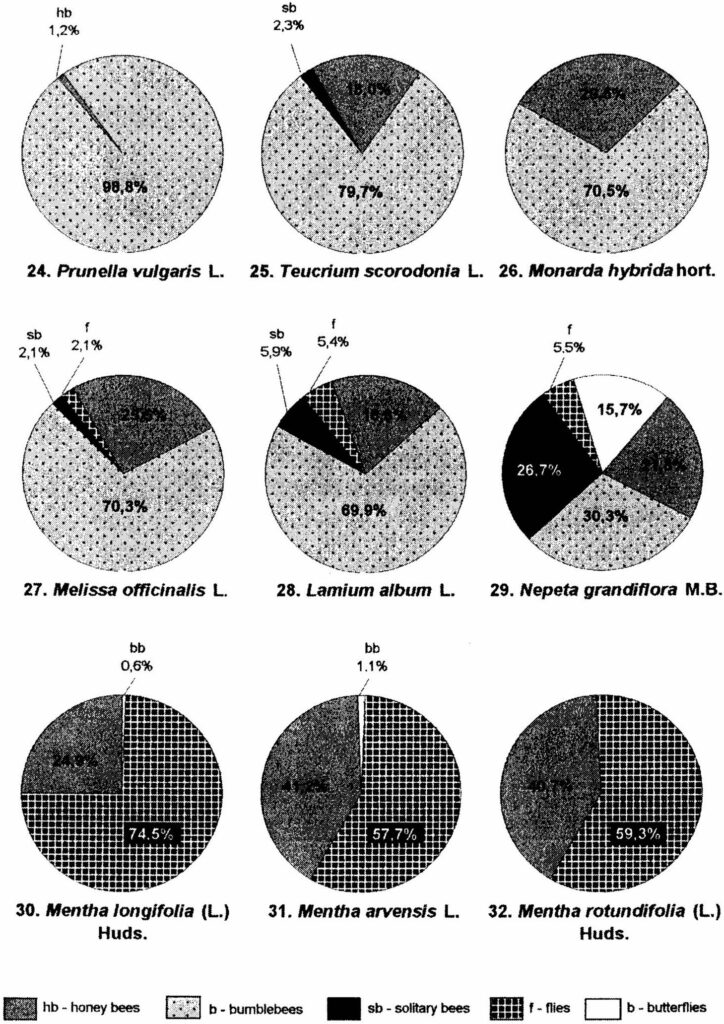
Bumblebees were the main pollinators of Prunella vulgaris L. (99% of all visitors), Teurcium scorodonia L. (80%), and Monarda hybrida hort., Melissa officinalis L. and Lamium album L. (approx. 70%). Flies mainly occurred on Mentha L. flowers. They were 74,5% of all visitors of M. longifolia (L.) Huds. and approx. 58-59% of pollinators of M. rotundifolia (L). Huds. and M. arvensis L. The percentage of honeybees was also high and ranged from 25 to 41%. Flowers of M. piperita L. were more attractive for honeybees (55%) than for flies (43%). Every year, only Nepeta grandiflora M. B. was visited similarly abundantly by bumblebees (30%), solitary bees (27%), honeybees (22%), but less frequently by butterflies (16%) and flies (approx. 5%).
Keywords: Lamiaceae, forage by bees, bee flow
INTRODUCTION
In Lamiaceae family there are numerous species supplying a food flow for honeybees and wild pollinating insects. However, specific structures and different sizes of these plants’ flowers cause that they are visited by particular groups of pollinators (Faegri and van der Pijl 1979, Ricciardelli 1983, Lipiński 1982, Cruden et al. 1984, Tanacs and Gulyas 1986, Petanidou and Vokou 1993). According to Jabłoński and Szklanowska (1997) the ratios of pollinating insects on plants depend not
strona 294only on a degree of plant-insects adaptation. The important factors are the weather conditions affecting a flowering process and nectar production in plants as well as flight conditions for insects. The occurrence of different groups of pollinators in a particular area also plays significant role.
The aim of this paper is to determine a percentage of various groups of insects pollinating 32 plants species from Lamiaceae family cultivated in the same conditions.
MATERIAL AND METHOD
In the years 1995-1997 investigations were carried out in a melliferous plants collection in the ISK Puławy. Thirty-two species from 23 genera from Lamiaceae family were observed (Fig. 1, Nos. 1 to 32). The area of experimental plots ranged from 4 to 6(8) m2. During a blooming period plants of all species covered the soil surface with a dense carpet. Fertiliser (2-3 kg a-1) was applied once in springtime. During summer the plots were weeded by hand, as needed.
Every year, during 3-5 fine days, in a peak of flowering of each studied species, the insects’ visits on plots were observed. On each experimental plot the 1 m2 area was designated, on which in one-hour intervals (between 4.00h to 21.00h Eastern European Time), the simultaneously foraging insects were counted. The following groups of pollinators were distinguished: honey bees, bumblebees, solitary bees, flies and butterflies.
RESULTS
The mean values obtained in the course of 3 years of study allowed to determine the percentage of main insects that visited each of 32 investigated plant species (Fig. 1) as well as to classify all observed plants into 3 groups, depending on their principal pollinator. The first group (I group) contains species flowers of which are visited mainly by honeybees. The majority of studied plants belong to this group (Fig.1, Nos. 1 to 23). Honey bees definitely dominated on flowers of Marrubium vulgare, Nepeta nuda, Pycnanthemum californicum, Elsholtzia cristata, Lavandula angustifolia and Origanum vulgare where they were almost 100% of all visiting insects. These insects were approx. 90% of pollinators of Hyssopus officinalis, Agastache anethiodora, Leonurus sibiricus, Salvia nemorosa, Satureja hortensis, Salvia officinalis, Agastache nepetoides and Physostegia virginiana flowers. However, the flowers of Nepeta cataria var. citriodoris, Salvia verticillata, Leonurus cardiaca and Dracocephalum moldavicum, pollinated by honeybees in approx. 80%, were also attractive to bumblebees (15-20% of all visiting insects) and to a few flies (1-5% of insects). On the plants of Phlomis tuberosa and Ballota nigra honeybees were 60-70% of foraging insects, but also
strona 295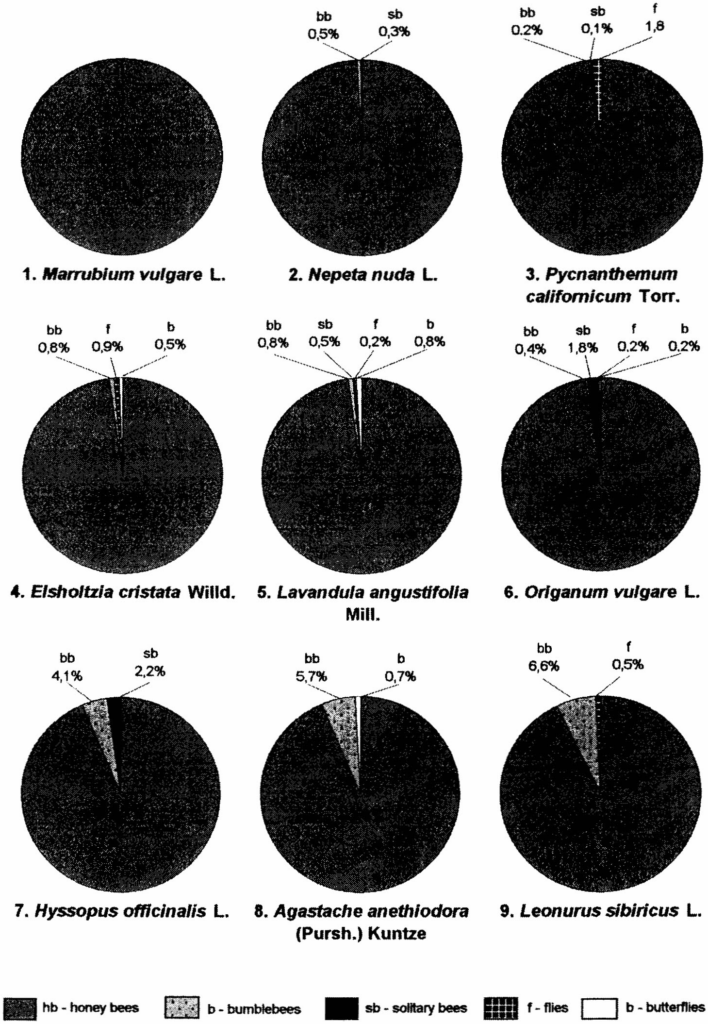
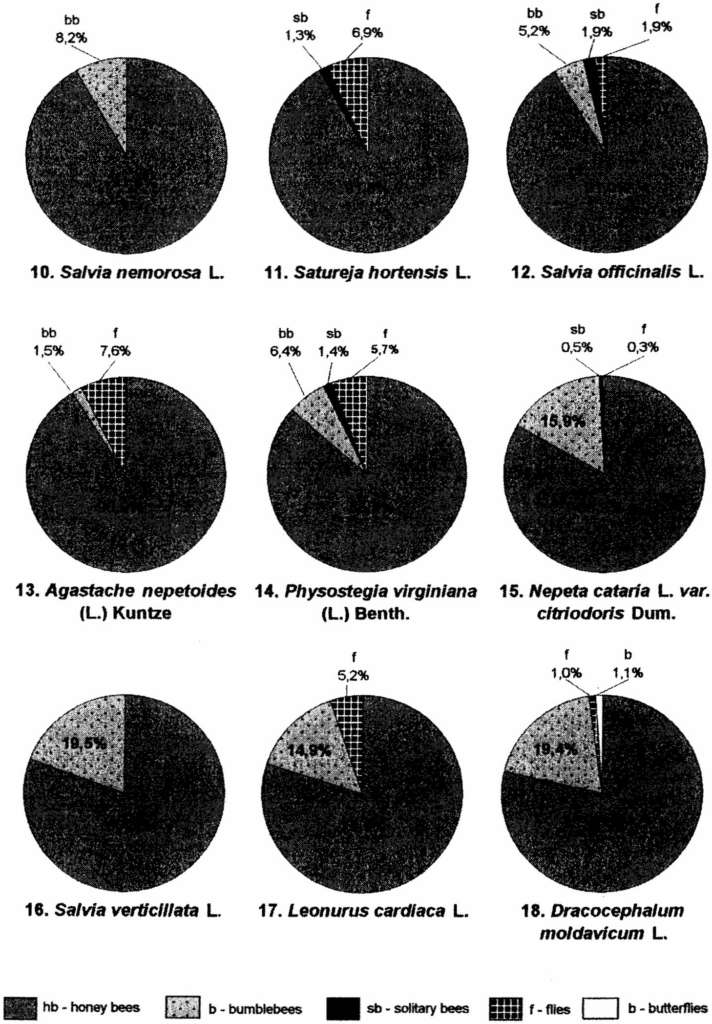
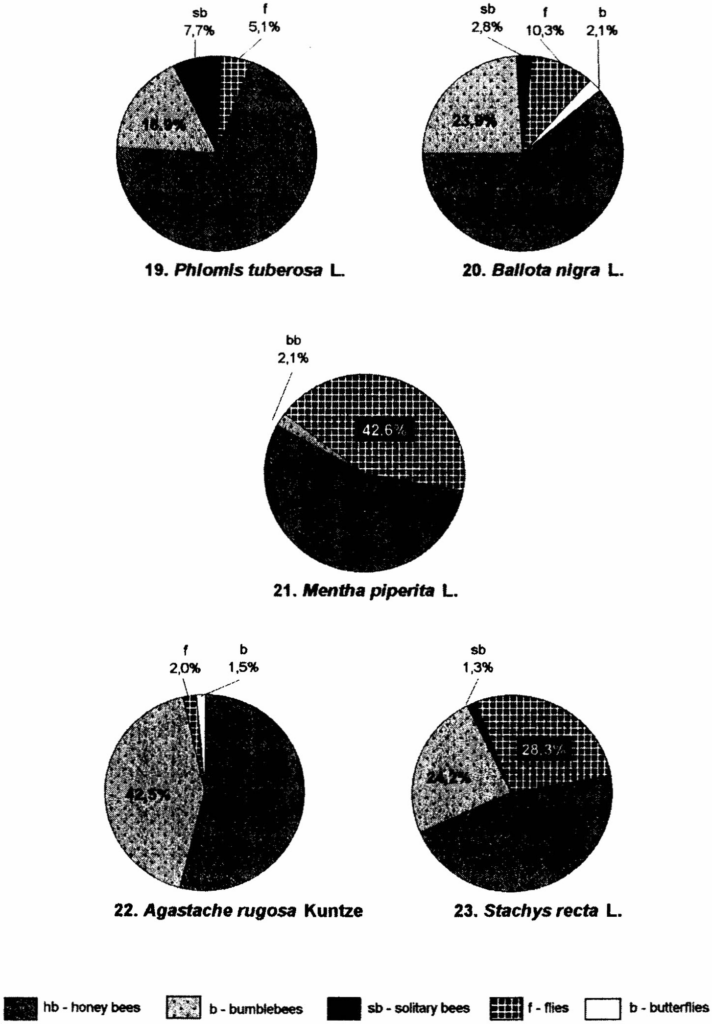
bumblebees (approx. 20%), solitary bees (3-8%), flies (5-10%) and a few butterflies were observed. In the case of Mentha piperita, Agastache rugosa and Stachys recta honeybees were still principal pollinators but their percentage was lower and reached 46-55% of all insects. However, on those plants flies and bumblebees were relatively numerous.
Into the second group (group II) can be included plants visited mainly by bumblebees (Fig. 1, Nos. 24 to 28): Prunella vulgaris (98.8%), Teucrium scorodonia (79.7%), Monarda hybrida (70.5%), Melissa officinalis (70.3%), Lamium album (69,9%). The contribution of the other insects ranged from 1 to 20(30)%. Exceptionally, on flowers of Nepeta grandiflora (Fig. 1, Nos. 29) all groups of pollinating insects occurred in a higher percentage. This species was almost equally frequently visited by bumblebees (30,3%), solitary bees (26.7%), honey bees (21.8%) while butterflies (15.7%) and flies (5.5%) were less abundant. On flowering plants the following species of bumblebees were observed: Bombus terrestris, B. lucorum, B. lapidarius, B. pascuorum, B. ruderarius, B. pratorum and B. hypnorum.
The third group (group III) includes plants visited mainly by flies. Here belong species from the genus Mentha L. (Fig. 1, Nos. 30 to 32). The contributions of flies as pollinators of Mentha longifolia, M. rotundifolia and M. arvensis were 74.5%, 59.3% and 57.7%, respectively. The percentage of honey bees was also high and ranged from 25 to 41%. Bumblebees occurred rather sporadically (0.6-1.1%). They were never observed on flowers of M. rotundifolia. Only flowers of M. piperita were more attractive for honeybees (55.3% of all pollinators) than for flies (42.6% of visiting insects). So this species, as the only one from Mentha genus, is included into group I (Fig. 1, Nos. 21).
The contribution of honey bees as pollinators of studied representatives of genera Agastache Clayton ex Gronov., Salvia L. and Nepeta L. varied. Among 3 species of Agastache (Fig. 1, Nos. 8, 13, 22) honeybees were observed mainly on A. anethiodora and A. nepetoides, where they were over 90% of all foraging insects. However, those bees were less abundant of A. rugosa flowers (54.0%), but bumblebees (42.5%) always frequently visited this species. It may be connected with the long floral tube characteristic of A. rugosa flowers which makes nectar hardly accessible for honey bees but easily obtainable for bumblebees. All studied species of Salvia were preferred by honeybees (Fig. 1, Nos. 10, 12, 16). Their percentage on S. nemorosa and S. officinalis flowers was approx. 91% of all insects while on S. verticillata it was 80.5%. Additionally, S. verticillata flowers were also frequently visited by bumblebees (19.5%) which worked on S. nemorosa and S. officinalis only sporadically (5-8%). Solitary bees and flies occurred rarely (1.9% of insects) only on plots where S. officinalis grew.
strona 300Flowers of three Nepeta species were also unequally attractive for different group of pollinating insects (Fig. 1, Nos. 2, 15, 29). Honeybees foraged most readily on N. nuda and N. cataria var. citriodoris (83-99%). On flowers of N. grandiflora, where nectar is deeply hidden, honeybees were only 21.8 % of all visiting insects.
DISCUSSION
Flowers of 32 observed Lamiaceae species were visited and pollinated by: honey bees, bumblebees, solitary bees, flies and rarely by butterflies. Such different groups of pollinators were reported earlier in papers concerning pollination aspects in Lamiaceae family (Ricciardelli 1983, Cruden et al. 1984, Tanacs and Gulyas 1986, Herrera 1990, Petanidou and Vokou 1993). In Puławy, where experimental plants were grown and honey bees occurred abundantly, the workers of honey bees were the principal pollinators for 23 of investigated Lamiaceae species. The data obtained for Nepeta nuda, Origanum vulgare, Lavandula angustifolia, Satureja hortensis, Pycnanthemum californicum, Agastache anethiodora, Salvia officinalis correspond with earlier observations made by (1989-1997) and Riccardelli (1983).
The data concerning plants recognised in this study as definitely preferred by bumblebees (Prunella vulgaris, Teurcium scorodonia, Monarda hybrida, Lamium album) are in agreement with results reported by other authors (Lipiński 1982, Ruszkowski at al. 1997ab, Wróblewska 1999).
Flies worked most readily on flowers of Mentha longifolia, M. arvensis and M. rotundifolia. Those three species were also visited abundantly by honeybees. In the case of Mentha piperita honeybees were even predominant. The attractiveness of Mentha flowers to flies was described by Faegri and van der Pijl (1979). Lipiński (1982) highlights that if Mentha plants grow on bigger areas their flowers may attract also honeybees. Jabłoński (1989a) observed frequent visits of honeybees on flowers of Mentha piperita and M. longifolia.
CONCLUSIONS
The contribution of different groups of insects pollinating 32 studied species from Lamiaceae family varied. In the case of 23 species predominant pollinators were honeybees. They were from 46 to 100% of all insects visiting flowers of those plants.
Bumblebees visited mainly 5 Lamiaceae species (70-99% of all insects) whereas flies were principal pollinators only for 3 species (60-75%). Solitary bees and butterflies occurred sporadically.
strona 301REFERENCES
Cruden R. W., Hermanutz L., Shuttleworth J. (1984)- The pollination biology and breeding system of Monarda fistulosa (Labiatae). Oecologia, 64(1):104-110.
Faegri K., van der Pijl (1979)- The Principles of Pollination Ecology. Pergamon Press, Oxford: 291.
Herrera C.M. (1990)- Daily patterns of pollinator activity, differential pollinating effectiveness, and floral resource availability, in a summer-flowering Mediterranean shrub. Copenhagen, Oikos., 58:277-288.
Jabłoński B. (1989a)- Mięta długolistna – roślina miododajna na wilgotne nieużytki. Pszczelarstwo, 40(2):6-7.
Jabłoński B. (1989b)- Kłosowiec fenkułowy – nowa roślina miododajna. Pszczelarstwo, 40(4):4-6.
Jabłoński B. (1989c)- Miododajność kocimiętki nagiej. Pszczelarstwo, 40(10-12):5-6.
Jabłoński B. (1990a)- Nektarowanie lebiodki pospolitej. Pszczelarstwo, 41(5):7-8.
Jabłoński B. (1990b)- Nektarowanie mięty pieprzowej. Pszczelarstwo, 41(11-12):8-9.
Jabłoński B. (1992)- Wartość pszczelarska lawendy. Pszczelarstwo, 43(11):10-11.
Jabłoński B. (1994)- Tulia kalifornijska – roślina pożytkowa końca lata. Pszczelarstwo, 45(1):11.
Jabłoński B. (1997)- Cząber ogrodowy – roślina przyprawowa, lecznicza i miododajna. Pszczelarstwo, 48(1):8.
Jabłoński B., Szklanowska K. (1997)- Wpływ niektórych czynników pogody na kwitnienie, nektarowanie, pylenie i oblot przez owady zapylające entomofilnych roślin uprawnych. I Ogólopolska Konferencja Naukowa „Biologia Kwitnienia, Nektarowania i Zapylania Roślin”, 13-14 listopada, Lublin: 53-58.
Lipiński M. (1982)- Pożytki pszczele, zapylanie i miododajność roślin. PWRiL, Warszawa : 425.
Petanidou T., Vokou D. (1993)- Polination ecology of Labiatae in a phygranic (East Mediterranean) ecosystem. American Journal of Botany, 80(8):892-899.
Ricciardelli D’Albore G. (1983)- Wild insects and honeybees as pollinators of some Labiatae of herbal interest (Origanum majorana, Origanum vulgare, Rosmarinus officinalis, Salvia officinalis, Salvia sclarea.) in a specialized area. Redia., 66:283-293.
Ruszkowski A., Zadura M., Biliński M. (1997a)- Wiosenny wzorzec składu gatunkowego trzmieli (Bombus Latr.) na różnych roślinach. Pszczeln. Zesz. Nàuk., 41:43-51.
strona 302Ruszkowski A., Zadura M., Biliński M., Gosek J., Kaczmarska K., Wojdaszka J. (1997b)- Letni wzorzec składu gatunkowego trzmieli (Bombus Latr.) na różnych roślinach. Pszczeln. Zesz. Nauk., 41:53-62.
Tanacs L., Gulyas S. (1986)- The role of the flood area and slopes of dam of the river Tisza in feeding wild bees. Acta Biologica Szeged., 32:103-120.
Wróblewska A. (1999)- Monarda hybrida hort. jako źródło pożytku dla owadów. Bibliotheca Fragmenta Agronomica. Polish Society of Agrotechnical Sciences, Lublin, 6(99):169-172.
OWADY ZAPYLAJĄCE NA KWIATACH 32 GATUNKÓW Z RODZINY LAMIACEAE
Bożek M.
Streszczenie
W rodzinie Lamiaceae jest wiele cennych roślin dostarczających pożytku pszczole miodnej i dzikim owadom zapylającym. Jednak specyficzna budowa i zróżnicowana wielkość kwiatów tych roślin decyduje, że odwiedzane są przez określone grupy owadów. W niniejszej pracy postanowiono określić procentowy udział poszczególnych grup owadów zapylających (pszczoły miodne, trzmiele, pszczoły samotnice, muchówki i motyle) 32 gatunki z rodziny Lamiaceae uprawianych w tych samych warunkach. Badania prowadzono w latach 1995-1997 na terenie ISK w Puławach w kolekcji roślin miododajnych. Na doświadczalnych poletkach wyznaczano powierzchnię 1 m2, na której rokrocznie przez 3-5 pogodnych dni w okresie pełni kwitnienia każdego gatunku rośliny, liczono co godzinę od 4 do 21 (czasu wschodnio-europejskiego) pracujące owady.
Stwierdzono, że spośród wytypowanych 32 gatunków aż 23 odwiedzała głównie pszczoła miodna, na których udział jej w ogólnej liczbie zapylaczy wynosił od 46-100%. Zdecydowanie dominowała ona (87-100%) na kwiatach Marrubium vulgare L., Nepeta nuda L., Pycnanthemum californicum Torr., Elsholtzia cristata Willd., Lavandula angustifolia Mill., Origanum vulgare L., Hyssopus officinalis L., Agastache anethiodora (Pursh.) Kuntze, Leonurus sibiricus L., Salvia nemorosa L., Satureja hortensis L., Salvia officinalis L., Agastache nepetoides, a także Physostegia virginiana Benth. Kwiaty natomiast Nepeta cataria L. var citriodoris, Salvia verticillata L., Leonurus cardiaca L., Dracocephalum moldavicum L., Phlomis tuberosa L. i Ballota nigra L. pszczoła miodna odwiedzała w 61-83% sumy wszystkich obserwowanych owadów. Na poletkach z uprawianą Mentha piperita L., Agastache rugosa Kuntze i Stachys recta L. pszczoła miodna również przeważała, ale jej udział w oblotach był już niższy i wynosił 46-55% ogólnego składu zapylaczy. Pozostałe grupy owadów stanowiły różny procent w zależności od gatunku rośliny.
Trzmiele najliczniej, prawie w 100% odwiedzały kwiaty Prunella vulgaris L., w 80% Teurcium scorodonia L., i w około 70% Monarda hybrida hort., Melissa officinalis L. i Lamium album L. Muchówki natomiast głównie obserwowano tylko na roślinach z rodzaju Mentha L., wśród których kwiaty M. longifolia (L.) Huds. były odwiedzane przez te owady w 74.5%, a M. rotundifolia (L.) Huds. i M. arvensis L. w około 58-59%.
strona 303Pozostały udział, także wysoki (41-25%) na tych trzech przedstawicielach, niemal w całości przypadał pszczole miodnej. M. piperita L. okazała się natomiast nieco bardziej atrakcyjna dla pszczoły miodnej (55%) niż dla muchówek (43%). Kwiaty Nepeta grandiflora M. B. wyjątkowo odwiedzały w większym procencie wszystkie grupy owadów i tak co roku prawie jednakowo licznie oblatywały je trzmiele (30%), pszczoły samotnice (27%), pszczoła miodna (22%), słabiej motyle (16%) i muchówki (około 5%).
Słowa kluczowe: wargowe, owady zapylające.
Errata — błędy druku znalezione podczas digitalizacji
- s. 293, 300, 302: „Teurcium” → Teucrium
- s. 300: „Riccardelli” → Ricciardelli
- s. 300: „at al.” → et al.
- s. 301, piśmiennictwo: „Ogólopolska” → Ogólnopolska
- s. 301, piśmiennictwo: „Nàuk.” → Nauk.
- s. 301, piśmiennictwo: „Polination” → Pollination
- s. 301, piśmiennictwo: „phygranic” → phryganic