

THE PRELIMINARY STUDIES ON FLOWERING BIOLOGY AND MELLIFEROUS VALUE OF THREE PERENNIAL SPECIES FROM LAMIACEAE FAMILY
tekst: Marzena Masierowska, Katarzyna Krzysiak
Pszczelnicze Zeszyty Naukowe, Rok XLIV, Nr 2, 2000 — Marzena Masierowska, Katarzyna Krzysiak
strona 245PSZCZELNICZE ZESZYTY NAUKOWE Rok XLIV, Nr 2 2000
Marzena Masierowska, Katarzyna Krzysiak
Department of Botany, Agricultural University of Lublin, Akademicka 15, 20-950 Lublin, Poland
Summary
In 1998 preliminary studies on flowering biology (the longevity and abundance of flowering, seasonal and diurnal dynamics of flower opening, life span of open-pollinated flower) as well as on the nectar secretion of Nepeta melissifolia Lam., Salvia glutinosa L. and Salvia przewalskii Maxim. were conducted in Lublin area, south eastern Poland. The frequency of visiting flowers by insects was recorded, too.
The investigated species were blooming between the middle of June and the end of September. Some plants of S. glutinosa grown in the shade extended their flowering till autumn frosts in October. The length of flowering period ranged from 45 to 105 days for S. przewalskii and S. glutinosa, respectively. The studied perennials were characterised by abundant flowering. The mean number of flowers formed per one plant reached 838 for N. melissifolia. Flowers of all species lived 1.5 to 2 days, on average. Flower buds opened from 6:00 h till 18:00 h, with the peak at 13:00 h (S. glutinosa, N. melissifolia) or about 15:00 h (S. przewalskii).
The nectar secretion started in a loose bud stage but the process was the most intensive at the first day of anthesis, when the anthers dehisced. Flowers of studied Salvia produced nectar more abundantly in comparison to small flowers of N. melissifolia, 62.2-106.4 mg and 28.9 mg per 10 flowers, respectively. In all species the sugar concentration of nectar was high and ranged from 34.4% to 50.6%. Ten flowers of S. przewalskii secreted 36.5 mg sugars in nectar while 10 flowers of N. melissifolia provided only 9.6 mg of sugars. However, the melliferous value expressed as the amount of sugars per 1 ha of crop was highest for N. melissifolia, which was influenced by very abundant flowering of this species.
The principal pollinators of investigated perennials were bumblebees. Honeybees occurred only on N. melissifolia. Moreover, flowers of this species were visited the most frequently. In the peak hours 18 foraging insects on 1 m2 of plot were observed.
Keywords: Nepeta, Salvia, flowering, nectar, honey plant.
INTRODUCTION
In the flora of Poland almost 80 species, both annuals and perennials, represent the Lamiaceae family. Numerous species from this family are nectariferous (Demianowicz 1962, Demianowicz et al. 1963). Large quantity of nectar secreted by their flowers is an important attractant for many pollinators such as honeybees, bumblebees and solitary bees. Pollen is
strona 246produced rather in small amounts. Nectar is secreted at the base of ovary and fills the bottom part of the tube formed by the lower part of blossom (Faegri and van der Pijl 1979).
Species from Lamiaceae family such as: Salvia pratensis, Prunella vulgaris, Mentha piperita, M. longifolia, Thymus serphyllum are common components of natural plant communities, estimated as valuable bee forages (Lipiński 1982). Some Salvia and Nepeta species can be also planted in gardens, staying decorative for a long time and improving food sources for pollinating insects.
The aim of the present study was to compare the biology of flowering as well as to determine the nectar production in three Lamiaceae ornamental species melliferous value of which is completely unknown. The frequency of insect visits was observed, too.
MATERIAL AND METHODS
In 1998 season the preliminary field studies were carried out in Lublin, southeastern Poland. Three perennial species from Lamiaceae family were selected for this research: 1) Nepeta melissifolia Lam.- plants with abundant, small blue flowers with small red spots, covered with grey hairs, 2) Salvia glutinosa L. – commonly occurred in Central and South Europe; plants with dull-yellow flowers, densely covered with sticky glands emitting balsamic scent, 3) Salvia przewalskii Maxim. – originated from North China, developing blue purplish flowers.
The studied plants grew on a loess-originated soil, in the Botanical Garden of the UMCS.
During the vegetation season the time and length of flowering period, life span of free pollinated flowers as well as the seasonal and diurnal dynamics of flowers opening were observed. To determine the diurnal dynamics of flower opening the number of opened flowers on plant was counted every hour during a day. The data are expressed as a percentage of the total number of all flower buds opened throughout a day. All observations concerning the flowering biology were carried out on 6 plants (replications) of each species.
The abundance of flowering was determined by counting the number of flowers developed during the flowering period on one plant (as an average of 10 plants) and per 1m2 of a plot.
The amount of nectar secreted throughout a lifetime of isolated flowers was tested by the pipette method (Jabłoński and Szklanowska 1979). For each species, nectar samples were collected twice a season, each time in seven replications. Particular sample contained nectar gathered from 5 (Salvia) to 20 (Nepeta) flowers. Measurements of sugar concentrations of nectar were carried out with the Abbe refractometer. Then, from the nectar amount and the sugar content of nectar the sugar amount (in mg) secreted in nectar per 10
strona 247flowers was calculated. The sugar yield of nectar was also expressed in kilograms per 1 ha of crop.
The frequency of pollinators’ visits to the flowers of observed plants was recorded. The number and composition of visitors on all opened flowers on 1m2 of plot area was recorded in an hour intervals from 8:00 h till 18:00 h (East European Summer Time, GMT+2h), throughout 3 days of peak flowering period.
The nectar production as well as the visits of insects to flowers were studied on plants grown in a sunny situation.
RESULTS
Biology and abundance of flowering
In 1998 the flowering of investigated species occurred during a summer and early autumn time in Lublin climatic conditions (table 1). N. melissifolia was the first to flower – at the beginning of June. Then, one week later the flowering of both studied Salvia species began. The blooming of S. przewalskii was short (45 days) and terminated at the end of July. Plants of N. melissifolia ended to bloom at the beginning of September while S. glutinosa finished the flowering at the end of September. It was observed that in a shade, plants of S. glutinosa kept their flowers opened until first ground frosts occurred in October. In general, the total length of flowering period of S. glutinosa and N. melissifolia was very extended (table 1). Flowers of N. melissifolia developed most abundantly between the 3^rd and the 7^th week of flowering. In the case of S. przewalskii the peak of bloom occurred in the second week of flowering and lasted only 7 days. Most flowers of S. glutinosa opened between 10^th July and 20^th August.
It was observed that during the day, flowers of both Salvia species opened from 6:00 h till18:00 h (E.E. Summer Time, GMT+2h) while flower buds of N. melissifolia started to open even before 6:00 h. The peak of flower opening occurred at 13:00 h for N. melissifolia and S. glutinosa and was 2 hours late in the case of S. przewalskii (figure 1). The life span of free-pollinated flowers was similar for all species (table 1) – 1.5 to 2 days.
The studied perennials were characterised by abundant flowering (table 1). For N. melissifolia the mean numbers of flowers formed per plant and per 1m2 of plot area reached 838 and 70,392, respectively. In the case of S. glutinosa the abundance of flowering was strongly influenced by plants situation. In a shade plants developed seven times less flowers when compared to plants which grew in a sunny situation (table 1).
strona 248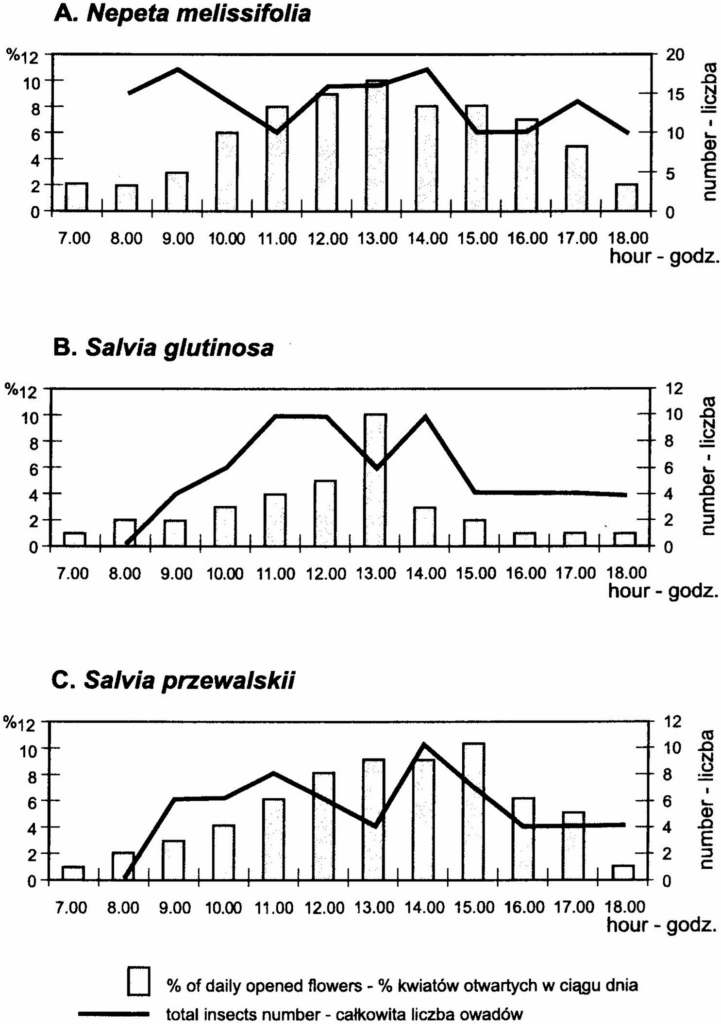
Table 1 The flowering period, life span of one flower and abundance of flowering of studied Lamiaceae species in the 1998 season – Okres i obfitość kwitnienia oraz długość życia pojedynczego kwiatu badanych przedstawicieli rodziny wargowych w roku 1998
| Species – Gatunek | Time of flowering / Pora kwitnienia | Lenght of flowering period in days – / Długość okresu kwitnienia w dniach | Life span of one flower in days / Długość życia 1 kwiatu w dniach | Mean flowers number per — Średnia liczba kwiatów na: 1 plant / 1 roślinie | Mean flowers number per — Średnia liczba kwiatów na: 1 m2 – 1m2 |
|---|---|---|---|---|---|
| Nepeta melissifolia | 9.VI – 2.IX | 88 | 2.0 | 838 | 70392 |
| Salvia glutinosa | 15.VI – 30. IX (31. X)* | 105 | 1.5 | 361 (49)* | 16240 (980)* |
| Salvia przewalskii | 16.VI – 30.VII | 45 | 1.5 | 221 | 5967 |
- data for plants grown in a shade situation
- dane dla egzemplarzy rosnących w cieniu)
Nectar secretion
All observed perennials are nectariferous. Nectar secretion starts in a loose bud stage but the process is the most intensive on the first day of anthesis, when anthers dehisced. The amounts of produced nectar were high and reached 106.4 mg per 10 flowers (S. przewalskii) (table 2). In general, flowers of investigated Salvia species secreted nectar more abundantly in comparison to small flowers of N. melissifolia . Ten flowers of S. przewalskii and S. glutinosa produced, on average, 3.7 – times and 2.2 – times bigger weights of nectar than the same number of N. melissifolia flowers. In all species the mean values of sugar content of nectar were high and ranged from 34.4% to 50.6% (table 2).
Table. 2 The averages of nectar amount, weight of sugars secreted in nectar, sugars content in nectar and sugar yield of studied Lamiaceae in 1998 — Średnia masa nektaru i cukrów wydzielonych w nektarze oraz koncentracja nektaru i wydajność cukrowa badanych gatunków z f. Lamiaceae w 1998 r.
| Species – Gatunek | Amount (per 10 flowers in mg) of — Masa (z 10 kwiatów w mg): nectar / nektaru | Amount (per 10 flowers in mg) of — Masa (z 10 kwiatów w mg): sugars * – (mean±SD) / cukrów * / (średnia ± odchylenie standardowe | Sugars content in nectar (%) / Koncentracja nektaru w % | Sugars yield per 1 ha of crop (in kg) / Masa cukrów z 1ha nasadzenia w kg |
|---|---|---|---|---|
| Nepeta melissifolia | 28.9 | 9.6^c + 4.12 | 34.4 | 678 |
| Salvia glutinosa | 62.2 | 27.8^b + 4.31 | 50.6 | 451 |
| Salvia przewalskii | 106.4 | 36.5^a + 6.53 | 36.4 | 217 |
*different latters inside the column denote significant differences,Tukey test , p<0.01
- wartości średnie oznaczone tą samą literą nie różnią się istotnie, Tukey test, p<0.01
The results of one-way analysis of variance and HSD Tukey test showed that the mass of sugars secreted in nectar per 10 flowers was significantly dependent upon the species (F=105.34, df=2, p<0.01). The amounts of sugars secreted in nectar by 10 flowers of both Salvia species were several times higher than values obtained for 10 flowers of N. melissifolia (table 2). Ten flowers of S. przewalskii secreted 36.5 mg of sugars in nectar while the same number of N. melissifolia flowers produced only 9.6 mg of sugars. However, when the amounts of secreted sugars were calculated per 1 ha of crop, the highest value- 678 kg per 1 ha, was found for that last species, which was the effect of very abundant flowering of Nepeta plants.
Insect visits
Flowers of studied species were visited mainly by bumblebees. Honeybees were more numerous only on N. melissifolia. Moreover, insects visited those flowers more frequently when compared to Salvia species. They collected both nectar and pollen. In the peak hours 18 foraging insects per 1m2 of plot were observed while for Salvia species the highest number of pollinators was 10 per 1m2 (figure 1).
In all species an increasing number of flowers opened freshly during the day affected the intensification of foraging flowers by insects (figure 1).
DISCUSSION AND CONCLUSIONS
In the conditions of south eastern Poland the observed Lamiaceae species flowered from the middle of June till the end of July. Only S. przewalskii terminated blooming at the end of July. Plants of S. glutinosa developed flowers continuously throughout 105 days. Such long lasting flowering of this species was reported earlier by Szafer et al. (1967), Broda and Mowszowicz (1996) and Rutkowski (1998). The flowering period of N. melissifolia was twice longer than it was reported for this species by Ostrowska (1981) in north eastern Poland. The difference can be connected with move severe climate conditions in that area. In the present study we observed that even the situation where studied perennials were grown significantly influenced both time and abundance of their flowering.
On the basis of this preliminary study the melliferous value of investigated Lamiaceae can be estimated as good. However, the amounts of produced nectar as well as the amounts of sugars secreted in nectar significantly differed between species. These values were higher for the larger flowers of Salvia species. Dafni et al. (1988) stated that three out of nine Labiateae species, with long corolla tubes (Phlomis viscosa, Salvia fruticosa and Salvia hierosolymitana), secreted highest volumes of nectar. They also found that more abundant nectar production might correspond to the large size of nectary. All these morphological features of S. glutinosa, S. przewalskii and N. melissifolia flowers should be additionally analysed in the future studies.
strona 251Flowers of investigated Lamiaceae seem to be a good nectar source mainly to bumblebees. Honeybees occurred only occasionally on small flowers of N. melissifolia. Honeybees do not visit flowers with corolla tubes longer than 10 mm; presumably because their proboscis length is about 6 mm and they may not be able to reach the level of accumulated nectar (Baker and Baker 1983).
The results of the present study indicate that the melliferous value of N. melissifolia is higher when compared to S. przewalskii and S. glutinosa. However, Nepeta flowers produced the smallest amount of nectar and sugars in nectar among investigated species but abundant flowering of this species resulted in the sugar yield of 678 kg per 1 ha. Additionally it was the only species visited by honeybees. However, these are only one-year data and to get a good assessment of the species the studies should be continued in the next few years.
REFERENCES
Baker H. G., Baker J. (1983)- Floral nectar sugar constituents in relation to pollinator type. In Handbook of experimental pollination biology. Eds. C. E. Jones and R. J. Little. Van Nostrand Reinhold Co. New York: 117 – 141.
Broda B., Mowszowicz J., (1996)- Przewodnik do oznaczania roślin leczniczych, trujących i użytkowych. PZWiL W-wa: 751.
Dafni H., Lensky Y., Fahn A. (1988)- Flower and nectar characteristics of nine species of Labiateae and their influence on honeybee visits. Jour. Apicult. Res., (27) 2:103 – 114.
Demianowicz Z. (1962)- O miodach jednogatunkowych 6 przedstawicieli rodziny wargowych. Pszczel. Zesz. Nauk., 6 (2): 75 – 80.
Demianowicz Z., Jabłoński B., Ostrowska W., Szybowski St. (1963)- Wydajność miodowa ważniejszych roślin miododajnych w warunkach Polski. Część II. Pszczel. Zesz. Nauk., 7 (2): 95 – 110.
Faegri K., van der Pijl L. (1979)- The principles of pollination ecology. Pergamon Press, Oxford: 146 -148.
Jabłoński B., Szklanowska K. (1979)- Propozycje zmiany metody badań nektarowania roślin. Pszczel. Zesz. Nauk., 23: 105 -114.
Lipiński M. (1982)- Pożytki pszczele. PWRiL W-wa, Wyd. III: 214 -216, 221 – 227.
Ostrowska W. (1981)- Obserwacje fenologiczne i pszczelarskie roślin nektaro- i pyłkodajnych w warunkach przyrodniczych Siejnika. Maszynopis.
Rutkowski L. (1998)- Klucz do oznaczania roślin naczyniowych Polski niżowej. PWN W-wa: 751.
Szafer Wł., Kulczyński S., Pawłowski B. (1967)- Rośliny polskie. PWN W-wa: 559 -560.
strona 252WSTĘPNE BADANIA NAD BIOLOGIĄ KWITNIENIA I WARTOŚCIĄ POŻYTKOWĄ TRZECH GATUNKÓW BYLIN Z RODZINY WARGOWYCH (F. LAMIACEAE)
Masierowska M., Krzysiak K.
Streszczenie
W 1998 r przeprowadzono wstępne badania nad biologią kwitnienia i nektarowaniem 3 gatunków bylin z rodziny Lamiaceae: Salvia glutinosa L. – szałwia lepka, Salvia przewalskii Maxim. – szałwia Przewalskiego i Nepeta melissifolia Lam. – kocimiętka melisowata. Okazy doświadczalne rosły na glebie lessowej na poletkach w Ogrodzie Botanicznym UMCS w Lublinie.
W trakcie wegetacji przeprowadzono obserwacje pory i długości okresu kwitnienia poszczególnych gatunków. Badano również sezonową i dzienną dynamikę rozwijania się kwiatów na roślinach, a także długość życia swobodnie zapylanego kwiatu. Wszystkie obserwacje dotyczące biologii kwitnienia przeprowadzono na 6 egzemplarzach każdego gatunku, traktując je jako replikacje. W celu oceny i porównania obfitości kwitnienia policzono liczbę kwiatów wytworzonych na pojedynczym egzemplarzu danego taksonu (średnia z 10 roślin) jak również całkowitą liczbę kwiatów rozwiniętych na 1 m2 poletka doświadczalnego. Nektarowanie roślin zbadano metodą pipetową, zbierając jednorazowo porcję nektaru wydzieloną w ciągu całego życia izolowanych kwiatów. Koncentrację cukrów w nektarze oznaczono przy pomocy refraktometru Abbego. Z masy wydzielonego nektaru i stężenia cukrów w nektarze wyliczono przeciętną masę cukrów wydzieloną w nektarze 10 kwiatów poszczególnych gatunków, a następnie masę cukrów uzyskanych z 1 ha jednogatunkowego nasadzenia. Notowano również skład gatunkowy i liczbę owadów pracujących na kwiatach badanych wargowych, przez 3 dni w okresie pełni kwitnienia gatunków przy sprzyjających warunkach pogodowych w godzinach 8^00 – 18^00 czasu letniego. Badania dotyczące nektarowania i intensywności oblotu prowadzono na roślinach rosnących na stanowisku nasłonecznionym.
W warunkach klimatycznych Lublina kwitnienie badanych taksonów miało miejsce w okresie od połowy czerwca do końca września. Długość okresu kwitnienia wahała się od 45 dni (S. przewalskii) do 105 dni (S. glutinosa). Obserwowane wargowe, zwłaszcza N. melissifolia, charakteryzowały się obfitym kwitnieniem. Średnie liczby kwiatów na 1 egzemplarzu i 1m2 poletka wyniosły dla tego gatunku odpowiednio 838 i 70 392 sztuk. W trakcie badań zaobserwowano wyraźny wpływ siedliska na termin i obfitość kwitnienia S. glutinosa. Na okazach rosnących w cieniu kwiaty otwierały się aż do momentu wystąpienia przygruntowych przymrozków w październiku ale jednocześnie średnia liczba kwiatów wytworzonych na 1 egzemplarzu była 7-krotnie niższa w porównaniu do roślin rosnących na stanowisku nasłonecznionym. Przeciętna długość życia nie izolowanego kwiatu dla poszczególnych gatunków była zbliżona i wahała się od 1,5 do 2 dni. Szczytowy okres otwierania się kwiatów przypadał na godziny 13^00 -15^00.
Kwiaty badanych gatunków rozpoczynały sekrecję nektaru już w stadium luźnego pąka ale najintensywniej proces ten zachodził w ciągu pierwszego dnia antezy, gdy pękały pylniki. Zaobserwowano, że drobne kwiaty N. melissifolia produkowały średnio mniej nektaru (28,9 mg/10 kwiatów) niż kwiaty S. przewalskii i S. glutinosa (106,4 i 62,2 mg/10 kwiatów). U wszystkich taksonów koncentracja cukrów w nektarze była wysoka i wahała się od 34,4% do 50,6%. Średnie masy cukrów wydzielonych w nektarze z 10 kwiatów
strona 253różniły się istotnie pomiędzy gatunkami. Najniższą przeciętną masę uzyskano dla N. melissifolia -9,6 mg a najwyższą w przypadku S. przewalskii – 106,4 mg.
Głównymi zapylaczami kwiatów były trzmiele. Pszczoły miodne spotykano sporadycznie wyłącznie na roślinach N. melissifolia. Kwiaty tego gatunku były też najintensywniej oblatywane przez owady. W godzinach szczytowych obserwowano 18 jednocześnie pracujących zapylaczy na 1 m2 poletka. Zbierały one zarówno nektar jak i pyłek.
Wstępne wyniki przeprowadzonych badań wskazują na wyższą, w porównaniu z pozostałymi gatunkami, wartość pożytkową N. melissifolia. Mimo iż drobne kwiaty kocimiętki melisowatej produkowały niewielkie ilości cukrów w nektarze to niezwykle obfite kwitnie tego gatunku sprawiło, że wydajność cukrów z 1 ha nasadzenia sięgnęła 678 kg. Należy jednak podkreślić, że przeprowadzone badania wymagają powtórzenia i kontynuacji w kolejnych sezonach wegetacyjnych.
Słowa kluczowe: Nepeta, Salvia, kwitnienie, nektar, rośliny pożytkowe.
Errata — błędy druku znalezione podczas digitalizacji
- s. 246: „serphyllum” → serpyllum
- s. 249, tab. 1: „Lenght” → Length
- s. 249, tab. 2: „latters” → letters
- s. 250: „move” → more
- s. 250, 251: „Labiateae” → Labiatae
- s. 253, streszczenie: „kwitnie” → kwitnienie