

FLIGHT ACTIVITY OF APIS MELLIFERA FORAGERS AT THE HIVE ENTRANCE DURING 86% ECLIPSE OF SUN
tekst: Jerzy Woyke, Zygmunt Jasiński, Cezary Fliszkiewicz, Halina Woyke
Pszczelnicze Zeszyty Naukowe, Rok XLIV, 2000 — Jerzy Woyke, Zygmunt Jasiński, Cezary Fliszkiewicz, Halina Woyke
strona 239PSZCZELNICZE ZESZYTY NAUKOWE Rok XLIV 2000
Jerzy Woyke*, Zygmunt Jasiński, Cezary Fliszkiewicz, Halina Woyke
Bee Division, Agricultural University – SGGW,166 Nowoursynowska, 02-787 Warsaw, Poland
- e-mail: woyke@alpha.sggw.waw.pl
Data nadesłania – 27 lipiec 2000
Summary
Flight activities of foragers were observed at hive entrances of 10 Apis mellifera mellifera hybrid colonies during 86% eclipse of sun (ES) in Warsaw, 11 August 1999. Foragers leaving and returning to the hive during 5 min were counted. The counts were repeated after each 15 min. The maximal eclipse of sun (MES) of 86% was lower than any at which flight activity was investigated until now. Despite the lower MES, foragers returned to the hives in considerable increased number and left in considerable lower number with the progress of the eclipse. However, contrary to total eclipse, when foragers stopped to leave the hives, as many as 43 to 68% of foragers left the hives at 86% of MES in comparison to the activity on a sunny day. The lowest number of foragers left particular hives between 20 min before to 20 min after MES. In half the number of hives, the number of outgoing foragers increased even at MES. Contrary to total eclipse, as many as 57 – 93% foragers returned to the hives at 86% of MES, in comparison to returning in a sunny day. After MES of 86% the foragers continued to return to the hives in much higher number than after total or 95% of ES. The lowest number of foragers returned to all hives 10 – 50 min after MES of 86%. This indicates that more foragers remained in the field at 86% than at 95% of MES or at total eclipse. All figures showed considerable variation in foragers’ reaction on partial sun eclipse. In five colonies more foragers left the hive 10 – 20 min after the MES than 10 – 20 min before. An increase of up to 4.5 times was observed. Thus, the determining factor of leaving the hives by the foragers from those colonies was not the percentage of sun coverage, but rather the direction of increasing or decreasing of the eclipse.
Keywords: eclipse of sun, flight activity, foragers.
INTRODUCTION
Eclipse of sun exerts a big influence on animal behavior. The most distinct reaction of honey bees is visible during the total eclipse (Lundie 1940, Nakano 1958, Holms 1963, Nitschmann 1999 and Pechhaker 1999). At the total coverage of the sun surface by the moon,
strona 240the foragers stop their activities. Woyke (1954) and Showler (1999) reported that foragers do not stop flight activities at maximal sun coverage of 95% during partial eclipse. However, their activities changed considerable. Till now, it is not known to which extent lower percentage of maximal eclipse of sun influences foragers’ flight activities. Therefore we investigated flight activities of foragers during 86% eclipse of sun. Till now, one to three bee colonies were observed. However, it is interesting to know the variation in the reaction of bees on changing light intensity of the sun. Therefore flight activities were now observed on larger number of bee colonies during partial eclipse of sun.
MATERIALS AND METHODS
We observed the flight activity of foragers from 10 Apis mellifera mellifera hybrid colonies, during partial eclipse of sun. The observations were conducted in Warsaw, August 11, 1999 and started at 10.30 h i. e. 1 h before the beginning of the eclipse of sun and finished at 15.00, h i. e. 1 h after the end of the eclipse. The observations were continued on three colonies up to 16.00 h.
Two people conducted observations on each colony. One person counted the number of foragers leaving the hive during 5 min. The second person counted the number of foragers returning to the hive at the same time. Next a 5 min pause was taken, and the same procedure was conducted on another colony. After 5 min break, counting was repeated on the first colony, and so on. Thus, 15 min expired between the end of one count and the start of the next one at the same bee colony.
For comparison, the observations were repeated on four colonies on 26 August, the first clear day after the eclipse of sun. Results of these observations are described first.
Temperature and relative humidity were measured. The progress of sun eclipse was photographed as well as was recorded by video camera.
RESULTS
1. The eclipse of sun
The eclipse of sun (ES) occurred in Warsaw on August 11, 1999. It started at 11.32 h, the maximum eclipse of sun (MES) of 86% of surface coverage was reached at 12.51 h, and the eclipse finished at 14.09 h. It past 78.5 min from the start to the MES, and the total phenomenon of ES lasted 2.37 h. At the beginning of observations, at 10.30 h the sky was partly covered with cumulus clouds. At 11.20 h (before the start of ES) a dark thick cloud covered
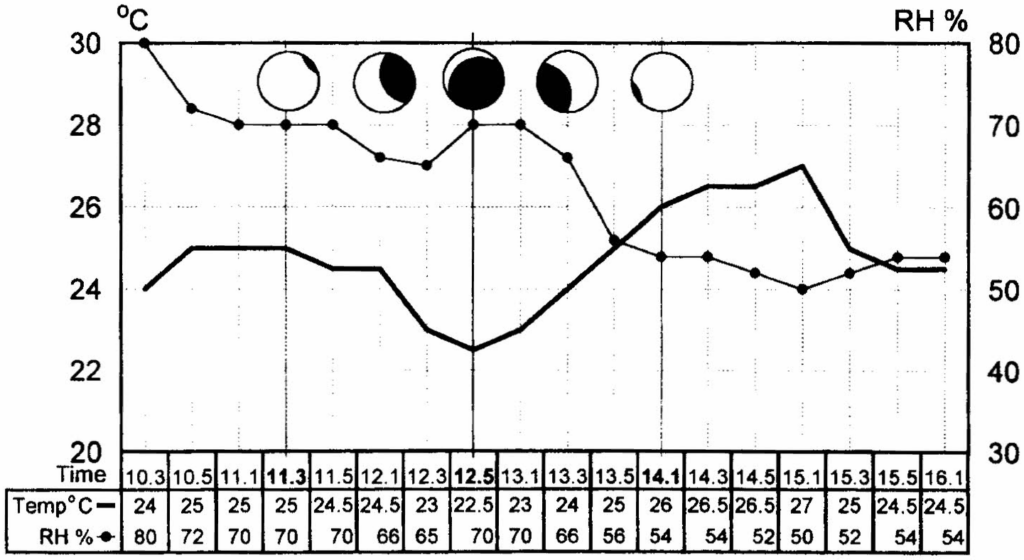
strona 241the sun for a while, and it became darker. At the beginning of the ES, the sun was clear. It was covered by a cloud for a while at 12.10 h and 12.12 h. Starting from 12.15 h, the sky was clear throughout the MES at 12.51 h. After 14.00 h small cirrus clouds appeared on the sky. Fig. 1 shows that the temperature dropped from 24°C at the start of ES to 22.5°C at the MES and raised to 26°C at the end of ES. Later, the temperature reached the maximum of 27°C at 15.10 h and than decreased. The relative humidity dropped from 80% at 10.30 h to 70% at the start of ES and followed to drop to 65% at 12.30 h, i. e. 1 hour after the start of ES and 20 min before MES. Because the temperature dropped, the relative humidity increased to 70% at MES and remained the same 20 min later. Next it dropped to 54% at the end of ES and continued to drop to a minimum of 50% at 14.50 h when the temperature reached the maximum.
| Time | 10.3 | 10.5 | 11.1 | 11.3 | 11.5 | 12.1 | 12.3 | 12.5 | 13.1 | 13.3 | 13.5 | 14.1 | 14.3 | 14.5 | 15.1 | 15.3 | 15.5 | 16.1 |
|---|---|---|---|---|---|---|---|---|---|---|---|---|---|---|---|---|---|---|
| Temp°C | 24 | 25 | 25 | 25 | 24.5 | 24.5 | 23 | 22.5 | 23 | 24 | 25 | 26 | 26.5 | 26.5 | 27 | 25 | 24.5 | 24.5 |
| RH % | 80 | 72 | 70 | 70 | 70 | 66 | 65 | 70 | 70 | 66 | 56 | 54 | 54 | 52 | 50 | 52 | 54 | 54 |
Temperature and relative humidity at the day of eclipse of sun, August 11, 1999. The vertical lines indicate the time of the beginning, maximum and end of eclipse of sun. Temperatura i wilgotność względna w dniu zaćmienia słońca 11 sierpnia 1999. Pionowe linie wskazują początek, maksimum i koniec zaćmienia.
On August 26, when the comparative ,observations were conducted, the sky was clear. Fig. 2 shows that the temperature was 24°C at 11.30 h when the eclipse of sun had started on August 11. The temperature did not change till 13.50 h, when the MES occurred the other day, and later it decreased a little. The relative humidity decreased from 56% at 10.30 h to 39% at 14.50 h.
strona 242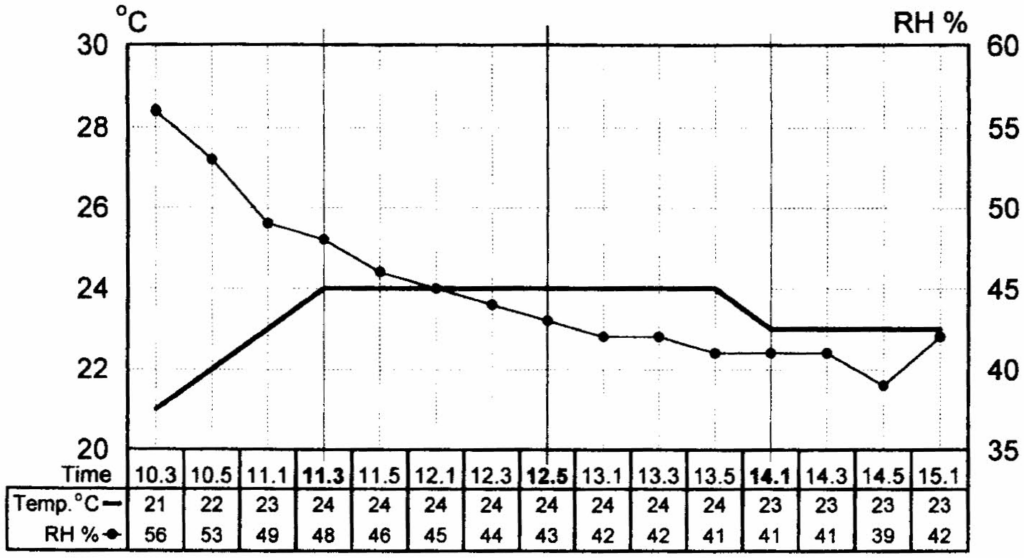
| Time | 10.3 | 10.5 | 11.1 | 11.3 | 11.5 | 12.1 | 12.3 | 12.5 | 13.1 | 13.3 | 13.5 | 14.1 | 14.3 | 14.5 | 15.1 |
|---|---|---|---|---|---|---|---|---|---|---|---|---|---|---|---|
| Temp°C | 21 | 22 | 23 | 24 | 24 | 24 | 24 | 24 | 24 | 24 | 24 | 23 | 23 | 23 | 23 |
| RH % | 56 | 53 | 49 | 48 | 46 | 45 | 44 | 43 | 42 | 42 | 41 | 41 | 41 | 39 | 42 |
Temperature and relative humidity at the first clear day after the eclipse of sun, August 26, 1999. Other explanations see fig. 1. Temperatura i wilgotność względna pierwszego słonecznego dnia po zaćmieniu, 26 sierpnia 1999. Inne objaśnienia patrz fig. 1.
2. Foragers’ activity during a sunny day
Fig. 3 shows that on a clear day, fluctuation of flight activity occurred at hive entrances during the observation period. After a peak of activity, a depression was noticed 20 – 60 min later. Many times, a peak of the number of foragers leaving the hives was followed by a peak of returning ones, 20 min later. The maximum number of foragers left the hive at 13.00 h in one colony (No 68). Two peaks, one at 13.00 h and the other at 13.40 h. were observed in the next colony (No 28), and one peak at 14.00 h or 14.10 h were observed in the other two colonies. Thus, the variation between different colonies ranged up to 1 h. During the time when the maximum eclipse of sun occurred the other day, high activity of foragers leaving the hives was observed. The numbers ranged from 127 to 340 per 5 min at the time of MES or 10 min earlier.
3. Foragers’ activity before maximal eclipse of sun
Fig. 4 shows that from the beginning of the observations until the start of ES, the number of foragers leaving and returning to the hives mostly increased. After the start of ES, the number of foragers leaving the hives mostly decreased, and that of returning increased or continued to be high. A decreased number of foragers <u>leaving</u> the hive in comparison to the previous count was noticed, in three colonies (Nos 6, 68 and 86), already at 11.40 h, i. e. 10 min after the start of ES. In three next colonies (Nos 2, 69 and 82), the number decreased at 11.50 h, 20 min
strona 243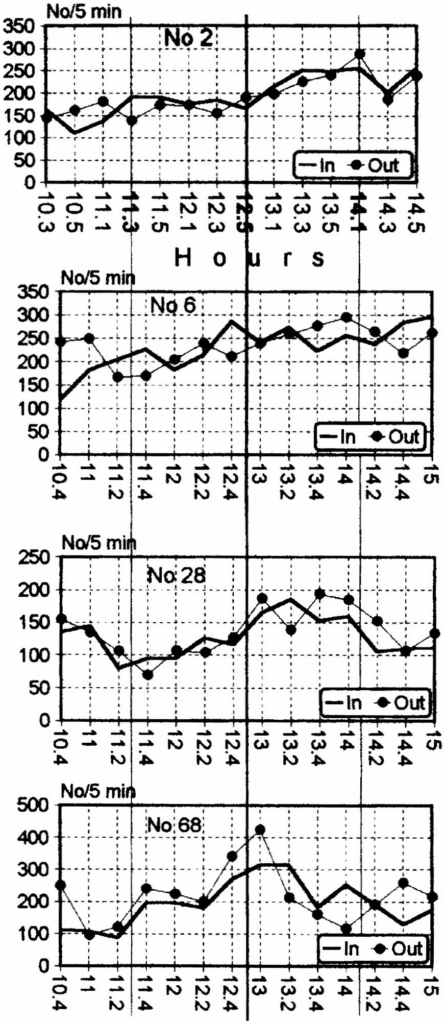
strona 244Foragers’ flight activity at hive entrance during the first clear day after eclipse of sun, August 26, 1999. In – returning, Out – leaving. Other explanations see Fig. 1. Aktywność lotna zbieraczek na wylotku ula pierwszego słonecznego dnia po zaćmieniu., 26 sierpnia 1999. In – zbieraczki przylatujące, Out – wylatujące. Inne objaśnienia patrz fig. 1.
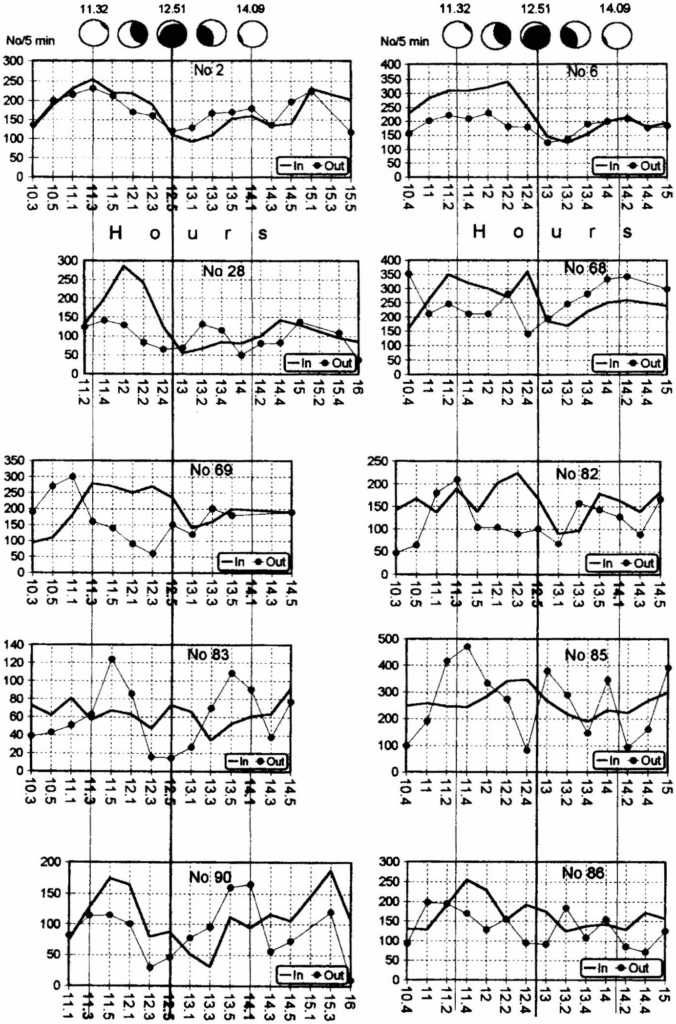
strona 245Foragers’ flight activity at hive entrance during the day of eclipse of sun, August 11, 1999. Other explanation see Fig. 1. and 3. Aktywność lotna zbieraczek na wylotku ula w dniu zaćmienia słońca, 11 sierpnia 1999. Objaśnienia patrz fig. 1 oraz fig. 3.
after the start, when the sun surface was covered in 16%. In two next colonies (Nos 28 and 85) it decreased at 12.00 h, 30 min after the start, when the sun was covered in 24%. In two last colonies (Nos 83 and 90) it decreased at 12.10 h, 40 min after the start, when the sun was covered in 35%. Thus between 10 and 40 min after the start of the ES i. e. 40 – 70 min before MES, a decreased number of foragers leaving the hives was noticed. Considerable variation in the reaction of outgoing foragers for the progress of ES is visible.
Table 1. Minimal (Min) number of bees leaving different number of hives during the total period of eclipse of sun (ES) and maximal (Max) and minimal leaving after the maximum eclipse (MES) – Minimalna (Min) liczba pszczół wylatujących z ula w czasie całego okresu zaćmienia słońca (ZS), oraz maksymalna (Max) i minimalna liczba wylatujących po maksymalnym zaćmieniu (MZS)
| During total period of ES / Podczas całego okresu ZS — Time min / Czas min | … — Min / Min | After MES / Po MZS — Time min / Czas min | … — Max / Max | … — Min after Max / Min po Max |
|---|---|---|---|---|
| 20 before MES / 20 przed MZS | 2* | 10 | 1 | 0 |
| 10 before MES / 10 przed MZS | 3 | 20 | 0 | 5 |
| MES, MZS | 2 | 30 | 2 | 0 |
| 10 after MES / 10 po MZS | 2 | 40 | 2 | 4 |
| 20 after MES / 20 po MZS | 1 | 60 | 1 | 1 |
| Total, Razem | 10 | 80 | 2 | 0 |
| 90 | 2 | 0 | ||
| Total, Razem | 10 | 10 |
- The figures in columns indicate No of hives.
- Liczby w kolumnach oznaczają liczbę pni
Afterwards, the number of foragers leaving the hive decreased with the progress of the ES. Table 1 shows, that the minimal number of foragers (Min) left particular hives between 20 min before – to 20 min after the MES. It is interesting to note, that in five colonies (Nos 28, 68, 69, 85 and 90), the number of foragers leaving the hive increased a little already at the time of MES (fig. 4), in two it was the lowest at MES, and in 3 it continued to decrease. The minimal number of foragers leaving the hives 20 min before to 20 min after MES ranged from 12 to 54% of the maximal number of foragers leaving the hive at the time close to the start of the eclipse. The percentages in
strona 246successive colonies were as follows: 52, 54, 46, 40, 20, 32, 12, 17, 46, and 26%. In comparison to flight on a sunny day, the percentages of foragers leaving the hives at MES amounted 63, 68, 43 and 48% in the four compared colonies Nos 2, 6, 28 and 68. This shows that the foragers did not stop to leave the hives at the 86% of MES, but left the hives in high percentage.
Fig. 4 shows that the number of foragers <u>returning</u> to the hives was mostly high at the start of the ES. It continued to be high, or even increased in six colonies (Nos 6, 28, 83, 85, 86 and 90) within 10 – 30 min after the start of the eclipse. This increase could be caused by cumulus clouds, which had been covering the sun from time to time at the beginning of the ES. Later the sky became clear. After 12.00 h, i.e. 30 min after the start of ES, when the sun surface was covered in 24%, the number of returning foragers decreased. In six colonies (Nos 6, 68, 69, 82, 85 and 86), a second peak of returning forager was observed 10 – 30 min before the MES. At this time, the sky was clear and the increased number of returning foragers must be attributed to the increasing eclipse of sun. In two colonies (Nos 83 and 90) the second peak of the increased number of returning foragers occurred at the time of MES at 12.51 h. At the MES of 86% not all foragers returned to the hives. At the MES, as many as 67, 75, 57 and 93% foragers returned to the hives, in comparison to the number returning to the four compared hives (Nos 2, 6, 28 and 68) in a sunny day. Here also considerable variation in the reaction of returning foragers on the MES of 86% is visible.
4. Foragers’ activity after the maximal eclipse of sun
Fig. 4 shows that in five colonies more foragers <u>left</u> the hive 10 – 20 min after, than 10 – 20 min before the MES. In colony No 85, only 81 foragers left the hive 10 min before MES, and as many as 379, it is 4.5 times more 10 min after the MES. In the other four colonies Nos 68, 69, 83, and 90, – 1.7, 2.0, 1.7 and 2.6 times more left the hives after than before MES. Thus, the determining factor of leaving the hives by the foragers was here not the percentage of sun coverage, but rather the direction of increasing or decreasing of the eclipse. Thus, the foragers noticed the direction of changes. After the minimal number of foragers leaving the hive at the time around the MES, the outgoing foragers increased their activities. Table 1 shows that the maximal number of foragers left the hives 10 to 90 min after the MES. Thus, some colonies reached the maximum activity very quickly, namely 10 min after the MES, while others delayed it up to 90 min. After so many foragers left the hives, few of them remained inside, and thus the number of outgoings decreased. Table 1 shows that the minimal number left the hives 20 to 60 min after the previous maximum. The fluctuation continued in different degrees until the end of the observation at 16.00 h
The number of foragers <u>returning</u> to the hives continued to decrease after the MES. The lowest number returned at 13.00 to 13.40 h, i. e. 10 to 50 min
strona 247after the MES (Table 2). This indicates that different proportions of foragers from particular colonies remained in the field during the MES. Because in the meantime, many foragers left the hives, the number of returning foragers increased to a maximum 20 to 60 min after the previous minimum (Table 2). The fluctuation continued to the end of the observations.
Table 2 Minimal (Min) and maximal (Max) number of bees returning to different number of hives after the maximum eclipse of sun. – Minimalna (Min) i maksymalna (Max) liczba pszczół powracających do ula po maksymalnym zaćmieniu
| Time min / Czas min | Min / Min — No hives / Licz. pni | Max after Min / Max po Min — No hives / Licz. pni | Between Max leaving & Max returning / Pomiędzy Max wylatujących i Max powracających — Time min / Czas min | … — No hives / Licz. pni |
|---|---|---|---|---|
| 10 | 1 | 0 | 10 | 0 |
| 20 | 3 | 2 | 20 | 2 |
| 30 | 3 | 0 | 30 | 0 |
| 40 | 2 | 4 | 40 | 2 |
| 50 | 1 | 0 | 60 | 3 |
| 60 | 0 | 4 | 80 | 2 |
| Total, Razem | 10 | 10 | Total | 9* |
- one (No 68) could not be determined
- jeden pień (nr 68) nie można było określić
The peak of returning foragers was caused by earlier peak of outgoing bees. Table 2 shows that the time laps between the peak of outgoing and returning foragers ranged from 20 to 80 min (colony No 68 not determined). This shows that foragers from particular colonies remained in the field for different times.
DISCUSSION
Till now flight activity of bees at lower MES than 95% was not recorded. We observed foragers’ flight activity at MES of 86%. This allowed us to detect foragers’ reaction on lower percentage of ES. Till now flight activities of bees from 1-3 colonies were observed. We investigated foragers’ activities of 10 colonies. This permitted us to detect variations in foragers’ behavior from different colonies.
Apis mellifera foragers reacted very distinctly for both total ES (Lundie 1940, Nakano 1958, Holms 1963, Nitschmann 1999 and Pechhaker 1999), as well as for 95% of MES (Woyke 1954 and Showler 1999). Although in our investigation, the MES was only 86%, the
strona 248foragers returned to the hives before MES also in considerable increased number and left in considerable lower number with the progress of the eclipse. Thus the lower percentage of only 86% of MES influenced also considerably the foragers flight activities. However, contrary to total ES, when bees stopped to leave the hives, in the present investigation as many as 43 to 68% of foragers left the hives at 86% of MES in comparison to the activity on a sunny day. The lowest number of foragers did not left the hives at MES, but between 20 min before to 20 min after MES. In half the number of the hives, the number of outgoing foragers increased even at MES. At total eclipse, foragers from all tree hives stop to leave the hives, no variation occurred (Pechhacker 1999). During MES of 86% considerable variation in the number of foragers leaving the hives was found (Fig. 4, and 43 – 68% presented above).
During 95% of MES, the largest number of foragers <u>returned</u> to the hive 10 to 20 min before MES (Woyke 1954). In the present investigation, foragers from half the number of observed colonies returned to the hives in increased number at this time. During total eclipse, foragers stopped to return to hives and only few of them returned shortly before or shortly after MES (Pechhacker 1999). In the present investigation as many as 57 to 93% foragers returned to the hives at 86% of MES in comparison to the number returning during a sunny day. Considerable variation in the reaction of returning foragers on 86% of MES is visible.
Some foragers continued to return to the hives shortly after the total eclipse (Holms 1963, Peschhacker 1999) as well as after partial MES (Woyke 1954). They returned also in high number after 86% of MES presented in this paper. This means that some foragers remained in the field as well during total as during partial MES. During 95% MES, the lowest number of foragers returned to one hive at MES and to the other 10 min later (Woyke 1954). In the present investigation, the lowest number of foragers returned to all hives 10 – 50 min after MES of 86%. This indicates that more foragers remained in the field at 86% than at 95% of MES. The above figures show also considerable behavioural variation of foragers from different colonies during the post MES period. In five colonies more foragers left the hive 10 – 20 min after the MES than 10 – 20 min before. An increase of up to 4.5 times was observed. This phenomenon occurred also in Woyke (1954) investigation. Although Pechhaker (1999) did not mention this, his fig. 1 shows that 225 foragers left the hives 50 min before MES and as many as 410, 50 min after MES. All the figures show that the determining factor of leaving the hives by the foragers from those colonies was not the percentage of sun coverage, but rather the direction of increasing or decreasing of the eclipse.
ACKNOWLEDGMENTS We would to thank very much dr Nikola Bradbear for improving our English language.
strona 249REFERENCES
Holmes F.O. (1963)- The effect of a total eclipse of on bee activity. Am. Bee J., 103 (11): 416-417.
Lundie A. E. (1940)- The flight activities of the honeybee in a total eclipse of the sun. The South Afr. Bee J., 22 (12): 4-5.
Nakano S. (1958)- The behaviour of honeybees during a solar eclipse. Jap. Bee J. 11: 206-207 (Japanese) A.A., 88/60.
Nitschann J. (1999)- Die totale Sonnenfinsternis und die Flugaktivität der Bienen. Deutch. Bienen J., 7 (10): 424-426.
Pechhacker M. (1999)- Das Verhalten der Bienen bei der Sonnenfinsternis. Bienenvater, 120 (12): 19- 22.
Showler K. (1999)- A British solar eclipse observed. Bee World, 80 (3): 159-160.
Woyke J. (1954)- The behaviour of bees during the eclipse of the sun. Folia Biologica, 3 (3): 267-274.
AKTYWNOŚĆ LOTNA PSZCZÓŁ APIS MELLIFERA NA WYLOTKU ULA PODCZAS 86% ZAĆMIENIA SŁOŃCA
J. Woyke, Z. Jasiński, C. Fliszkiewicz, H. Woyke
Streszczenie
Zaćmienie słońca wywiera duży wpływ na zachowanie się pszczół. Dotychczas opisywano loty pszczół w czasie zjawiska prowadzącego do całkowitego zaćmienia lub 95% zakrycia tarczy słonecznej. Nieznana jest reakcja pszczół na mniejszy stopień częściowego zaćmienia. My obserwowaliśmy loty pszczół w Warszawie, dnia 11 sierpnia 1999 r. podczas częściowego zaćmienia, którego maksimum wynosiło 86% zakrycia tarczy słonecznej. Prowadziliśmy obserwacje lotów pszczół z 10 rodzin mieszańców rasy środkowo europejskiej. Obserwacje zaczęto o godz 10.30, to jest 1 godzinę przed początkiem zaćmienia, a zakończono o godz.15.00, t.j. 1 godz po zakończeniu zaćmienia. Przy trzech rodzinach kontynuowano obserwacje do godz 16.00. Spośród dwu osób, jedna liczyła pszczoły przylatujące, a druga wylatujące z ula w ciągu 5 minut. Liczenia powtarzano co 15 min. Dla porównania, powtórzono badania na czterech pniach w dniu 26 sierpnia, pierwszego słonecznego dnia po zaćmieniu.
Zaćmienie słońca (ZS) w dniu 11.08.1999 r zaczęło się o godz. 11.32, maksimum zaćmienia (MZS) wynoszące 86% zakrycia tarczy słonecznej osiągnęło o godz. 12.51, a zakończyło się o godz 14.09. Z ryc. 4 widać, że pomimo zmniejszonego procentu (MZS), pszczoły bardzo wyraźnie zareagowały na częściowe zaćmienie. Po rozpoczęciu zaćmienia liczba wylatujących zbieraczek zmniejszała się, a powracających zwiększała w miarę postępu zaćmienia. Zmniejszoną liczbę <u>wylatujących</u> pszczół zauważono już 10 do 30 min po rozpoczęciu zaćmienia. W 30 min po rozpoczęciu zaćmienia, kiedy tarcza słońca była
strona 250zakryta w 24% zmniejszona liczba zbieraczek wylatywała z 8 na 10 obserwowanych uli. Najmniejszą liczbę pszczół wylatujących z różnych uli zanotowano między 20 min przed a 20 min po MZS. W przeciwieństwie do całkowitego zaćmienia, kiedy zbieraczki przestają wylatywać, podczas 86% MZS wyleciało z uli aż 43 – 68% robotnic w porównaniu do wylatujących podczas normalnego słonecznego dnia. Liczba wylatujących zbieraczek z połowy pni nawet wzrosła podczas MZS. Wszystkie powyższe liczby wskazują na dużą zmienność reakcji pszczół wylatujących z różnych pni na częściowe zaćmienie słońca.
Z ryc. 4 widać, że zbieraczki zaczęły <u>wracać</u> do uli w zwiększonej liczbie zaraz na początku zaćmienia. Liczba wracających do niektórych uli zwiększyła się w ciągu następnych 10 – 30 min. Drugi wzrost zanotowano 30 – 10 min przed MZS, lub nawet podczas MZS. W przeciwieństwie do całkowitego zaćmienia, kiedy zbieraczki przestają wracać do uli, nie wszystkie wróciły podczas 86% MZS. Podczas MZS wróciło aż 57 – 93% zbieraczek wracających do uli podczas słonecznego dnia. Bezpośrednio po 86% MZS znacznie więcej zbieraczek wracało do uli, niż ma to miejsce po całkowitym zaćmieniu. Znaczy to, że podczas maksimum częściowego zaćmienia znacznie więcej zbieraczek pozostaje w polu, niż w czasie całkowitego zaćmienia.
W ciągu 10 – 20 min po MZS, wyleciało z 5 uli 1.7 do 4.5 razy więcej pszczół niż w ciągu 10 – 20 min przed tym zjawiskiem. Tak więc czynnikiem determinującym liczbę wylatujących zbieraczek nie był procent zakrycia tarczy słonecznej, lecz kierunek zmniejszania lub zwiększania zakrycia słońca. Wynika z tego, że zbieraczki są w stanie reagować na sam kierunek zachodzących zmian. Maksymalna liczba pszczół opuściła ul 10 do 90 min po MZS. Widać, że zbieraczki z niektórych pni bardzo szybko osiągnęły maksymalną aktywność po MZS, podczas gdy inne opóźniły to do 90 min. Ponownie uwidacznia się dużą zmienność w reakcji pszczół z różnych pni na częściowe zaćmienie słońca. Po MZS, liczba <u>powracających</u> pszczół malała w dalszym ciągu. Najmniej zbieraczek wróciło do uli 10 – 50 min po MZS. Wskazuje to, że proporcja pszczół, z różnych uli, pozostających w polu podczas MZS była różna.
Reasumując należy stwierdzić, że pszczoły zbieraczki bardzo wyraźnie zareagowały na 86% MZS, pomimo, że było ono znacznie mniejsze, niż dotychczas badano. Jednak reakcja zbieraczek wyraźnie różniła się od zachowania podczas całkowitego zaćmienia słońca.
Słowa kluczowe: zaćmienie słońca, aktywność lotów, zbieraczki.
Errata — błędy druku znalezione podczas digitalizacji
- s. 239, 247, 248: „Holms” → Holmes
- s. 239, 247, 248: „Pechhaker” → Pechhacker
- s. 240: „It past” → It passed
- s. 241: „and than” → and then
- s. 247: „laps” → lapse
- s. 248: „Peschhacker” → Pechhacker
- s. 248: „tree” → three
- s. 248: „would to thank” → would like to thank
- s. 249, piśmiennictwo: „Nitschann” → Nitschmann
- s. 249, piśmiennictwo: „Deutch.” → Deutsch.