

THE MIDDLE EUROPEAN HONEYBEE AS A COMPONENT OF PRODUCTIVE HYBRIDS
tekst: Jarosław Prabucki, Bożena Chuda-Mickiewicz
Pszczelnicze Zeszyty Naukowe, Rok XL, 1996 — Jarosław Prabucki, Bożena Chuda-Mickiewicz
strona 61PSZCZELNICZE ZESZYTY NAUKOWE Rok XL, Nr 2 1996
Jarosław Prabucki, Bożena Chuda-Mickiewicz
Department of Apiculture, Agricultural University ul. Doktora Judyma 20, 71-466 Szczecin, POLAND
Summary
The studies were carried out in 1993-1995 (on 120, 210 and 450 bee queens in 1993, 1994 and 1995, respectively). Totally, 780 bee queens were included into them. Honey yield of colonies was crucial for the study, whereas developmental rate (D), swarming tendency, bees’ character (docility) and wintering resistance composed additional criteria. The Carniolan bees (Apis mellifera carnica Pallm), being recognized a very productive one in Western Pomerania, was treated as the control group. In majority of groups compared, this bee was of a con-siderable productivity (30.2 kg of honey per colony on the average). Compared to it, the Pomeranian bee had showed higher productivity (32.6 kg), whereas the Norwegian bee was of lower honey production (28.7 kg). Markedly better results were obtained in inter-breed cross-breeds (Car x Nor – 38.7 kg). The Norwegian line proved to be a very good component in production of productive crossbreeds. The Car x Nor productive hybrids came first in the point classification in 1995; the Middle European bees of Nor x Nor population were third and of Pom x Pom population – sixth, whereas the Pom x Nor inter-line crossbreed was fourth. The Norwegian bee makes a good male component in production of productive crossbreeds with the Carniolan and Pomeranin bees. The hybrids produced that way provided the high production of honey ranging from 28.7 to 38.7 kg.
Keywords: the Middle European bee, breeding, productivity, evaluation.
INTRODUCTION
Bees inhabiting the middle part of Europe originate from the Iberian Peninsula (Ruttner, 1988). They settled in the northern part of Europe reaching as far as to the Ural Mountains and the Sub-arctic Circle. There developed local populations of the Middle European bee (Apis mellifera mellifera L.) adapted to different climate and flow conditions. These bees, being well adapted to the environment, deserve to be of interest and to be legally protected (Prabucki et al. 1996). Three forms of the Middle European bee, that is the short-, the medium- and the long-tongue one, had been noted in Poland as far back as in the fifties (Gromisz 1961). Today, it can be found in the Białowieska and Kampinoska Forests as well as in breeding centres. In the Szczecin Province, the short-tongue form is reared (Bornus et al. 1981). The Po-meranian line was derived from it
strona 62(Prabucki 1994a, b). This bee be-longs to medium-vicious bees, with medium-early spring development, being medium-swarming and medium-productive. In crossbreeding with drones of the Norwegian population, it enlarges its productivity (from 25.6 to 29.8 kg of honey per colony), advances spring development of colonies what allows to use it for taking advantage of the early-spring flows, increases docile disposition, improves wintering resistance, increases immunity from diseases and decreases swarming tendency (Prabucki et al. 1995a). Further observations showed that hybrids of the Pomeranian line with the Norwegian drones are well adapted to the climate and the flow conditions of the Northern Poland (Prabucki 1995b).
Therefore, examination of different crossbreeds with one of the components being the Middle European bee in respect of their honey production, developmental dynamics, swarming tendency, bees’ character (docile disposition) and wintering resistance seems to be necessary and shall give a possibility to choose an adequate productive hybrid for practical application
MATERIAL AND METHODS
The studies were carried out in the years of 1993-1995 (on 120, 210 and 450 bee queens in 1993, 1994 and 1995, respectively). They included 780 queens in total. In the first year, the field evaluation of productive value was performed in the Szczecin and Koszalin Districts. In the second year the evaluation was carried out in the Szczecin, Koszalin, Bydgoszcz and Zielona Góra Districts, whereas in the third one it comprised five districts (Szczecin, Koszalin, Bydgoszcz, Wrocław and Olsztyn). The honey yield of colonies was the basic criterion in the evaluation, while developmental rate (D), swarming tendency, bees’ character (docile disposition) and wintering resistance consisted supplemental criteria. The latter characters were determined according to a 1 to 4 point classification (with 1 being the worst result, and 4 – the best one). Developmental rate was calculated as a relation of the number of bees to the growth of brood surface during 21 days of the spring development of colonies. The bee queens had been delivered for field evaluation to bee-keepers selected by the Regional Animal Breeding Offices in the season preceding the year of evaluation. Evaluation sheets, including 8-12 colonies, had been reaching the Laboratory in the autumn each year. The queens artificially inseminated reared in apiaries of the Szczecin Regional Animal Breeding Office and Agricultural University of Szczecin were subjected to evaluation in the following crossbreeding combinations: Nor x Nor, Pom x Pom, Car x Car, Car x Nor, Nor x Car, Car x Pom, Nor x Pom, Pom x Nor, and Car mated in natural manner in apiary. The
strona 63experimental colonies had been utilizing the followings flows: dandelion, rape and orchards in May, acacia, raspberry, spring rape, cornflower and meadows in June, lime-tree, phacelia, mustard and honey-dew in July, and heather and other late-blooming plants in August. The Carniolan bee (Car x Car), recognized as a very productive one, was treated as the control group.
RESULTS
The studies carried out during the period of three years had showed the increase in the honey yield of evaluated colonies from 23.8 kg in 1993 to 34.6 kg in 1995, that means over 10.5 kg of honey. Each year was different in respect to the number of districts in which the evaluation was carried on. The results from three successive years were obtained only for the Szczecin and Koszalin Districts. The mean honey production in these districts in the years of 1994 and 1995 exceeded production of 1993 by over 9 kg of honey per colony on average (Table 1). In the majority of groups compared, the crossbreed of the Carniolan bee with the Norwegian one (Car x Nor) was characterized by the highest yield amounting to 38.7 kg of honey from a colony. This crossbreeding combination took the I place. The pure-bred Carniolan bee (Car x Car) had been placed on the IV stand (30.2 kg), while the Carniolan bee inseminated naturally in apiary had the II position (34.1 kg). The groups made of the Middle European bees: Pom x Pom, Pom x Nor and Nor x Nor, had gotten the III, IV and VI stand. Out of them, the Pomeranian bee was of the largest yield of honey (32. 6 kg). The remaining combinations, Pom x Nor, Nor x Nor and Car x Nor, did not surpassed 30 kg of honey from a colony. Thus, the Norwegian drones are able to increase the yield of colonies by 10 kg of honey on the average, although the pure-bred Norwegian bee is not too highly productive in the crossbreed with the Carniolan one. The attempt of making reverse mating had not been giving any positive results. The use of that bee as a paternal material, therefore, seems to be reasonable (Table 1).
In order to indicate the most productive crossbreed for the year of 1995, the honey yields obtained in particular districts were grouped and the mean values were worked out for particular groups of flow plants in May, June, July and August. It was found that the best production results were obtained in May from the Car x Nor hybrid (almost 20 kg of honey from a colony). The remaining groups gave in May over 7 kg of honey less. In June, the pure-bred Norwegian bee and the Carniolan one, mated in natural way in apiary, as well as the Pom x Nor hybrid were the best, giving approximately 10 kg of honey each. The pure-bred Carniolan bee and the
strona 64Pom x Nor crossbreed came next. In July, the Norwegian bee and the Car x Nor hybrid were the best, followed by the Pomeranian and the Carniolan bees as well as the Car x Pom hybrid. Late flows were utilized in the best way by the Car x Nor hybrids and the Pomeranian bees. The highest annual production of honey was obtained from the Car x Nor hybrid, followed by the Nor x Nor, Pom x Nor and Car x n/n crossbreeds. The Pomeranian bee placed itself as the fifth, while the crossbreed of the Carniolan bee with the Pomeranian one was the seventh (Fig. 1).
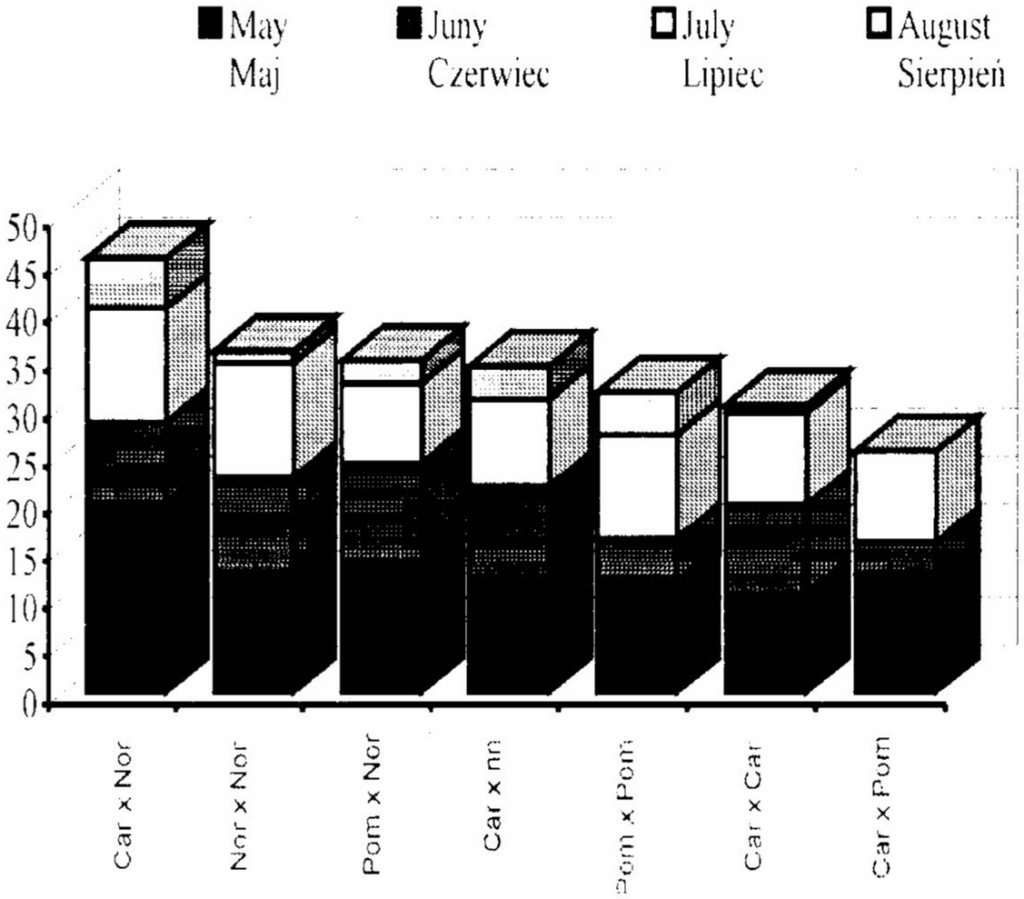
In the point classification, the Car x Nor hybrid came as the most advantageous. This combination exceeded the remaining ones by over 11.5 points. The Carniolan bee inseminated in apiary, the pure-bred Norwegian bee and the Pom x Nor crossbreed were the II, III and IV, and did not differ between each other. The fifth and the sixth place was taken by the pure-bred Carniolan and the pure-bred Pomeranian bees, respectively, whereas the Car x Pom hybrid came last.
strona 65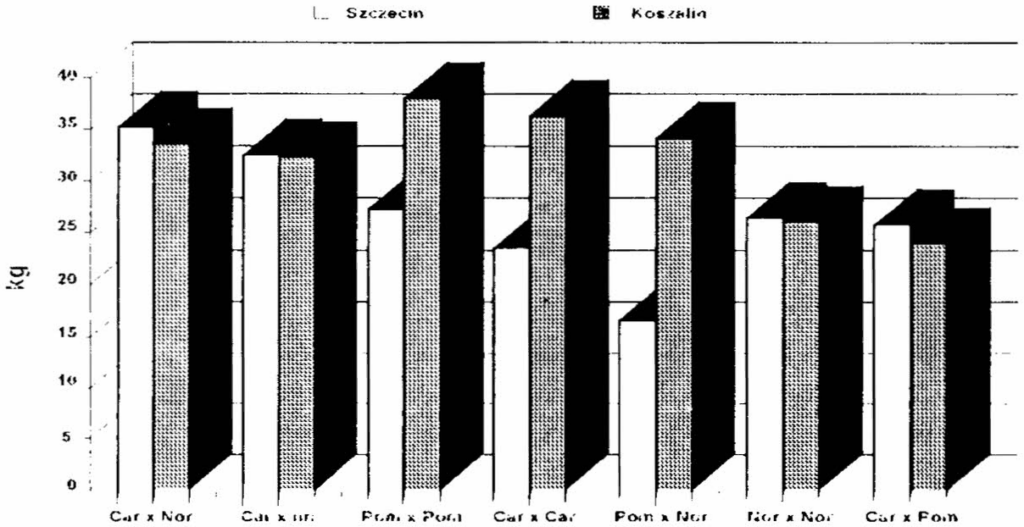
In respect to honey yield, the best results were obtained from the Car x Nor crossbreed. The Norwegian bee and the Pom x Nor cross-breed took the second and the third position, respectively, while the remaining ones came next, including the Carniolan bee. The Carniolan bee, on the other hand, had been distinguished by its developmental dynamics, with the Car x Nor and the Pom x Nor crossbreeds coming next. None of the mentioned groups distinguished itself by swarming tendency, whereas the Norwegian and the Pomeranian bees were conspicuous by their vicious disposition. All groups had rather good overwintering capabilities with very small winter fall-off of bees (Table 2).
Interesting results were obtained when comparing productivity of colonies in two districts: in the Szczecin District, producing the hybrids, and in the Koszalin District, using these hybrids commercially (Fig. 2). The mean honey production from all groups from three years studied amounted to 26.8 kg in Szczecin and to 32.1 kg in Koszalin. The Car x Nor hybrid was the most advantageous (35.2 kg) in Szczecin, while the pure-bred Pomeranian bee (38.0 kg) in Koszalin. The poorest results were obtained from the Pom x Nor hybrid in Szczecin and from the Car x Pom crossbreed in Koszalin, being 16.7 and 24.0 kg, respectively. Over 30 kg of honey was given by two crossbreeding combinations each in the Szczecin District (Car x Nor, Car x n/n), and by five combina-tions each in the Koszalin District (Car x Car, Pom x Nor, Pom x Pom, Car x Nor, Car x n/n). Thus, the medium yielding material in breeding and reproductive apiaries in Szczecin turned out to be the highly productive in Koszalin.
strona 66Table 1 The average honey yield of studied groups in 1993 – 1995 Średnia wydajność miodowa badanych grup w larach 1993 – 1995
| Kojarzenie Breeding | n | Years Lata 1993: Szczecin | Years Lata 1993: Koszalin | Years Lata 1994: Szczecin | Years Lata 1994: Koszalin | Years Lata 1994: Z. Góra | Years Lata 1994: Bydgoszcz | Years Lata 1995: Szczecin | Years Lata 1995: Koszalin | Years Lata 1995: Bydgoszcz | Years Lata 1995: Wrocław | Years Lata 1995: Olsztyn | Average Średnio |
|---|---|---|---|---|---|---|---|---|---|---|---|---|---|
| Car x Nor | 90 | – | 20,8 | 35,8 | 38,5 | – | – | 34,5 | 41,7 | – | 60,7 | – | 38,66 |
| Car x n/n | 130 | – | – | – | – | – | – | 32,5 | 32,3 | 22,6 | 49,1 | – | 34,13 |
| Pom x Pom | 70 | 14,9 | 42,7 | – | – | – | – | 39,6 | 33,3 | – | – | – | 32,62 |
| Car x Car | 140 | 10,5 | 35,3 | 36,7 | 37,3 | 35,7 | 14,8 | – | – | – | – | 41,4 | 30,24 |
| Pom x Nor | 80 | 16,1 | 33,6 | – | – | – | – | 17,3 | 34,9 | – | 41,7 | 35,3 | 29,81 |
| Nor x Nor | 210 | 17,6 | 22,5 | – | 16,1 | 26,8 | 24,6 | 35,5 | 39,8 | 19,7 | 51,5 | 32,5 | 28,66 |
| Car x Pom | 60 | – | – | – | – | – | – | 25,8 | 24,0 | 27,5 | 23,9 | – | 25,30 |
| Razem okręgi | 780 | 17,77 | 30,98 | 36,25 | 30,60 | 31,25 | 19,70 | 30,86 | 34,33 | 23,26 | 45,26 | 36,40 | |
| Razem lata | 23, 77 b | 29,58 b | 34,65 a |
Table 2 Scoring of studied groups in 1995 Ocena punktowa badanych grup w roku 1995
| Breeding Kojarzenie | n | Honey production (kg) Produkcja miodu (kg) | Development rate (D) Dynamika rozwoju | Swarming tendency Skłonność do rójki | Bees Characfter Charakter pszczół | Wintering resistance Zimotrwałość | Total Łącznie | Score Lokata |
|---|---|---|---|---|---|---|---|---|
| Car x Nor | 40 | 45,6 | 2,4 | 3,4 | 3,1 | 3,6 | 58,1 | I |
| Car x n/n | 130 | 33,8 | 2,6 | 3,1 | 3,3 | 3,6 | 46,4 | II |
| Nor x Nor | 140 | 35,8 | 1,6 | 2,9 | 2,6 | 3,5 | 46,4 | III |
| Pom x Nor | 50 | 34,8 | 2,3 | 2,5 | 2,9 | 3,8 | 46,3 | IV |
| Car x Car | 140 | 30,2 | 2,8 | 3,5 | 3,1 | 3,6 | 43,2 | V |
| Pom x Pom | 50 | 30,5 | 1,3 | 3,3 | 3,0 | 3,3 | 42,4 | VI |
| Car x Pom | 60 | 25,4 | 1,2 | 3,1 | 3,1 | 3,5 | 36,3 | VII |
CONCLUSIONS
1.The Middle European bees (Pomeranian and Norwegian lines) have low rates of developmental dynamics; later entering of colonies into production powers as compared to the Carniolan bee is connected to it. 2.The strong improvement of developmental dynamics is obtained by crossbreeding the Carniolan bee with the Norwegian drones. This type of breeding has influence on clear increase of the honey yield of colonies and on improvement of the spring harvest. 3.The Norwegian and Pomeranian lines of the Middle European bee are good male components in producing productive crossbreeds with the Carniolan bee. The hybrids obtained this way provide high productivity ranging 28.7-38.7 kg of honey.
REFERENCES
Bornus L., Chuda-Mickiewicz B., Kantorek R., Kosidło Z. , Prabucki J., Rafińska B., Skiba E., Szpet L., (1981) – Morfologiczna ocena pszczół województwa szczecińskiego. Pszczel. Zesz. Nauk., 25: 67-83.
Gromisz M. (1961) – Zmienność długości języczka u pszczoły krajowej. Pszczel. Zesz. Nauk. 5: 1-31.
Prabucki J.,(1995 a) – Pszczoła środkowoeuropejska po ocenie terenowej. Pszczelarstwo 2: 5.
Prabucki J.,(1994 b) – Bewertung der Dunklen Biene ortlichen Bedingungen. Die Neue Bienenzucht, 10: 339-340
Prabucki J., Chuda-Mickiewicz B., (1995 a) – Przydatność użytkowa pszczoły Srodkowoeuropejskiej (Apis mellifera mellifera L.) w warunkach pożytkowych Pomorza Zachodniego. Pszczel. Zesz. Nauk.,39: 21-30
Prabucki J., Chuda-Mickiewicz B.,(1995 b) – Influence of norwegian bee on improvement of northern Poland local bees yield. Zesz. Nauk. AR Szczecin Zoot.. 31 (166): 9-15.
Prabucki J., Chuda-Mickiewicz B., (1996) – Norweska inicjatywa. Pszczelarstwo 8: 20.
Ruttner F. 1988) – Biogeography and taxonomy of honeybees. Springer-Verlag, Berlin.
PSZCZOŁA ŚRODKOWOEUROPEJSKA KOMPONENTEM MIESZAŃCÓW UŻYTKOWYCH
J. Prabucki, B. Chuda-Mickiewicz
Streszczenie.
Badania prowadzono w latach 1993 – 1995 (w roku 1993 na 120, w 1994 na 210 i w 1995 na 450 matkach pszczelich). Łącznie badaniami objęto 780 rodzin pszczelich. W
strona 69pierwszym roku ocenę prowadzono w okręgu szczecińskim i koszalińskim. W drugim w szczecińskim koszalińskim, bydgoskim , zielonogórskim zaś trzeci rok badań objął pięć okręgów (Szczecin, Koszalin, Bydgoszcz, Wrocław, Olsztyn). Pszczołę kraińską (Apis m. Carnica) uznawaną za bardzo wydajną potraktowano jako grupę kontrolną. Podstawowym kryterium oceny była wydajność miodowa rodzin zaś uzupełniającymi były: wskaźnik rozwoju (D), skłonność do rójki, charakter pszczół (łagodność) oraz zimotrwałość (cechy te określano w skali punktowej od 1 do 4, przyjmując 1 jako najgorsze i 4 jako najlepsze). Ocenie poddano matki pszczele sztucznie unasienione zaś grupy rodzin oceniano w maju, czerwcu, lipcu i sierpniu. Mieszańce Car x Nor charakteryzowały się najwyższą wydajnością (38,7 kg miodu z rodziny). Pszczoła kraińska w większości porównywanych grup wykazywała dość wysoką produkcyjność (30,2 kg miodu z rodziny). W odniesieniu do niej pszczoła pomorska wykazywała wyższą produkcję miodu (32,6 kg) zaś pszczoła norweska niższą – 28,7 kg. Zdecydowanie lepsze efekty dała krzyżówka międzyrasowa Car x Nor – 38,7kg. Populacja norweska okazała się bardzo dobrym komponentem w tworzeniu krzyżówek użytkowych. Mieszańce użytkowe Car x Nor w 1995 r uzyskały I lokatę w wycenie punktowej. Pszczoły środkowoeuropejskie Nor x Nor – III i Pom x Pom – VI zaś międzyliniowa krzyżówka Pom x Nor – VI.
Badania wykazały, że pszczoła środkowoeuropejska (pomorska i norweska) posiadają niski wskaźnik rozwoju wiosennego. Lepsze pod tym względem są mieszańce pszczoły kraińskiej z pszczołą norweską. Pszczoła norweska jest dobrym komponentem męskim w tworzeniu krzyżówek użytkowych z pszczołą kraińską i pomorską. Mieszańce tak kojarzone zapewniają wysoką produkcyjność rodzin w granicach od 28,7 do 38,7 kg miodu z rodziny.
Słowa kluczowe: pszczoła środkowoeuropejska, kojarzenie, wydajność, ocena.
Errata — błędy druku znalezione podczas digitalizacji
- s. 61, streszczenie: „Pallm” → Pollm
- s. 61, streszczenie: „con-siderable” → considerable
- s. 61, streszczenie: „Pomeranin” → Pomeranian
- s. 61: „Po-meranian” → Pomeranian
- s. 62: „be-longs” → belongs
- s. 63: „III, IV and VI” → III, V and VI
- s. 63: „32. 6 kg” → 32.6 kg
- s. 63: „and Car x Nor, did not” → and Car x Pom, did not
- s. 64, ryc. 1: „yeld” → yield
- s. 64, ryc. 1: „Szecin” → Szczecin
- s. 64, ryc. 1: „Juny” → June
- s. 64, 65, ryc. 1, 2: „Car x nn” → Car x n/n
- s. 65: „combina-tions” → combinations
- s. 66, tab. 1: „larach” → latach
- s. 66, tab. 1: „23, 77″ → 23,77
- s. 67, tab. 2: „Characfter” → Character
- s. 68, piśmiennictwo: „ortlichen” → örtlichen
- s. 68, piśmiennictwo: „Srodkowoeuropejskiej” → Środkowoeuropejskiej
- s. 69, streszczenie: „Pom x Nor – VI” → Pom x Nor – IV