

THE EFFECT OF PROPOLIS EXTRACTS CONTAINING FLAVONOID COMPOUNDS ON ACID-RESISTANT SAPROPHYTIC BACILLI
tekst: Zbigniew Jóźwik, Jolanta Trytek
Pszczelnicze Zeszyty Naukowe, Rok XXIX, 1985 — Zbigniew Jóźwik, Jolanta Trytek
strona 47PSZCZELNICZE ZESZYTY NAUKOWE Rok XXIX 1985
Zbigniew Jóźwik, and Jolanta Trytek
Department of Plant Physiology, Maria Curie-Skłodowska University, Lublin
INTRODUCTION
Water and alcohol extracts of propolis and its various products show bacteriostatic action on tubercle bacilli (Kiwałkina 1959, Karmiowa 1963, Lindenfelster 1968, Jóźwik et al. 1976). Flavonoids and their derivatives contained in propolis constitute a large group of biologically active compounds (Poprawko et al. 1969). These substances are also characterized by antibacterial and antiviral action (Wilska-Jeszka 1959).
The effect of flavonoid compounds present in propolis extracts on the growth of tubercle bacilli has not been studied so far. The action of extracts from propolis, obtained by using various organic solvents on this group of bacteria was studied in this paper. Special attention was given to fractions containing flavonoid compounds.
MATERIAL AND METHODS
- Propolis samples were obtained directly from bee-keepers in the Lublin province and were also purchased in an apiarian shop in Lublin.
- Saprophytic strains of acid-resistant bacillli; Mycobacterium smegmatis, Mycobacterium butyricum, Mycobacterium phlei, Mycobacterium sp. 607 and Mycobacterium sp. 279 were from the Museum of Strains of the Department of Plant Physiology, Maria Curie-Skłodowska University, Lublin.
- Preparation of ethanol propolis extract (EPE). Propolis was purified from accidental impurities such as wood, straw fragments, insect and wax remains. Then 10% solution was made in 96% ethanol. It was shaken for half an hour and left in a shaded place over 24 h. This procedure was repeated three times. After three days the extract was
filtred on filter paper Whatman No 4. The obtained ethanol propolis extract (EPE) was condensed to a thick mass on water bath in vacuum, which hardened after cooling.
From thus prepared extract 10% propolis solutions were made in 96% ethanol. The activity of 10% EPE was examined in relation to Mycobacterium sp. by the cylinder method. All propolis samples used in the studies inhibited the growth of tubercle bacilli.
- Obtaining a uniform bacterial mass. Saprophytic acid-resistant bacilli were cultivated on Sauton’s medium for 4 days. Then the bacteria were collected with on ooze into previously sterilized and weighed bacteriological mortars. The mortars with the bacteria were weighed again. Five ml of bacilli suspension at a concentration of 1 mg/ml prepared in Sauton’s medium was introduced into 200 ml of Sauton medium with agar (1,4%). Heated medium with bacilli was poured into Petri dishes on which glass cylinders had been set up.
- Examination of propolis activity by the cylinder-plate method. Three-five glass cylinders 7 mm in outer diameter were set up on Petri dishes into each of them 15 ml Sauton medium with 1,4% agar and suspended saprophytic tubercle bacilli were poured. When the medium hardened the cylinders were removed and the formed wells were dispensed each 0,1 ml of 10% propolis extracts in 96% ethylene alkohol. The plates were kept for 6 h’ at room temperature for the substance studied to diffuse into the medium. Next, the plates were put into a thermostate (37°C).
The results were checked after four days. In the case of active preparations zones free of bacteria, the so-called growth inhibition zones, were formed round the wells, which were measured in mm.
- Separation of flavonoid compounds. Flavonoid compounds were separated from EPE by the methods used to isolate these compounds from alcohol plant extracts (Jerzmanowska 1967, Strzelecka et al. 1978). The author’s own modifications were also used.
The separation was carried out according to three schemes.
Scheme I: 10 g of EPE condensed ot soild mass was leached three times with distilled water heated to 50°C, using 250 ml of water each time. A milky white emulsion and dark brown sediment were obtained. The sediment contained waxes, resins and tars and did not show antibacterial activity.
The emulsion was poured into a flask and left in a refrigerator (4°C) for 48 h. A light-yellow sediment (0) precipitated after this time. 10% solutions in 96% ethanol were made from the sediment. The supernatant was extracted with ethylacetate in 100 ml portions. This extraction was performed several times until the ethyl acetate layer coloured. The water layer being inactive was discarded. The solvent was separated from combined ethyl-acetate extracts under reduced pressure. From the dry residue 10% solution was made in 96% ethanol. The activity of the
strona 49sediment (0) dissolved in ethanol as well as of ethyl acetate fraction was examined for tubercle bacilli (Table I).
Scheme II: 10 g of condensed EPE was dissolved in 100 ml of 96% ethanol and extracted with ethyl acetate mixed at 1 : 2 ratio (200 ml of ethyl acetate + 400 ml water). Two fractions were obtained: light yellow water-alcohol and brown ethyl acetate (top layer). A yellow sediment (0₁) precipitated then from which 10% solutions were made in 96% ethanol.
The water-alcohol layer was evaporated to dryness. A sediment (O₂) was obtained from which 10% solutions were also made in 96% ethanol. Both sediments were tested for biological activity in the presence of Mycobacterium sp. (Table I).
Scheme III: 10 g of condensed EPE was subsequently extracted with organic solvents of increasing polarity: 15 ml of etherbenzene (1 : 2), 150 ml of benzene, 150 ml of carbon tetrachloride, 150 ml of chloroform
Table 1 The activity of propolis fractions in relation to acid-resistant saprophytic bacilli (cylinder-plate method) Aktywność frakcji propolisowych w stosunku do saprofitycznych prątków kwasoopornych (metoda cylinderkowo-płytkowa)
| Strains / Szczepy; Fractions / Frakcje | Growth inhibition zones in mm / Strefy zahamowania wzrostu w mm: Myc. smegmatis | Growth inhibition zones in mm / Strefy zahamowania wzrostu w mm: Myc. butyricum | Growth inhibition zones in mm / Strefy zahamowania wzrostu w mm: Myc. phlei | Growth inhibition zones in mm / Strefy zahamowania wzrostu w mm: Myc. sp. 279 | Growth inhibition zones in mm / Strefy zahamowania wzrostu w mm: Myc. sp. 607 |
|---|---|---|---|---|---|
| Sediment (0) / Osad (0) | 16 | 16 | 17 | 25 | 17 |
| Ethyl acetate / Octan etylu | 19 | 22 | 22 | 32 | 24 |
| Ethyl acetate / Octan etylu | 19 | 20 | 18 | 29 | 23 |
| Sediment (0₁) / Osad (0₁) | 16 | 15 | 16 | 20 | 18 |
| Sediment (0₂) / Osad (0₂) | 18 | 17 | 19 | 25 | 26 |
| Ether-benzene / Ether-benzen | 18 | 21 | 20 | 31 | 20 |
| Benzene / Benzen | 16 | 19 | 18 | 28 | 22 |
| Carbon tetrachloride / Czterochlorek węgla | 16 | 18 | 17 | 20 | 18 |
| Chloroform / Chloroform | 17 | 17 | 16 | 21 | 17 |
| Acetone / Aceton | — | — | 9 | 13 | 8 |
The wells were dispensed each 0,1 ml of 10% solution of the particular fractions. Do studzienek wprowadzono 0,1 ml roztworów 10% poszczególnych frakcji.
strona 50and 150 ml of acetone. Five fracctions were obtained from which solvents were evaporated under reduced pressure, and from the obtained sediments 10% solutions were made in 96% ethanol. The activity of these fractions was examined for tubercle bacilli (Table I).
From all fractions obtained on the basis of the above schemes 10% solutions were made in 96% ethyl alcohol, carrying out the following determinations for these fractions: the activity in relation to saprophytic acid-resistant bacilli, the amount of flavonoids by the method of Christ-Müller, and measurements of light absorption in the range 250—450 nm on a spectrophotometer. UV VIS Carl Zeiss, Jena, GDR. Moreover, qualitative tests were made for the presence of compounds from the group of flawonoids, and fractions were separated using thin-layer chromatography.
- Qualitative tests for the presence of flawonoids. They were carried out in all fractions obtained from the schemes I, II and III (Jerzmanowska et al. 1969).
- Quantitative determinations of flavonoids. Flawonoids were determined by Christ-Müller’s method (Strzelecka et al. 1978) omitting the initial stage of material preparation because of the fact that propolis was purified earlier.
The 25 cm³ measuring flasks were dispensed 10 ml of the solution each, adding 2 ml of 2% aluminium chloride (2 g of AlCl₃·6 H₂O was dissolved in 10 ml of acetic acid- ethanol mixture 5 : 10), and topped up to the scale mark with acetic acid — ethanol mixture (5 : 100). After 45 min the solution extinction was measured against the blank (acetic acid: ethanol, 5 : 100) at the wave length 425 nm on a photocolorimeter Specol. The amount of flavonoids in the particular fractions was calculated from the analytical curve of quercetin. The content of flavonoids in the particular fractions and the biological activity of these fractions in relation to Mycobacterium sp. 279 are presented in Table II and in the diagram.
- Separation of propolis extracts by thin-layer chromatography. The compounds occurring in propolis extracts were separated on plates covered with cellulose and silica gel. A better separation was obtained using plates with DC-Fertigplatten PEI-Cellulose and a developer which was 60% acetic acid.
One ml of 10% ethanol extracts of propolis fractions obtained according to the schemes I, II, and III was deposited at each starting point. The separation time was 6—7 h. The separated flavonoid compounds seen in UV light as coloured spots were transferred together with the adsorbent into test tubes nad flooded with 2 ml of 96% ethanol. The separated compounds passed into ethanol, and the adsorbent was removed by filtering the solutions on filter paper Whatman No 4.
In thus obtained subfractions the amount of flavonoids was determined by the method described above, as well as light absorption in the
strona 51spectrum range 250—450 nm on a spectrophotometer UV VIS. Furthermore, the activity of the particular subfractions was examined in relation to Myc. sp. 279 (Table III).
RESULTS AND DISCUSSION
Basing on the data from literature, purification and separation of compounds from the group of flavonoids in plant material as well as using the modyfications according to the schemes I, II and III, separation of ethanol propolis extract into individual fractions was carried out. As solvents were used: water of 50°C, ethyl acetate, benzene, ether, chloroform, carbon tetrochloride and acetone. The active substances passed into these solvents, and the largest zones of growth inhibition of tubercle bacilli were obtained, treating with ethyl acetate fractions (scheme I and II) and with ether-benzene and benzene fraction- scheme
Table 2 The amount of flavonoids and biological activity of propolis fractions in relation to Mycobacterium sp. 279 Ilość flawonoidów i aktywność biologiczna frakcji propolisowych w stosunku do Mycobacterium sp. 279
| Fractions / Frakcje; Tests / Próby | Scheme I / Schemat I: Sediment (O) / Osad (O) | Scheme I / Schemat I: Ethyl acetate / Octan etylu | Scheme II / Schemat II: Ethyl acetate / Octan etylu | Scheme II / Schemat II: Sediment (O₁) / Osad (O₁) | Scheme II / Schemat II: Sediment (O₂) / Osad (O₂) | Scheme III / Schemat III: Etherbenzene / Eter—benzen | Scheme III / Schemat III: Benzene / Benzen | Scheme III / Schemat III: Carbon tetrachloride / Czterochlorek węgla | Scheme III / Schemat III: Chloroform / Chloroform | Scheme III / Schemat III: Acetone / Aceton | EPE / EEP |
|---|---|---|---|---|---|---|---|---|---|---|---|
| Amount of flavonoids in mg/ml / Ilość flawonoidów w mg/ml | 1,6132 | 2,0551 | 1,7328 | 1,4797 | 1,8051 | 1,9461 | 1,9328 | 1,4671 | 1,4797 | 0,6799 | 1,6830 |
| Growth inhibition zones in mm / Strefy zahamowania wzrostu w mm | 25 | 32 | 20 | 20 | 25 | 31 | 28 | 20 | 21 | 13 | 30 |
The wells were dispensed each 0,1 ml of 10% solution of the particular fractions and also 0,1 ml of EPE. Do studzienek wprowadzano po 0,1 ml 10% roztworów poszczególnych frakcji a także 0,1 ml 10% EEP.
strona 52III. The most sensitive strain to the action of flavonoid compounds in propolis fractions was Myc. sp. 279. This strain was used in subsequent tests.
Propolis fractions undergoing qualitative tests for the content of flavonoids contained flavones, flavanones and flavonoles. This was the basis for carrying out quantitative determinations for the content of these compounds in the particular fractions. The results are summarized in tables.
In further experiments the growth inhibition zones of Myc. sp. 279 were compared with the amount of flavonoids in mg/ml of the particular fractions. It appeared that a proportional relationship existed between the concentration of these compounds and the biological activity measured by the size of the growth inhibition zones of bacteria (Table II and diagram).
The use of the methods for separation of flavonoid compounds according to the schemes I, II and III made it possible to obtain propolis fractions active in relation to saprophytic acid-resistant bacilli.
Scheme III, in which solvents of increasing polarity were used, seems to be the simplest separation method of EPE into active fractions (Uszkałowa et al. 1973). Ethyl acetate used in scheme I and II is also a good solvent for these compounds. The growth inhibition zone of Myc. sp. 279 for ethyl acetate fraction (scheme I) was 32 mm.
The results of an analysis of the subfractions obtained by thin-layer chromatography, using cellulose as absorbent (DC-Fertigplatten PEI-Cellulose F), are summarized in Table III. The concentration of flavonoids, biological activity in relation to Myc. sp. 279 as well as the
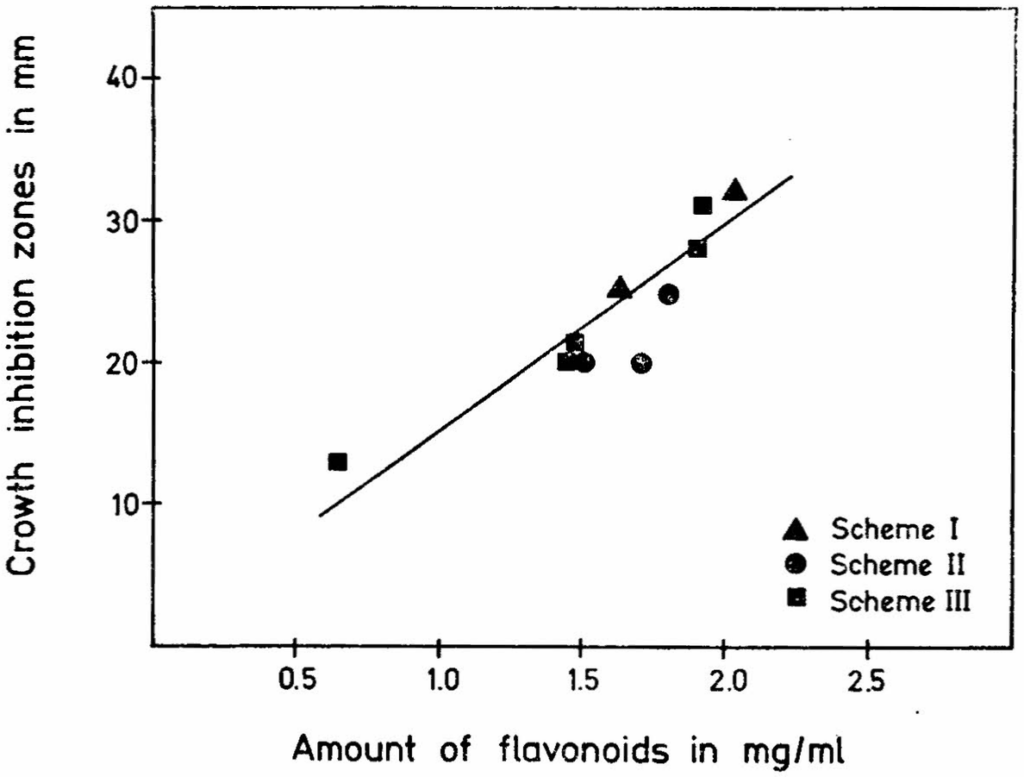
Fig. 1. Relationship between the concentration of flavonoids and growth inhibition zones of Mycobacterium sp. 279
strona 53Table 3 The effect of propolis subfractions obtained by thin-layer chromatography on the growth of Mycobacterium sp. 279 Wpływ subfrakcji propolisowych uzyskanych na drodze chromatografii cienkowarstwowej na wzrost Mycobacterium sp. 279
| Fraction / Frakcje | Rf | Amount of flavonids mg/ml / Ilość flawonidów w mg/ml | Max. of light absorption (in 96% C₂H₅OH) / Max. absorpcji światła (w 96% C₂H₅OH) | Growth inhibition zones in mm. / Strefy zahamowania wzrostu mm | |
|---|---|---|---|---|---|
| Scheme I / Schemat I | Sediments (0) / Osad (0) | 0,59 | 0,01494 | 270, 364 | 11 |
| 0,72 | 0,03154 | 271, 324, 418 | 10 | ||
| 0,82 | 0,06660 | 273, 290, 418 | 16 | ||
| 0,92 | 0,10000 | 293, | 19 | ||
| Ethyl acetate / Octan etylu | 0,45 | 0,01162 | 273 | 9 | |
| 0,61 | 0,00996 | 273 | 9 | ||
| 0,81 | 0,02990 | 274, 288 | 11 | ||
| 0,93 | 0,05000 | 290 | 13 | ||
| Scheme II / Schemat II | Ethyl acetate / Octan etylu | 0,58 | 0,00996 | 279, | 9 |
| 0,83 | 0,02158 | 271 | 11 | ||
| 0,95 | 0,04502 | 282, 313, 418 | 13 | ||
| Sediment (0₁) / Osad (0₁) | 0,54 | 0,01494 | 287, 418 | 9 | |
| 0,68 | 0,01498 | 287, 418 | 10 | ||
| 0,76 | 0,01669 | 287, | 10 | ||
| 0,98 | 0,01162 | 272, 312 | 9 | ||
| 0,96 | 0,03800 | 294 | 12 | ||
| Sediment (0₂) / Osad (0₂) | 0,44 | 0,02155 | 271 | 9 | |
| 0,58 | 0,02300 | 272 | 10 | ||
| 0,77 | 0,02820 | 290, 310 | 11 | ||
| 0,89 | 0,02492 | 290, 310 | 11 | ||
| 0,94 | 0,09672 | 287 | 13 | ||
| Scheme III / Schemat III | Ether-benzene | 0,63 | 0,01494 | 290 | 9 |
| 0,81 | 0,01660 | 272, 425 | 10 | ||
| 0,87 | 0,02820 | 270, 418 | 13 | ||
| Benzene / Benzen | 0,65 | 0,01162 | 288 | 10 | |
| 0,81 | 0,02158 | 288 | 11 | ||
| 0,95 | 0,08994 | 277 | 14 | ||
| Carbon tetrachloride / Czterochlorek węgla | 0,61 | 0,01660 | 285 | 10 | |
| 0,73 | 0,03800 | 274 | 11 | ||
| 0,86 | 0,02820 | 271, 289, 418 | 12 | ||
| Čhloroform / Chloroform | 0,55 | 0,00996 | 278 | 9 | |
| 0,79 | 0,01660 | 286, 418 | 11 | ||
| 0,88 | 0,01162 | 289 | 9 | ||
| 0,95 | 0,03800 | 292, 314 | 12 | ||
| Acetone | 0,33 | 0,00498 | 282 | — | |
| 0,45 | 0,00664 | 288 | — | ||
| 0,64 | 0,00664 | 280, 418 | — | ||
| 0,68 | 0,00996 | 285, 418 | 9 | ||
| 0,72 | 0,00996 | 288, 418 | 11 |
adsorption spectrum in the range 250—450 nm were determined in the particular subfractions. For individual subfractions absorption maxima were found, corresponding to compounds from the group of flavonoids described in the monographies of Harbone (1967) and Markham (1982).
Compounds were also found the maxima of which deviated from those described in the literature. These compounds showed maxima at 293 and 294 nm. It was also found that the lowest concentration of flavonoids at which inhibition of bacteria growth was obtained amounted, 0,00996 mg/ml.
Basing on the obtained results it can be found that the presented schemes of propolis purification allow the obtaining of biologically active fractions containing compounds from the group of flavonoids. Further separation by using thin-layer chromatography results in obtaining individual compounds of this group characterized by absorption maxima.
CONCLUSIONS
- Flavonoids present in propolis inhibit the growth of saprophytic acid-resistant bacilli.
- The strain Mycobacterium sp. 279 is the most sensitive to the action of these compounds.
- A proportional relational relationship was found between the concentration of flavonoids and the inhibition zones of Mycobacterium sp. 279 growth.
- The lowest concentration of flavonoids at which inhibition growth of bacteria was obtained amounted 0,00996 mg/ml.
LITERATURA
- Harbone J. B., 1967: Comparative Biochemistry of the Flavonoids. Academic Press, London, New York.
- Jerzmanowska Z., 1967: Substancje roślinne — metody wyodrębniania. PWN, Warszawa.
- Jóźwik Z., Baraniecka-Włoszycka A., 1976: The Effect of Propolis on Mycobacterium sp. Annales UMCS, sec. C, XXXI, 9, 127—134.
- Karimowa Z. N., 1963: Tuberkulez legkich i propolis. Pczełowodstwo, 1, 36—37.
- Kiwałkina W. P., 1959: Prottiwmikrobnoje dejstwije propolisa. Pczełowodstwo, 10, 50—51.
- Lindenfelster L. A., 1968: Antimicrobial Activity of Propolis. Am. Bee J., 3, 90—92.
- Markham K. R., 1982: Techniques of Flavonoid Identification. Academic Press, London, New York, Paris, San Diego, San Francisco, Sao Paulo, Sydney, Tokyo, Toronto.
- Poprawko S. A., Gurewicz A. J., Kołosow H. N., 1969: Flawonojdnyje komponenty propolisa. Chimija Prir. Sojedin. 5/6, 476—482.
- Strzelecka H., Kamińska J., Kowalski J., Walewska E., 1978:
Chemiczne metody badań roślinnych surowców leczniczych. PZWL, Warszawa.
- Uszkałowa W. H., Murychnicz T. P., 1973: Antikislitielnyje swoistwa propolisa. Pczełowodstwo, 2, 15—16.
- Wilska-Jeszka J., 1959: Chemia i własności fizjologiczne flawonoidów. Wiad. Chem., 6 (144), XIII, 289—327.
WPŁYW EKSTRAKTÓW PROPOLISOWYCH ZAWIERAJĄCYCH FLAWONOIDY NA SAPROFITYCZNE PRĄTKI KWASOOPORNE
Z. Jóźwik, J. Trytek
Streszczenie
Flawonoidy i ich pochodne wchodzą w skład propolisu jako liczna grupa biologicznie czynnych związków. Substancje te wykazują własności antybakteryjne i przeciwwirusowe. W pracy tej przedstawiono wpływ ekstraktów propolisowych zawierających związki z grupy flawonoidów na wzrost saprofitycznych prątków kwasoopornych (Mycobacterium smegmatis, Mycobacterium 607, Mycobacterium 279, Mycobacterium phlei i Mycobacterium butyricum). Propolis otrzymywano od pszczelarzy z makroregionu lubelskiego. Ekstrakt etanolowy propolisu (EEP) o znanej aktywności przeciwprątkowej poddawano ekstrakcji przy użyciu szeregu rozpuszczalników organicznych stosując trzy schematy rozdziału. EEP poddawano ekstrakcji: octanem etylu, octanem etylu z gorącą wodą oraz stosowano rozpuszczalniki o wzrastającej polarności (eter, benzen, chloroform czterochlorek węgla i aceton). W uzyskanych frakcjach oznaczono ilość flawonoidów stosując w modyfikacji własnej, metodę Christa-Müllera. Frakcje zawierające flawonoidy poddano chromatografii cienkowarstwowej na celulozie PEI-Cellulose F stosując jako rozwijacz 60% CH₃COOH. W otrzymanych subfrakcjach oznaczono także poziom flawonoidów a także sprawdzono działanie tych subfrakcji na wzrost prątków gruźlicy. Okazało się, że istnieje proporcjonalna zależność między ilością flawonoidów a wielkością stref zahamowania wzrostu saprofitycznych prątków kwasoopornych. Najbardziej wrażliwym szczepem na działanie poszczególnych frakcji był Mycobacterium sp. 279. Octan etylu jest dobrym rozpuszczalnikiem ekstrahującym związki flawonoidowe. Związki te przechodziły również do eteru, benzenu i czterochlorku węgla.
ВЛИЯНИЕ ЭКСТРАКТОВ ПРОПОЛИСА, СОДЕРЖАЩИХ ФЛАВОНИДЫ НА САПРОФИТИЧЕСКИЕ КИСЛОТОУПОРНЫЕ ПАЛОЧКИ
З. Юзвик, Я. Трытек
Резюме
В состав прополиса входят флавониды и их производные, многочисленная группа биологически активных соединений. Эти вещества обладают антибактериальными и антивирусными свойствами.
В настоящей работе рассматривается влияние экстрактов прополиса, содержащих соединения из группы флавонидов, на рост сапрофитических кислотоупорных палочек (Mycobacterium smegmatis, Mycobacterium 607, Mycobacterium 279, Mycobacterium phlei, Mycobacterium butiricum).
Прополис был доставлен пчеловодами Люблинского макрорегиона. Спиртовой экстракт прополиса, известный противотуберкулезной активностью, экстрагировали рядом органических растворителей, применив при этом три схемы
strona 56деления. Спиртовой экстракт экстрагировали этилацетатом, этилацетатом с горячей водой и при помощи растворителей с возрастающей полярностью (эфир, бензон, хлороформ, тетрахлоруглерод и ацетон). Количество флавонидов в полученных фракциях определяли при помощи модифицированного авторами метода Х. Мюллера. Содержащие флавониды фракции подвергли тонкослойной хроматографии на целлюлозе PEI-Cellulose F в 60%-ом CH₃COOH. В полученных подфракциях определяли уровень флавонидов и проверяли действие этих подфракций на рост палочек туберкулеза. Установлена пропорциональная зависимость между количеством флавонидов и величиной зон заторможения роста сапрофитических кислотоупорных палочек. Наиболее чувствительным к действию отдельных фракций штаммом оказался Mycobacterium sp. 279. Этилацетат является хорошим растворителем, экстрагирующим флавонидные соединения. Эти соединения проникали также в эфир, бензон и тетрахлоруглерод.
Errata — błędy druku znalezione podczas digitalizacji
- s. 47: „bacillli” → bacilli
- s. 47: „Karmiowa” → Karimowa
- s. 48: „filtred” → filtered
- s. 48: „ethylene alkohol” → ethyl alcohol
- s. 48: „thermostate” → thermostat
- s. 48: „condensed ot soild mass” → condensed to solid mass
- s. 50: „fracctions” → fractions
- s. 50, 2×: „flawonoids” → flavonoids
- s. 50: „Flawonoids” → Flavonoids
- s. 50: „test tubes nad flooded” → test tubes and flooded
- s. 51: „modyfications” → modifications
- s. 51: „tetrochloride” → tetrachloride
- s. 52: „cellulose as absorbent” → cellulose as adsorbent
- s. 52, ryc. 1: „Crowth” → Growth
- s. 53, tab. 3: „flavonids” → flavonoids
- s. 53, tab. 3: „flawonidów” → flawonoidów
- s. 53, tab. 3: „Čhloroform” → Chloroform
- s. 54, 2× (tekst i piśmiennictwo): „Harbone” → Harborne
- s. 54, piśmiennictwo: „Flawonojdnyje” → Flawonoidnyje
- s. 55, tytuł streszczenia rosyjskiego: „ФЛАВОНИДЫ” → ФЛАВОНОИДЫ
- s. 55, streszczenie: „butiricum” → butyricum
- s. 55–56, streszczenie: „флавониды” → флавоноиды
- s. 55–56, streszczenie: „флавонидов” → флавоноидов
- s. 56, streszczenie: „флавонидные” → флавоноидные
- s. 56, streszczenie, 2×: „бензон” → бензол