

POLLEN LOADS AS A FOOD OF STORED PRODUCT MITES (ACAROIDEA)
tekst: Wit Chmielewski
Pszczelnicze Zeszyty Naukowe, Rok XXXIX, 1995 — Wit Chmielewski
strona 169PSZCZELNICZE ZESZYTY NAUKOWE Rok XXXIX, Nr 1 1995
Wit Chmielewski
Research Institute of Pomology and Floriculture, Bee Division, Kazimierska 2, 24-100 Puławy, POLAND
Summary
The aim of this study was the recognition of the possibility of development and fecundity of two stored product mite species common in apiaries (Acarus siro L., Tyrophagus putrescentiae /Schr./), on bee-collected pollen, in aspect of their noxiousness for this product.
Results show that flower pollen collected by bees is an attractive food warranting favourable development, high fecundity and vitality for acarids. Therefore they are threatening pests of this product. Besides that T.putrescentiae in comparison to A.siro shows the highest biological potential. Their (male and female) longevities and fecundities differ considerably.
Pollen seems to be an effective natural medium for rearing both acarid species in laboratory cultures. It makes possible to obtain a lot of biological material in comparatively short time for teaching and experimental purposes.
<u>Keywords:</u> Acarina, mites, pests, bee products, pollen.
INTRODUCTION
Acarids are important and numerous group of mite species associated with honey bees (Apis mellifera L.). Most of them are known as invaders of hives and scavengers feeding on natural hive debris. Some species are common and cosmopolitan stored product mites. They usually form very numerous colonies settling debris in bee nests, which are natural reservoirs of these pests. Flour mite (Acarus siro L.) and mould or copra mite (Tyrophagus putrescentiae /Schr./) belong to the most frequent species of Acaroidea superfamily occupying these habitats (Banaszak 1980; Chmielewski 1971, 1977, 1987, 1991, 1994; De Jong et all. 1982; Gaponova, Grobov 1978; Haragsim et all. 1987). Last investigations of wintering bee colonies prove their presence in 20,2 and 10,3% of total number 1783 analysed debris samples collected from Polish apiaries, respectively (Chmielewski 1992). They are polyphagous cemmensals of bees and considered as common free living, saprophagous mites inhabiting various synantropic and natural biotopes.
The aim of present studies was the experimental confirmation of the thesis that above-mentioned bee hive acarids can successfully develop on bee-collected pollen and are real pests of this product.
strona 170MATERIAL AND METHODS
Material for laboratory investigations – living mites were isolated from infested stored products and natural bee-hive debris. Stock cultures of each acarid species were maintained in rearing cells, under laboratory conditions (+20±2°C, 85% r.h.) using bee-collected pollen as food. Pollen loads were taken from pollen traps.
New emerged, one day adults were sexed and paired. Each mite pair was placed in separate cage supplied with pollen. 100 pairs of mites of each species were observed. Behaviour, egg laying and longevity of mites were studied. Observations were conducted 3 times a week until all mites had die. All laid eggs and died adults were successively removed and fresh food was added if necessary. In the other experiments the life history, sex ratio and natural mortality were examined. New laid eggs were placed on food in rearing cells (2 species x 10 cages x 10 eggs) and were observed daily. All changes, beginning from eclosion of larvae, through the nymphal stages, to emergency of adults, were registered. Every time new emerged adults were sexed and removed from cages. Results of biological observations were tested statistically (Duncan test).
RESULTS AND DISCUSSION
Investigations of two commonest stored product mites often inhabiting bee hives – A.siro and T.putrescentiae, conducted under laboratory conditions on bee-collected pollen showed that it is an attractive food for these acarids. Their longevity, fecundity and life history on pollen proved their high vitality and good adaptation to this kind of food (tab.1-2). Adult mites start to copulate before long after their emergency from deutonymphal skins. Females begin to lay first eggs 2-3 days afterwords. The intensity of egg production increases every next day. Oviposition rate of both species is clearly differentiated (tab.3, fig.1). The comparison of bionomics of each of both species shows that biological potential of mould mite is evidently higher than the potential of flour mite on this food. Such biological data of both acarids as longevity of males, females and egg productivity, differ considerably. Flour mite females laid the majority (56,3%) of eggs between 6th and 25th day of their lifespans. Oviposition of mould mite is more expended in time and females lay most of all eggs (64,3%) between 6th and 55th their life days. Maximum intensity of egg production of A.siro takes place in interval between 10th and 15th of its lifespan. T.putrescentiae laid daily maximum numbers of eggs between 16th and 20th life days. Complete developmental cycle of mould mite was 1-2 days shorter than the cycle of flour mite and took on average 12,7 and 14,4 days, respectively. However, this difference is insigificant statistically. Juvenile instars
strona 171Table 1 Longevity, development and mortality of acarids feeding on bee-collected pollen, under laboratory conditions (20±2°C, r.h. – nearly 85%); number of examined mites – 100 specimens of both sexes and each species Długość życia, rozwój i śmiertelność rozkruszków żywiących się pyłkiem zbieranym przez pszczoły, w warunkach laboratoryjnych (20±2°C, wilgotność względna – około 85%); liczba zbadanych roztoczy – 100 osobników obu płci i każdego gatunku
| Mite species / Gatunek roztoczy | Longevity (days) / Długość życia (dni): Male averages (from-to) / Samiec średnie (od-do) | Longevity (days) / Długość życia (dni): Female averages (from-to) / Samica średnie (od-do) | Development (days) / Rozwój (dni): Embryonic / Zarodkowy | Development (days) / Rozwój (dni): Complete averages (from-to) / Całkowity średnie (od-do) | Natural mortality (%) / Śmiertelność naturalna (%): Eggs / Jaja | Natural mortality (%) / Śmiertelność naturalna (%): Other juvenile stages / Inne stadia młodociane | Frequency of females % / Frekwencja samic % |
|---|---|---|---|---|---|---|---|
| Acarus siro L. | 85,0a(21-142) | 60,3b(22-181) | 4,2(2-8) | 14,4a(9-25) | 17,2(4-43) | 42,0(15-79) | 49,5(41,2-54,7) |
| Tyrophagus putrescentiae (Schr.) | 112,8c(35-216) | 105,8d(24-166) | 3,9(2-14) | 12,7a(9-27) | 4,2(0-9) | 11,7(10-14) | 50,1(44,4-60,2) |
Averages (longevity, complete development) followed by the various letters differ significantly (Duncan test) Różne litery po średnich (długość życia, rozwój całkowity) oznaczają, że wartości te różnią się istotnie (test Duncana)
strona 172Table 2 Oviposition of acarids feeding on bee-collected pollen, under laboratory conditions (20±2°C, r.h. – nearly 85%); number of examined mites – 100 pairs (female + male) of each species Składanie jaj przez rozkruszki żywiące się pyłkiem zbieranym przez pszczoły, w warunkach laboratoryjnych (20±2°C, wilgotność względna – około 85%); liczba zbadanych roztoczy – 100 par (samica + samiec) każdego gatunku
| Mite species / Gatunek roztoczy | Egg laying females (%) / Samice składające jaja (%) | Mean number of eggs per: / Średnia liczba jaj na: Fecundity day / Dzień płodny | Mean number of eggs per: / Średnia liczba jaj na: Life day / Dzień życia | Mean number of eggs per: / Średnia liczba jaj na: Whole life averages (from-to) / Całe życie średnie (od-do) | Oviposition period (days) / Okres płodny (dni) | Unfecund days: / Dni niepłodne: Before oviposition period / Przed okresem składania jaj | Unfecund days: / Dni niepłodne: After oviposition period / Po okresie składania jaj |
|---|---|---|---|---|---|---|---|
| Acarus siro L. | 99,0 | 4,6(1-27) | 3,6(0-27) | 218,0a(64-419) | 44,3(19-95) | 2,7(1-10) | 8,9(0-122) |
| Tyrophagus putrescentiae (Schr.) | 100,0 | 7,8(1-30) | 6,4(0-30) | 635,6b(32-1169) | 72,7(12-149) | 2,6(1-5) | 10,9(0-98) |
Averages (number of eggs per whole life) followed by the various letters differ significantly (Duncan test) Różne litery po średnich (liczba jaj przypadająca na całe życie) oznaczają, że wartości te różnią się istotnie (test Duncana)
strona 173of T.putrescentiae were more vital but adults lived longer than A.siro. Frequency of females of each species was very similar.
Confrontation of present results with biological data obtained in the earlier similar studies on the same species using various products as food shows that attractiveness of pollen for acarids is comparable to other kinds of food accepted by them very much. Biological parameters obtained in these studies evidence that pollen is a medium equivalent or even more preferable than such attractive products as baker’s yeast and wheat germ. A.siro and T.putrescentiae seem to be able to adapt themselves to pollen as food very much and their liveliness is almost the same or even higher than other acarids on this product (Chmielewski 1978, 1983, 1994).
Table 3 Egg production (%) in particular (10 days) intervals of oviposition periods of Acarus siro L. and Tyrophagus putrescentiae (Schr.) feeding on pollen loads. Data based on laboratory observations of 100 females of each species under controled conditions (20±2°C, r.h. – about 85%) Produkcja jaj (%) w poszczególnych (10-dniowych) przedziałach okresów płodności Acarus siro L. i Tyrophagus putrescentiae (Schr.) żerujących na obnóżach pyłkowych. Dane oparte na laboratoryjnych obserwacjach 100 samic każdego gatunku w warunkach kontrolowanych (20±2°C, wilgotność względna – około 85%)
| Consequtive intervals of female life days / Kolejne przedziały dni życia samicy | Percentage of eggs laid in particular periods of female life / Udział procentowy jaj składanych w poszczególnych okresach życia samicy: A.siro L. | Percentage of eggs laid in particular periods of female life / Udział procentowy jaj składanych w poszczególnych okresach życia samicy: T.putrescentiae (Schr.) |
|---|---|---|
| 1 – 10 | 19,2 | 7,6 |
| 11 – 20 | 30,1 | 15,2 |
| 21 – 30 | 20,5 | 15,5 |
| 31 – 40 | 14,2 | 12,1 |
| 41 – 50 | 9,3 | 10,9 |
| 51 – 60 | 3,7 | 9,8 |
| 61 – 70 | 2,2 | 7,1 |
| 71 – 80 | 0,4 | 5,6 |
| 81 – 90 | 0,2 | 5,7 |
| 91 – 100 | 0,2 | 4,7 |
| 101 – 110 | 0,0 | 3,6 |
| 111 – 120 | 1,5 | |
| 121 – 130 | 0,2 | |
| 131 – 140 | 0,2 | |
| 141 – 150 | 0,2 | |
| 151 – 160 | 0,1 | |
| 161 – 170 | 0,0 |
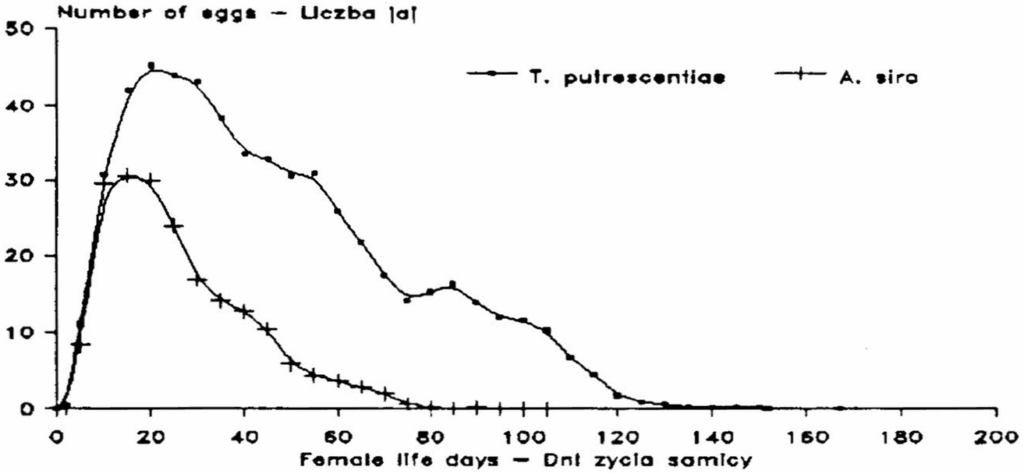
Fig.1. Oviposition course of acarids on bee-collected pollen under laboratory conditions; mean numbers of eggs per particular periods of female life (5 day intervals). Data based on observations of 100 females (pairs) of each of both studied species.
Przebieg składania jaj przez rozkruszki na pyłku zbieranym przez pszczoły, w warunkach laboratoryjnych; średnie liczby jaj w poszczególnych okresach życia samicy (5-dniowe przedziały). Dane oparte na obserwacjach 100 samic (par) każdego z obydwu badanych gatunków.
CONCLUSIONS
- Bee-collected pollen is an attractive food for the commonest stored product mites – A.siro and T.putrescentiae.
- Both species feeding on pollen reach high fecundity and complete their life history on this product.
- Some biological parameters (longevity, egg production) of T.putrescentiae obtain significantly higher values than the same parameters of A.siro.
- Mould mite has comparatively shorter developmental cycle and lower mortality of its juvenile instars than flour mite.
- Sex ratio of both species was similar; proportion of males to females fluctuates usually near 1:1.
- Both acarids are well adapted to bee-collected pollen as food and seem to be important threat as its pests.
- These mites introduced into pollen under favourable laboratory conditions colonize it and grow in numbers at a great rate.
- This method of rearing of acaroid mites is worthy of recommendation for mass-production of mite material for acarological studies and for teaching acarology.
REFERENCES
Banaszak J. (1980) – Badania nad fauną towarzyszącą w zasiedlonych ulach pszczelich. Fragm.Faun., 25(10):127-177.
Chmielewski W. (1971) – Badania nad składem gatunkowym roztoczy w zasiedlonych ulach pszczelich i w przechowalniach miodu. Pszczeln.Zesz.Nauk., 15(1-2):69-80.
Chmielewski W. (1977) – Wyniki obserwacji powiązań roztoczy z owadami (Acari – Insecta). Bull.Entomol.Pol., 47:59-78.
Chmielewski W. (1978) – Płodność i rozwój niektórych gatunków roztoczy na pyłku. Pszczeln.Zesz.Nauk., 22:173-180.
Chmielewski W. (1983) – Pierzga jako pokarm rozkruszków z rodzaju Acarus (Acarina: Acaridae). Zesz.Probl.Post.Nauk Roln., 252:171-178.
Chmielewski W. (1989) – Mites (Acarida) associated with honey bee (Apis mellifica L.) in Poland. Proc. XXXI-st Int.Apic.Congr.Apimondia, August 19-25, 1987, Warsaw, Poland. Apimondia Publishing House, Bucharest – Romania, 205-208.
Chmielewski W. (1991) – Stored product mites (Acaroidea) in Polish bee hives. Proc. VIII-th Int.Congr.Acarology, 1990.08.5-11, Česke Budejovice, Čechoslovakia, F.Duśbábek and V.Bukva (Eds.): Modern Acarology, Co-published by SPB Academic Publishing bv. The Hague and Academia Prague, 1:615-619.
Chmielewski W. (1992) – Skład gatunkowy i liczebność akarofauny w osypie naturalnym zimujących rodzin pszczelich. Pszczeln.Zesz.Nauk., 36:74-90.
Chmielewski W. (1994) – Składanie jaj i rozwój rozkruszków (Acaroidea) na pyłku zbieranym przez pszczoły. Pszczeln.Zesz.Nauk., 38:131-142.
De Jong D., Morse R.A., Eickwort G.C. (1982) – Mite pests of honey bees. A.Rev.Ent., 27:229-252.
Gaponova V.S., Grobov O.F. (1978) – Kleščevyje bolezni pčel. Rosselxozizdat, Moskva, 85-91.
Haragsim O., Sámšińák K., Vobrázková E. (1987) – The mites inhabiting the bee-hives in ČSR. Z.angew.Ent., 87(1):52-67.
OBNÓŻA PYŁKOWE JAKO POKARM ROZKRUSZKÓW MAGAZYNOWYCH (ACAROIDEA)
W. Chmielewski
Streszczenie
Celem badań było poznanie możliwości rozwoju i płodności 2 pospolitych gatunków roztoczy przechowalnianych występujących w pasiekach (Acarus siro L., Tyrophagus putrescentiae /Schr./), na pyłku zbieranym przez pszczoły, w aspekcie ich szkodliwości dla tego produktu.
Materiałem doświadczalnym były żywe roztocze z monokultur prowadzonych od wielu lat w warunkach laboratoryjnych (20°C, wilgotność względna powietrza – ok. 85%, pożywka – drożdże, pyłek, zarodki zbożowe /1:1:1/). W doświadczeniach nad rozwojem i śmiertelnością roztoczy na pyłku jako pokarmie obserwowano po 100 osobników, a nad długością życia i płodnością po 100 par imagines każdego z 2 badanych gatunków.
Obnóża pyłkowe do doświadczeń pozyskiwano za pomocą poławiaczy zewnętrznych, zainstalowanych u wylotków uli w pasiece ukierunkowanej na produkcję pyłku.
strona 176Stwierdzono, że pyłek kwiatowy zbierany przez pszczoły stanowi atrakcyjny pokarm dla obydwu gatunków rozkruszków, zapewnia im pomyślny rozwój, dużą płodność i żywotność, co sprawia że stanowią one realne zagrożenie dla tego produktu jako jego szkodniki. T.putrescentiae (T.p.) wykazuje się przy tym większym potencjałem biologicznym w porównaniu z A.siro (A.s.), o czym świadczą następujące dane uzyskane w badaniach (wyniki średnie):
| A.s. | T.p. | |
|---|---|---|
| Długość rozwoju osobniczego (dni) | 14,4 | 12,7 |
| % osobników kończących rozwój (imagines) | 58,0 | 88,3 |
| Frekwencja samic (%) | 49,5 | 50,1 |
| Liczba jaj składanych w ciągu całego życia samicy | 218,0 | 635,6 |
| Długość życia roztoczy (dni) | 72,6 | 109,3 |
Rozwój rozkruszka drobnego trwa nieco krócej niż u rozkruszka mącznego; różnica nie jest jednak statystycznie istotna. Natomiast w przypadku liczby składanych jaj (nieśność) w ciągu całego życia, długości życia samic i samców, zarówno obydwu gatunków jak i każdego z osobna, różnice są wyraźne i statystycznie istotne (test Duncana).
Poza tym pyłek może być efektywną pożywką naturalną w laboratoryjnych hodowlach obydwu gatunków rozkruszków, pozwalającą na uzyskiwanie w stosunkowo krótkim czasie dużej ilości materiału biologicznego do celów doświadczalnych i dydaktycznych.
<u>Słowa kluczowe:</u> Acarina, roztocze, szkodniki, produkty pszczele, pyłek.
Errata — błędy druku znalezione podczas digitalizacji
- s. 169, 2×: „et all.” → et al.
- s. 169: „cemmensals” → commensals
- s. 169: „synantropic” → synanthropic
- s. 170: „afterwords” → afterwards
- s. 170: „insigificant” → insignificant
- s. 173, tab. 3: „controled” → controlled
- s. 173, tab. 3: „Consequtive” → Consecutive
- s. 175, piśmiennictwo: „Duśbábek” → Dušbábek
- s. 175, piśmiennictwo: „Sámšińák” → Samšiňák