

STUDY ON BIOLOGY OF FLOWERING, NECTARING, POLLINATION AND SEED SETTING IN RED CLOVER (TRIFOLIUM PRATENSE L.)
tekst: Bolesław Jabłoński
Pszczelnicze Zeszyty Naukowe, Rok XXI, 1977 — Bolesław Jabłoński
strona 177BEE RESEARCH COPIES V.XXI DECEMBER 1977
Bolesław Jabłoński
I.S. Puławy, Poland
Red clover seed yields are relatively low and unstable. This is due, among others, to the unsatisfactory pollination of this entomophilous plant. Its nectar is placed relatively deep down in the tube, which is the main reason why honeybees do not willingly visit its flowers. On the other hand the number of bumblebees, these natural wild pollinators, is getting fewer and fewer as the development of farming continues. That is why wherever this fodder plant is grown, ways of increasing its seed yield are searched for. This purely agricultural and apicultural problem is also dealt with in the Department of Beekeeping I.S. in Puławy. Here we try to understand better the biology of red clover blooming, nectaring, pollination and seed setting. We look for flowers with nectar which is more easily, accessible to bees. The aim of this paper is to present some of our observations in this field.
BLOOMING
In Poland we grow mostly red clover yielding two crops a year. Only the second crop is set aside for seed production; the first crop is harvested for hay at the end of May or at the beginning of June. In our studies we took into account the first crop too. The second crop has, as a rule, shorter and stiffer off shoots, it is free from weeds and
strona 178
it is not overgrown with young sprouts. It produces even more flowers thanks to its bigger heads (Table 1). Besides, the second crop blooming falls on the turn of July and August which is a favourable period for pollinating at that time bumblebee colonies reach the peak of their upgrowth. Also honeybees can visit clover flowers in more numerous groups if only for pollen.
Very interesting observations can be made on the size of clover heads. In the later stage of blooming the number of flowers per head of the first crop increases and of the second crop decreases (Table 2). Presumably this is connected with the length of day and weather conditions.
The new flowers of red clover beginn to bloom only during the day from about 5—6 a.m. till 7 p.m. (Fig. 1). Just after the beginning of blooming the flower can be visited and pollinated by insects. It happens very often, however, that flowers which are not in full bloom are visited by bumblebees or honeybees, which gather already mellow pollen pouring out easily.
During the day about 8 flowers per head of the first crop and, on an average, 12 flowers of the second crop start to bloom. The variation in the number of flowers starting to bloom per day in particular heads
Table 1 Analysis of first and second crops (averages of 1969—1971)
| Feature investigated | Crop: I | Crop: II |
|---|---|---|
| Plant heights (in cm) | 83 | 62 |
| Number of plants per/m2 | 99 | 96 |
| Number of offeshoots per 1 m2 | 182 | 193 |
| Number of heads per 1 m2 | 608 | 542 |
| Number of flowers per head | 57,8 | 77,7 |
| Number of flowers per 1 m2 (in thousands) | 34,2 | 41,8 |
Table 2 Number of flowers per head undergoing stages of blooming of first and second crop (averages of 1969—1971)
| Stage of blooming | Crop: I | Crop: II |
|---|---|---|
| Initial stage (about 20% of heads) | 53,4 | 86,5 |
| First half (about 30% of heads) | 55,7 | 83,0 |
| Second half (about 30% of heads) | 57,9 | 75,2 |
| Final stage (about 20% of heads) | 66,8 | 66,3 |
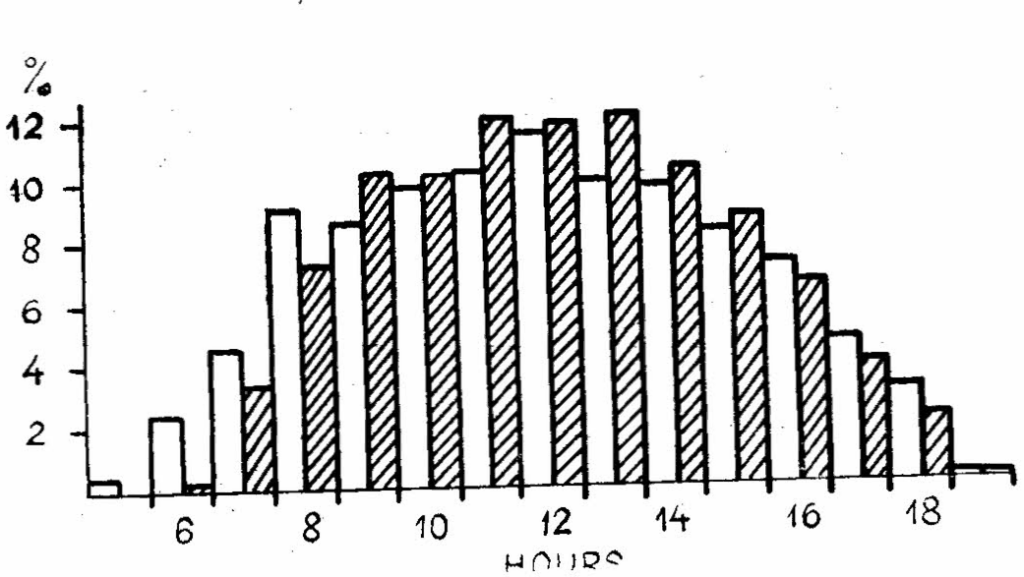
Fig. 1 Daily dynamics of starting to bloom field red clover, measured in one hour intervals by counting the number of starting to bloom flowers on the plot
ranged from several to above thirty. In smaller heads fewer flowers started to bloom during the day, in bigger ones, correspondingly more. The variation mentioned above is largely due to air temperature; air humidity has a negligeable influence in this case (Table 3). The length of the flowering period of one head with references to its size and weather conditions ranges from 3 to 12 days. The greatest number of flowers per head bloom in the middle stage of clover flowering, and the smallest in its final phase. When not visited by insects, the flower though in full bloom, lives, as a rule, 5—7 days; afterwards its corolla slowly withers away. At high temperature and a low soil moisture such a flower lives even a shorter time and at low temperature and a considerable soil moisture it can live 10 days and longer. The corolla of the flower from which insects took pollen away, thereby pollinating it, starts withering after several hours in hot weather and after 2—3 days at a lower temperature and a marked air humidity.
The seasonal dynamics of red clover field bloomings was studied in 1970 (Fig. 2). In the remaining years the process of flowering was very much alike. Second clover crop blooming is more intensive and its pe-
Table 3 Influence of temperature and relative air humidity on number of flowers starting to bloom in red clover head during day
| Temperature (in Centigrade) | Number of flowers | Humidity (in %) | Number of flowers |
|---|---|---|---|
| <16 | 5,3 | <40 | 9,6 |
| 16,1—18 | 7,9 | 40,1—50 | 11,4 |
| 18,1—20 | 8,7 | 50,1—60 | 10,6 |
| 20,1—22 | 10,4 | 60,1—70 | 9,0 |
| 22,1—24 | 10,1 | 70,1—80 | 9,1 |
| 24,1—26 | 11,3 | 80,1< | 7,3 |
| 26,1< | 12,2 | — | — |
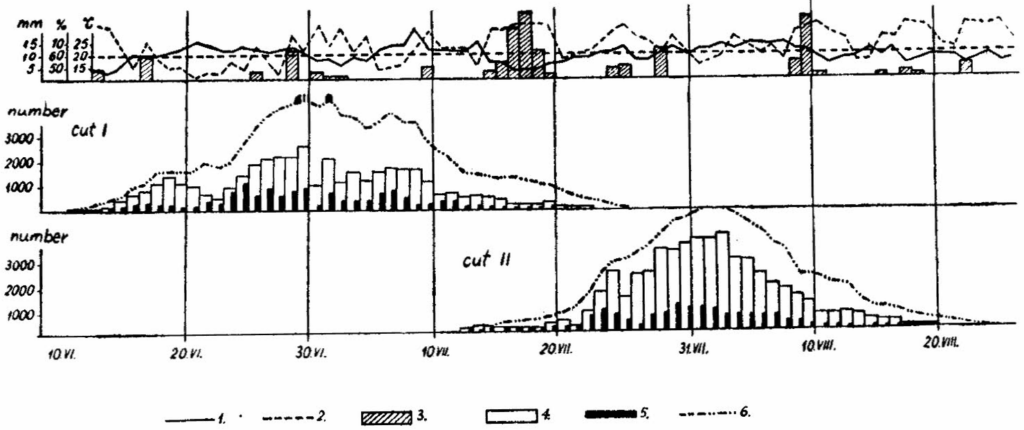
Fig. 2 Course of red clover flowering with reference to weather conditions 1 — daily acerage temperature of air in °C 2 — daily average relative humidity of air in % 3 — sums of rainfalls in mm 4 — number of starting to bloom flowers on 1 m2 5 — number of heads starting to bloom during a day on the plot of 20 m2 6 — number of heads blooming at the same time on 20 m2
roid shorter than that of first crop. Obviously, this is more favourable for seed harvesting. The number of flowers starting to bloom during the day per 1 m2 amounts to 2000 on the first crop and about 4000 on the second crop. Weather conditions, and air temperature, in particular exert a great influence on the dynamics of blooming. Warmth intensifies the process of flower bloomings and low temperatures hampers it.
NECTARING
After the development of the flower has been completed, its corolla tube length increases only at the very beginning to remain unchanged throughout its whole life time (Table 4). The corolla tube length ranges from 8 to 10 mm; in usually reaches 8,5 mm. Weather conditions and soil moisture have a great influence on tube lengths: high temperatures and a low soil moisture cause shortening of flower tubes. In southern regions of Poland clover tubes are, as a rule, shorter than in the North of Poland.
The flower begins to secrete nectar as soon as its corolla has been developed, sometimes even earlier. Nectar is accumulated at the bottom of the flower on its ventral side where the style of the pistil and the tenth free stamen adhere to the inner wall of the flower tube. Nectar height in a flower not visited by insects increases step by step up till the third day of the flowers life. Afterwards it remains constant and as the corolla starts withering away, it diminishes. In a flower visited and pollinated by insects, on the other hand, nectar secretion
strona 181Table 4 Corolla tube length and nectar accumulation with reference to age of non — pollinated flower (Data of 1969)
| Age of flower counted in days | Corolla tube length in mm | Distance to nectar in mm | Nectar height in mm | Quantity in nectar or 10 flowers in mg | % of sugar of nectar | Quantity of sugar of 10 flowers in mg |
|---|---|---|---|---|---|---|
| 1 | 7,77 | 7,44 | 0,33 | 0,18 | * | * |
| 1 | 8,52 | 7,78 | 0,74 | 1,14 | 65,4 | 0,75 |
| 2 | 8,55 | 7,39 | 1,16 | 2,85 | 57,3 | 1,64 |
| 3 | 8,66 | 7,41 | 1,25 | 3,50 | 57,3 | 2,01 |
| 4 | 8,73 | 7,25 | 1,48 | 3,39 | 58,5 | 1,99 |
| 5 | 8,96 | 7,52 | 1,44 | 3,53 | 62,0 | 2,19 |
| 6 | 8,96 | 7,49 | 1,47 | 3,38 | 59,8 | 2,02 |
| 7 | 8,06 | 7,44 | 0,62 | 2,16 | 60,0 | 1,30 |
- — due to its small quantity no percentage of sugar was recorded
lasts a shorter time. In the initial stage of flowers life, when nectar secretion takes place, the flower can be visited several times. Flowers unvisited in this stage, after the process of nectar secretion has stopped, may happen to be visited only once by an insect, which normally drinks up the whole nectar stored there.
The total quantity of sugar secreted by one flower usually amounts to 0,1—0,2 mg. The abundance in nectar secretion is largely dependent of weather conditions. Allways a sunny and warm weather, given a sufficient soil moisture has a favourable effect on clover nectaring, whereas a cloudy and chilly weather especially with rainfalls hampers nectar secretion.
The percentage of sugar in nectar depends on the actual air humidity. It ranges from 40% to 50%, given favourable weather conditions. At higher temperatures the concentration of sugar in nectar reaches 60%—70%, at great air humidity, on the other hand, it falls even below 20%. Rain water has no direct access to nectar of flowers which were not visited by insects.
The fluctuations in the percentage of sugar in nectar do not have an influence on nectar height in the tube. Thick nectar accumulates between the wall of the flower tube and the style adhering to it. Thin nectar, on the other hand, fills the tube out to a greates degree. There exists, however a direct relation, irrespective of sugar concentration, between nectar height and the profusion of nectaring. The fluctuations in sugar concentration determining the total quantity of nectar in the flower do not affect its accessibility to honeybees. Its acces-
strona 182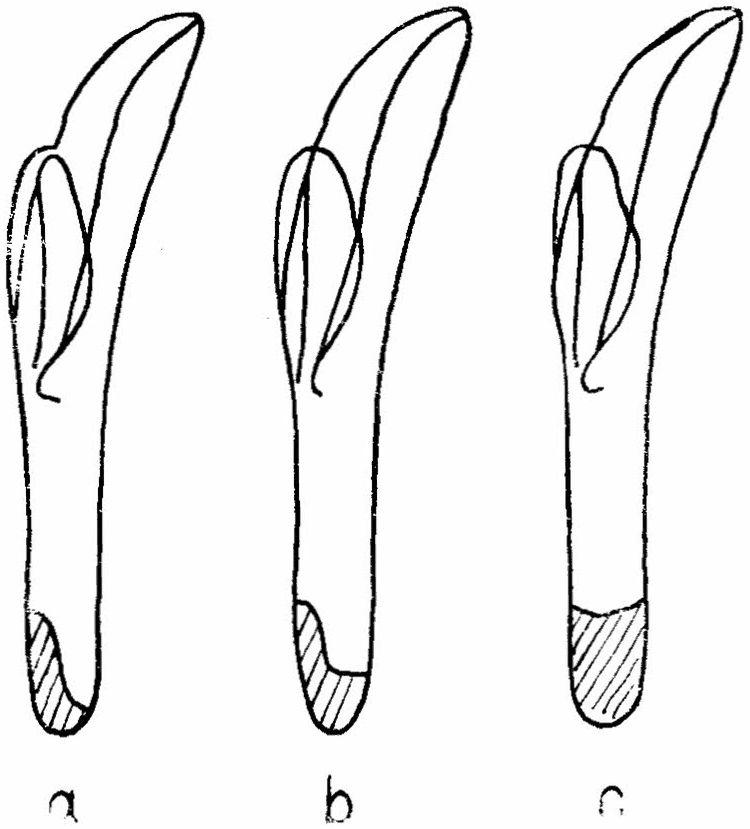
Fig. 3 Accumulation of nectar in flower tube in relation to percentage at sugar in it: a — high concentration of sugar b — medium concentration of sugar c — low concentration of sugar
sibility is conditioned only by the amount of sugar secreted and of course by the length of the flower tube. Even a very small shortening of the flower tubes causes that the plant is visited more frequently. This can be supported by the observations made on a short tubed variety found in Poland (Table 5).
At the corolla tube length reaching 8,5 mm and nectar height being 1,5 mm, nectar is to be found at a depth of 7 mm. In this case, long — tongued Caucasian bees and their hybrids with insects living in Poland can presumably reach it. A somewhat longer tube and poorer nectaring, on the other hand, make it impossible even for long — tongued beets to get at nectar in red clover. Meanwhile honey yield obtained from this clover is very high. From 1 ha of an average plantation 100 kg of honey can be obtained. A prosperous plantation can even produce 150 kg of honey.
Table 5 Influence of shortening of red clover tube on frequency of its visitation by pollinator insects (averages of 1968—1970)
| Variety | Corolla tube length | Number per 100 m2: honneybees | Number per 100 m2: bumblebess | Number per 100 m2: solitary bees |
|---|---|---|---|---|
| the Gloria | 9,3 | 27,5 | 14,2 | 3,5 |
| the „Variety” Kr. | 7,9 | 59,3 | 14,4 | 2,4 |
Some portion of nectar is reached by bees thanks to bumblebees which bite corolla tubes. A bumblebee which happened to cut the tube does not normally visit the flower again. It does not collect nectar carefully; the syrup left is picked up by bees, which get at it through the holes pierced by bumblebees.
POLLINATION
Cross — pollination of red clower can be performed, as a rule, only by insects of family Apidae: bumblebees and solitary bees, on the one hand and honeybees, reared by man, on the other.
All individuals of these species, when they come into contact with generative organs of flowers, pollinate then. However, the final pollinating effectiveness of an average individaul, measured by the quantity of seed obtained as a result of one day’s work on flowers, varies from species to species and with sexes. Here such factors combine as differences in the length of their daily work, agility at work, different effectiveness, resulting from different ways of visiting flowers and finally a different frequency of flying from a head to a head (Table 6). It is understandable that the greatest chance of being out — pollinated has that flower in the head which was visited first by an insect coming to it from another head. Thus the chances of out — pollinating other flowers become smaller (Fig. 4). A somewhat weaker pollinating effectiveness of male rather than female bumblebees comes from the fact that the former never collect pollen, which makes their contact with generative organs of flowers weaker. Meanwhile the Andrena gelriae Vecht which gathers pollen very carefully and slowly, pollinates the visited flowers most effectively.
Table 6 Length of daily work, work speed, frequency of flying from flower to flower and effectiveness of insects in pollinating red clover
| Species | Number of work hours during day | Number of flowers visited per 1 min | Number of flowers visited one after another in head | Quantity of seed of 100 flowers visited: once | Quantity of seed of 100 flowers visited: twice | Quantity of seed of 100 flowers visited: three times |
|---|---|---|---|---|---|---|
| Apis mellifica (L.). | 9 | 12,0 | 3,6 | 45,3 | 70,1 | 83,6 |
| Bombus Latr. | 10 | 24,4 | 5,5 | 43,4 | 68,0 | 81,9 |
| Bombus Latr. | 10 | 19,0 | 5,3 | 38,6 | 62,4 | 77,9 |
| Andrena gelariale Vicht. | 8 | 4,7 | 2,1 | 51,1 | 76,1 | 88,3 |
Table 6 shows that a flower visited once is not, in fact, pollinated fully. A complete pollination is accomplished after the flower has been visited three times. Only then the total quantity of seed set with reference to the number of flowers reaches 80%. The remaining (20%) flowers though they were pollinated do not, normally, under our field conditions, yield seed. This is due presumably to disturbancies in the development of buds, to damages made by various in sects etc.
The number of in sects needed for complete pollination of a 1 hectare red clover plantation can be determined in different ways.
The basis of our calculations constituted the detailed observations on field bloomings and the daily work effectiveness of an average individual of a particular species, measured by the number of seeds coming from flowers pollinated (Table 7). In this formulation the pollinating effectiveness of one bumblebee was twice as high as the efectiveness of one pollinator honeybee and 5 times as big as that of an individual of the species Andrena gelriae Vecht. Table 7 shows more over that by a single visitation of three flowers the pollinating effectiveness of insects is much higher than that by three visitations of one flower. In conjunction with this the same amount of pollinators can ensure a higher seed yield on a plantation blooming abundantly, rather than on a plantation flowering poorly. Thus to obtain a given seed yield the number of insects needed should be determined with reference to the degree of clover blooming on plantation.
Clover field blooming intensifies at the beginning to reache its peak and then it decreases rather quickly but it lasts a long time however. In this connection the need for pollinators in different stage of blooming is different (Table 8). Obviously the best thing to do would be to ensure a sufficient amount of Apoidea to visit a flower three times during the peak of blooming. That means what 16000 honeybees or about 7000 bumblebees are needed on an average blooming plantation, which
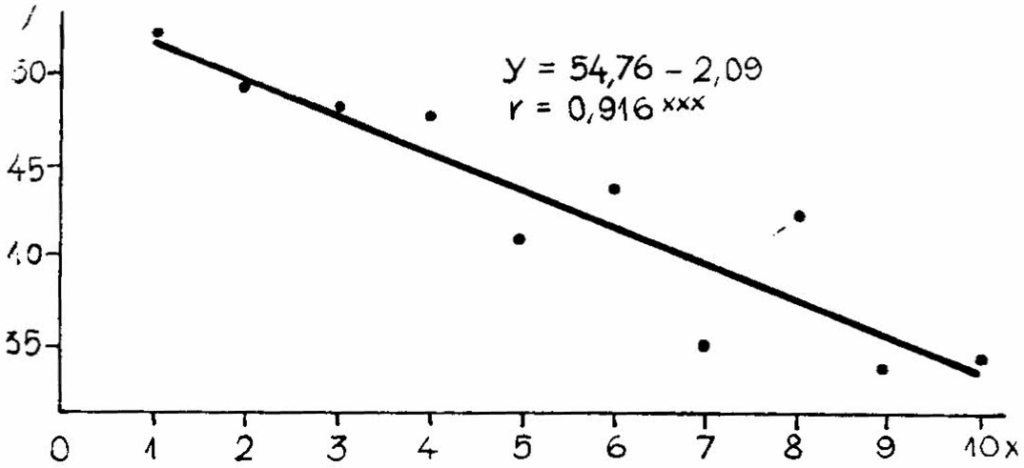
Fig. 4 Seed setting in red clover according to whether flower in head was visited as first, second, third etc x — flower number according to order of being visited y — percentage of seed set
strona 185Table 7 Working effectiveness of insects pollinating red clover with reference to number of flower visitations and the comparison of effectiveness of different species
| Species | Number of seed set after whole day of visitation: once visited | Number of seed set after whole day of visitation: twice visited | Number of seed set after whole day of visitation: visited three times | Pollinating effectiveness of one individual in relation to: Apis mell. | Pollinating effectiveness of one individual in relation to: Bombus |
|---|---|---|---|---|---|
| Apis mellifica (L.) | 2922 | 2261 | 1799 | 1,00 | 0,46 |
| Bombus Latr. | 6352 | 4972 | 3992 | 2,19 | 1,00 |
| Bombus Latr. | 4414 | 3562 | 2966 | 1,57 | 0,71 |
| Andrena gelriae Vecht. | 1156 | 861 | 666 | 0,38 | 0,18 |
produces 500 million flowers/ha and sets 800 kg of seed (half of it usually picked up by the farmer). In practice, however, such a density of population is found very rarely. It seems then that the minimum concentration of insects should not be lower than the density of population which ensures that each flower is visited at least once during the peak of field blooming. To get such a density about 500 honeybees or 2000 bumblebees are needed.
These individuals of bumblebees and honeybees which are getting nectar through the holes bitten on the corolla tube do not count as pol-
Table 8 Concentration of insects needed for pollinating red clover plantation — for average plantation producing 500 million flowers per ha, which could set by one, two and three visitations 430 kg, 680 kg and 800 kg of seed respectively
| Consecutive pentades on blooming period | Number of flowers starting to bloom per 1 m2 in 1 day | Concentration of honeybees needed per ha by flower visitations: once | Concentration of honeybees needed per ha by flower visitations: twice | Concentration of honeybees needed per ha by flower visitations: three times | Concentration of bumblebees needed per ha by flower visitations: once | Concentration of bumblebees needed per ha by flower visitations: twice | Concentration of bumblebees needed per ha by flower visitations: three times |
|---|---|---|---|---|---|---|---|
| I | 172 | 267 | 534 | 801 | 118 | 236 | 354 |
| II | 902 | 1398 | 2796 | 4194 | 617 | 1234 | 1851 |
| III | 2232 | 3459 | 6918 | 10377 | 1526 | 3052 | 4578 |
| IV | 3400 | 5269 | 10538 | 15807 | 2325 | 4650 | 6975 |
| V | 2045 | 3169 | 6338 | 9507 | 1399 | 2798 | 4197 |
| VI | 797 | 1235 | 2470 | 3705 | 545 | 1090 | 1635 |
| VII | 337 | 522 | 1044 | 1566 | 230 | 460 | 690 |
| VIII | 114 | 117 | 354 | 531 | 78 | 156 | 234 |
Remark: The average of flower visitations performed by one individual during a fine day was assumed: for honeybees 6454 and for bumblebees 14.622.
strona 186linators. It should be added that the bumblebees cutting holes in clover flowers as well as the individual sof Andrena ripping flower tubes in search for nectar do not damage the generative organs of flowers. Nor do they have a negative influence on seed setting in flowers perforated by then. Bumblebees, bitting flower tubes, make it possible for honeybees to get the remaining nectar. It is possible that also bees collecting pollen, that is pollinator individuals, are thus indirectly made to visit clover flowers.
SEED SETTING
Clover flowers set seeds most easily after they have been visited by insects straight after they begin to bloom. If an insect visits a flower later, the chance of having its seed set diminishes (Table 9). This is presumably due to a smaller flower attractiveness to insects rather than the diminished ability of the stigma to have pollen germinated. Old flowers do not secrete nectar, hence an insect after picking up all nectar stored, does not normally visit it again.
Seed setting in pollinated clover is largely conditioned by the actual weather. Low temperature, high air humidity and soil moisture during the blooming period have a harmful effect on seed setting (Table 10). The afore — mentioned factors cause that flowers during the period of seed maturing and seed growth are poorly shaped and wither away. That is why flowers of the final blooming stage of the second crop set seeds poorly; a great quantity of offal is found among them (Table 11). From this follows that, if possible, first crop should be cut early so that second seed crop ripening fall early in summer when the weather conditions are more favourable for seed production.
The most important period for seed production is the stage of its
Table 9 Red clover seed setting with reference to age of flowers pollinated (Data of 1969)
| Age of flowers in days | Percentage of seed: set according to number of flowers | Percentage of seed: withered away in relation to seed set |
|---|---|---|
| 0 | 80,0 | 17,9 |
| 1 | 72,5 | 13,3 |
| 2 | 71,4 | 14,6 |
| 3 | 52,8 | 14,8 |
| 4 | 49,5 | 19,1 |
| 5 | 53,4 | 17,3 |
| 6 | 41,2 | 18,9 |
| 7 | 38,0 | 14,5 |
Table 10 Influence of temperature and relative air humidity on red clover seed setting (observations from 1969—1971)
| Air temp. in Centigrade | % of seed set in relation to flowers being pollinated | Air humidty in % | % of seed set in relation to flowers pollinated |
|---|---|---|---|
| <18 | 41,3 | <40 | 85,8 |
| 16,1—18 | 59,5 | 40,1—50 | 80,0 |
| 18,1—20 | 69,0 | 50,1—60 | 77,9 |
| 20,1—22 | 72,0 | 60,1—70 | 62,3 |
| 22,1—24 | 79,5 | 70,1—80 | 49,5 |
| 24,1< | 84,0 | 80,1< | 34,6 |
Table 11 Seed setting in red clover in particular stages of its blooming (averages of 1969—1971)
| Stages of blooming | % of seed set in relation to flowers on crop: I | % of seed set in relation to flowers on crop: II | % of seed withered away on crop: I | % of seed withered away on crop: II |
|---|---|---|---|---|
| Initial (about 20% heads) | 59,1 | 73,3 | 16,9 | 6,9 |
| First half (about 30% heads) | 58,4 | 82,4 | 18,9 | 9,6 |
| Second half (about 30% heads) | 56,7 | 67,9 | 14,4 | 19,3 |
| Final (about 20% heads) | 57,2 | 42,7 | 15,1 | 44,6 |
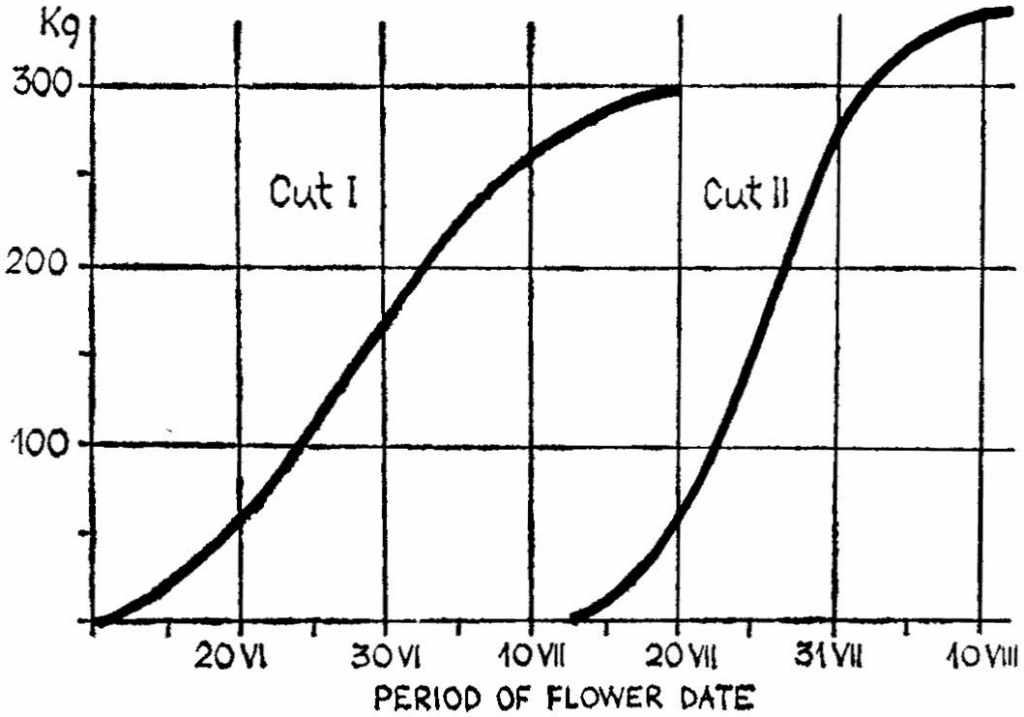
Fig. 5 Yield of red clover seeds with reference to field coming out of bloom
strona 188mass blooming (Fig. 5). Then the quantity of seed obtained from heads starting to bloom during one day amounts to 40 kg/ha. The quantity of seed to be found in heads starting to bloom during one day in the final stage of this process is negligeable. For this reason the time of clover harvesting should not be determined by seed maturity of the final stage of flowering since their proportion in crops is very small.
LITERATURE
Jabłoński B. (1962) — Improvements in nektar contets estimations in hybrids of red clover. Pszczelnicze Zeszyty Naukowe, 4 (2): 81—92.
Jabłoński B. (1972) — Nectar secretion of red clover (Trifolium pratense L.) in few lokations of Poland. Pszczelnicze Zeszyty Naukowe, 16: 91—124.
Jabłoński B. (1972) — Height of nectar column in corolla tube of red clover and quantity of nectar and it sugars content. Pszczelnicze Zeszyty Naukowe, 16: 125—132.
Jabłoński B. (1974) — Investigations on biology of blooming and pollination of red clover (Trijolium pratense L.). Pszczelnicze Zeszyty Naukowe, 18: 201—228.
Jabłoński B. (1974) — Influence of cutting red clover by bumble bees on setting of seeds. Pszczelnicze Zeszyty Naukowe, 18: 229—236.
Jabłoński B. (1974) — Particular case of red clover flowers mutation. Pszczelnicze Zeszyty Naukowe, 18: 237—240.
Jabłoński B. (1975) — Density of Apoidae necessary for good pollination of red clover. Pszczelnicze Zeszyty Naukowe, 19: 13—30.
Jabłoński B. (1975) — Comparison of short corolla tube population of red clover with common cultivated variaties. Pszczelnicze Zeszyty Naukowe, 19: 31—38.
Z BADAŃ BIOLOGII KWITNIENIA, NEKTAROWANIA, ZAPYLANIA I PLONOWANIA KONICZYNY CZERWONEJ (TRIFOLIUM PRATENSE L.)
Bolesław Jabłoński, Puławy, Polska
Streszczenie
Koniczyny czerwona, jako roślina gospodarczo bardzo ważna, od dawna uwzględniana jest w tematyce badań Oddziału Pszczelnictwa I.S. Zbadano dotąd dość szczegółowo procesy kwitnienia, nektarowania, zapylania i osadzania nasion przez tę roślinę, we wzajemnym ich dynamicznym związku, na tle przebiegu ważniejszych czynników pogody w okresie kwitnienia i dojrzewania nasion.
Errata — błędy druku znalezione podczas digitalizacji
- s. 178, tab. 1: „offeshoots” → offshoots
- s. 178: „beginn to bloom” → begin to bloom
- s. 179, 188: „negligeable” → negligible
- s. 180, ryc. 2: „acerage” → average
- s. 180: „in usually reaches” → it usually reaches
- s. 181: „Allways” → Always
- s. 181: „greates degree” → greater degree
- s. 182, ryc. 3: „percentage at sugar” → percentage of sugar
- s. 182: „tongued beets” → tongued bees
- s. 182, tab. 5: „honneybees” → honeybees
- s. 182, tab. 5: „bumblebess” → bumblebees
- s. 183: „red clower” → red clover
- s. 183: „pollinate then” → pollinate them
- s. 183: „individaul” → individual
- s. 183, tab. 6: „Andrena gelariale Vicht.” → Andrena gelriae Vecht
- s. 184: „disturbancies” → disturbances
- s. 184: „in sects” → insects
- s. 184: „efectiveness” → effectiveness
- s. 184: „more over” → moreover
- s. 184: „to reache” → to reach
- s. 184: „means what 16000″ → means that 16000
- s. 184, ryc. 4: „y = 54,76 – 2,09″ → y = 54,76 – 2,09x
- s. 185, tab. 8, wiersz VIII, pszczoły, jednokrotne odwiedziny: „117″ → 177
- s. 186: „individual sof” → individuals of
- s. 186: „perforated by then” → perforated by them
- s. 186: „bitting” → biting
- s. 187, tab. 10: „<18″ → <16
- s. 187, tab. 10: „humidty” → humidity
- s. 188, literatura: „nektar contets” → nectar contents
- s. 188, literatura: „lokations” → locations
- s. 188, literatura: „it sugars content” → its sugars content
- s. 188, literatura: „Trijolium” → Trifolium
- s. 188, literatura: „variaties” → varieties
- s. 188, streszczenie: „Koniczyny czerwona” → Koniczyna czerwona