

INCREASE OF RED CLOVER (TRIFOLIUM PRATENSE L.) SEED YIELD WITH HYBRID HONEYBEES (APIS MELLIFICA LIGUSTICA × A.MELLIFICA CAUCASICA)
tekst: J. N. Tasei, G. Joubert, A. Delaude
Pszczelnicze Zeszyty Naukowe, Rok XXI, 1977 — J. N. Tasei, G. Joubert, A. Delaude
strona 167BEE RESEARCH COPIES V.XXI DECEMBER 1977
J. N. Tasei, G. Joubert, A. Delaude
France
INTRODUCTION
In France forage legumes are grown for seed on about 58 000 ha. Red clover is the second species in total surface (15 000 ha) after lucerne (35 000 ha) — Data of 1974.
Our country often exports more than half of its production of red clover seed, chiefly to West Germany, Average yields range from 200 to 300 Kg/ha.
The importance of this forage plant and the lack of native pollinating apoids in several growing areas (Fig. 1) encouraged research on pollination techniques with the honeybee.
In 1973 we wanted to know the influence of the race on the foraging behaviour of the honeybee and the effectiveness of hybrid honeybee (A.m.ligustica × A.m.caucasica) in promoting seed yields.
METHODS
We chose 6 pairs of fields (diploid variety „Oldenwalder”) in the plain of Troyes in eastern central France. The fields were as similar as possible (same soil, date of cutting, environmet, harvesting…). In each pair there was a control field and a field with two hives of hybrid bees per hectare introduced after the beginning of bloom, except in one field where caucasian bee (A.m.caucasica) were provided.
strona 168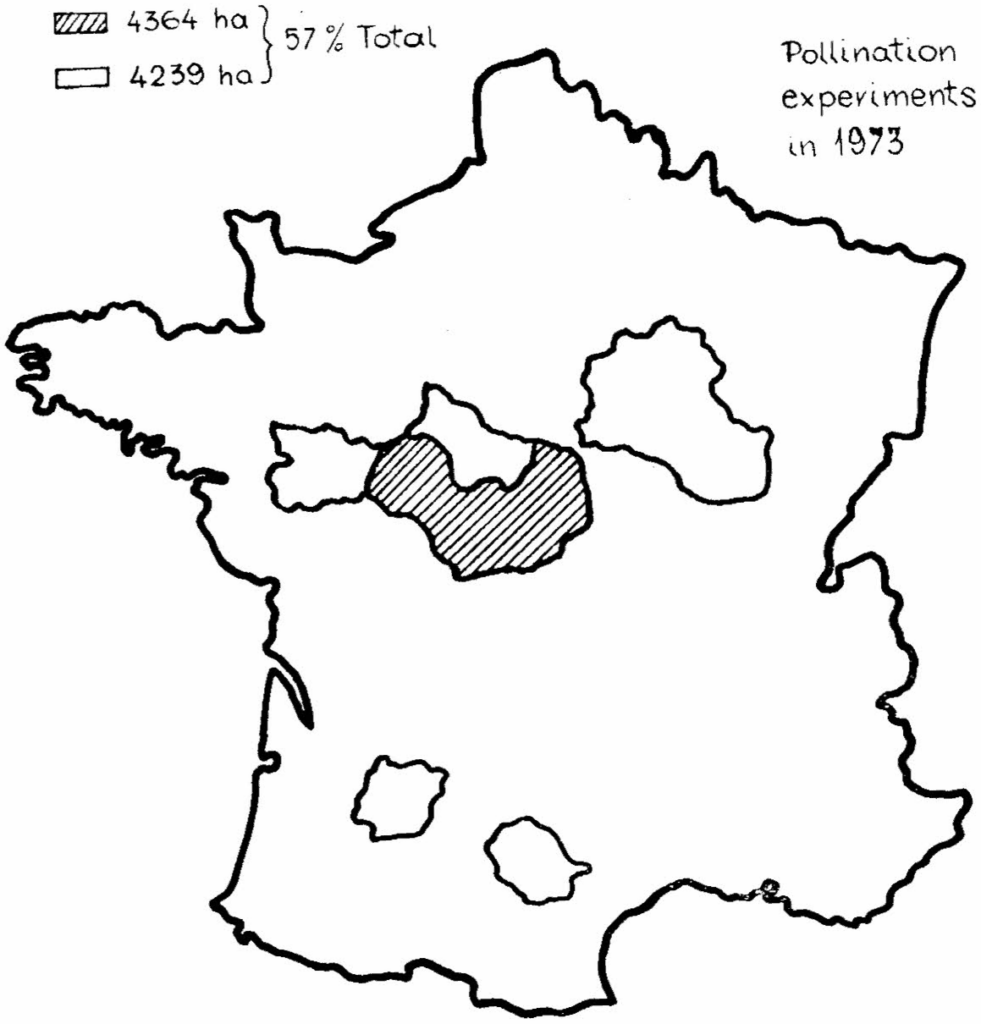
Every two days in the 12 fields we counted the number of heads with at least one open flower, the percentage of seed setting and the number of „positive” and „negative” insects (bees entering or robbing the flower) of all the species or races. At the end of the season we registered the yields.
Table 1 Climatic data for the year 1973 in the experimental area
| May | June | July | August | September | |
|---|---|---|---|---|---|
| Rain (mm) | 65 | 4 | 117 | 8 | 41 |
| Average Max. temperature (d°C) | 18,1 | 23,9 | 24,4 | 27,6 | 23,4 |
| Average Min. temperature (d°C) | 7,9 | 11,4 | 12,9 | 13,7 | 9,7 |
RESULTS
1). Climatic conditions — Flowering period and pod setting. In 1973 the climate was characterized by a very wet July and dry August. Both were warm (Table 1).
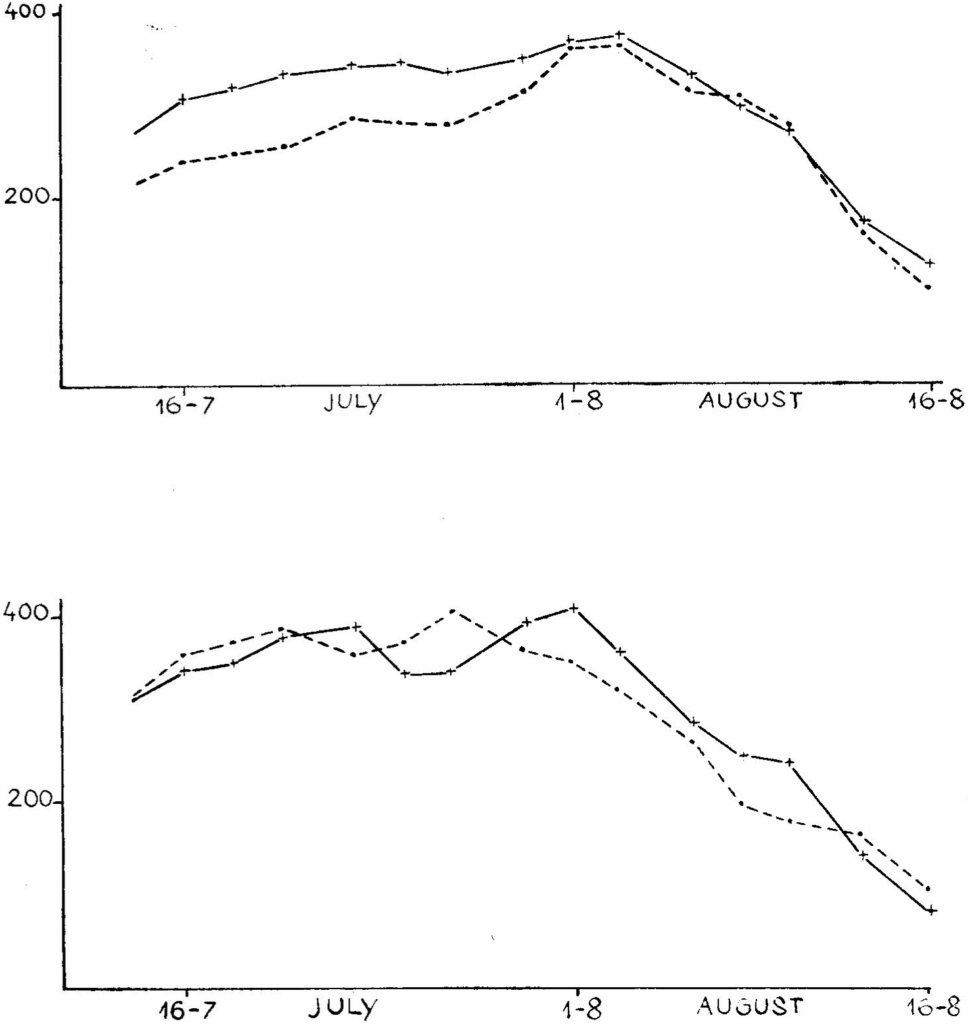
Flowering took place from July 10 to August 22. The flowering peak reached 300—400 heads/m2 (Fig. 2).
In every pairs of fields the number of flowers/head was constant. Between pairs we noted variations from 114 to 130 flowers/head.
The average pod setting was 42% (32,7 to 46,8 in the control fields and 42,7 to 45,9 in the fields with hybrid bees). There was no significant difference between the control fields and the other ones.
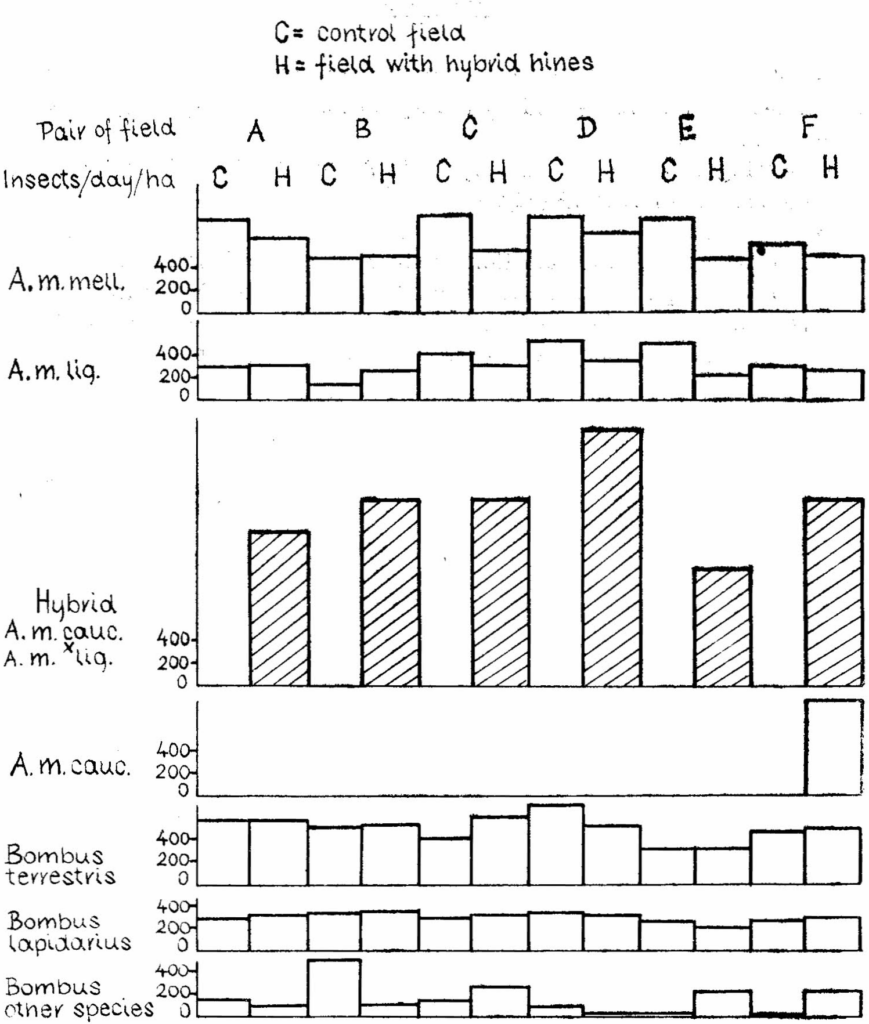
- Bees distribution. Bombus population tended to be constant from one field to another. B. lapidarius was the most constant species, B.hortorum, B. agrorum, B. sylvarum were the least, their number increasing with the proximity of forests. B.terrestris was always the most abundant species (Fig. 3 — Table 2).
In control fields honeybees were represented by the two common races: A.m.mellifica and A.m.ligustica in an average ratio of 2 : 1, in the other fields by three racse: A.m.mellifica, A.m.ligustica and hybrid
strona 171Table 2 Average spectrum of pollinating fauna in experimental fields of red clover
| Number of individuals (day) ha: Control field | Number of individuals (day) ha: 2 hives of hybrid bees per ha | |
|---|---|---|
| Apis mellifica mellifica | 751 | 585 |
| „ „ ligustica | 375 | 292 |
| Hybrid ligustica × caucasica | 0 | 1803 |
| Bombus terrestris | 513 | 521 |
| „ lapidarius | 289 | 284 |
| „ hortorum | 78 | 83 |
| „ agrorum | 44 | 54 |
| „ sylvarum | 27 | 54 |
ligustica × caucasica. Hybrid bees seemed to prefer foraging in the larger fields (Fig. 4).
On average Bombus spp. represented 45,8% of the total fauna in the control fields 2077 bees/ha and 27,1× in the other fields 3676 bees/ha.
During the flowering period the populations of the different honeybees decreased with the appearance of queens and death of workers in mid August (Fig. 5).
A.m.mellifica was more affected by cool weather than bumblebees and hybrid bees.
Very few solitary bees were observed.
- Flower visiting behaviour of bees.
A large number of individual observations proved the ability of A.m.mellifica to rob flowers of nectar (21× of visits positive) thanks to
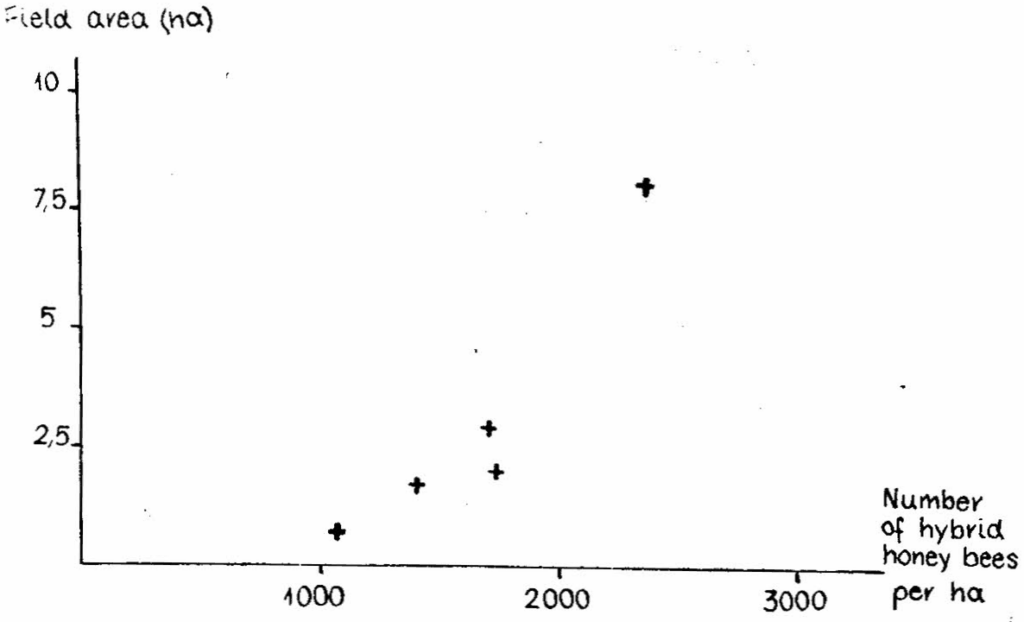
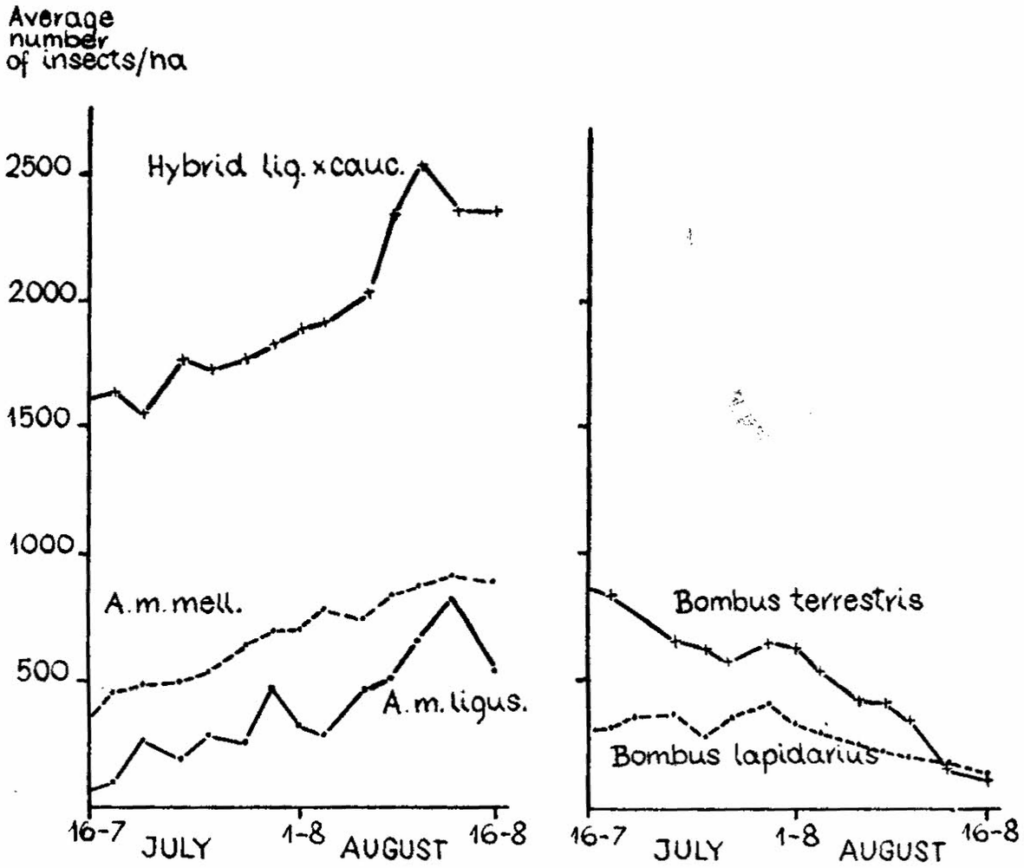
Table 3 Foraging behaviour of Apoids on red clover
| % postive visits | Species or race | Number of individuals |
|---|---|---|
| 100 | Bombus lapidarius | 916 |
| 80 | Apis mellifica caucasica | 225 |
| 63 | Hybrid A.m. cauc. × A.m. ligu. | 3119 |
| 50 | Bombus terrestris | 1669 |
| 41 | Apis mellifica ligustica | 607 |
| 21 | Apis mellifica mellifica | 2136 |
| 0 |
Table 4 Behaviour constancy of bees in flower visits
| Species | Percentage of positive visits: variation between fields | Percentage of positive visits: variation between days |
|---|---|---|
| Apis mellifica mellifica | 14,1 to 34,8 | 15 to 38 |
| Apis mellifica ligustica | 33,4 to 48,2 | — to — |
| Bombus terrestris | 40,8 to 59,7 | 46 to 60 |
| Hybrid A.m. ligust. × A.m. cauc. | 57,4 to 68,4 | 58 to 73 |
B.terrestric holes, pearced at the base of corolla tubes. A.m.ligustica, hybrid ligustica × caucasica and A.m.caucasica worked with more efficiency (41%, 63%, 80% of visits positive respectively). Though B.terrestris pearces corolla tubes, 50% of the individuals made positive visits (Table 3). These percentages may vary over the flowering period and from one field to another, but low rates of positive visits were always attributed to A.m.mellifica and high ones to hybrid honeybees (Table 4).
- Pollination and seed yields.
In control fields more than 65% of positive insects were bumblebees. In the other fields 67% of positive insects were honeybees (Fig. 6).
The seed yields were higher in the fields with hybrid bees except in two fields where two detrimental factors wer noted (Apion trifolii in the first one and lodging in the second).
If we consider that positive bumblebee is twice as valuable as a positive honeybee we conclude that bumblebees were responsible for 80% of the seed production in the control fields and 50% in the fields with hybrid bees.
The average increase of 70 Kg of seed per hectare must be attributed to the addition of 1,554 hybrid honeybees/ha, that is, 1,130 positive insects/ha.
We found a correlation r = 0,51 (0,05 P 0,1) between the number of positive insects (in „honeybee units”) and the seed yield (Fig. 7).
DISCUSSION — CONCLUSION
In the experimental area, Bombus fauna was rich enough to ensure good yields. The flower pearcing species B.terrestris had a better pollinating activity than reported in previous publications.
The visiting behaviour of honeybees seems to be a racial character. The best pollinator races were the caucasian bee and the hybrid bee (caucasian × italian). Honeybee races have different tongue lenght and probably different tendancies to collect red clover pollen. We do not
strona 174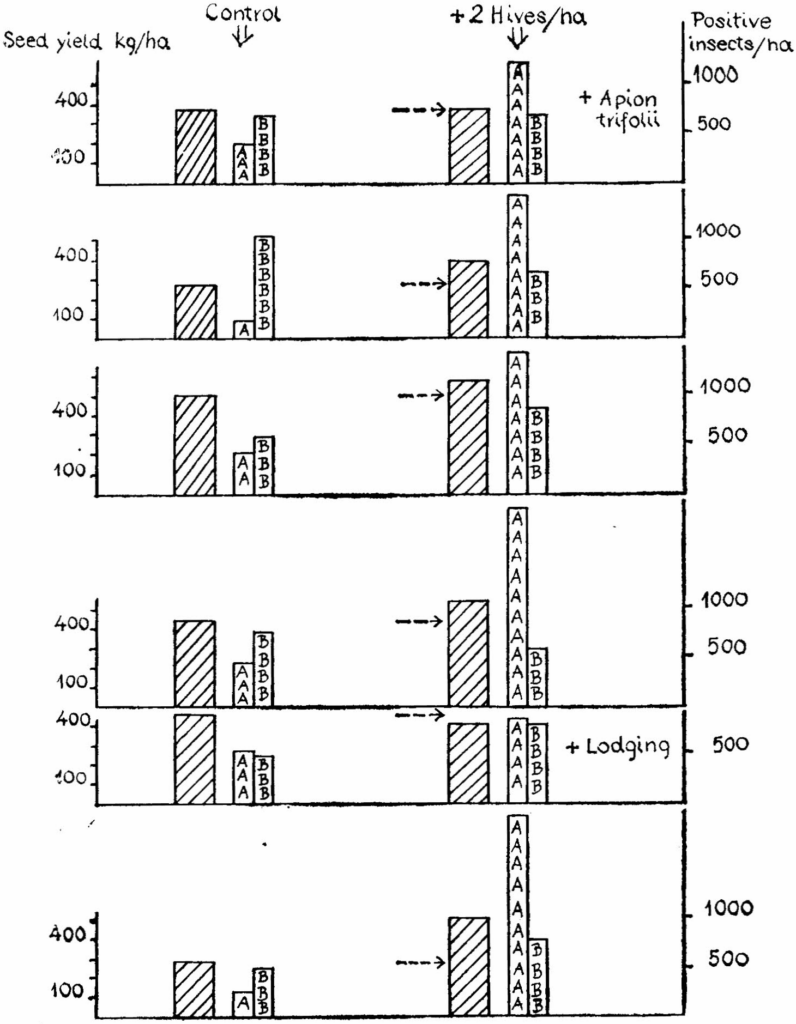
know which of these two factors could explain the different rates of positive visits.
Our experiments proved the efficiency of introducing hybrid caucasian × italian bees in red clover crops. Two hives per hectare increased the population of honeybees 2.3 times. This treatment yielded significantly more seed than the control (70 Kg/ha).
strona 175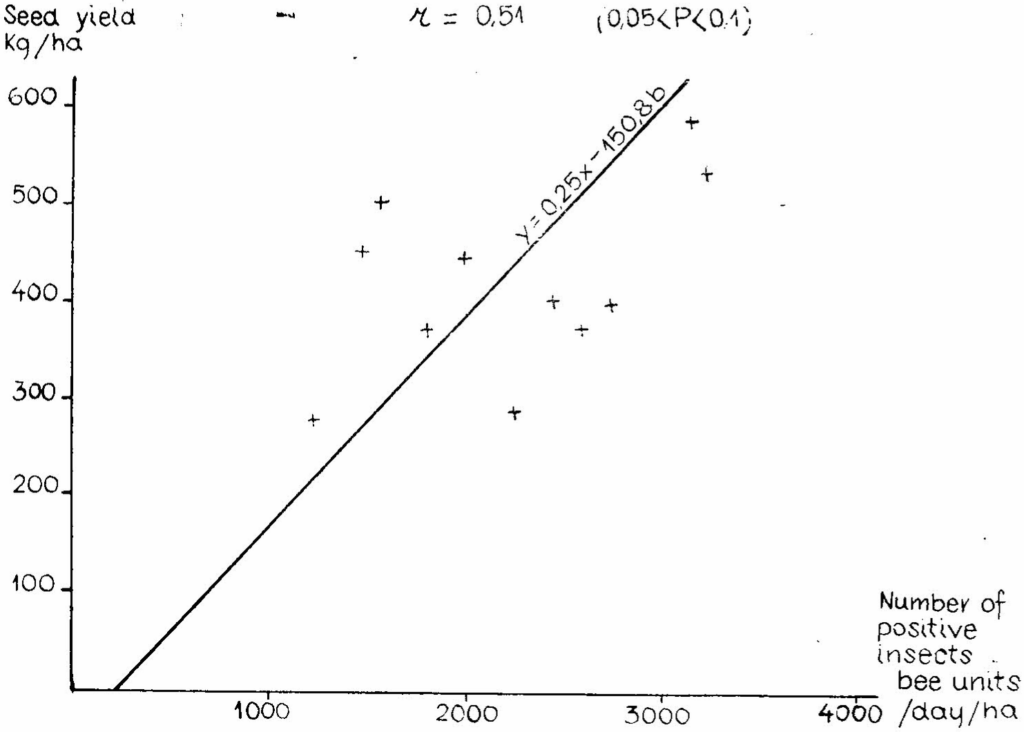
In our conditions of field area and environment, the density of 2 hives/ha is not enough to ensure the optimum pollination. Complementary experiments are needed to estimate the adequate number of hives/ha). Further observations should provide information concerning the constancy of visiting behaviour of the honeybee races and their pollen collecting activity.
ROZWÓJ PRODUKCJI NASION KONICZYNY CZERWONEJ PRZY WYKORZYSTANIU KRZYŻÓWEK PSZCZOŁY WŁOSKIEJ I KAUKASKIEJ
J. N. Tassei, Francja
Streszczenie
Na polach doświadczalnych była wystarczająca liczba populacji trzmieli dla dobrych plonów nasion. Rurki przegryzione przez B. terrestris miały lepsze warunki zapylenia niż w doświadczeniach wcześniejszych.
Oblot pszczół różnił się ze względu na pochodzenie rasowe. Najlepszymi zapylaczami okazały się pszczoły kaukaskie i mieszańce kaukaskiej z włoską. Rasy pszczół różniły się pod względem długości języczka i chyba różną skłonnością do zbioru pyłku koniczyny. Nie wiemy, która z tych dwóch cech decydowała o różnicy w oblocie koniczyny czerwonej.
strona 176Doświadczenie nasze dotyczyło efektywności wprowadzenia pszczół mieszańców przy produkcji nasion koniczyny czerwonej. Dowiezienie do pola 2 pni/1 ha zwiększało oblot kwiatów 2- i 3-krotnie. Dawało to o 70 kg/ha nasion więcej od pola kontrolnego.
W naszych warunkach dowiezienie 2 pni pszczół nie wystarcza do uzyskania optymalnego zapylenia kwiatów. Są potrzebne dalsze badania dla określenia potrzebnej liczby pni na 1 ha.
Errata — błędy druku znalezione podczas digitalizacji
- s. 167: „environmet” → environment
- s. 169: „In every pairs” → In every pair
- s. 170: „racse” → races
- s. 171: „27,1×” → 27,1%
- s. 171: „(21× of visits positive)” → (21% of visits positive)
- s. 172, tab. 3: „postive” → positive
- s. 173: „B.terrestric” → B.terrestris
- s. 173: „pearced” → pierced
- s. 173: „pearces” → pierces
- s. 173: „pearcing” → piercing
- s. 173: „wer noted” → were noted
- s. 173: „lenght” → length
- s. 173: „tendancies” → tendencies
- s. 173: „(0,05 P 0,1)” → (0,05<P<0,1)
- s. 175, streszczenie: „Tassei” → Tasei