

REPRODUCTION OF VARROA JACOBSONI IN BEE BROOD WITH DIFFERENT POST-CAPPING PERIODS
tekst: Maciej Siuda, Jerzy Wilde
Pszczelnicze Zeszyty Naukowe, Rok XL, 1996 — Maciej Siuda, Jerzy Wilde
strona 183PSZCZELNICZE ZESZYTY NAUKOWE Rok XL, Nr 2 1996
Maciej Siuda, Jerzy Wilde
Apiculture Department, University of Agriculture and Technology in Olsztyn, ul. Oczapowskiego 5, 10-957 Olsztyn, POLAND, e-mail: jurwild@moskit.art.olsztyn.pl
Summary
In 1993, as a result of a research program aimed at breeding bees resistant to Varroa jacobsoni, honeybee queens were bred that produced workers emerging in less than 276 hours (11.5 days) at a 50% rate (a SPCP group – a short post-capping period). An attempt has been made to examine the influence of a shorter post-capping period on the rate of Varroa jacobsoni reproduction. The control group contained workers produced by queens from the same breeding lines, and emerging in less than 288 hours (12 days) at a 50% rate (a LPCP group – a long post capping period).
The difference in numbers of Acarina found on the SPCP bees (64.9 mites) and the LPCP bees (72.2 mites) after the incubation of brood was highly significant. The calculated growth of a Varroa jacobsoni population per generation was lower in the SPCP group (1.75) than in the LPCP group (1.98). The difference was highly significant.
Key words:: Varroa jacobsoni, post-capping period, breeding, resistance.
INTRODUCTION
Varroa jacobsoni still remains one of the principal beekeeping problems not only in Poland but also in Europe (Koeniger and Fuchs 1988, Wilde 1994). One possible way to produce bee colonies resistant to V. jacobsoni is to breed bees with a short post-capping period (Wilde and Koeniger 1992, Wilde and Siuda 1992). Such a method of improving resistance to a parasitic invasion has been discovered on South African bees Apis mellifera capensis, whose workers emerge 10-11 days after capping, thus leaving immature V. jacobsoni brood to die (Moritz 1985, Moritz, Mautz 1990). A post-capping period as short as 264 hours is believed to allow for a simple reproduction of parasites only, therefore reducing or eliminating an application of acaricides in a honeybee nest.
The effect of a shorter PCP of workers on the reproduction potential of V. jacobsoni has not been well examined yet. Wilde (1994) discovered
^1 This work was supported by KBN grant Nr 5 S3110107
strona 184no difference in the resistance to a parasitic invasion among bee nuclei with queens producing workers of different mean PCP. In his experiment the difference between the shortest mean PCP (274.7 hours) and the longest one (288.5 hours) was 13.8 hours. Schmidt (1995), however, observed significant differences in the reproduction of V.jacobsoni on similar material. Colonies with queens producing workers that emerged 14 hours faster than Carniolan bees experienced a less intensive reproduction of the mite.
The aim of the experiment has been to determine the effect of a post-capping period shorter by 14 hours than the PCP of Apis mellifera carnica on the reproduction of V. jacobsoni.
MATERIALS AND METHODS
The experiment, carried out on brood of 20 queens from short post-capping period lines, took place at the Apiculture Institute of the University of Agriculture and Technology in Olsztyn, Poland, in August 1996. One group (SPCP – 10 queens) included these producing workers that emerged in less than 276 hours (11.5 days) at a 50% rate. The control group (LPCP – 10 queens) consisted of queens whose workers emerged in less than 288 hours (12 days) at a rate of 50% and less (Fig. 1).
The duration of PCP of workers was determined in mating hives in July 1996. A sheet of plastic film was put on a comb three times daily at six-hourly intervals (at 8.00 a.m., 2.00 p.m. and 8.00 p.m.) to record the time of capping. Ten days later the mating hives were checked at the same times to mark emerged cells on the same film. This was done for three days. Nine time periods, in which workers were emerging, were thus established from 252 to 300 hours (every six hours). After the post-capping period of workers was determined, the queens were divided into experimental groups and introduced to new mating hives. The bottom of each hive under a brood nest was replaced with a small mesh net to prevent bees from moving out.The bees were sprayed with a solution of Perizin one day before they were put to the hives. The hives were kept in a cellar for two days after the introduction of queens and then tranferred to an apiary, where they were placed in separation, each on a single stand, at a distance of 1.5 m. Once the queens initiated oviposition each hive was infested with 50 females of V. jacobsoni. The mite were obtained from an emerging drone brood, which was uncapped with a fork uncapper several hours before emergence. Dark mite were brushed away with a brush into glass tubes, which were then placed on the bottom of each hive. Greasy paper sheets were placed under the hives and dropped V. jacobsoni females were collected and counted daily. A whole capped brood was transferred to an incubator fourteen days after the queens began oviposition, while the bees were anaesthetised and checked for the presence of Varroa parasites. In the incubators the brood
strona 185from every mating hive was kept in isolation. Bees were anaesthetised after emergence and parasites were counted. The coefficient of growth of the population of Varroa jacobsoni was calculated on the basis of the ratio of Varroa jacobsoni females found on bees after emergence to bees that entered the cells. The latter was estimated hypothetically by subtracting the number of individuals found on bottom sheets and bees from the number of infected females.
All numerical data collected during the experiment were processed with the Statigrafics programme (Dąbkowski 1992). Significance of differences was determined by variance analysis (ANOVA) and multiple range test with least significant difference range (LSD). Values that differed significantly at 0.01 are marked with capitals.
RESULTS AND DISCUSSION
In both groups workers were emerging in all the time periods. However, their numbers were different. Only 10-15% of the SPCP workers emerged in the time period of 282 to 300 hours, contrary to the LPCP workers, 10% of which approximately emerged in the time period of 252 – 276 hours (fig.1). The calculated mean PCP for the SPCP bee workers (274.02 hours) was much shorter than the mean PCP for the LPCP bee workers (293.24). The difference was highly significant (tab.1). The mean PCP for the SPCP bee workers was shorter by 14 hours and the mean PCP for the LPCP group was longer by 5 hours than the mean PCP for Carniolan bees estimated by Langenbach (1992). A shorter PCP of bee workers has been achieved due to breeding programs. Actually, the mean PCP of LPCP workers does nor differ from the mean PCP of Carniolan bees. A similar PCP of workers, observed in 1992 for one line of these bees, lasted for 294.1 hour (Wilde and Siuda 1992). The range of mean PCPs of workers was similar (about 10 hours), whereas the difference between the shortest (269.23 hours) and the longest PCP of workers (298.32 hours) reached 29.09 hours. A similar range of difference was observed between Carniolan and South African A.m. capensis bees (Moritz and Mautz 1990).
Similar numbers of bees were put into the mating hives: in the SPCP group average 908.1 bees, and in the LPCP group average 911.7 bees. Nuclei contained similar amounts of brood, and in the SPCP group an average of 566.3 bees emerged, whereas in the LPCPgroup – 582.7 (tab.1).
The highest number of V. jacobsoni dropped in the first week, probably due to damage caused on V. jacobsoni females while they were collected from drone brood. In total for 1 nuclei, an average of 8.7 mite (from 7 to 10) fell on bottom sheets in the SPCP group, and 8.8 (from 7 to 11) in the LPCP group (tab.2). In the future it seems advisable to collect
strona 186mites from adult bees, following a suggestion made by Fuchs and Bienefeld (1991).
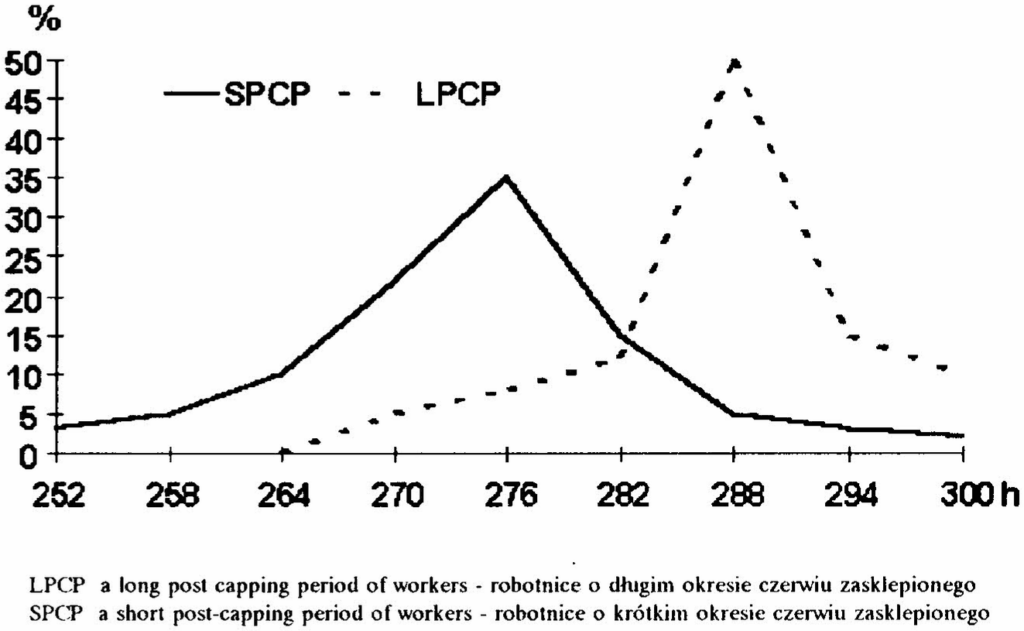
Fig 1. Duration of post-capping period of the workers in the experiment Długość okresu czerwiu zasklepionego robotnic użytych w doświadczeniu
An average for 1 nuclei of 4.2 mites were left on the SPCP bees (from 3 to 5) and 4.7 on the LPCP bees (from 3 to 7), which amounted to 10% of the total V. jacobsoni females. The results resemble those obtained by Schultz (1984) and Fuchs and Langenbach (1989).
Table 1 Duration of post-capping period (PCP) of the workers and number of investigated bees Długość okresu czerwiu zasklepionego robotnic oraz liczba badanych pszczół
| Group Grupa | PCP (in h – w godz.): average średnia | PCP (in h – w godz.): min-max | Number of bees in mating nucs / Liczba pszczół w ulikach weselnych (szt.): average średnia | Number of bees in mating nucs / Liczba pszczół w ulikach weselnych (szt.): min-max | Number of bees after emerging / Liczba pszczół po wygryzieniu (szt.): average średnia | Number of bees after emerging / Liczba pszczół po wygryzieniu (szt.): min-max |
|---|---|---|---|---|---|---|
| SPCP | 274.02A | 269.23 – 278.33 | 908.1 | 831 – 987 | 566.3 | 342 – 757 |
| LPCP | 293.24B | 288.64 – 298.32 | 911.7 | 842 – 981 | 582.7 | 421 – 746 |
LPCP – a long post capping period of workers – robotnice o długim okresie czerwiu zasklepionego SPCP – a short post-capping period of workers – robotnice o krótkim okresie czerwiu zasklepionego Different letters indicate significant defferences at p=0.01 Różne litery oznaczają różnice istotne na poziomie p=0,01
strona 187Table 2 Number of not reproducted female of Varroa jacobsoni in average for one mating nuclei Liczba samic Varroa jacobsoni nie rozmnażających się średnio dla 1 rodzinki weselnej
| Group Grupa | Dead mites / Martwe pasożyty: average średnio | Dead mites / Martwe pasożyty: min – max | Mites on bees / Pozostałe na pszczołach: average średnio | Mites on bees / Pozostałe na pszczołach: min – max | Sum Suma | % |
|---|---|---|---|---|---|---|
| SPCP | 8.7 | 7 – 10 | 4.2 | 3 -5 | 12.9 | 25.8 |
| LPCP | 8.8 | 7 – 11 | 4.7 | 3 -7 | 13.5 | 27.0 |
Group explanation in table 1 Wyjaśnienie nazw grup pod tabelą 1
Table 3 Number of female of Varroa jacobsoni after the end of experiment in average for one mating nuclei Liczba samic Varroa jacobsoni po zakończeniu doświadczenia średnio dla 1 rodzinki weselnej
| Group Grupa | From brood / Z czerwiu: average średnio | From brood / Z czerwiu: min – max | Total / Ogółem: average średnio | Total / Ogółem: min – max | Coefficient of grow of the population / Wskaźnik przyrostu populacji: average średnio | Coefficient of grow of the population / Wskaźnik przyrostu populacji: min – max |
|---|---|---|---|---|---|---|
| SPCP | 64.9A | 61 – 71 | 69.1A | 64 – 76 | 1.75A | 1.63 – 1.97 |
| LPCP | 72.2B | 68 – 78 | 76.9B | 71 – 85 | 1.98B | 1.85 – 2.16 |
Group explanation in table 1 Wyjaśnienie nazw grup pod tabelą 1 Different letters indicate significant defferences at p=0.01 Różne litery oznaczają różnice istotne na poziomie p=0,01
Fewer parasites were found on the SPCP bees (average 64.9) after the incubation of a brood from 1 nuclei than on the LPCP bees (average 72.2 – tab.3). The difference was highly significant. In their experiment, Wilde and Fuchs (1993) found no difference in the resistance to a parasitic invasion between nuclei with queens whose workers showed different PCPs. Too small a difference between the workers used in their experiment could be a likely cause. Schmidt (1995) examined workers whose PCPs differed by 14 hours and noticed a significantly slower growth of V.
strona 188jacobsoni on the SPCP group.
The population growth of V. jacobsoni calculated per generation was slower in the SPCP group (1.75) than in the LPCP group (2.01). The difference was highly significant. The calculated population growth of mite was slower than that quoted by Schulz (1984) for Carniolan bees (2.3), but faster than the figure calculated by Wilde (1994), who estimated this index at 1.224.
CONCLUSIONS
1.A short PCP of workers decreases the reproduction rate of V. jacobsoni. Fewer parasites were found on bees that emerged from a short PCP brood. The difference appeared to be highly significant.
2.A shorter PCP decreased the rate of growth of a V. jacobsoni population per generation to 1.75, less than in the control group (2.01) of Carniolan bees (2.3).
3.The experiment needs to be repeated with normal bee colonies in different weather and honey flow conditions, to confirm the results.
REFERENCES
Dąbkowski J. (1992) – Statgrafics – System statystycznego opracowania danych. Komputerowa Oficyna Wydawnicza „Help”: 1-240.
Fuchs S. (1992): Ein testverfahren zum Vergleich der Varroatoseanfälligkeit in kleinen Volkseinheiten. Annales. UMCS. Sectio DD, 47: 193-199.
Fuchs S., Bienefeld K. (1991): Ein testverfehren zum Vergleich der Varroatoseanfälligkeit in kleinen Volkseinheiten. Annales. UMCS. Sectio DD, 47: 193-199.
Fuchs S., Langenbach K. (1989): Multiple infestation of Apis mellifera L. brood cells and reproduction in Varroa jacobsoni Oud. Apidologie, 20: 257-266.
Koeniger N., Fuchs S. (1988): Control of Varroa jacobsoni Oud. in honey bee colonies containing sealed brood cells. Apidologie, 19: 117-130.
Langenbach K. (1991): Bestimmung der Zellverdeckelungsdauer verschiedener Bienenherkünfte. Apidologie, 22: 448-450.
Moritz R. F. A., Mautz D. (1990): Development of Varroa jacobsoni in colonies of Apis mellifera capensis and Apis mellifera carnica. Apidologie, 21: 53-58.
Mortiz R. F. A. (1985): Heritability of the postcaping stage in Apis mellifera and its ralation to varroatosis resistence. J. Hered., 76: 267-270.
Schmidt J. (1995): Der Einfluß einer verkürzten verdeckelten Brutphase bei Apis mellifera LINNÉ auf die Überwinterung und Frhjahrsentwicklung der Bienenvölker und auf die Populationsentwicklung von Varroa jacobsoni OUDEMANS. Diplomarbeit, J.W. Goethe-Universität. Frankfurt/Mein. s. 59.
Schulz A. E. (1984): Reproduktion und Populationsentwicklung der parasitischen Milbe Varroa jacobsoni in Abhängigkeit vom Brutzyklus ihres Wirtes Apis mellifera L. Apidologie 15: 401-420.
Wilde J. (1994): Hodowla pszczół o skróconym okresie postlarwalnym, odpornych na
strona 189Varroa jacobsoni. Acta Acad. Agricult. Tech. Olst., Zootechnica, 39 B: 1-43.
Wilde J., Koeniger N. (1992): Selection auf Verkurzung der Zellverdeckelungsdauer (ZVD) der Arbeiterinnenbrut von Apis mellifera carnica. Annales. UMCS Lublin. Sectio DD, 47: 133-136.
Wilde J., Fuchs S. (1993): Testowanie odporności wobec Varroa jacobsoni pszczół o zróżnicowanym okresie stadium postlarwalnego w małych rodzinkach pszczelich. 30. Naukowa Konferencja Pszczelarska. Puławy. Streszczenia referatów: 47-48.
Wilde J., Siuda M. (1992): Próba selekcji na skrócenie stadium czerwia zasklepionego u pszczoły miodnej Apis mellifera carnica. Annales UMCS. Sectio DD, 47: 137-140.
ROZMNAŻANIE SIĘ VARROA JACOBSONI W CZERWIU PSZCZELIM RÓŻNIĄCYM SIĘ OKRESEM ZASKLEPIENIA
M. Siuda, J. Wilde
Streszczenie
W efekcie prowadzonej hodowli pszczół o krótkim okresie czerwiu zasklepionego wyhodowano matki, których robotnice miały średnio o 14 godzin krótszą tę cechę w porównaniu z nieselekcjonowanymi pszczołami kraińskimi. Podjęto próbę określenia wpływu okresu czerwiu zasklepionego robotnic na rozmnażanie się V. jacobsoni. Do doświadczenia użyto 10 matek z hodowanych linii pszczół, których 50 lub więcej procent robotnic wygryzało się do 276 godzin (11,5 dnia) (grupa SPCP). Grupę kontrolną stanowiło 10 matek z linii, których robotnice wygryzały się do 288 godzin (12 dni) w 50. lub mniej procentach (grupa LPCP). Matki te poddano do świeżo nasiedlonych ulików weselnych. Na dobę przed nasiedlaniem ulików pszczoły opryskano roztworem Perizinu. Dna w ulikach weselnych zastąpiono metalową siatką co umożliwiło podłożenie wkładek dennicowych i obserwację osypu V. jacobsoni. Po rozpoczęciu czerwienia przez matki infekowano pszczoły w ulikach jednorazowo 50 samicami V. jacobsoni, pozyskanymi z wygryzającego się czerwiu trutowego. Po zasklepieniu komórek czerwiu, plasterki z czerwiem przenoszono do cieplarki, a pszczoły w ulikach uśpiono, w celu policzenia znajdujących się na nich samic V. jacobsoni. Po wygryzieniu się czerwiu, pszczół także uśpiono i policzono znajdujące się na nich samice pasożyta.
Robotnice z grupy SPCP charakteryzowały się wysoko istotnie krótszym, średnim PCP (274,02 godz.), w porównaniu z robotnicami grupy LPCP (293,24 godz.). Nie stwierdzono różnic statystycznych pomiędzy liczbą nasiedlonych pszczół i pochodzących z wygryzionego czerwiu pomiędzy doświadczalnymi grupami. Po nasiedleniu pszczół w grupie SPCP było średnio 908,1 szt. a w grupie LPCP 911,7 szt. Z czerwiu grupy SPCP wygryzło się średnio 566,3 pszczół a w LPCP 582,7. Podobny też był osyp V. jacobsoni na wkładkach dennicowych w grupie SPCP średnio 8,7 szt. a w grupie LPCP 8,8 szt. oraz liczba roztoczy pozostałych na pszczołach odpowiednio 4.2 i 4,7 szt.. Łącznie nie weszło w kolejny cykl reprodukcyjny ok. 26% samic V. jacobsoni.
Po wygryzieniu się czerwiu z grupy SPCP na pszczołach stwierdzono wysoko istotnie mniej pasożytów średnio 64,9 szt. niż w grupie LPCP 72,2 roztoczy. Przyrost populacji roztoczy na jedno pokolenie w grupie SPCP wynosił 1,75 i był wysoko istotnie mniejszy niż w grupie LPCP 1,98.
Na podstawie uzyskanych wyników można stwierdzić, iż skrócenie okresu czerwiu zasklepionego u robotnic o około 20 godzin powoduje wolniejsze rozmnażanie się V. jacobsoni.
Słowa kluczowe: Varroa jacobsoni, okres czerwiu zasklepionego, hodowla, odpornoś
Errata — błędy druku znalezione podczas digitalizacji
- s. 184: „tranferred” → transferred
- s. 185: „does nor differ” → does not differ
- s. 185: „LPCPgroup” → LPCP group
- s. 186: „Schultz” → Schulz
- s. 186, tab. 1: „defferences” → differences
- s. 187, tab. 3, 2×: „Coefficient of grow” → Coefficient of growth
- s. 187, tab. 3: „defferences” → differences
- s. 188, 2×: „(2.01)” → (1.98)
- s. 188, piśmiennictwo: „testverfehren” → testverfahren
- s. 188, piśmiennictwo: „Mortiz” → Moritz
- s. 188, piśmiennictwo: „postcaping” → postcapping
- s. 188, piśmiennictwo: „ralation” → relation
- s. 188, piśmiennictwo: „resistence” → resistance
- s. 188, piśmiennictwo: „Frhjahrsentwicklung” → Frühjahrsentwicklung
- s. 188, piśmiennictwo: „Frankfurt/Mein” → Frankfurt/Main
- s. 189, piśmiennictwo: „Selection auf Verkurzung” → Selektion auf Verkürzung
- s. 189, słowa kluczowe: „odpornoś” → odporność