

REPRODUCTIVE STRATEGY OF NOSEMA APIS IN HONEYBEE WORKERS WITH DIFFERENT LIFE EXPECTANCIES
tekst: Krystyna Czekońska, Michał Woyciechowski
Pszczelnicze Zeszyty Naukowe, Rok XLIV, Nr 2, 2000 — Krystyna Czekońska, Michał Woyciechowski
strona 133PSZCZELNICZE ZESZYTY NAUKOWE Rok XLIV, Nr 2 2000
Krystyna Czekońska, Michał Woyciechowski
Bee Research Department, Agricultural University, Al. 29 Listopada 52, 31-425 Kraków, Poland
Summary
Assuming that the parasite Nosema apis can assess the honeybee worker’s life expectancy, the optimal reproductive strategy of the parasite should be different depending on this parameter. We hypothesised that when the host is young the parasite increases the number of divisions before production of mature spores and/or increases production of less durable spores, which are responsible for horizontal spread. Before the host dies such a strategy creates the possibility of disseminating a higher number of durable spores to become responsible for the transmission of the parasite between hosts. When the host is old, the best strategy is to produce durable spores immediately after infection, because the host may die in the near future. The study tested whether the rate of production of the durable spores was dependent on the host’s life expectancy. During the laboratory experiment, caged workers were divided into three groups. Workers in group I (269 bees) were individually inoculated with N. apis spores (107.5 x 10^3 spores per bee). Workers in group II (270 bees) were treated with CO2 for 20 min just before inoculation with the same number of spores. The purpose of this treatment was to reduce the life expectancy of the workers. Workers in group III (92 bees) constituted the not infested control. The number of spores in the workers in all groups was checked at three-day intervals post inoculation. Only the mortality of workers from the control group free from parasites (III), was significantly lower than the mortality of the inoculated workers from both experimental groups (I and II). No differences were found in mortality and the number of spores between both inoculated untreated (I) and CO2 treated groups (III). The lack of differences in mortality did not make possible to confirm the hypothesis under test, predicting that the parasite N. apis adapts its reproductive strategy to the honeybee worker’s life expectancy.
Keywords: Apis mellifera, Nosema apis, nosema disease.
INTRODUCTION
Nosema apis Zander (Microsporida, Nosematidae) develops within the epithelial cells of the midgut of the honeybee (Apis mellifera L.) and causes nosema disease. This disease occurs worldwide, wherever bees are kept (Matheson 1993) and is regarded as one of the most harmful honeybee diseases in temperate climates (Fries 1994). According to Sherman et al. (1988), the parasite might be one of the selective factors responsible for the evolution of the honeybee. There are no suggestions, however, that a life strategy of N. apis evolved under the pressure of its specific host.
strona 134The life cycle of N. apis was described by Fries (1993). The parasite infects a new honeybee host after the spores pass into the midgut. When the spores germinate, the coiled polar filament is discharged and penetrates an epithelial cell wall. Like all Microspora, N. apis multiplies only within living cells. The sporoplasm that enters an epithelial cell matures to a meront which, after a series of divisions, develops into merozoite stages. The merozoites mature to sporonts that divide once and produce two sporoblasts, which develop into the spores. There is strong evidence that N. apis produces two types of spores at the end of its life cycle. One type has thin endospores and the other form is more durable with a thick endospore (Fries et al. 1992, Graaf et al. 1994). It is suggested by Fries (1997) that the first type, which may be young spores of the durable type, is important for the horizontal spread of the parasite in the epithelium of the same infected host. The second type, consisting of durable spores, which are voided with the faeces from infected bees, remains viable for longer periods and transmits the parasite between one host and others.
The time between spore ingestion and the formation of new spores varies with temperature (Lotmar 1943, Woyciechowski and Czekońska 1999). There are also some data which suggests that the level of infection of an individual bee depends on the infection dose (Fries 1988). However, differences in the length of the parasite’s life cycle as well as the infection levels can be explained not only by physiological or environmental conditions but also by different reproductive strategies on the part of the parasite.
Assuming that N. apis can assess the host’s life expectancy, the optimal strategy of the parasite should differ in dependence on this parameter. The parasite should increase the number of divisions during the merozoite stage or/and increase the number of spores with a thin endospore when the host is young. Such a strategy creates a possibility to spread a high number of durable spores before the host dies. When the host is old, the best strategy should be to produce durable spores immediately after infection, because the host is liable to die in the near future. The present study tested whether the reproductive strategy of the parasite N. apis, as shown by the spore numbers, depended on the host’s life expectancy. The honeybee seems to be a really good subject for such an investigation because the bees do not defecate during the first 18 days of caging (El-Shemy and Pickard 1989). During this period all durable spores developed in the bees’ digestive system are accumulated in the rectums of infected individuals and can be counted at any time.
MATERIAL AND METHODS
The experiment was conducted in July 1999. The honeybee workers (A. meliffera carnica) were developed from a queen inseminated with the semen of a single drone. Workers emerging within 40 h in an incubator were divided
strona 135into seven cages (15 x 14 x 6 cm) with wire mesh sides, provided with a small piece of bee comb. Each cage contained from 86 to 93 workers. On the next day, workers from three cages (group I) were individually inoculated with the same number of N. apis spores (107.5 x 10^3 spores per bee) dosed in 10 μl 50% (w/v) sugar syrup. Workers from three other cages (group II) were treated with CO2 for 20 min before inoculation with the same number of spores. The aim of this anesthesia was to shorten the life duration of the workers. Workers from the last cage (group III) were a control group (they were neither inoculated nor treated with CO2). All the cages were kept in the same incubator at 31°C, but the workers from those cages had no opportunity to come into contact with each other. During the experiment the cages were checked daily, dead bees were removed and food (50% sugar syrup) was replenished in gravity feeders if necessary.
To estimate the number of N. apis spores in individual workers on the 6th, 9th, 12th and 15th day after inoculation, 15 living bees were selected at random from each of the cages. Only on the 15th day was the number of remaining workers in the cages in the experimental groups usually lower than 15 (group I: 11, 4 and 15 workers; group II: 7, 14 and 8 workers). The abdomen of each tested worker was macerated in 1 ml of distilled water and the spores were counted in a haematocytometer in 0.025 mm^3 of suspension. If less than 10 spores were found in the sample they were recounted in 0.2 mm^3 of suspension. The results were expressed as the number of spores per ml, which was treated as being representative of the total number of spores per bee. We assumed that we counted mainly durable spores with a thick endospore. Spores with a thin endospore are less durable because they germinate immediately inside the same host’s cytoplasm.
To compare the spore numbers in inoculated workers in different cages or different groups, the Kruskal-Wallis test was used. To compare the difference in the proportion of living and dead workers in all the groups the G-test with William’s correction was used (Sokal and Rohlf 1981).
RESULTS
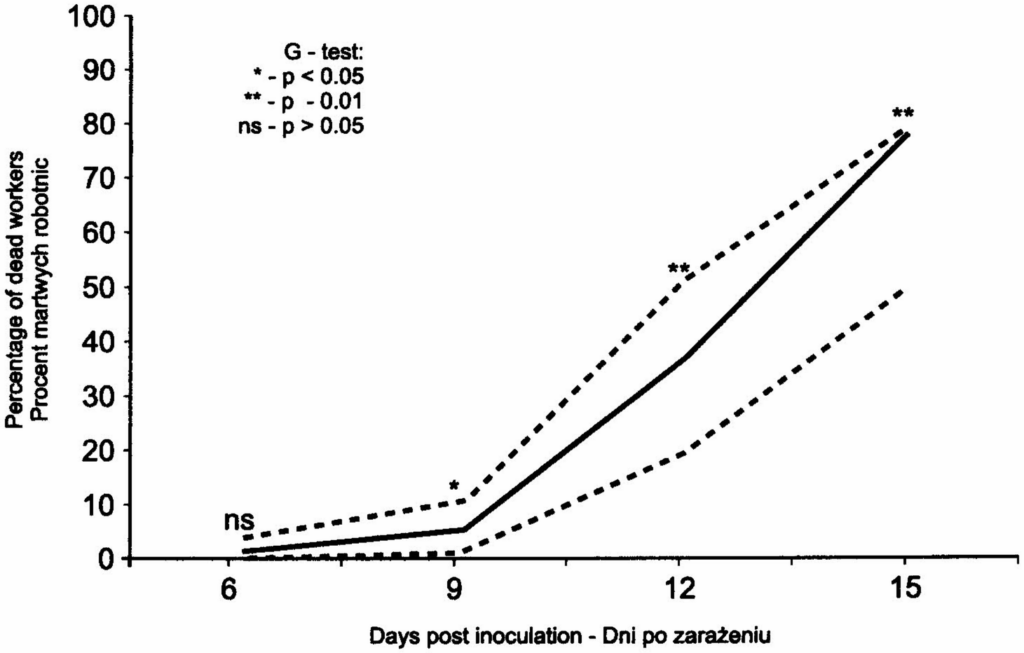
To compare the mortality of the workers from the three groups: those inoculated with N. apis spores (group I; 269 bees in three cages), those treated with CO2 and inoculated with N. apis (group II; 270 bees in three cages), and the untreated control group (group III; 92 bees in one cage) data from all cages that belonged to the same group were combined. The proportion of the cumulative number of dead workers (dead/alive) counted at successive three-day intervals differed significantly between the three groups after the 9th day post-inoculation (Fig. 1). These differences were a result of a lower mortality of workers from the control group. No differences were found between the two experimental groups, I and II. This implies that treatment of
strona 136the workers with CO2 does not significantly influence their mortality if they are inoculated with N. apis spores.
The levels of infection of workers were first compared among the cages that belonged to the same group, I or II. Only in group II on the 12th day post inoculation did the number of spores in workers from one cage differ significantly from the number of spores in workers from two other cages (H = 22.0675, n = 45, p 0.0001). This result was not taken into consideration, because no significant differences were found in the other seven tests. Comparing the infection level of experimental groups I and II at the three-day intervals, the data from the three cages belonging to the same group were combined. The results show that the infection levels of workers from group I and II only differed significantly on the 12th day post inoculation (Fig. 2). This means that no significant differences were found at the other three time intervals. Therefore, there is no convincing evidence that CO2 narcosis influences the level of infection in the workers. During the whole experiment no infected bees were found in control group III.
strona 137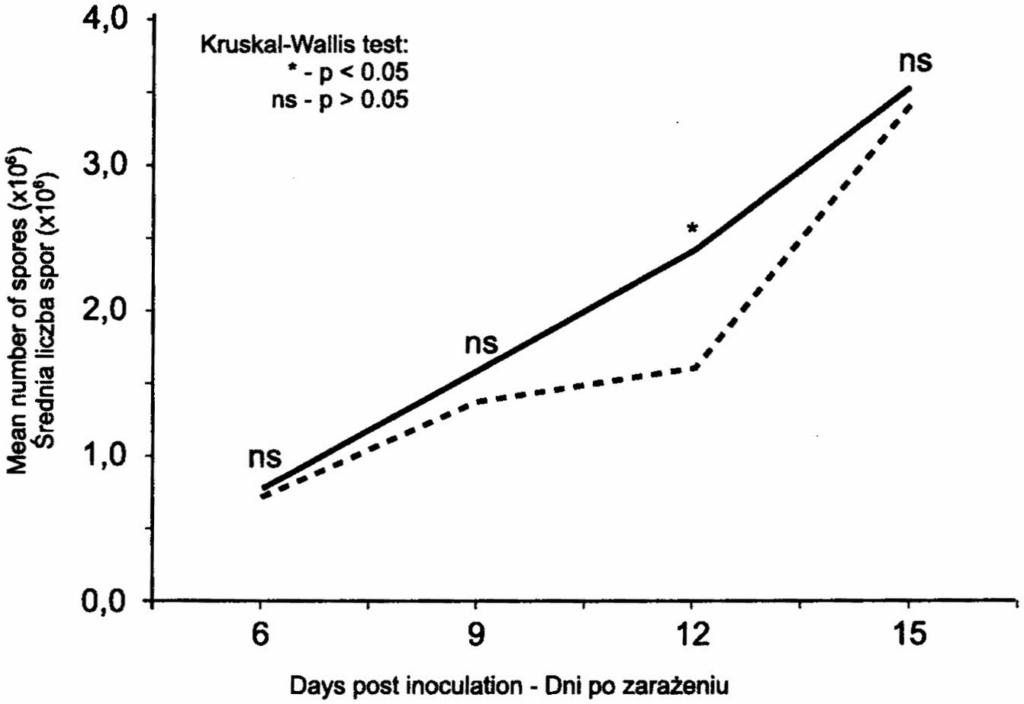
DISCUSSION
To maximise reproduction, N. apis should adapt its reproductive strategy to the expected life duration of its host. If the parasite infects a host with really short life expectation the best strategy should be to produce durable spores as soon as possible before the host’s death. Only durable spores viable for a longer period transmit the parasite between hosts. Multiple replication during the merozoite stage or/and production of less durable spores germinating inside the same host is more profitable if the host’s life expectancy is long. The second alternative strategy gives the opportunity to produce a really large number of durable spores to be voided with the faeces of the infected bees before their death.
There is evidence suggesting that the reproductive strategy of N. apis differs although the host was kept in the same conditions. In independent experiments the time between the infection of a new host and the formation of new spores varied from two (Kellner 1980) to six days (Lotmar 1943), at the same temperature (30°C). There are also data showing that the levels of infection differ significantly between individuals inoculated with the same dose (Fries 1988). This means that the rate of the parasite’s multiplication can vary in different hosts. In our experiment, at the same period
strona 138post-inoculation, workers from the same cage with the highest infection level had as much as a hundred times more spores than the workers with the lowest infection level. This difference was observed despite the fact that all the workers were full sisters and therefore their genetic diversity was very low.
The results of the experiment described above did not confirm our hypothesis. The expected differences in the levels of infection between workers inoculated with N. apis, and the workers treated with CO2 before inoculation with the same spore dose did not occur (Fig. 2). Our assumption had been that the workers treated with CO2 would live for a shorter time than untreated workers. Skowronek and Jaycox (1974) suggested that workers treated with CO2 for 20 min lived only half as long as untreated ones, because anaesthesia accelerates ageing. However, this effect was not observed in our experiment. The mortality of inoculated workers did not differ between untreated and CO2 treated groups (Fig. 1). The probable reason for this was the use of too high dose of spores for inoculation. In an earlier experiment Fries (1988) used maximum doses of only one twentieth of those used by us. It is possible that such high doses of the parasite shorten the expected lifespan of workers much more than CO2 anaesthesia does. It is clear, however, that workers from both experimental groups I and II had a shorter life expectation than the non-inoculated workers from the control group III (Fig. 1).
Although the results presented did not make it possible support our hypothesis, we believe that the parasite N. apis can maximise reproduction by adaptation of its reproductive strategy to the expected life duration of its host. The data presented here may be useful in further experiments bringing a solution to this problem.
REFERENCES
El-Shemy A.A., Pickard R.S. (1989)- Nosema apis Zander infection levels in honeybees of known age. J. Apic. Res. 28(2):101-106.
Fries I. (1988)- Contribution to the study of nosema disease (Nosema apis Z.) in honey bee (Apis mellifera L.) colonies. Ph D Thesis, Swedish University of Agricultural Sciences, Uppsala, Sweden.
Fries I. (1993)- Nosema apis – a parasite in the honey bee colony. Bee World 74(1):5-19.
Fries I. (1994)- Nosema apis – still a lot of questions. Bee World 75(1):42-43.
Fries I. (1997)- Protozoa, in: Morse R.A. and Flottum K. (Eds.), Honey bee pests, predators, and diseases :57-76. A.I. Root Company, Medina, Ohio, USA.
Fries I., Granados R. R., Morse R. A. (1992)- Intracellular germination of spores of Nosema apis Z. Apidologie, 23:61-70.
strona 139Graaf D. C., Raes H., Jacobs F.J. (1994)- Spore dimorphism in Nosema apis (Microsporida, Nosematidae) developmental cycle. J. Invertebr. Pathol., 63: 92-94.
Kellner N. (1980)- Studie van de levenscyclus van Nosema apis Zander in de honingbij (Apis mellifera L.). Diss. Fac. Wetenschappen, Rijksuniversitet Gent, Gent, Belgium.
Lotmar R. (1943)- Über den Einfluss der Temperatur auf den Parasiten Nosema apis. Beih. Schweiz. Binenztg 1:261-284.
Matheson A. (1993)- World bee health report. Bee World 74:176-212.
Sherman P.W., Seeley T.D., Reeve H.K. (1988)- Parasites, pathogens and polyandry in social Hymenoptera. Am. Nat. 131:602-610.
Skowronek W., Jaycox E.R. (1974)- Wpływ dwutlenku węgla na pszczoły robotnice. Pszczeln. Zesz. Nauk. 18:107-119.
Sokal R.R. Rohlf F.J., (1981)- Biometry. W.H. Freemam and company, N. York, USA.
Woyciechowski M., Czekońska K. (1999)- The effect of temperature on Nosema apis Zander (Microsporida, Nosematidae) infection in honey bees (Apis mellifera). Parasite, 6:185-187.
STRATEGIA ROZRODCZA NOSEMA APIS W ZALEŻNOŚCI OD OCZEKIWANEJ DŁUGOŚCI ŻYCIA ROBOTNIC PSZCZOŁY MIODNEJ
Czekońska K., Woyciechowski M.
Streszczenie
Pierwotniak Nosema apis, wywołujący chorobę sporowcową, u pszczoły miodnej pasożytuje i rozwija się w komórkach nabłonka jelita środkowego. W trakcie cyklu rozwojowego tego pasożyta, po licznych podziałach, wytwarzane są dwa rodzaje spor. Spory z cienką otoczką przeznaczone są do zarażenia kolejnych komórek nabłonka jelita środkowego tego samego gospodarza. Spory z grubą otoczką, wydalane z kałem, przeznaczone są do zarażenia innych osobników. Dotychczas nie wiadomo czy N. apis dostosowuje swoją strategię rozrodczą do oczekiwanej długości życia gospodarza. W niniejszym doświadczeniu testowano tempo wytwarzania spor z grubą otoczką w zależności od oczekiwanej długości życia gospodarza. Spodziewano się, że u osobników z krótką oczekiwaną długością życia liczba podziałów pasożyta będzie mniejsza i spory z grubą otoczką będą wytwarzane szybciej niż u robotnic z długą oczekiwaną długością życia. Strategia taka pozwoliłaby maksymalizować reprodukcje pasożyta w zależności od oczekiwanej długości życia żywiciela.
Wygryzione w inkubatorze, w czasie 40 h, robotnice rozdzielono do siedmiu klateczek hodowlanych, które podzielono na trzy grupy. Pierwsza grupa robotnic (grupa I; 269 osobników w trzech klateczkach) została indywidualnie zarażona sporami N. apis (107.5 x 10^3 spor/osobnika). Druga grupa robotnic (grupa II; 270 osobników w trzech klateczkach), przed zarażeniem tą sama dawką spor co grupa I, potraktowana została dwutlenkiem węgla
strona 140przez 20 min, celem skrócenia ich oczekiwanej długości życia. Grupa trzecia robotnic nie poddana żadnym zabiegom stanowiła kontrolę (grupa III; 92 osobniki w jednej klateczce). Wszystkie klateczki przetrzymywano w inkubatorze w temperaturze 31°C. Liczbę spor u robotnic badano w 6, 9, 12, i 15 dniu po zarażeniu.
Śmiertelność robotnic oraz poziom infekcji wśród zarażonych osobników z obu grup eksperymentalnych (I i II) nie różniły się statystycznie (Fig. 1 i 2). Tylko w wolnej od spor N. apis grupie kontrolnej (III) śmiertelność robotnic była istotne niższa niż w obu zarażonych grupach (Fig. 1). Ponieważ nie stwierdzono wpływu usypiania CO2 na śmiertelność zarażonych robotnic, prezentowany eksperyment nie pozwolił na testowanie hipotezy, zgodnie z którą N. apis przystosowuje swą strategię rozrodczą do oczekiwanej długości życia robotnicy pszczoły miodnej.
Słowa kluczowe: Apis meliffera, Nosema apis, choroba sporowcowa.
Errata — błędy druku znalezione podczas digitalizacji
- s. 134: „meliffera” → mellifera
- s. 136, ryc. 1: „p – 0.01″ → p < 0.01
- s. 139, piśmiennictwo: „Rijksuniversitet” → Rijksuniversiteit
- s. 139, piśmiennictwo: „Binenztg” → Bienenztg
- s. 139, piśmiennictwo: „Freemam” → Freeman
- s. 139, streszczenie: „reprodukcje” → reprodukcję
- s. 139, streszczenie: „tą sama dawką” → tą samą dawką
- s. 140, streszczenie: „istotne niższa” → istotnie niższa
- s. 140, słowa kluczowe: „meliffera” → mellifera