

THE CONTAMINATION OF POLLEN LOADS HARVESTED BY MEANS OF POLLEN TRAPS WITH PESTS
tekst: Wit Chmielewski
Pszczelnicze Zeszyty Naukowe, Rok XLIV, Nr 2, 2000 — Wit Chmielewski
strona 123PSZCZELNICZE ZESZYTY NAUKOWE Rok XLIV, Nr 2 2000
Wit Chmielewski
Department of Bee Products, Apiculture Division, Research Institute of Pomology and Floriculture,Kazimierska 2, 24-100 Pulawy, Poland
Summary
A total of 539 samples of pollen loads collected by means of three types of pollen traps were analysed macro- and microscopically. Of these, 93% were contaminated: dead bees (imagines, brood and their body fragments) were found in the majority (93.9%) of the 501 contaminated samples; 76.8% and 56.2% of the total number of contaminated pollen samples were also infested with other arthropods – various insects and mites, respectively.
Pollen loads harvested by means of bottom and outer-entrance pollen traps, emptied less than twice a week, were usually more strongly infested and contaminated with pests than those collected from ceiling traps, especially when they were emptied more often, e.g. every 1-2 days; some such samples were even free of pests. This last kind of traps should be recommended for harvesting pollen of relatively high purity and quality.
Keywords: pollen, contaminations, arthropods, pests, pollen traps.
INTRODUCTION
The results of studies on flower pollen conducted in Poland as well as in other countries show the very varied biochemical composition, high biological activity and nutritive value of this product (Binding 1980, Bosi, Ricciardelli 1975, Echigo, Kazuhisa 1986, Herbert, Shimanuki 1978, McLellan 1977, Stanley, Linskens 1974, Szczęsna 1995, Szczęsna et al. 1999).
Bee-collected pollen (otherwise called pollen loads or pollen pellets) is used both as a natural medicinal product and a component for the production of valuable nutrients, cosmetics etc. (Binding 1980, Donadieu 1983, Matsuka 1991). As such this product should be of the highest quality and most of all free of pests and contaminations.
Both data from literature (Borchert 1974, Eickwort 1990, Grobov 1991, Hirschfelder 1961, Marletto, Ferrazzi 1982, Mitro, Schley 1993) and the results of our own initial acarological analyses of pollen loads and our biological observations of mites fed pollen conducted earlier show that this product is a very attractive food for these
strona 124pests and other arthropods associated with bees and hive products (Chmielewski 1975, 1978, 1984, 1985, 1994, 1995, 1997, 1998).
The aim of this study was to evaluate the cleanliness of fresh bee-collected pollen harvested by means of three types of pollen traps (emptied at various frequencies) described in literature and used in Poland (Bobrzecki, Wilde 1990), in respect of its contamination and infestation with arthropods.
MATERIAL AND METHODS
Three kinds of pollen traps (ceiling, bottom, outer-entrance) installed in beehives („Wielkopolski” type) were used to gather of pollen pellets (Fig. 1).
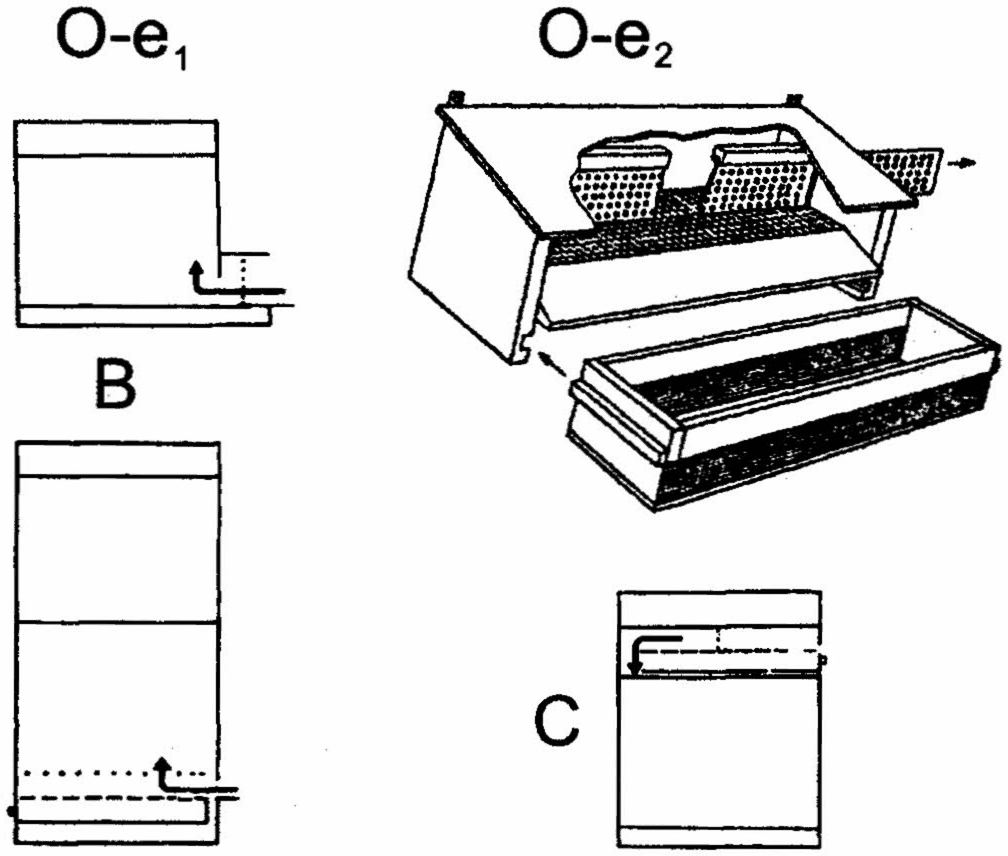
Schemat ula (typ „Wielkopolski”) i miejsca zainstalowania poławiaczy pyłku użytych w doświadczeniach: O-e – zewnętrzny (1 – miejsce zainstalowania, 2 – schemat poławiacza z perforowaną płytką strącającą wysuwaną z boku, i pojemnikiem na pyłek, wysuwanym z przodu), B – dennicowy, C – powałkowy; strzałki pokazują drogę pszczół do ich gniazda (szczegóły konstrukcji w literaturze, np. Bobrzecki, Wilde 1990)
The pollen traps were emptied:
- daily or every second day,
- once or twice a week,
- every two weeks,
- every four weeks (once a month)
Each combination of experiments was carried out three times with 3 bee-colonies.
The samples of new harvested pollen loads (ca. 80g) were analysed at first macroscopically for bigger insects, then they were sieved (with a laboratory strainer, mesh – ca. 2mm in diameter). The obtained in this way fine-grained fraction of pollen was examined microscopically (for mites and other tiny objects). The particulars of the procedure and the efficiency of the method were described earlier (Chmielewski 1997).
The intensity of the contamination of the pollen loads was expressed by the numbers of arthropods (mites + insects) calculated per 100g of pollen, according to the following three-degree scale: I – 1-2, II – 3-5, and III – over 5 objects (specimens or their body fragments) per 100g of the product.
RESULTS AND DISCUSSION
A total of 539 samples of pollen loads were collected. Of these over 93% were contaminated, most of them (93.9%) with dead bees (imagines, brood and their body fragments) and other arthropods – various insects (76.8%) and mites (56.2%).
The results show that cleanliness of pollen in respect of its contamination and infestation with pests depends first of all upon the method of harvesting, i.e. the type of pollen traps used for gathering the product and the frequency of emptying them (Tab. 1-4).
Some data is sometimes difficult to compare and interpret because of changing atmospherical conditions during the seasons of investigation: changes in temperature, precipitation, drought, sunny and windy weather etc. influence especially the microclimate inside the outer- entrance and the bottom pollen traps; ceiling traps installed in the top of the hives are usually more stable in this respect.
Higher humidity and lower temperature in those parts of the beehives, where the bottom and the outer-entrance pollen traps were installed, seem to be more favourable for the spreading and the development of invaders of bees and of pests of hive products, than the microclimate of the top of beehives. The place of installation of the ceiling pollen traps gave higher temperature and lower RH, which are unfavourable for some arthropods (e.g acaroid mites) and sometimes restrict to their multiplication. That is why the infestation of pollen loads collected from ceiling traps were usually cleaner (with a lower
strona 126level of infestation and contamination, and sometimes free of pests) than those taken from the other two types of traps.
Table 1 Comparison of contamination of pollen loads (%), collected from three types of pollen traps, with bees (B) and other arthropods (A) Porównanie zanieczyszczenia obnóży pyłkowych (%) zebranych za pomocą trzech typów poławiaczy, przez pszczoły (B) i inne stawonogi (A)
Kolumny liczbowe pod nadrzędnymi grupami: „Pollen samples / Próbki pyłku” (Examined / Contamined) oraz „Contamination in degrees (%)** / Zanieczyszczenie w stopniach (%)**” (stopnie I, II, III, każdy w podziale na B — pszczoły i A — stawonogi).
| Types of pollen traps* / Typy poławiaczy* | Examined (number) / Zbadane (liczba) | Contamined (%) / Zanieczyszczone (%) | I — B | I — A | II — B | II — A | III — B | III — A |
|---|---|---|---|---|---|---|---|---|
| B pt | 83 | 94.0 | 0.0 | 0.0 | 14.5 | 33.7 | 79.5 | 60.2 |
| O-e pt | 387 | 93.5 | 4.7 | 19.9 | 37.2 | 12.1 | 44.7 | 61.5 |
| C pt | 69 | 88.4 | 17.4 | 49.3 | 58.0 | 0.0 | 13.0 | 39.1 |
| Total – Razem | 539 | 93.0 | 5.6 | 20.6 | 36.4 | 13.9 | 46.0 | 58.5 |
- Types of pollen traps: bottom (B pt), outer-entrance (O-e pt), ceiling (C pt)
- Typy poławiaczy pyłku: dennicowe (B pt), zewnętrzne (O-e pt), powałkowe (C pt) ** Contamination scale (three degrees): I – 1-2, II – 3-5, III – >5 objects per 100g of pollen ** Skala zanieczyszczenia (trzy stopnie): I – 1-2, II – 3-5, III – >5 obiektów na 100g pyłku
Table 2 The percentage of infestation of pollen load samples with pests (insects + mites), collected from the three types of pollen traps; the number of examined samples – 539 Procent porażenia prób obnóży pyłkowych przez szkodniki (owady + roztocze), zebranych z trzech typów poławiaczy; liczba zbadanych prób – 539
Kolumny I, II, III pod nadrzędną grupą „Infestation of samples in degree (%)** / Porażenie prób w stopniach (%)**”.
| Types of pollen traps* / Typy poławiaczy* | Number of infested pollen samples / Liczba porażonych prób pyłku | I | II | III |
|---|---|---|---|---|
| B pt | 78 | 0.0 | 35.9 | 64.1 |
| O-e pt | 362 | 21.3 | 5.5 | 73.2 |
| C pt | 61 | 55.7 | 0.0 | 44.3 |
| Total – Razem | 501 | 22.2 | 9.6 | 68.2 |
- Types of pollen traps: bottom (B pt), outer-entrance (O-e pt), ceiling (C pt)
- Typy poławiaczy pyłku: dennicowe (B pt), zewnętrzne (O-e pt), powałkowe (C pt) ** Infestation scale (three degrees): I – 1-2, II – 3-5, III – >5 arthropods per 100g of pollen ** Skala zanieczyszczenia (trzy stopnie): I – 1-2, II – 3-5, III – >5 obiektów na 100g pyłku
Table 3 The results of acaro-entomological analyses of the infested pollen pellets collected by means of the three kinds of pollen traps, with regard to the frequency of their gathering; 539 pollen samples were analysed Wyniki analiz akaro-entomologicznych porażonych obnóży pyłkowych zebranych za pomocą trzech rodzajów poławiaczy pyłku, z uwzględnieniem częstości ich odbioru; wykonano analizy 539 prób pyłku
Górna komórka nagłówka nad kolumnami danych: „Types of pollen traps* / Typy poławiaczy pyłku*”. Lewa pionowa (obrócona) etykieta obejmująca wiersze częstości: „Average number of insects (I) and mites (M) per 100g of pollen from traps emptied: / Średnia liczba owadów (I) i roztoczy (M) w 100g pyłku z poławiaczy opróżnianych:”. Kolumna I/M rozróżnia owady (I) i roztocze (M).
| Kategoria | I / M | B pt | O-e pt | C pt | Total Razem |
|---|---|---|---|---|---|
| Infested samples / Próby porażone | Number – Liczba | 78 | 362 | 61 | 501 |
| Infested samples / Próby porażone | % | 94.0 | 93.5 | 88.4 | 93.0 |
| Daily or every 2nd day / Codziennie lub co drugi dzień | I | 4.2 | 4.4 | 1.3 | 3.9 |
| Daily or every 2nd day / Codziennie lub co drugi dzień | M | 7.5 | 0.9 | 1.8 | 2.3 |
| 1 or 2 times a week / 1 lub 2 razy w tygodniu | I | 6.7 | 8.0 | 2.3 | 7.1 |
| 1 or 2 times a week / 1 lub 2 razy w tygodniu | M | 28.3 | 7.3 | 2.6 | 10.2 |
| Every 2 weeks / Co 2 tygodnie | I | 2.7 | 16.4 | 3.7 | 15.0 |
| Every 2 weeks / Co 2 tygodnie | M | 7.7 | 12.8 | 3.7 | 12.0 |
| Every 4 weeks / Co 4 tygodnie | I | 62.4 | 21.8 | 44.2 | 37.1 |
| Every 4 weeks / Co 4 tygodnie | M | 3248.7 | 39.2 | 26.0 | 801.8 |
- Types of pollen traps: bottom (B pt), outer-entrance (O-e pt), ceiling (C pt)
- Typy poławiaczy pyłku: dennicowe (B pt), zewnętrzne (O-e pt), powałkowe (C pt)
The majority of arthropods found in the pollen loads belong to synanthropic species, commonly known to be stored product pests of economic and sanitary importance. The insects were represented mostly by beetles (Tribolium, Dermestes), moths (Achroia, Galleria), psocids (Corrodentia), earwigs (Forficula auricularia L.), ants (Formicidae, Myrmicidae) and other invaders of beehives. Among mites the most frequent and numerous were found acaroid species (Acarus, Carpoglyphus, Glycyphagus, Tyrophagus, etc.) and other associates of bees and pests of hive products. The results of these studies confirm to some data on the subject in literature (Borchert 1974, Chmielewski 1975, 1985, 1998, Grobov 1991, Hischfelder 1961, Marletto, Ferrazzi 1982, Mitro, Schley 1993).
strona 128Table 4 The infestation degrees of pollen (%) with insects (I) and mites (M) according to the frequency of emptying the pollen traps; the total number of infested pollen samples – 501 Stopnie porażenia pyłku (%) przez owady (I) i roztocze (M) w zależności od częstości opróżniania poławiaczy pyłku; ogólna liczba porażonych próbek – 501
Górna komórka nagłówka nad kolumnami I, II, III: „Infestation degrees* / Stopnie porażenia*”. Lewa pionowa (obrócona) etykieta: „Infestation of pollen samples collected from traps emptied: / Porażenie prób pyłku pobranych z poławiaczy opróżnianych:”. Kolumna „Total – Ogółem” jest w druku scalona pionowo dla pary wierszy I+M każdej częstości (wartość podano w wierszu I; wiersz M pozostawiono pusty).
| Częstość / Frequency | I / M | I | II | III | Total – Ogółem |
|---|---|---|---|---|---|
| Daily or every 2nd day / Codziennie lub co 2 dni | I | 24.9 | 7.8 | 15.3 | 51.1 |
| Daily or every 2nd day / Codziennie lub co 2 dni | M | 33.7 | 12.6 | 4.8 | |
| 1 or 2 times a week / 1 lub 2 razy w tygodniu | I | 4.0 | 8.0 | 6.4 | 18.4 |
| 1 or 2 times a week / 1 lub 2 razy w tygodniu | M | 2.4 | 4.6 | 11.4 | |
| Every 2 weeks / Co 2 tygodnie | I | 1.6 | 0.0 | 21.6 | 23.1 |
| Every 2 weeks / Co 2 tygodnie | M | 0.8 | 6.6 | 15.8 | |
| Every 4 weeks / Co 4 tygodnie | I | 0.0 | 0.0 | 7.4 | 7.4 |
| Every 4 weeks / Co 4 tygodnie | M | 0.0 | 0.0 | 7.4 |
- Infestation scale (degrees): I – 1-2, II – 3-5, III – >5 pests per 100g of pollen
- Skala porażenia (stopnie): I – 1-2, II – 3-5, III – >5 szkodników w 100g pyłku
CONCLUSIONS AND REMARKS
The samples of pollen loads harvested by means of bottom and outer-entrance pollen traps (emptied less than two or three times a week) were usually strongly infested and contaminated with arthropods (over 5 objects per 100g of the product – IIIrd degree).
The pollen gathered from ceiling traps was less contaminated usually in the lower – Ist or IInd degrees (below 5 objects per 100g of the product), especially when the traps were emptied more often (e.g. 2-4 times a week or every day) and very thoroughly; some such samples (a few percent) were even free of pests.
This last kind of trap should be recommended for harvesting pollen of high cleanliness (especially if it is collected every 2 days or more often).
The high quality of the final product taken from pollen traps is conditioned also by its frequent and regular removal from the traps and then by a careful preparatory process (clearing, desiccation, packing) before storage.
strona 129REFERENCES
Binding J. (1980)- About pollen as a health food and healing agent. Thorsons pub. Ltd.:40-41.
Bobrzecki J., Wilde J. (1990)- Pozyskiwanie i zagospodarowanie obnóży pyłkowych. PWRiL, Poznań, 95ss.
Borchert A. (1974)- Schädigungen der Bienenzucht durch Krankheiten, Vergiftungen und Schädlinge der Honigbiene. S. Hirzel Verlag, Leipzig, 366ss.
Bosi G., Ricciardelli D’Albore G. (1975)- Quantitative determination of amino acids in some bee collected pollens. XXXV Int. Beekeep. Congr. Apimondia, Grenobl. s.459-464.
Chmielewski W. (1975)- Roztocze (Acarina) występujące w zbieranym przez pszczoły i przechowywanym pyłku kwiatowym. Zesz. probl. Post. Nauk rol., 171: 237- 244.
Chmielewski W. (1978)- Płodność i rozwój niektórych gatunków roztoczy na pyłku. Pszczeln. Zesz. Nauk., 22: 173-180.
Chmielewski W. (1984)- Biologia Tyrophagus longior (Gerv.) (Acarina, Acaridae), szkodnika zapasów pyłku. Pszczeln. Zesz. Nauk., 28: 135-140.
Chmielewski W. (1985)- Roztocze (Acarina) w poławiaczach pyłku. Pszczeln. Zesz. Nauk., 29: 315-321.
Chmielewski W. (1994)- Składanie jaj i rozwój rozkruszków (Acaroidea) na pyłku zbieranym przez pszczoły. Pszczeln. Zesz. Nauk., 38: 131-142.
Chmielewski W. (1995)- Pollen loads as a food of stored product mites (Acaroidea). Pszczeln. Zesz. Nauk., 39(1): 157-168.
Chmielewski W. (1997)- Skuteczność wykrywania szkodników w obnóżach pyłkowych metodą przesiewania przy użyciu sit laboratoryjnych. Pszczeln. Zesz. Nauk., 41: 183-188.
Chmielewski W. (1998)- Szkodniki pyłku. (W:) Pszczelnictwo, J. Prabucki (Red.). Wydawnictwo Promocyjne „Albatros”, Szczecin: 601-605.
Donadieu Y. (1983)- Pollen in natural therapeutics. Libr. Maloine S. A. Paris, 55pp.
Echigo T., Kazuhisa Y. (1986)- Studies on chemical composition of pollen loads. Honeybee Science, 7(3): 97-100.
Eickwort G. C. (1990)- Mites: an overview. (In:) Honey bee pests, predators, and diseases R. A. Morse & R. Nowogrodzki (Eds) – 2nd ed., Comstock Publishing Associates, Cornell University Press, Ithaca and London: 188-199.
Grobov O. F. (1991)- Kleśći: parazity pchel i vrediteli ich produkcii. Rosagropromizdat, Moskva, 94ss.
Herbert E. W., Shimanuki H. (1978)- Chemical composition and nutritive value of bee-collected and bee-stored pollen. Apidologie, 9(1): 33-40.
Hirschfelder H. (1961)- Uber Pollenmilben und ihre Bekampfung. Bayer. Landw. Jahrbuch, 38(3): 368-372.
strona 130Marletto F., Ferrazzi P. (1982)- Arthropodi infestanti polline immagazinato (1). La difesa antiparassitaria nelle industrie alimentari e la protezione degli alimenti. Atti del 3′ Simposio a cura di G. Domenichini, Piacenza 22-24 settembre 1982: 369-373.
Matsuka M. (1991)- Nature and use of pollen loads. Honeybee Science, 12(1): 34-38.
McLellan A. R. (1977)- Minerals, carbohydrates and amino acids of pollens from some woody and herbaceous plants. Ann. Bot., 41: 1225-1232.
Mitro S., Schley P. (1993)- Pollenmilben als Wabenschadlinge. Die Biene, 2199: 58- 63.
Rybak-Chmielewska H. (1998)- Pyłek kwiatowy (obnóża). (W:) Pszczelnictwo, J. Prabucki (Red.). Wydawnictwo Promocyjne „Albatros„, Szczecin: 583-588.
Stanley R. G., Linskens H. F. (1974)- Pollen: biology, biochemistry, management. Springer Verlag, New York, p. 133-142, 145-146.
Szczęsna T. (1995)- Wartość biologiczna pyłku kwiatowego zbieranego przez pszczoły, świeżego i przechowywanego w różnych warunkach. Inst. Sadownictwa i Kwiaciarstwa, Oddz. Pszczelnictwa, Puławy (praca doktorska), 90ss.
Szczęsna T., Rybak-Chmielewska H., Chmielewski W. (1999)- Pyłek kwiatowy (obnóża) – naturalna odżywka i surowiec farmaceutyczny. O.P. Instytut Sadownictwa i Kwiaciarstwa, Skierniewice, 64ss.
ZANIECZYSZCZENIE OBNÓŻY PYŁKOWYCH POZYSKIWANYCH ZA POMOCA POŁAWIACZY PYŁKU PRZEZ SZKODNIKI
Chmielewski W.
Streszczenie
Celem badań była ocena higieny świeżego pyłku zbieranego przez pszczoły pod względem jego zanieczyszczenia i porażenia przez stawonogi.
Trzy typy poławiaczy (powałkowe, dennicowe, zewnętrzne – wylotkowe) były używane do pozyskiwania obnóży pyłkowych. Opróżniano je: 1) codziennie lub co drugi dzień, 2) 1-2 razy w tygodniu, 3) co 2 tygodnie, 4) co 4 tygodnie (raz w miesiącu). Próbki pyłku (o masie ca. 80g) były przeglądane w pierwszej kolejności makroskopowo (większe owady), a następnie przesiewano je na sitach laboratoryjnych (średnica oczek – ca. 2mm). Otrzymaną w ten sposób drobnocząsteczkową frakcję pyłku badano mikroskopowo (roztocze i inne drobne stawonogi). Szczegóły procedury i skuteczność metody opisano we wcześniejszej publikacji (Chmielewski 1997). Intensywność zanieczyszczenia obnóży pyłkowych wyrażano liczbą znalezionych stawonogów (głównie roztoczy i
strona 131owadów) przeliczaną na 100g pyłku, według następującej 3-stopniowej skali: I – 1-2, II – 3-5, III – ponad 5 obiektów w 100g produktu.
Zebrano łącznie 539 prób obnóży pyłkowych. 93% z nich było zanieczyszczonych; najwięcej spośród 501 zanieczyszczonych prób (93.9%) zawierało martwe pszczoły (imagines, czerw i fragmenty ciała) i inne stawonogi – różne owady (76.8%) i roztocze (56.2%). Większość z nich to gatunki synantropijne, znane powszechnie jako szkodniki magazynowe o gospodarczym i sanitarno-higienicznym znaczeniu.
Owady reprezentowane były głównie przez chrząszcze (Tribolium, Dermestes), motyle (Achroia, Galleria), psotniki (Corrodentia), skorki (Forficula), mrówki (Formicidae, Myrmicidae) i szereg innych. Spośród roztoczy najczęściej i najliczniej spotykano rozkruszki (Acarus, Carpoglyphus, Glycyphagus, Tyrophagus, etc.) i inne, mniej lub bardziej związane z produktami pszczelimi i środowiskiem pasiecznym. Szczegółowe wyniki analizy składu gatunkowego akaro-entomofauny pyłku są przedmiotem oddzielnej publikacji (Chmielewski, w przygotowaniu do druku).
Próby pyłku zbierane za pomocą poławiaczy dennicowych i zewnętrznych (opróżnianych rzadziej niż dwa razy w tygodniu) były zwykle silnie porażone i zanieczyszczone przez różne stawonogi (III stopień). Pyłek z poławiaczy powałkowych był zazwyczaj zanieczyszczony w mniejszym (I lub II) stopniu, zwłaszcza gdy poławiacze opróżniano bardzo starannie i często (np. 2-4 razy w tygodniu lub codziennie); niektóre z takich prób były nawet wolne od szkodników. W związku z tym ten ostatni typ poławiaczy można zalecać do pozyskiwania pyłku o stosunkowo wysokim stopniu czystości.
Poza typem poławiaczy, dobra jakość produktu końcowego zależy także w dużym stopniu od jego częstego i regularnego odbioru z poławiaczy, odpowiedniego procesu przygotowania (oczyszczanie, suszenie, konfekcjonowanie) do przechowywania w przystosowanych do tego opakowaniach i pomieszczeniach magazynowych o niskiej temperaturze i wilgotności względnej powietrza.
Słowa kluczowe: pyłek, zanieczyszczenia, stawonogi, szkodniki, poławiacze pyłku.
Errata — błędy druku znalezione podczas digitalizacji
- s. 126, tab. 1: „Contamined” → Contaminated
- s. 127: „Hischfelder” → Hirschfelder
- s. 129, piśmiennictwo: „Uber” → Über
- s. 129, piśmiennictwo: „Bekampfung” → Bekämpfung
- s. 130, piśmiennictwo: „immagazinato” → immagazzinato
- s. 130, piśmiennictwo: „Wabenschadlinge” → Wabenschädlinge
- s. 130, tytuł polski: „POMOCA” → POMOCĄ