

PHYSIOLOGICAL CONDITION OF WORKER BEES (APIS MELLIFERA L.) AFTER CONSUMPTION OF POLLEN SUBSTITUTE
tekst: Bożena Szymaś, Antoni Przybył
Pszczelnicze Zeszyty Naukowe, Rok XL, 1996 — Bożena Szymaś, Antoni Przybył
strona 109PSZCZELNICZE ZESZYTY NAUKOWE Rok XL, Nr 2 1996
Bożena Szymaś, Antoni Przybył
Department of Useful Insect Breeding and Department of Inland Fishery and Aquaculture University of Agriculture, ul.Wojska Polskiego 71 c, 60-625 Poznań, POLAND
Summary
The objective of this work was the evaluation of the form of worker bees after the cosumption of pollen substitute prepared on the basis of potato protein and the hydrolyzate of fish protein. The physiological condition of bees was determined on the basis of their fresh body weight and morphological picture of the pharyngeal glands and fat body. Both investigated nutrients have shown a favourable influence on the physiological state of bees. The poorest development of fat body, pharyngeal glands and fresh weight of bees was found in the control group with a zero level of protein.
<u>Keywords:</u> honeybee, pollen substitute, fresh weight body, pharyngeal glands, fat body, feeding.
INTRODUCTION
It is commonly known, that the physiological condition of bees depends on the type and amount of consumed bee bread and this fact has been confirmed by many source materials (Maurizio 1950, Standifer 1967, Campana and Moeller 1977). Although pollen is the most appropriate proteinaceous food for bees, in periods of pollen deficit, bees can be given substitution food whose biological value has been determined by laboratory tests (Maurizio 1954, Pain 1961, Herbert and Shimanuki 1982, Kulinčevič and Rothenbuhler 1983, Szymaś 1994).
For the production of pollen substitute for bees, different proteinaceous fodder and even by-products of agricultural and food industries are used. Such proteinaceous raw material is found in potato protein gained from potato juice being a waste product. In the dry mass of potato protein, there is about 80% of total protein (Karol and Matyka 1996; Szymaś and Przybył 1995). For the production of pollen substitute, we utilized in this work, next to potato protein, the
strona 110hydrolyzate of fish protein containing 79% of total protein. It is characterized by a high degree of digestbility „in vitro” exceeding 92% , as well as by a high level of aminoacids necessary in the feeding of bees, i.e. valines, isoleucines and leucines (De Groot 1953).
The objective of this work was the evaluation of the physiological condition of worker bees after the consumption of pollen substitute prepared on the basis of potato protein and the hydrolyzate of fish protein. The physiological condition of bees was determined on the basis of their fresh body weight and the morphological picture of the pharyngeal glands and the fat body.
MATERIAL AND METHODS
A laboratory experiment was carried out in the Department of Useful Insects Breeding, University of Agriculture in Poznań. One – day old bees were settled in small hives according to the construction of Szymaś, Wójtowski (1974) and they were kept in an incubator at 30 ⁰C and 40% relative air humidity. For two weeks, the worker bees were given food and water.
The design of the experiment is presented in table 1. There were two experimental groups and two control groups. In each group, there were three hives with 150 worker bees in each of them.
T a b l e 1
Arrangement of Experiment Układ doświadczenia
| Group – grupa | Kind of feed – rodzaj paszy |
|---|---|
| Control – kontrolna (Kc) | Candy – Ciasto cukrowe |
| Control – kontrolna (Kp) | Bee bread + Sugar, weight prop. 1:1 Pierzga + Cukier, stos. wagowy 1:1 |
| Experimental I – doświadczalna I (D I) |
Nutrient I + Sugar, weight prop.1:1 Odżywka I + Cukier, stos.wagowy 1:1 |
| Experimental II – doświadczalna (D II) |
Nutrient II + Sugar, weight prop.1:1 Odżywka II + Cukier, stos.wagowy1:1 |
The pollen substitute was made in the Experimental Department of Fodder Production Technology and Aquaculture University of Agriculture in Poznań situated in Muchocin near Międzychód.
strona 111The chemical composition of raw materials and the content of exogenic aminoacids in the nutrients are presented in tables 2, 3, 4. The basic proteinaceous raw material of the produced nutrients was the potato protein and the hydrolyzate of fish protein.
In order to improve the digestibility of some components of the nutrients such as rape cake, wheat flour and potato flour, the components were subject to the extrusion process before mixing them with the remaining ingredients (Mościcki 1982).
T a b l e 2.
Raw material composition of protein nutrients ( % ). Skład surowcowy odżywek białkowych ( % ).
| Specification Wyszczgólnienie |
Nutrient I Odżywka I |
Nutrient II Odżywka II |
|---|---|---|
| Potato protein – Białko ziemniaka | 32.0 | 16.0 |
| Hydrolyzate of fish protein – Hydrolizat białka rybnego | – | 16.0 |
| Soya meal – Mąka sojowa | 15.0 | 15.0 |
| Torula yeast – Drożdże Torula | 5.0 | 5.0 |
| Rape cake* – Makuch rzepakowy* | 5.0 | 5.0 |
| Wheat meal * – Mączka pszenna * | 24.8 | 24.8 |
| Potato meal * – Kartoflanka * | 6.5 | 9.5 |
| Whey – Serweatka | 7.0 | 7.0 |
| Soya oil – Olej sojowy | 3.0 | – |
| Vitamin mixture – Mieszanka witaminowa | 1.7 | 1.7 |
- Components subject to extrusio Składniki poddane ekstruzji
T a b l e 3.
Chemical composition of nutrients and bee bread ( Skład chemiczny odżywek i pierzgi ( % ).
| Specification Wyszczególnienie |
Nutrient I Odżywka I |
Nutrient II Odżywka II |
Bee bread Pierzga |
|---|---|---|---|
| Crude protein – Białko ogólne | 20.3 | 20.3 | 24.1 |
| Crude fat – Tłuszcz surowy | 2.6 | 2.6 | 3.2 |
| NFE – ZBAW * | 18.5 | 19.1 | 59.4 |
| Crude fibre – Włókno surowe | 1.7 | 1.7 | 0.6 |
| Crude ash – Popiół surowy | 2.0 | 1.9 | 2.8 |
- Frae extractives Związki bezazotowe wyciągowe
T a b l e 4.
Content of essential amino acids in nutrients and bee bread ( g /100 g protein ). Zawartość aminokwasów egzogennych w odżywkach i pierzdze ( g/100 g białka ).
| Amino acid Aminokwas |
Nutrient I Odżywka I |
Nutrient II Odżywka II |
Bee bread Pierzga |
|---|---|---|---|
| Arginine – Arginina | 5.19 | 5.77 | 4.65 |
| Histidine – Histydyna | 2.42 | 2..25 | 2.85 |
| Lisine – Lizyna | 6.29 | 6.43 | 7.32 |
| Tryptophan – Tryptofan | 1.09 | 1.05 | 1.30 |
| Phenyl + tyrosine – Fenyl + tyrozyna | 11.25 | 9.14 | 7.63 |
| Methionine + cystine – Metionina + cystyna | 3.43 | 3.37 | 2.90 |
| Treonine – Treonina | 4.38 | 4.07 | 5.28 |
| Leucine – Leucyna | 9.37 | 8.07 | 8.69 |
| Izoleucine – Izoleucyna | 5.01 | 4.57 | 5.01 |
| Valine – Walina | 5.54 | 5.05 | 6.02 |
All components were ground in an impact mill with a diameter smaller than 200 μm. Milk acid was added in such an amount that the pH of the mixture was 4.1, and powdered sugar was added in 1:1 weight proportion. Before serving to the bees, the nutrients were enriched with a taste attractant: geraniolic oil, and a small amount of water was added to make the consistency of the nutrient closer to that of bee bread.
After two weeks, the bees were put to sleep, and the Maurizio‘s method (1954) was used to evaluate in a 1-4 evaluation scale the development degree of their pharyngeal glands and fat body. Degree 4 indicated the most developed investigated organs of the worker bees. The fresh weight of bees was weighted after the removal of the digestive tract.
RESULTS AND DISCUSSION
In the experiment, sugar cake was the most willingly consumed food confirming among others the earlier experimental results of the above mentioned authors (Szymaś, Przybył 1992, 1994; Szymaś 1994). The nutrient containing hydrolyzate of fish protein was consumed almost as willingly as bee bread. The worker bees more eagerly consumed the substitute II than the substitute I (table 5). The amount of food consumed by bees in laboratory conditions, without the possibility of performing purifying flights, has a negative effect on the survival of these insects
strona 113(table 5). The lowest death rate was recorded when carbohydrate food was supplied being easily digestible, and its consumption fills the large intestine of bees in the slowest way (Szymaś 1994).
T a b l e 5.
Average consumption of food by bees (mg/bee/day) and bee losses in laboratory conditions in 1 st week (number) Średnie spożycie pokarmu przez pszczoły (mg/pszczołę/dzień) i upadki pszczół w warunkach laboratoryjnych, w 1 tygodniu (sztuki)
| Group – grupa | Consumption – spożycie | Death rate – śmiertelność |
|---|---|---|
| K | 3.5 | 8.0 |
| K | 2.6 | 67.0 |
| D I | 2.1 | 96.0 |
| D II | 2.4 | 108.0 |
In spite of the fact that the consumption of bee bread was higher than that of the substitutes, less bees died, giving evidence that maybe bee bread is better digested than the nutrients. It is possible that the extrusion process is not sufficient in the preparation of nutrients only in reference to some raw materials such as rape cake, wheat flour, potato flour (table 2).
Extrusion is a thermoplastic process disintegrating the granules of starch grains and transforming them into a gruel-like consistency thereby making the food better digestible and assimilable (Mościcki 1982; Szymaś, Przybył 1994).
The content of fresh body weight of bees, the size of pharyngeal glands and fat body are features that are most frequently used for the characterization of the quality of the physiological condition of bees (Konopacka et al. 1975).
Both investigated nutrients have shown a favourable influence on the physiological state and physiological condition of bess (table 6, 7 and fig.1). The strongest development was shown by the fat body in bees fed nutrient II. On the other hand, after consumption of nutrient I, the fat body of these bees was developed in the same way as in the control group fed bee bread. Slightly less developed than in the control group (Kp) were the pharyngeal glands in worker bees fed with the produced nutrients ( experimental groups DI and DII ) ( table 6 and 7). The poorest development of fat body, pharyngeal glands and fresh weight of bees was found in the control group with a zero level of protein (Kc)
strona 114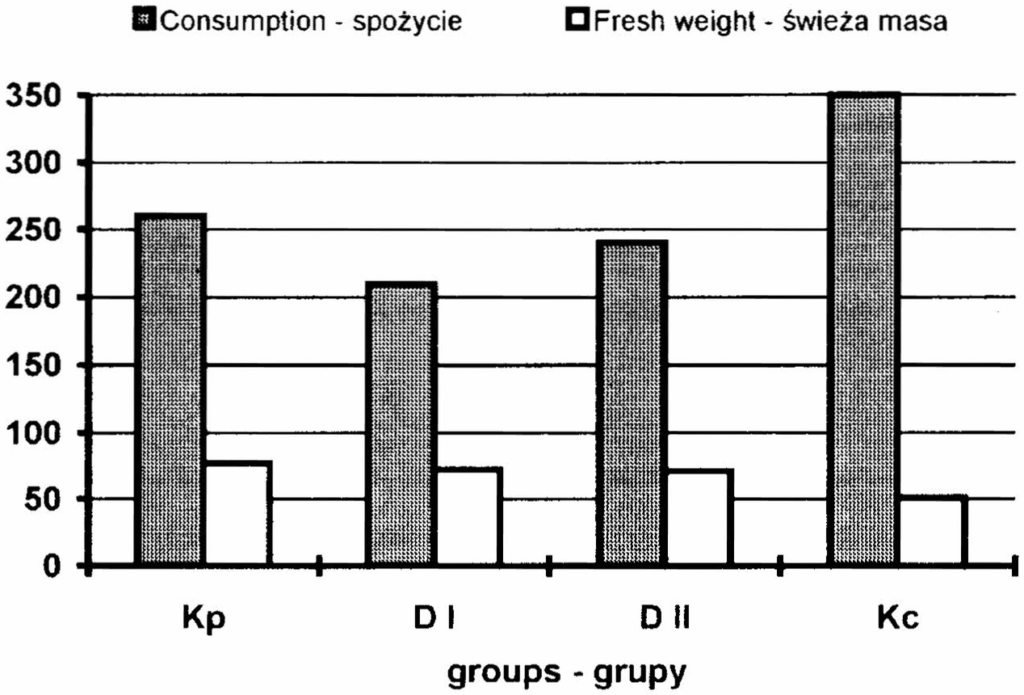
T a b l e 6.
Development of internal organs of bees fed in laboratory conditions in weighted mean classification degrees (1-4) (Maurizio 1954). Rozwój narządów wewnętrznych pszczół żywionych w warunkach laboratoryjnych wyrażony w średnich ważonych stopni bonitacyjnych (1-4) (Maurizio 1954).
| Group grupa |
Mean value – średnia: Pharyngeal glands gruczoły gardzielowe |
Mean value – średnia: Fat body ciało tłuszczowe |
|---|---|---|
| Kc | 1.5 | 1.5 |
| Kp | 3. | 3.3 |
| D I | 2.8 | 3.3 |
| D I | 3.1 | 3.5 |
T a b l e 7.
Bees with 3rd and 4th degrees of development of the examined organs (%). Pszczoły z 3. i 4. stopniem rozwoju badanych narządów (%).
| Group grupa |
Pharyngeal glands gruczoły gardzielowe |
Fat body ciało tłuszczowe |
|---|---|---|
| Kc | 7.5 | 5.0 |
| Kp | 95.0 | 87.5 |
| D I | 67.5 | 87.5 |
| D II | 82.5 | 92.5 |
CONCLUSION
On the basis of the experiment and the obtained results referring to the fresh weight of bees, size of pharyngeal glands and fat body, it can be stated that the nutrients improve the physiological condition of bees.
The low values of the investigated parameters obtained in the control group with a zero level of protein prove that it is necessary to use protein in the nutritive diet of bees.
The bee bread has shown a slightly higher nutritive value than the produced pollen substitutes
REFERENCES
Campana B., Moeller F.E. (1977): Honey bees: Preference for and nutritive value of pollen from five plant sources. J. Econ. Ent. 70, 1:39-41.
Groot A.P.de (1953): Protein and amino acid requirements of the honeybee (Apis mellifica L.) Physiol.comp. (s-Grav) 3:197-285.
Herbert E. W.Jr., Shimanuki H. (1982): Effect of population density and available diet on the rate of brood rearing by honey bees offered a pollen substitute. Apidologie 12, 1: 21-28.
Karol W., Matyka S.(1996): Użyteczność koncentratu białka ziemniaczanego w produkcji pasz przemysłowych. Pasze przemysłowe, 2/3:5-7.
Kulinčevič J .M., Rothenbuhler W.C. (1983): Effects of certain protein sources on brood rearing and lenght of life in the honey bee under laboratory conditions. Am. Bee J. 123, 1: 50-53.
Maurizio A. (1950): The influence of pollen feeding and brood rearing on the lengh of life and physiological condition of the honeybee. Bee World 31: 9-12.
strona 116Maurizio A.(1954): Pollenernährung und Lebensvorgänge bei Honigbiene (Apis mellifica L.). Ladw. Jrb. Scheiz. 62: 115-183.
Mościcki L. (1982): Zmiany w surowcach roślinnych poddawanych procesowi ekstruzji. Pos.Nauk rol. 5:91-104.
Pain J. (1961) : Sur quelques facteurs alimentaires accélérateurs du development des oeufs dans les ovaires des ouvrieres d’abeilles (Apis m.L.) Ins. Soc. 8, 1:31-93.
Standifer L.N. (1967): A comparison of the protein quality of pollen’s for growth-stimulation of the hypopharyngeal and longevity of honey bees, Apis mellifera L. (Hymenoptera, Apidae) Ins.Soc. 14: 415-426.
Szymaś B. (1994): Ocena wartości odżywczej surogatów pyłku kwiatowego dla pszczoły miodnej (Apis mellifera L.).Roczn. AR Pozn. Rozp. nauk. 256:1-68.
Szymaś B., Przybył A.(1992):Wpływ higienizacji radiacyjnej na wartość pokarmową substytutu pyłku kwiatowego dla pszczoły miodnej (Apis mellifera L.). Rocz. AR Pozn. 239, Zootech. 43: 213-219.
Szymaś B., Przybył A.(1994): Usefulness of extrusion and radurization in the preparation of granulated feeds utilized in the feeding of honey bee (Apis mellifera L.). Rocz. AR Pozn. 261, Zootech. 45: 139-145.
Szymaś B., Przybył A.(1995): Zastosowanie białka ziemniaka w żywieniu pszczoły miodnej (Apis mellifera L.). Pszczel. Zesz. Nauk. 39: 49-53.
Szymaś B., Wójtowski F. (1974): Podstawy i metody laboratoryjnego badania wartości użytkowej namiastek pyłku kwiatowego dla pszczół. Rocz. AR Pozn. 74, Zoot. 21:105-119.
Konopacka Z., Muszyńska J., Szczepański K.(1975): Ocena przydatności niektórych cech fizykochemicznych i anatomicznych dla charakteryzowania kondycji robotnic pszczoły miodnej. Pszczel. Zesz. Nauk. 19: 39-52.
KONDYCJA PSZCZÓŁ ROBOTNIC (APIS MELLIFERA L.) PO SPOŻYCIU NAMIASTEK PYŁKU KWIATOWEGO.
B. Szymaś, A. Przybył
Streszczenie
Celem niniejszej pracy była ocena kondycji ciała pszczoły robotnicy po spożyciu namiastek pyłku kwiatowego, sporządzonych na bazie białka ziemniaka i hydrolizacie białka rybnego. Kondycję pszczół określano na podstawie ich świeżej masy ciała oraz obrazu morfologicznego gruczołów gardzielowych i ciała tłuszczowego.
Doświadczenie laboratoryjne wykonano w Katedrze Hodowli Owadów Użytkowych Akademii Rolniczej w Poznaniu. Jednodniowymi pszczołami zasiedlono uliki, które przetrzymywano
strona 117przez dwa tygodnie w temperaturze 30 ⁰C i wilgotności względnej powietrza 40%. Utworzono dwie grupy kontrolne, jedną opartą na cieście cukrowym, a drugą na pierzdze oraz dwie doświadczalne, zawierające jako pokarm wytworzone namiastki. W każdej grupie były trzy uliki po 150 robotnic. Wszystkie komponenty obu namiastek bardzo drobno zmielono i przed podaniem pszczołom dodano do nich atraktant smakowy, kwas mlekowy oraz cukier puder ( cukier zmieszano z namiastką w stosunku wagowym 1:1). Niektóre komponenty namiastek poddano procesowi ekstruzji.
W przeprowadzonym doświadczeniu najchętniej spożywanym pokarmem było ciasto cukrowe, natomiast namiastka zawierająca w swym składzie hydrolizat białka rybnego była równie chetnie wyjadana jak pierzga.
Obie wytworzone namiastki pyłku wykazały korzystny wpływ na stan fizjologiczny i kondycję pszczół. Najsilniej rozwinęło się ciało tłuszczowe u pszczół odżywiających się namiastką II. Gruczoły gardzielowe pszczół z grup doświadczalnych nieco słabiej rozwinęły się niż u pszczół z grupy kontrolnej spożywających pierzgę. Świeża masa pszczół z grup doświadczalnych zbliżona była do śweżej masy pszczół z grupy kontrolnej opartej na pierzdze. Najniższe wartości badanych parametrów uzyskano w grupie kontrolnej o zerowym poziomie białka (Kc). Dowodzi to, iż białko jest koniecznym składnikiem diety żywieniowej pszczół. Pierzga i wytworzone namiastki pyłku wpłynęły korzystnie na kondycję ciała pszczół robotnic.
<u>Słowa kluczowe:</u> pszczoła miodna, namiastka pyłku, swieża masa ciała, gruczoły gardzielowe, ciało tłuszczowe, podkarmianie.
Errata — błędy druku znalezione podczas digitalizacji
- s. 109, streszczenie: „cosumption” → consumption
- s. 110: „digestbility” → digestibility
- s. 111, tab. 2: „Wyszczgólnienie” → Wyszczególnienie
- s. 111, tab. 2: „Serweatka” → Serwatka
- s. 111, tab. 2: „subject to extrusio” → subject to extrusion
- s. 111, tab. 3: „Frae extractives” → Free extractives
- s. 112, tab. 4: „2..25″ → 2.25
- s. 112, tab. 4: „Lisine” → Lysine
- s. 112, tab. 4: „Treonine” → Threonine
- s. 112, tab. 4: „Izoleucine” → Isoleucine
- s. 113: „bess” → bees
- s. 114, ryc. 1: „sożytego” → spożytego
- s. 114, tab. 6, ostatni wiersz: „D I” → D II
- s. 115, piśmiennictwo: „lenght” → length
- s. 115, piśmiennictwo: „lengh of life” → length of life
- s. 115, piśmiennictwo: „Ladw. Jrb. Scheiz.” → Landw. Jrb. Schweiz.
- s. 115, piśmiennictwo: „du development” → du développement
- s. 115, piśmiennictwo: „ouvrieres” → ouvrières
- s. 117, streszczenie: „chetnie” → chętnie
- s. 117, streszczenie: „śweżej” → świeżej
- s. 117, słowa kluczowe: „swieża” → świeża