

CONTENT OF THE PHEROMONE COMPONENT (E)-9-OXO-2-DECENOIC ACID IN MATED HONEY BEE (APIS MELLIFERA L.) QUEENS OF DIFFERENT AGE
tekst: Violeta Apsegaite, Algirdas Skirkevicius
Pszczelnicze Zeszyty Naukowe, Rok XLIV, Nr 2, 2000 — Violeta Apsegaite, Algirdas Skirkevicius
strona 7PSZCZELNICZE ZESZYTY NAUKOWE Rok XLIV, Nr 2 2000
Violeta Apsegaite, Algirdas Skirkevicius
Institute of Ecology, Akademijos 2, Vilnius 2600, Lithuania
Summary
One-, two- and three-year-old mated and egg-laying honey bee, Apis mellifera L., queens were investigated using gas chromatography technique.
It was revealed that the amount of (E)-9-oxo-2-decenoic acid (9-ODA) in individuals is highly variable independently of bee queen’s age. The average amount of 9-ODA in extracts of one-year-old mated queens was 144,73±37,38 µg, in two-year-old ones 153.1±36,28 µg and in three-year-old ones 173±54,76 µg. The differences between the amounts were not statistically significant (P > 0.05).
The variation of 9-ODA content differed in queens of different age groups. The range of variation was much less in one-year-old queens (from 84 to 256 µg) than in two-year-old (from 32 to 400 µg) or in three-year-old (from 40 to 380 µg) ones. The coefficient of variation of 9-ODA content was 42,55%, 71.08% and 77.54%, respectively.
The results of the investigations demonstrated that 100 µg of 9-ODA predominated in one-year-old queens, whereas the predominant range is broader in two-year-old queens, reaching from 75 tob 225 µg. No predominat level was present in 3 year old queens.
Keywords. (E)-9-oxo-2-decenoic acid, Apis mellifera L., queen pheromones.
INTRODUCTION
(E)-9-oxo-2-decenoic acid (9-ODA) is the most abundant component of honeybee queen pheromone. Its content varies from 12 µg to 400 µg in the mandible glands of mated queens (Naumann et al., 1991). 9-ODA content depends on the condition of a bee colony, subspecies, and the age of bee queen.
The amount of 9-ODA secreted by less related subspecies of Apis mellifera L. differ both in absolute value and in the relative proportion to other components present in the secretion of the mandible gland. The content of 9-ODA in the secretion of mandible gland of A. m. mellifera reaches 37,25%, A. m. adonsoni – 65,39%, and A. m. capensis – 84,83%% (Crewe 1982). Mated European bee queens, inhabiting the North American continent, secrete on average 200 µg of 9-ODA, while Africanised queens secrete 100 µg 9-ODA (Pankiw 1996).
strona 8There exists a positive correlation between the content of 9-ODA in the bee queen and honey productivity of a bee colony (Apsegaite, Skirkevicius 1991). In virgin 1-day-old A. m. caucasica queens the content of 9-ODA is very low (on average 9.87 ± 2.32 µg). With the queen maturing, the 9-ODA content increases. In the extracts of virgin 8-day-old queens the 9-ODA content is 24.5 ± 4.88 µg on average, after mating in 21-day-old queens it reaches 54.75 ± 7.45 µg and in mated egg-laying 2-year-old queens: – it amounts to 118.27 ± 37.38 µg (Apsegaite, Skirkevicius 1995). Similar results were obtained by Slessor et al., 1991, and by Engels et al., 1997.
However, no data are available on the change of 9-ODA content in queens reaching the age of 2-3 years, i.e. the age when they are substituted by a new queen. The aim of the present work was to reveal the effect of aging on the content of 9-ODA in honeybee queen pheromone.
METHODS
One, two and three year-old mated and egg-laying Apis mellifera mellifera, A. m. carnica and A. m. caucasica x A. m. carnica honeybee queens were used for the present study. Our earlier studies (Apsegaite, Skirkevicius 1999) showed that the mean 9-ODA values in mated two-year-old queens of closely related European subspecies (Apis mellifera mellifera, A. m. carnica and A. m. caucasica) are nearly the same. Therefore in the present work the status of subspecies was neglected.
Bee queens were obtained from the Apiculture Department of the Lithuanian Institute of Agriculture. They were removed from a bee colony in August 1996. Each queen was placed in a dish with ethanol and kept in a refrigerator at a temperature of +4°C.
The ethanol extracts were prepared by the method described by Apsegaite et al. (1995). The extract was analyzed by gas chromatography using a Chrom-5 gas chromatograph equipped with a flame ionisation detector and a glass column 3 m x 3 mm. Stationary phase was 5% SE-30 coated on Chromaton N-AW, with the thermostat program 6°C/min ranging from 80 to 250°C, the injector temperature being 200°C and the detector temperature 250°C. Nitrogen was used as the carrier gas at a flow rate of 30 ml/min.
For statistical evaluation the mean (X), the standard error (SE) and the variation coefficient (V) were calculated. Differences were considered to be statistically significant at P < 0.05 (Lakin 1973).
RESULTS AND DISCUSSION
Butler and Paton (1962) indicate that older (18 months) honeybee queens secrete lower levels of 9-ODA than do mated egg-laying queens 3 to 6
strona 9weeks old. Thus, the oldest queens in the experiment of Butler and Paton (1962) were aged 1.5 years. In our test the age limit was extended to three years.
Our results showed that the average amount of 9-ODA in extracts of one-year-old mated queens was 144,73 ± 37,38 µg, in two-year-old ones 153.1 ± 36,28 µg and in three-year-old ones 173 ± 54,76 µg (Fig. 1).
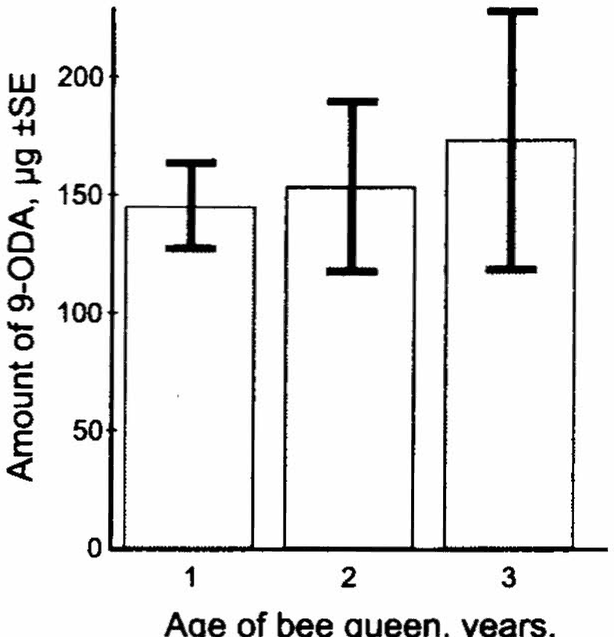
Średnia zawartość kwasu (E)-9-oxo-2-decenowego u różnego wieku matek unasienionych: 1-matki jednoroczne (n=11); 2-matki dwuletnie (n=9); 3-matki trzyletnie (n=6)
The differences between the amounts were not statistically significant (P > 0.05). However, the range of variance of 9-ODA content differs depending on queen’s age.
The range of variation was much less in one-year-old queens (from 84 to 256 µg) than in two-year-old (from 32 to 400 µg) or in three-year-old (from 40 to 380 µg) ones. Also, in one-year-old queens the coefficient of variation of 9-ODA content (V=42,55%) was significantly lower then in two-year-old (V=71.08%) or in three-year-old (V=77.54%) honey bee queens.
Histograms of 9-ODA amounts secreted by honeybee queens of different age (Fig. 2) show that 100 µg of 9-ODA predominates in one-year-old queens, whereas the predominant range is broader in two-year-old queens, reaching from 75 to 225 µg.
No dominant content of 9-ODA was detectable in three-year-old queens.
When summarising the obtained results, the dynamics of 9-ODA content should be accounted for. The content of 9-ODA secreted by older honeybee queens is not lower, however, its variation is much broader. It is manifested in significantly lower or higher 9-ODR levels then the mean value. The factors that predetermine such variations are not clear. The biological aspects of such variations are also very disputable.
strona 10Butler (1957) suggested that the honeybee queens secreting small amount of the pheromone fail to inhibit queen rearing in her own colony. The shortage of queen pheromone is the cause of queen supersedure or swarming. Winston et al. (1998) is of the same opinion. Allen (1965) noted that the proportion of replacements is lower among queens one-year-old than among those two- or three-year-old.
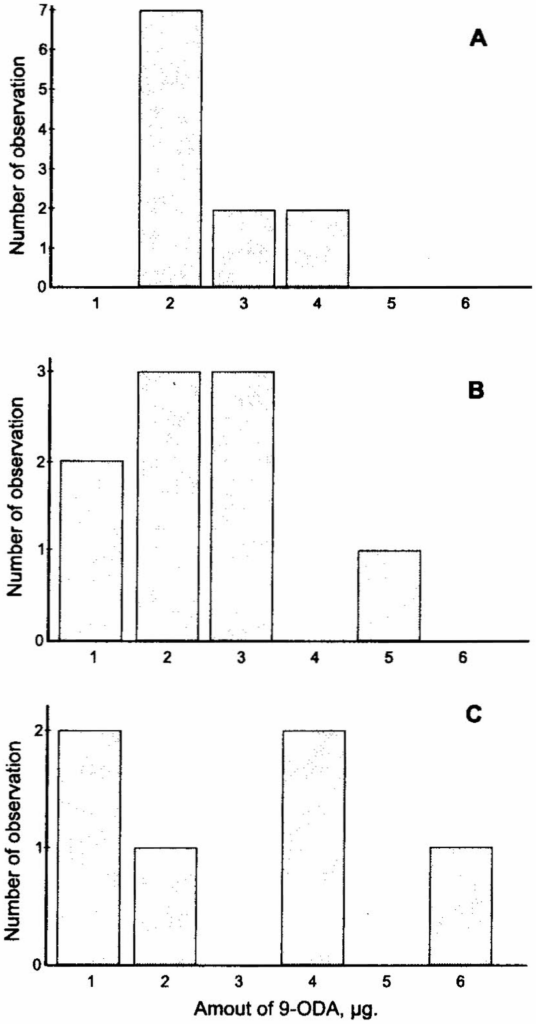
Histogram zawartości 9-ODA wydzielanego przez różnego wieku matki pszczele: a-jednoroczne (n=11); b-dwuletnie (n=9); c-trzyletnie (n=6);1 <75 µg; 2 -75-150 µg; 3 – 150-225 µg; 4 – 225-300 µg; 5 – 300-375 µg; 6 >375 µg
However, larger doses of honeybee queen mandible gland synthetic components ((E)-9-oxo-2-decenoic acid, (E)-9-hydroxy-2-decenoic acid, methyl p-hydroxybenzoate, 4-hydroxy-3-methoxyphenylethanol) produced no effect on pollen foraging (Higo et al., 1992), suppression of queen rearing or swarming (Winston et al., 1990; 1991).
CONCLUSIONS
It was revealed that the amount of (E)-9-oxo-2-decenoic acid (9-ODA) in individuals is highly variable independently of bee queen’s age. The range of variation was much less in one-year-old queens than in two-year-old or in three-year-old ones.
The results of the investigations demonstrated that 100 µg of 9-ODA predominates in one-year-old queens, whereas the predominant range is broader in two-year-old queens, reaching from 75 tob 225 µg. No predominant level was present in 3 year-old queens.
REFERENCES
Allen M.D. (1965)- The production of queen cups and queen cells in relation to the general development of honeybee colonies, and its connection with swarming and supersedure. J. apic. Res. 4: 121-141
Apsegaite V., Skirkevicius A. (1991)- Relationships between the quantity of (E)-9-oxo-2-decenoic acid in the bee queen and biological peculiarities in a bee colony, Apis mellifera L. Pheromones. 1: 121-128.
Apsegaite V., Skirkevicius A. (1995)- Quantitative and qualitative composition of extracts from virgin and mated honey bee queens (Apis mellifera L.). Pheromones. 5: 23-36.
Apsegaite V., Skirkevicius A. (1999)- Content of (E)-9-oxo-2-decenoic acid in pheromones of honeybee (Apis mellifera L.) queens. Pheromones. 6: 27-32.
Butler C.G. (1957)- The process of queen supersedure in colonies of honeybees (Apis mellifera Linn.). Insectes sociaux. 4: 211-223
Butler C.G., Paton P.N. (1962)- Inhibition of queen rearing by queen honeybees (Apis mellifera L.) of different ages. Proc. R. Entomol. Soc., London, Ser. A, 37: 114-116
Crewe R.M. (1982)- Compositional variability: The key to the social signals produced by honeybee mandible glands. In: The Biology of Social Insects, Breed (M.D.), Mitchener (E.D.) et Evans (H.E.), eds, Westview Press, Boulder, Co., 318-322
Engels W., Rozenkranz P., Adler A., Taghizadeh T., Lübke G., Francke W. (1997)- Mandible gland volatiles and their ontogenetic patterns in queen honey bees, Apis mellifera carnica. J. Insect Physiol. Vol. 43: 307-313
strona 12Higo H. A., Colley S.J., Winston M.L., Slessor K.N. (1992)- Effects of honey bee (Apis mellifera L.) queen gland pheromone on foraging and brood rearing. Can. Ent. 124: 409-418
Lakin G. F. (1973)- Biometrija. Moskva. P. 383 (In Russian).
Naumann K., Winston M. L., Slessor K. N., Prestwich G.D., Webster F.X. (1991)- Production and transmission of honey bee queen (Apis mellifera L.) mandibular gland pheromone. Behav. Ecol. sociobiol. 29: 321-332
Pankiw T., Winston M.L., Plettner E., Slessor K.N., Pettis J.S., Taylor O.R. (1996)- Mandible gland components of European and Africanized honey bee queens (Apis mellifera L.). J. Chem. Ecol. 22:605-615
Slessor K.W., Kaminski L.-A., King G.G.S., Winston M.L. (1990)- Semiochemicals of the honey bee queen mandible glands. J. Chem. Ecol. 16: 851-860.
Winston M. L., Higo H. A., Slessor K. N. (1990)- Effect of various dosages of queen mandible gland pheromone and colony congestion in honey bee (Apis mellifera L.) reproductive swarming. J. Insect Behav. 5:649-660
Winston M. L., Higo H. A., Colley S. C., Pankiw T., Slessor K. N. (1991)- The role of queen mandible gland pheromone on the inhibition of queen rearing in honey bee
Winston M. L., Slessor K. N. (1998)- Honey bee primer pheromones and colony organization: gaps in our knowledge. Apidologie 29: 81-95
ZWARTOŚĆ KWASU 9-OXO-2-DECENOWEGO, SKŁADNIKA FEROMONU U UNASIENIONYCH MATEK PSZCZELICH (APIS MAELLIFERA L.) W RÓŻNYM WIEKU
Apsegaite V., Skirkevicius A.
Streszczenie
U jedno, dwu i trzy letnich unasienionych i czerwiących matek pszczelich badano zawartość kwasu (E)-9-oxo-2-decenowego z zastosowaniem chromatografii gazowej. Stwierdzono, że zawartość kwasu u poszczególnych matek jest bardzo zróżnicowana, niezależnie od wieku. Średnia zawartość kwasu w ekstrakcie jednorocznych matek czerwiących wynosiła 144.73±37,38 µg, dwuletnich 153.1±36.28 µg, a trzyletnich 173±54.76 µg. Różnica w zawartości kwasu nie była statystycznie istotna (P > 0.05).
Zmienność w zawartości 9-ODA była różna w różnych grupach wiekowych. Zakres zmienności u matek jednorocznych (od 84 do 256 µg) był znacznie mniejszy niż u matek dwuletnich (od 32 do 400 µg) lub trzyletnich (od 40 do 380 µg). Współczynnik zmienności w tej zawartości wynosił odpowiednio 42,55%, 71,08% i 77,54%.
strona 13Wyniki badań zawartości kwasu wskazują, że wśród matek jednorocznych dominowały z zawartością 100 µg 9-ODA, u dwuletnich najwięcej było w przedziale 75 do 225 µg, a u trzyletnich takiej dominacji nie stwierdzono.
Słowa kluczowe: kwas (E)-9-oxo-2-decenowy, Apis mellifera, substancja mateczna, feromony matki.
Errata — błędy druku znalezione podczas digitalizacji
- s. 7, streszczenie, i s. 11: „75 tob 225″ → 75 to 225
- s. 7, streszczenie: „predominat level” → predominant level
- s. 7: „84,83%%” → 84,83%
- s. 9: „lower then” → lower than
- s. 9: „9-ODR levels then” → 9-ODA levels than
- s. 11, piśmiennictwo: „Mitchener (E.D.)” → Michener (C.D.)
- s. 11, piśmiennictwo: „Rozenkranz” → Rosenkranz
- s. 12, piśmiennictwo: „Slessor K.W.” → Slessor K.N.
- s. 12, tytuł polski: „ZWARTOŚĆ” → ZAWARTOŚĆ
- s. 12, tytuł polski: „MAELLIFERA” → MELLIFERA