

MICHAELOPUS CORTICALIS (MICH.) (ACARI: ACARIDAE), ARBOREAL MITE SPECIES FOUND ALSO IN BEEHIVE DEBRIS – BIOLOGY ON POLLEN PELLETS
tekst: Wit Chmielewski
Pszczelnicze Zeszyty Naukowe, Rok XLIV, Nr 2, 2000 — Wit Chmielewski
strona 115PSZCZELNICZE ZESZYTY NAUKOWE Rok XLIV, Nr 2 2000
Wit Chmielewski
Department of Bee Products, Apiculture Division, Research Institute of Pomology and Floriculture, Kazimierska 2, 24-100 Puławy, Poland
Summary
Living material (adult specimens) of Michaelopus corticalis (Mich.), used as inoculum for laboratory monocultures of the species, were collected from their natural habitats (apple-tree bark, damaged ash inflorescens, beehive debris). Stock cultures and biological experiments were conducted in the laboratory on bee- collected pollen (pollen loads) used as food, under controlled temperature (about +20°C) and RH (near 85%). Some of the more important bionomics obtained under these conditions were as follows (average data): life history – 27.7 days; natural mortality of preimaginal instars – 34.5%; longevity of imagines – 83.9 days; oviposition period of female – 56.6 days; fecundity – 145.8 eggs per female lifetime. These parameters give clear evidence of the attractiveness of pollen for M. corticalis and show that the biological potential of this species is fairly high and they explain its occurrence in bee hives. In this connexion acarids seem to be potential pests of pollen and of other provisions for bees.
Keywords: Acarina, arboreal mites, biology, beehive debris, pollen.
INTRODUCTION
Acarid mites are known to occupy very varied habitats and colonize various substrates. Among them, the corticolous species Michaelopus (= Thyreophagus) corticalis (Mich.) lives under or on the bark of orchard-, park- or forest-trees (e.g. apple-tree – Malus spp., chestnut – Castanea sativa Mill., ash – Fraxinus excelsior L.) (Figs. 1-2) and on the mould growing in the galleries of bark beetles and feeding grounds of other pests or in cankers of trees caused by fungi (Michael 1885, 1901, 1903; Chmielewski, Kozłowski 1978; Fain 1982; Nannelli 1996; Nannelli, Turchetti 1989). These mites have also been observed on stored fruits (apples) and in beehive debris as feeders on the leavings of bee provisions (Chmielewski 1971, 1990, 1992, 1998, 2000). They can feed and develop also on mycelia of fungi and can be expected as vectors of saprophagous and parasitic microorganisms – pathogens of plants (Nannelli et al. 1998) and stored products. Hypopi of M. corticalis (Figs. 3-4) have been found on ants (Kiełczewski, Wiśniewski 1971); they are associated also with bark beetles, social bees and other insects which are their natural carriers.
strona 116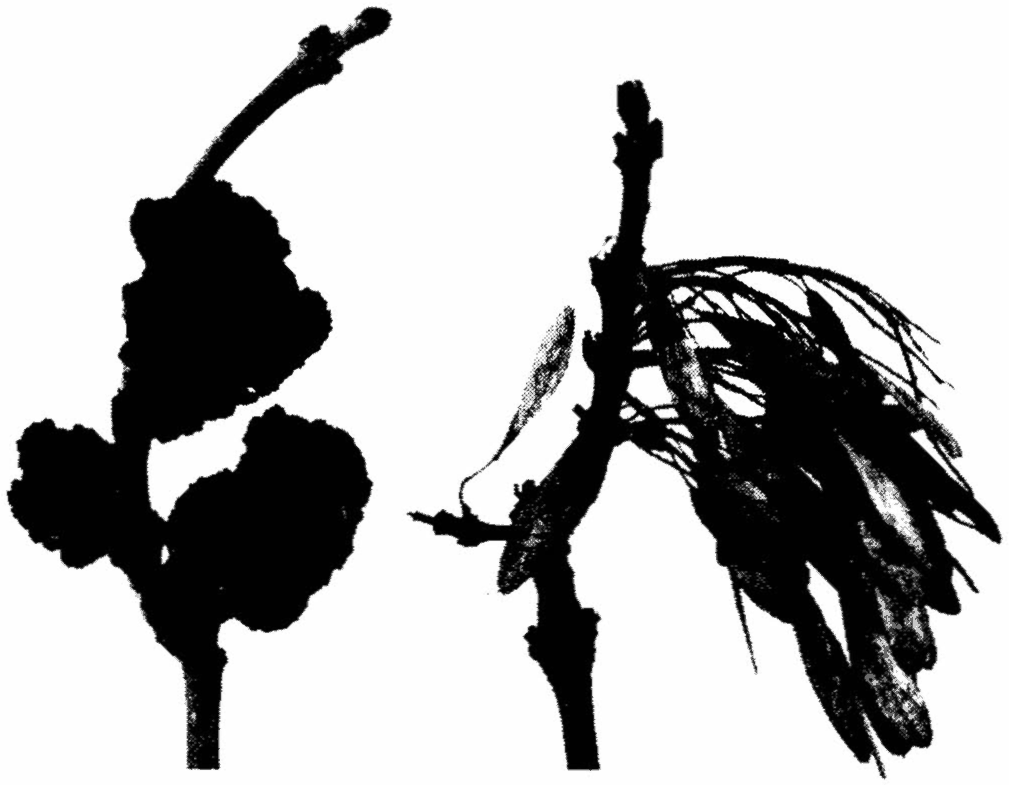
Kwiatostan jesionu wyniosłego (Fraxinus excelsior L.) zniekształcony przez szpeciela jesionowca, Aceria fraxinivora (Nal.) (po lewej) – jedno z naturalnych siedlisk Michaelopus corticalis (Mich.); po prawej, pęd jesionu wolny od roztoczy, z normalnie wykształconymi nasionami (fot. oryg.)
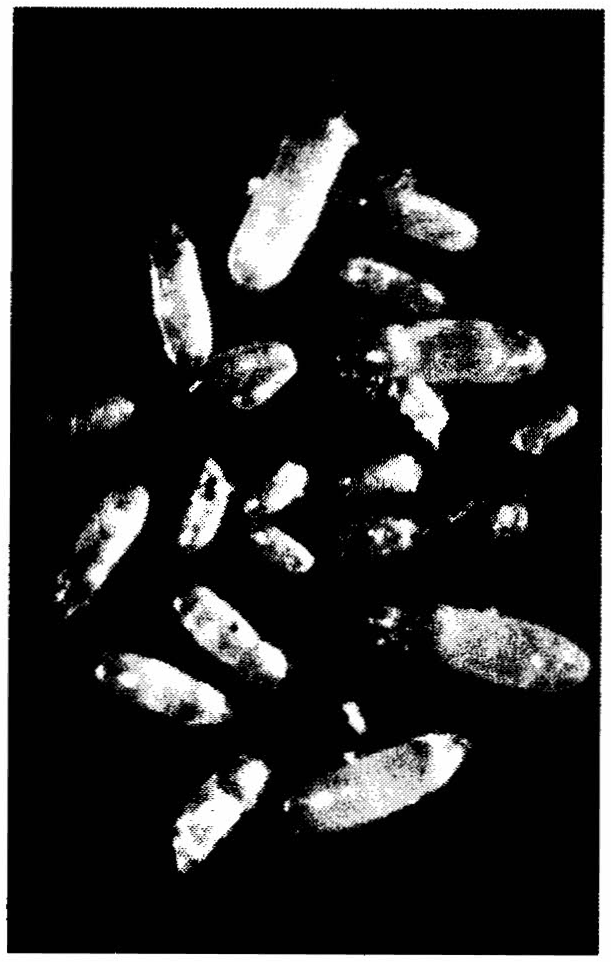
Michaelopus corticalis (Mich.) – rozkruszki z monokultur laboratoryjnych gatunku (różne stadia rozwojowe); mikroskop stereoskopowy (fot. oryg.)
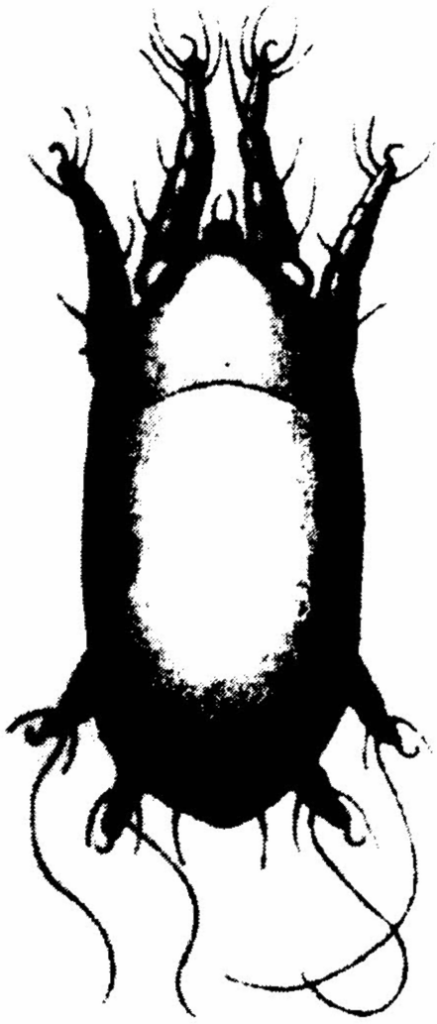
Hypopus Michaelopus corticalis (Mich.) – strona grzbietowa (Michael 1901-3)
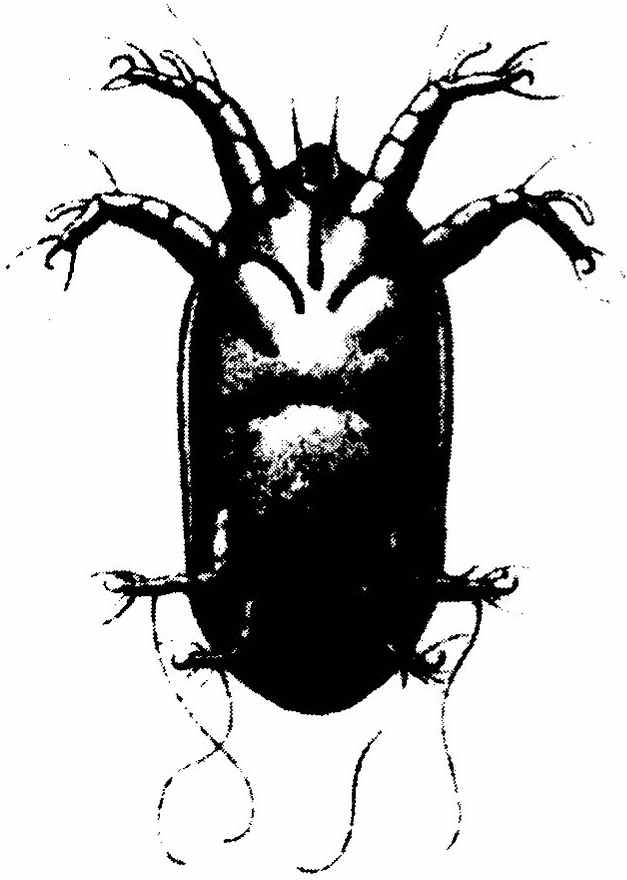
Michaelopus corticalis (Mich.) – hypopus, strona brzuszna (Michael 1901-3)
In the absence of satisfactory biological data regarding this common acarid mite species, the aim of this study was the recognition of its bionomics on bee collected pollen.
strona 118MATERIAL AND METHODS
Living specimens of the species as inoculum for its laboratory monoculture were collected from the bark of apple-trees, from damaged ash inflorescence and from sweepings of beehive debris (Figs. 1-2). Stock cultures and experiments were conducted under laboratory conditions (ca. +20°C, RH – ca. 85%, food – bee-collected pollen). Pollen loads were taken from pollen traps installed in the entrances of the beehives.
Other particulars of the procedure were described in earlier publications on the biology of other acaroid species (Chmielewski 1978, 1994, 1995).
RESULTS AND DISCUSSION
Some bionomics of M. corticalis obtained herein are as follows: Embryonic development – 9.9 (4-18) days; Mortality of eggs – 18.2 (3-39)%; Complete development (without hypopus) – 27.7 (20-43) days; Eclosion of imagines – 65.5 (55-80)%; Frequency of females – 55.3 (54-56)%; Longevity of adults: male – 85.5 (14-159) days, female – 82.2 (14-180) days, Oviposition period – 56.6 (7-123) days; Unfecundity: before oviposition – 4.9 (2-12), during oviposition – 9.3 (0-63), after oviposition – 15.8 (0-86) days; Fecundity: per female lifetime – 145.8 (23-339) eggs, per her lifetime day – 1.7 (0-11), per oviposition day – 2.6 (1-11).
A comparison of this data (on pollen) with the life parameters of the species used in similar studies conducted earlier on bee-bread (Chmielewski 2000) shows that this last one seems to be generally more effective. E.g., the fecundity of acarids fed bee-bread was significantly higher (on average 228.6 eggs per lifespan of female) and they usually lived longer (about 103 days) than the mites fed on pollen loads. Independently of that, it might be concluded that the pollen was also accepted as food and it was very willingly settled by them. In nature (e.g., in bee-nest debris) these mites colonize and feed on both bee-bread and the leavings of bee-collected pollen.
A comparison of the present results of biological research on M. corticalis fed pollen loads with bionomics of other mite species fed on pollen
strona 119(Chmielewski 1978, 1994, 1995) shows that it is well adapted to this kind of food similar to such acaroids as Acarus siro L., Tyrophagus putrescentiae (Schr.) or other stored product mites and associates of bees, which might be a real threat to the food provision for their hosts.
CONCLUSIONS
— The results of these investigations show a fairly high biological potential of M. corticalis fed on pollen and might be helpful in explaining the occurrence of this mite in bee nests and its association with the hosts as relation of commensalic type. — The pollen loads seem to be an attractive and friendly natural nourishment for this species. — This product can be recommended as an effective medium for rearing of M. corticalis under laboratory conditions. — The observations of the occurrence of these acarids in mouldy hive debris and on mycelia of fungi developing under the bark of trees suggests the need for further research on their importance in the spread of saprofagous and pathogenic microorganisms.
REFERENCES
Chmielewski W. (1971)- Badania nad składem gatunkowym roztoczy w zasiedlonych ulach pszczelich i w przechowalniach miodu. Pszczeln. Zesz. Nauk., 15(1-2):69-80.
Chmielewski W. (1978)- Płodność i rozwój niektórych gatunków roztoczy na pyłku. *Pszczeln. Zesz. Nauk.,*22:173-180.
Chmielewski W. (1990)- Roztocze (Acarina) zasiedlające jabłka w przechowalni owoców. Zesz.Probl.Post.Nauk Roln.,373:77- 85.
Chmielewski W. (1992)- Skład gatunkowy i liczebność akarofauny w osypie naturalnym zimujących rodzin pszczelich. *Pszczeln. Zesz. Nauk.,*36:74-90.
Chmielewski W. (1994)- Składanie jaj i rozwój rozkruszków na pyłku zbieranym przez pszczoły. Pszczeln. Zesz. Nauk. 38:131-142.
Chmielewski W. (1995)- Pollen loads as food of stored product mites (Acaroidea). *Pszczeln. Zesz. Nauk.,*39(1): 169-176.
Chmielewski W. (1998)- Mites (Acarina) collected from stored apples. J.Fruit Ornam.Plant Res., 6(1): 33-40.
Chmielewski W. (2000)- Parametry biologiczne Michaelopus corticalis (Michael) (Acari: Acaridae) – nadrzewnego rozkruszka spotykanego w sadach. Ogólnopolska Naukowa Konferencja Ochrony Roślin Sadowniczych, Skierniewice, 15-16 lutego, 2000: 240-243.
Chmielewski W., Kozłowski J. (1978)- Zimowanie roztoczy w sadach. *Ochr.Rośl.,*22,2:8-9.
strona 120Fain A. (1982)- Revision des genres Thyreophagus Rondani, 1874 et Michaelopus Fain et Johnston, 1974 (Acari, Acaridae) avec description de neuf especes nouvelles. Bull. Inst. Roy. Nat.Belgique Entomol., 54(7):1-47.
Kiełczewski B., Wiśniewski J. (1971)- Fauna roztoczy na mrówkach w Nadleśnictwie Doświadczalnym Zielonka. PTPN, Prace Kom. Nauk. Roln. i Leśnych,32:51-55.
Michael A. D. (1885)- Notes on the life-histories of some little-known Tyroglyphidae. J.Roy Microscop.Soc., Ser.II, 5: 27-31.
Michael A. D. (1901, 1903)- British Tyroglyphidae I, II. Ray Society, London, pp.52, 66.
Nannelli R. (1996)- Biological observations on Michaelopus corticalis (Mich.) and Histiogaster carpio (Kramer) (Acaridae) associated with chestnut blight fungus. Acarology IX Vol. 1 Proceedings, Section 1: Behaviour and Physiological Ecology. R. Mitchell, D. J. Horn, G. R. Needham, W. C. Welbourn (Eds), The Ohio Biological Survey Columbus, Ohio:67-69.
Nannelli R., Turchetti T. (1989)- Osservacioni preliminari sull’associazione dialcune speci di Acari corticoli con Cryptonectria parasitica (Murr.) Barr. *Redia,*72(2):581-593.
Nannelli R., Turchetti T., Maresi G. (1998)- Corticolous mites (Acari) as potential vectors of Cryphonectria parasitica (Murril) Barr hypovirulent strains. Internat. J. Acarol., 24(3): 237-244.
MICHAELOPUS CORTICALIS (MICH.) (ACARI: ACARIDAE), NADRZEWNY GATUNEK ROZTOCZY SPOTYKANY TAKŻE W OSYPIE Z ULI PSZCZELICH – BIOLOGIA NA OBNÓŻACH PYŁKOWYCH
Chmielewski W.
Streszczenie
Michaelopus corticalis (Mich.) jest nadrzewnym rozkruszkiem znanym ze swego występowania pod korą drzew owocowych, parkowych i leśnych (Malus spp., Castanea sativa Mill., Fraxinus excelsior L.). Spotykano go pod tarczkami niektórych czerwców i w zrakowaceniach drzew. Żeruje i rozwija się często na grzybni w chodnikach korników (Scolytus mali Bechst) i w żerowiskach innych szkodników jabłoni, a także na jabłkach w przechowalniach owoców. W ulach pszczelich kolonizuje osyp naturalny gromadzący się na dennicach w czasie zimowania pszczół.
Wobec braku informacji na temat powiązań M. corticalis z pszczołami i niedostatecznej znajomości biologii tego powszechnie występującego gatunku, celem obecnych badań było poszerzenie wiedzy z tego zakresu.
Jako inokulum do założenia monokultur laboratoryjnych rozkruszków posłużyły żywe osobniki dorosłe wyizolowane z osypu naturalnego zimujących rodzin pszczelich, z próbek kory jabłoni i z uszkodzonych przez szpeciele kwiatostanów jesionu. Hodowle i
strona 121doświadczenia biologiczne prowadzono w kontrolowanych warunkach laboratoryjnych (temperatura – ok. +20°C, wilgotność względna powietrza – ok. 85%), na pyłku kwiatowym zbieranym przez pszczoły (obnóża pyłkowe pozyskiwane za pomocą poławiaczy) jako pokarmie, według procedury stosowanej w podobnych doświadczeniach z innymi gatunkami roztoczy (Chmielewski 1978, 1994, 1995).
Ważniejsze parametry biologiczne rozkruszka przedstawiają się następująco (wartości średnie): rozwój embrionalny – 9.9 dni, całkowity cykl rozwojowy (bez stadium hypopus) – 27.7 dni, wylęg imagines – 65.5%, frekwencja samic – 55.3%, długość życia osobników dorosłych – 83.9 dni, okres składania jaj – 56.6 dni, płodność – 145.8 jaj w ciągu całego życia samicy.
Dane te świadczą o stosunkowo dużym potencjale biologicznym M. corticalis i o atrakcyjności pyłku jako jego pokarmu. Resztki pyłku w osypie gromadzącym się na dennicach uli, wraz z rozwijającymi się na nim grzybami pleśniowymi, stanowią przynętę dla saprofagicznych roztoczy, co jest jedną z przyczyn ich występowania w tym siedlisku. Relacje między rozkruszkami a gospodarzami można określić jako powiązania typu komensalizmu.
Uzyskane wyniki dowodzą, że w warunkach sprzyjających rozwojowi rozkruszków w ulach, roztocze te mogą stanowić zagrożenie dla zapasów pokarmu pszczół w plastrach; są one także potencjalnymi szkodnikami pyłku przechowywanego w magazynach.
Pyłek można zalecać jako skuteczną pożywkę w hodowli M. corticalis w warunkach laboratoryjnych.
Słowa kluczowe: Acarina, roztocze nadrzewne, biologia, osyp ulowy, pyłek.
Errata — błędy druku znalezione podczas digitalizacji
- s. 115, summary: „inflorescens” → inflorescence
- s. 119: „saprofagous” → saprophagous
- s. 120, piśmiennictwo: „Osservacioni” → Osservazioni
- s. 120, piśmiennictwo: „dialcune” → di alcune
- s. 120, piśmiennictwo: „Cryptonectria” → Cryphonectria
- s. 120, piśmiennictwo: „Murril” → Murrill