

INFLUENCE OF ALAR-85 ON FLOWER BIOLOGY, POLLINATION AND SEED SETTING IN RED CLOVER
tekst: T. Hulewicz, J. Wioncek
Pszczelnicze Zeszyty Naukowe, Rok XXI, 1977 — T. Hulewicz, B. Dyś, J. Wioncek
strona 197BEE RESEARCH COPIES V.XXI DECEMBER 1977
T. Hulewicz, B. Dyś and J. Wioncek
Academy of Agriculture at Lublin — Plant Breeding Station, Ulhówek, Poland
Since the seed yields in di- and especially in poliploid red clover are in our country very low, it was of importance to investigate the effects of some growth substances on the fertility of this species. The experiments were carried out in green house and in the field in 3 locations: the Experimental Station of Agricultural University of Lublin (at Felin) and in two Plant Breeding Stations: Ulhówek and Poturzyn, on the South East of Poland.
The weather conditions during the years 1972 and 1973 were suitable for the production of seeds, whereas the year 1974 was very disatventageous, because of everlasting rainfalls and high humidity, what prevented a good pollination and ripening of seeds: the plants which grew very vigorously in May and June logged intensively in July, what impaired seriously the visitation of insects and the seed yields.
A lot of different growth substances was applied as sprays (2,4,5-T, 2,4,5-TP, TIBA, IAA and CCC — Hulewicz and Hortyński 1970), but non of them proved to have such good stimulating effect on generative development and fertility of red clover than Alar-85 (N-dimethyl-amino-succinamic acid produced by the firm Uniroyal and containing 85% of active substance).
The influence of B-995 (or Alar-85) on red clover was previously studied by Valle and Berget (1966), Skride (1966) and then by Picard and Sigwalt (1967). Very extensive investigations were performed by TimoMela (1969) on late flowering varieties. All
strona 198results of these authors showed a beneficial effect of this substance in increasing the seed yields and influencing positively its elements.
In our experiments two dates of treatment were applied: the spraying in the rosette stage and during the first bloom, the solution being 1 and 2%, and in one experiment additionally 3 and 5%. The amount of Alar-85 on 1 ha was respectively 6, 12, 18 and 30 kg.
The early treatment proved to be deletorious to the plants which were seriously damaged by Alar-85 (more by higher doses), whereas the second date of spraying stimulated the generative development of plants, their fertility and resistance to lodding. This resulted in an increased seed yields (from 17 to 80% or more), the difference being dependent from weather conditions.
The analysis of morphological characters influencing the seed productivity revealed, that the treated plants were shorter, produced more side branches and more flower heads (Table 1). Therefore their type of growth was after tha treatment quite different as that of the control plants (Fig 1 and 2).
The number of flower heads was the most decisive element of seed yield, especially in diploid red clover. The analysis of the flower heads per one stem revealed, that the number of fertile flower heads increased after Alar-85 treatment, whereas of sterile ones decreased (Table 2). Since the vigour of plants, their forge yield and in some years the number of stemsp er one meter of row decreased significantly, the density of the treated plots was correspondingly lower. This caused a better
Table 1 The effect of different dates of treatment and different Alar-85 solutions on tetraploid red clover. Exp. Sta. Felin 1972
| Treatment | Height of plants in cm | Fresh matter yield kg/plot | Number of fl. heads on 1 m | Seed setting | 1000 seed weight | Seed yield in kg/ha | Seed yield in % of control |
|---|---|---|---|---|---|---|---|
| Controls | 68,1 | 1,81 | 205 | 38,2 | 2,83 | 218 | 100 |
| 1st date of spraying | |||||||
| 1% Alar-85 solution | 52,2 | 1,36 | 223 | 36,7 | 2,65 | 124 | 56,9 |
| 2% Alar-85 solution | 46,9 | 0,91 | 179 | 34,1 | 2,42 | 121 | 50,9 |
| 2nd date of spraying | |||||||
| 1% Alar-85 solution | 60,6 | 0,75 | 229 | 47,9 | 2,35 | 279 | 127,0 |
| 2% Alar-85 solution | 62,3 | 1,07 | 241 | 51,5 | 2,42 | 404 | 185,3 |
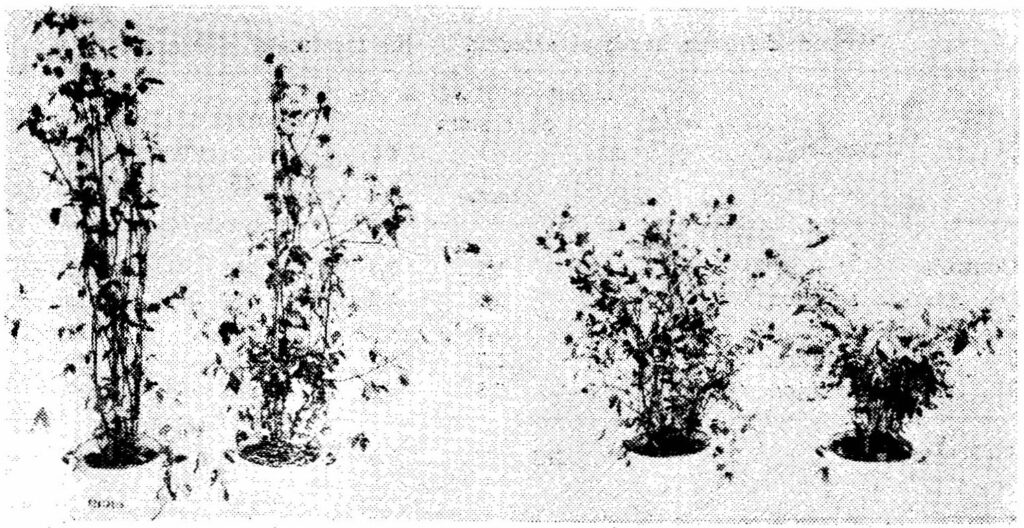
Fig. 1. Influence of Alar-85 on diploid red clover. From the left to right: control, 1%, 2%, 3% — solutions
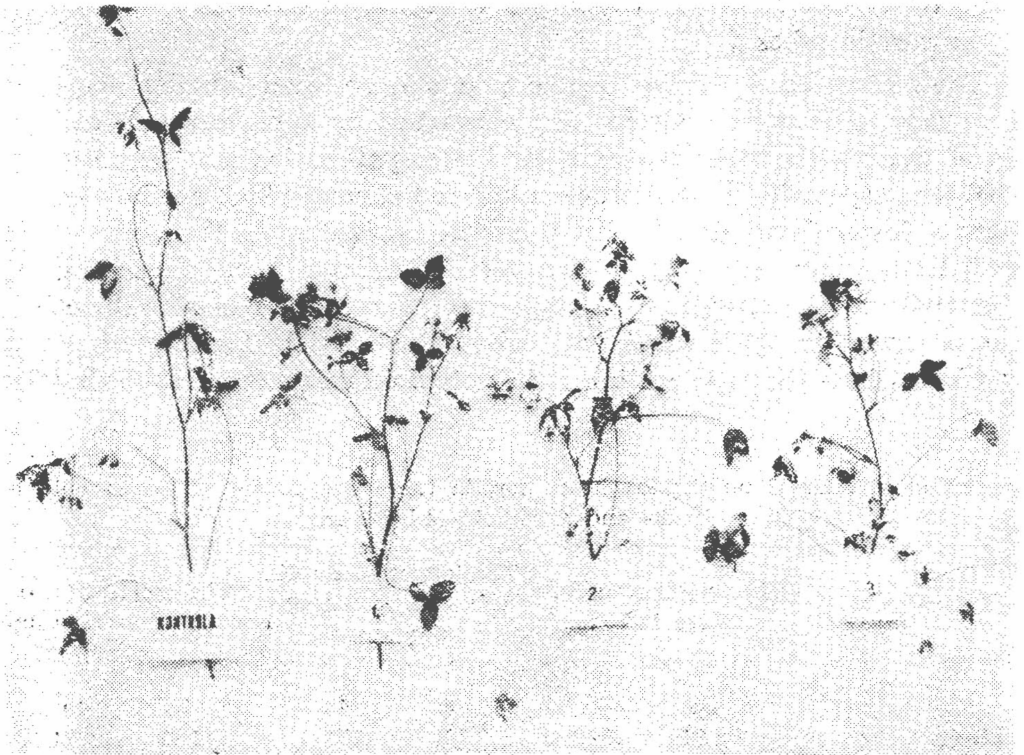
Fig. 2. Influence of Alar-85 on stem development in diploid red clover From the left to right: control, 1%, 2%, 3% — solutions
insolation of crop, a higher accessibility of lower situated flower heads for pollinators and a better ripening of seeds.
At the same time Alar-85 reduced the lenght of corolla tubes, what was of special importance for tetraploid red clover, the greatest dif-
strona 200Table 2 Number of flower heads as affected by the treatment of Alar-85
| Treatment | Number of flower heads on 1 stem: 2n fertile | Number of flower heads on 1 stem: 2n sterile | Number of flower heads on 1 stem: 4n | Number of flower heads on 1 m: 2n | Number of flower heads on 1 m: 4n |
|---|---|---|---|---|---|
| Controls | 6,2 | 2,3 | 1,4 | 241 | 57 |
| 1% Alar-85 solution | 6,2 | 2,0 | 3,1 | 332 | 75 |
| 2% Alar-85 solution | 8,3 | 1,7 | 4,1 | 395 | 111 |
| 3% Alar-85 solution | 6,7 | 1,7 | 3,8 | 419 | 126 |
| 5% Alar-85 solution | 3,3 | 3,3 | 6,4 | 255 | 157 |
| 2Sd × t0,05 | NS | 1,5 | 76 | 37 |
ference amounted by using 3% solution 2,3 mm in diploids and 2,90 mm in polyploids (24,2 and 27,7% respectively, Table 3). The higher was the Alar-85 concentration, the larger were the differences in the lenght of the corolla tubes.
The flower heads of the treated plants were much smaller and they were easy to recognize due to their characteristic appearence. The changes of the corolla tubes caused a far better pollination and seed setting, what was especially visible in tetraploid red clover, which on the average show a lower level of fertility than the diploid one. The increase of seed setting amounted 15—43%, the differences were depending on year and weather conditions. In diploid red clover the rise of seed setting was observed in these cases only when the average fertility of plants was low. Since the seed setting is in polyploid red more responsible for
Table 3 The effect of Alar-85 on the lenght of corolla tubes and height of nectar column in di- and tetraploid red clover.
| Treatment | The lenght of corolla tubes in mm: 2n | The lenght of corolla tubes in mm: 4n | The lenght of corolla tubes in percentage of controls: 2n | The lenght of corolla tubes in percentage of controls: 4n | The height of the nectar column in mm: 2n | The height of the nectar column in mm: 4n |
|---|---|---|---|---|---|---|
| Controls | 9,74 | 10,46 | 100 | 100 | 1,42 | 1,73 |
| 1% Alar-85 solution | 8,01 | 8,93 | 82,2 | 85,3 | 1,38 | 1,76 |
| 2% Alar-85 solution | 7,61 | 8,12 | 78,1 | 77,6 | 1,52 | 1,93 |
| 3% Alar-85 solution | 7,38 | 7,56 | 75,8 | 72,3 | 1,41 | 1,75 |
| Sd × t0,05 | 0,54 | 0,30 |
the seed production than in diploids, the increase of this character is of great importance.
In the field experiments Alar-85 promoted in some cases the generative development of red clover, what caused a faster and more regular ripening period. To investigate nearer the phenological phases of treated plants a greenhouse experiment was conducted in 1975 with 3 concentrations of Alar-85 (1, 2 and 3%). Alar-85 promoted the beginning of flowering of about 5 days, but in diploids only. The end of flowering and the beginning of ripening was 2—3 days earlier than in the control plants.
The rate of flowering was evaluated every 2 days from the beginning of this phase and the ripening period every 3—4 days. The number of flowering and ripening inflorescences was calculated in percentage of the whole number of flower heads in every combination and then presented on diagrams. (Fig 3 and 4). The earliest and more regular flowering showed the diploid red clover as affected with 1% Alar-85 solution, then followed the combination treated with 2% concentration and finally the control plants. The plants sprayed with 3% concentration showed a delayed flowering rate.
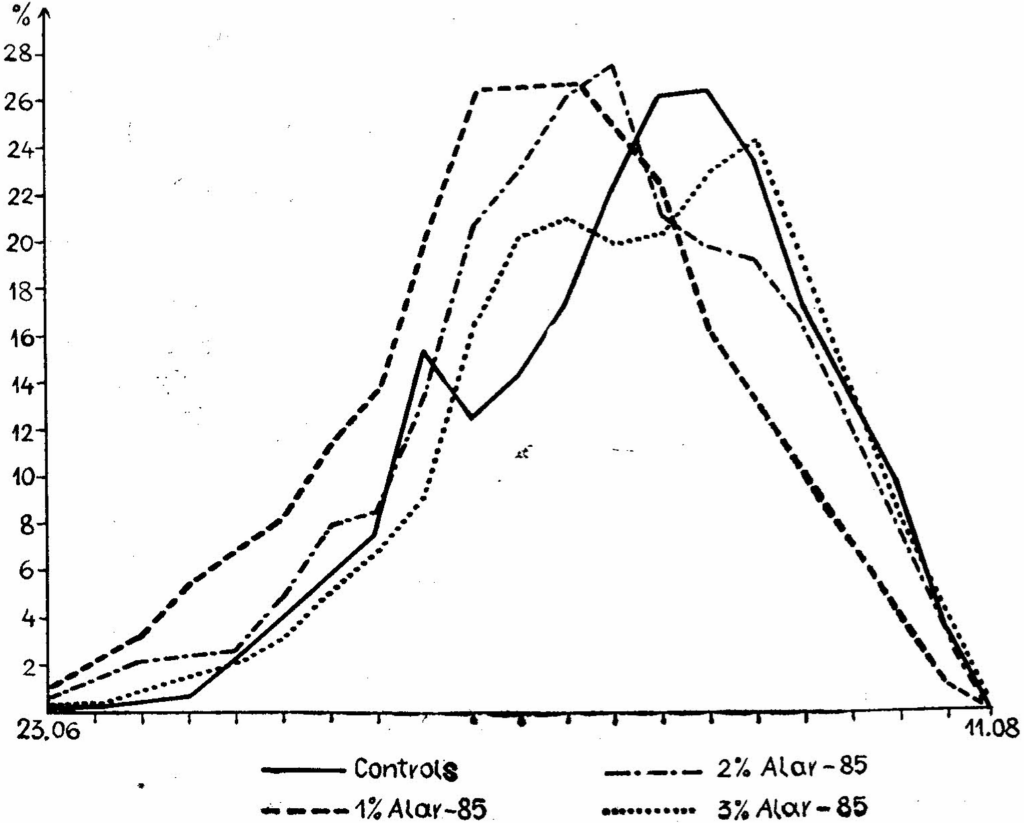
Fig. 3 The rate of flowering in diploid red clover
strona 202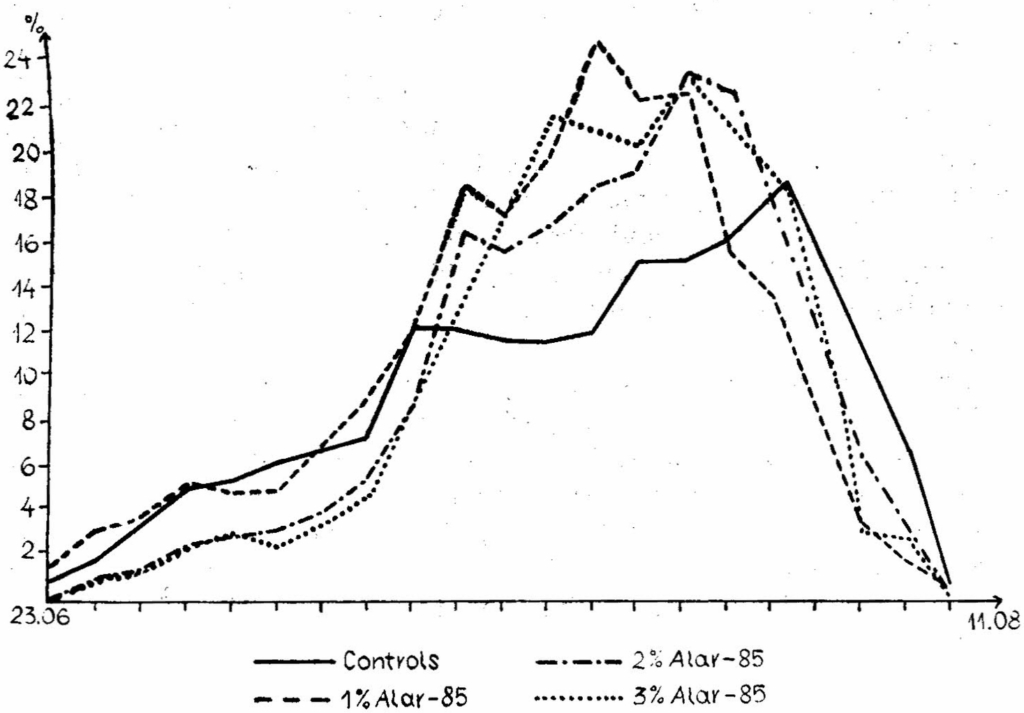
Fig. 4 The rate of flowering in tetraploid red clover
The flowering of tetraploids (Fig 4) treated with Alar-85 was more regular as those of the controls, whose diagram was streched and showed two peaks. The most preacox flowering was observed in plants treated with 1% Alar-85 solution and on the contrary two stronger doses retarded somewhat the beginning of flowering, but at the end of this process the rate of flowering was similar in all treated combinations.
Comparing the reaction of di- and polyploid red clover to the treatment with Alar-85 one can state that the effect of this growth substance is more pronounced in polyploids. The same was previously stated by Picard and Sigwalt. The influence of Alar-85 is also in an great extend dependent on weather conditions. In the years unsuitable fer seed production, when logging of plants takes place, the effect of Alar-85 is stronger than by good weather conditions. In the year 1974, when the seed yields of red clover were extremely low, their increase amounted in diploids 80% and in polyploids as much as 232% (Table 4).
The seeds of treated plants are of good quality and the percentage of inferior seeds does not exceed that of the controls. The 1000 seed weight is lower, however their capacity to germination is quite satisfactory (Hulewicz, Wioncek and Dyś 1975). No posteffect was noticed in the second generation obtained from seds of treated plants and this as well on forage yields as on seed productivity.
Taking in account a suitable effect of Alar-85 on flower biology
strona 203Table 4 The effect of Alar-85 on the seed yield of di- and tetraploid red clover (late phase of treatment)
| Location and year / Treatment | Felin 1972: kg/ha | Felin 1972: in % of control | Felin 1973: kg/ha | Felin 1973: in % of control | Felin 1973: kg/ha | Felin 1973: in % of control | Ulhówek 1974: kg/ha | Ulhówek 1974: in % of control |
|---|---|---|---|---|---|---|---|---|
| 4n red clover | ||||||||
| Control | 217 | 100 | 334 | 100 | 236 | 100 | 28 | 100 |
| 1% Alar-85 | 278 | 128,1 | 425 | 127,2 | — | — | 45 | 160,7 |
| 1,5% Alar-85 | — | — | — | — | 310 | 135,6 | — | — |
| 2% Alar-85 | 404 | 186,2 | 435 | 130,2 | — | — | 85 | 303,6 |
| 3% Alar-85 | — | — | — | — | — | — | 93 | 332,1 |
| 5% Alar-85 | — | — | — | — | — | — | 64 | 228,6 |
| Poturzyn — 2n red clover | ||||||||
| Control | 506 | 100 | 152 | 100 | — | — | 79 | 100 |
| 0,5% Alar-85 | — | — | 196 | 128,9 | — | — | — | — |
| 1% Alar-85 | 584 | 115,4 | 284 | 186,8 | — | — | 98[?] | 117,7 |
| 2% Alar-85 | 593 | 117,2 | — | — | — | — | 109 | 138,0 |
| 3% Alar-85 | — | — | — | — | — | — | 142 | 179,8 |
| 5% Alar-85 | — | — | — | — | — | — | 136 | 172,1 |
of red clover, the development of the elements of seed yield and the increase of seed productivity, as well the rise of logging resistance, the treatment with Alar-85 may be recommended in Plant Breesing Stations and especially by the reproduction of polyploid red clover.
LITERATURE
Hulewicz T. and J. Hortyński 1970: Wpływ niektórych regulatorów wzrostu na plon nasion i jego strukturę u poliploidalnej koniczyny czerwonej.
I. Wpływ CCC na rozwój i plon nasion. Biuletyn IHAR Nr 3/4, 63—70.
II. Wpływ TIBA, 2,4,5,-T, 2,4,5-TP, IAA i DMSO na rozwój i plon nasion. Biuletyn IHAR Nr 3/4, 71—78.
Hulewicz T. and Hortyński J. 1970: Die Wirkung von B-995 (N-Dimethyl-monoamid der Bernstainsäure und DMSO (Dimethylsulfoxyd) auf den Samenertrag des polyploiden Rotklees. Zeit. Acker- u. Pflanzenbau, 132, 2—15.
Hulewicz T., J. Wioncek and B. Dyś 1975: The germination of red clover seeds as affected by different growth substances. Seed. Sci. Technol. 3, 581—586.
MelaTimo 1969: The effects of N-dimethylamino-succinamic acid (B-995) on the seed cultivation characteristics of late flowering red clover. Acta Agralia Fennica 115, 1—114.
Picard J., and Sigwalt C. 1967: Action de substances ralentissent la croissance sur la production de semances de trèfle violet. Resultats préliminaires
strona 204Acad. d’Agriculture de France. Extrait du proces verbal de la Séance du Janvir 141—148.
Skirde W. 1966: Reaktion von Gräserarten und Sorten von Klee auf hemmend wirkende Wachstumsregulatoren. Zeit. Acker- u. Pflanzenbau 119, 263—282.
Valle O. and Bergt K. 1966: Sten shortening experiments on red clover with growth regulators. Acta Agralia Fennica 104, 1—20.
WPŁYW ALARU-85 NA BIOLOGIĘ KWITNIENIA, ZAPYLANIA I OSADZANIA NASION U KONICZYNY CZERWONEJ.
T. Hulewicz, B. Dyś J. Wioncek; Lublin, Polska
Streszczenie
Badania nad wpływem Alaru-85 (kwasu N-dwumetylo-amino-bursztynowego) prowadzone były w okresie od 1968—1975 r.. w doświadczeniach wazonowych i polowych, w trzech miejscowościach Alar-85 stosowano w postaci oprysków 1, 2, 3, 5% roztworem w fazie rozety i bezpośrednio przed kwitnieniem. Najkorzystniejsze efekty uzyskano przy opryskach w drugim terminie i przy wyższych stężeniach roztworów. Alar-85 wpływał na skrócenie pędów, bardziej regularne kwitnienie, wcześniejsze dojrzewanie, znaczne zwiększenie liczby główek na pędzie oraz na jednostce powierzchni. Rurki kwiatowe u opryskiwanych roślin były do 2,90 mm krótsze, co powodowało lepsze zapylanie i osadzanie nasion. Poziom nektaru w kwiatach był podobny jak u roślin kontrolnych. Plon nasion pod wpływem Alaru-85 zwiększał się w zależności od roku od 17 do 80% i więcej, koniczyna poliploidalna reagowała przy tym większą zwyżką plonu niż diploidalna. Nasiona z traktowanych roślin były dobrej jakości i wykazywały taką samą siłę kiełkowania jak z roślin nieopryskiwanych. Nie stwierdzono niekorzystnego wpływu Alaru-85 na plon zielonki i nasion w potomstwie.
Errata — błędy druku znalezione podczas digitalizacji
- s. 197: „poliploid red clover” → polyploid red clover
- s. 197: „disatventageous” → disadvantageous
- s. 197: „logged intensively” → lodged intensively
- s. 197: „non of them” → none of them
- s. 197: „Skride” → Skirde
- s. 198: „deletorious” → deleterious
- s. 198: „lodding” → lodging
- s. 198: „tha treatment” → the treatment
- s. 198: „forge yield” → forage yield
- s. 198: „stemsp er” → stems per
- s. 199, 200: „the lenght” → the length
- s. 200: „appearence” → appearance
- s. 200, tab. 3: „The lenght” → The length
- s. 202: „streched” → stretched
- s. 202: „preacox” → praecox
- s. 202: „in an great extend” → in a great extent
- s. 202: „fer seed production” → for seed production
- s. 202: „logging of plants” → lodging of plants
- s. 202: „seds of treated” → seeds of treated
- s. 203: „logging resistance” → lodging resistance
- s. 203: „Breesing” → Breeding
- s. 203, piśmiennictwo: „2,4,5,-T” → 2,4,5-T
- s. 203, piśmiennictwo: „Bernstainsäure” → Bernsteinsäure
- s. 203, piśmiennictwo: „ralentissent” → ralentissant
- s. 203, piśmiennictwo: „semances” → semences
- s. 204, piśmiennictwo: „Janvir” → Janvier
- s. 204, piśmiennictwo: „Sten shortening” → Stem shortening