

THE EFFICACY OF APIFOS – A NEW VARROA KILLING FORMULA
tekst: Zofia Konopacka, Małgorzata Bieńkowska, Dariusz Gerula
Pszczelnicze Zeszyty Naukowe, Rok XLIV, Nr 2, 2000 — Konopacka Zofia, Bieńkowska Małgorzata, Gerula Dariusz
strona 209PSZCZELNICZE ZESZYTY NAUKOWE Rok XLIV, Nr 2 2000
Konopacka Zofia, Bieńkowska Małgorzata, Gerula Dariusz
Research Institute of Pomology and Floriculture, Apiculture Division 24-100 Puławy, ul. Kazimierska 2, Poland
Summary
The experimental formulas which contained from 10 to 20% of bromphenvinphos in the surface layer had an average efficacy of 55,3%. The remaining versions containing from 20 to 60 mg of bromphenvinphos with 30 to 60% of a.i. in the surface layer had a very high average efficacy regardless of site, method or year of testing.
In 1999 the efficacy of Apifos (Biowet, Puławy) from serialized, market-oriented production averaged 99,9% in an apiary in which the same formula was applied in the previous year. Apifos turned out to be a fast-acting agent. As soon as 3 weeks from Varroa mite- killing efficacy of several series of bromphenvinphos-containing formulas supplied by the Institute of Organic Chemistry in Warsaw as part of the Apifos testing program was investigated at the Apiculture Division in the years 1994-1999. The formulas had a presentation of polyethylene strips 220x 45x 1 mm coated with a liquid composition of the active substance, vinyl polychloride and ethyl acetate. One strip contained, depending on technological version, from 20 to 60 miligram of active substance and from 10 to 60% bromphenvinphos in the surface micro-layer. Two strips were applied to one bee colony. The study was conducted in the apiaries of the Apiculture Division in Puławy and its vicinity and in apiaries run by several Agricultural Advisory Services Centres and by private beekeepers in different regions of Poland.
Two testing methods were applied:
Method I consisted in making counts of dead Varroa jacobsoni females found on the bottom boards following the introduction of the tested formulas to the colonies and of those which remained alive after six weeks of exposure to the formulas. The number of the latter was determined by three fumigations of the colonies with an amitraz-containing preparation.
Method II consisted in the assessment of colony infestation based on bees sampled before formula application and upon its removal. The method (field efficacy) was used in the remaining apiaries.
Introducing the strips to colonies an average of 91.6 to 98.3% of mites present in the colonies were dead, the efficacy reaching nearly 100% after 6 weeks.
The bees tore off the surface layer very quickly both from the 1999 commercial Apifos strips and from the earlier investigated trial versions, which, however, did not affect their Varroa-killing efficacy.
Keywords: Varroa jacobsoni, Apifos, bromphenvinphos, Varroa killing efficacy.
strona 210INTRODUCTION
After the first news about the resistance of Varroa jacobsoni mite to fluvalinate in Italy (Colombo et al. 1993) and also to other acaricidal synthetic pyrethroids due to cross-resistance (Milani 1995) it occurred necessary to find another formula to overcome the mites resistant to pyrethroids (Cieslak et al.-1995).
MATERIALS AND METHODS
Varroa mite- killing efficacy of several series of bromphenvinphos- -containing formulas supplied by the Institute of Organic Chemistry in Warsaw as part of the Apifos testing program was investigated at the Apiculture Division in the years 1994-1999. The formulas had a presentation of poliethylene strips 220x 45×1 mm coated with a liquid composition of the active substance, vinyl polychloride and ethyl acetate. After evaporation of the solvent a microlayer 7 – 9 microns thick remained on the surface of the strip.
One strip contained, depending on technological version, from 20 to 60 miligram of active substance and from 10 to 60% bromphenvinphos in the surface micro-layer. Two strips were applied to one bee colony.
The study was conducted in the apiaries of the Apiculture Division in Puławy and its vicinity and in apiaries run by several Agricultural Advisory Services Centres and by private beekeepers in different regions of Poland (Fig.1). The trials included a total of 307 bee colonies.
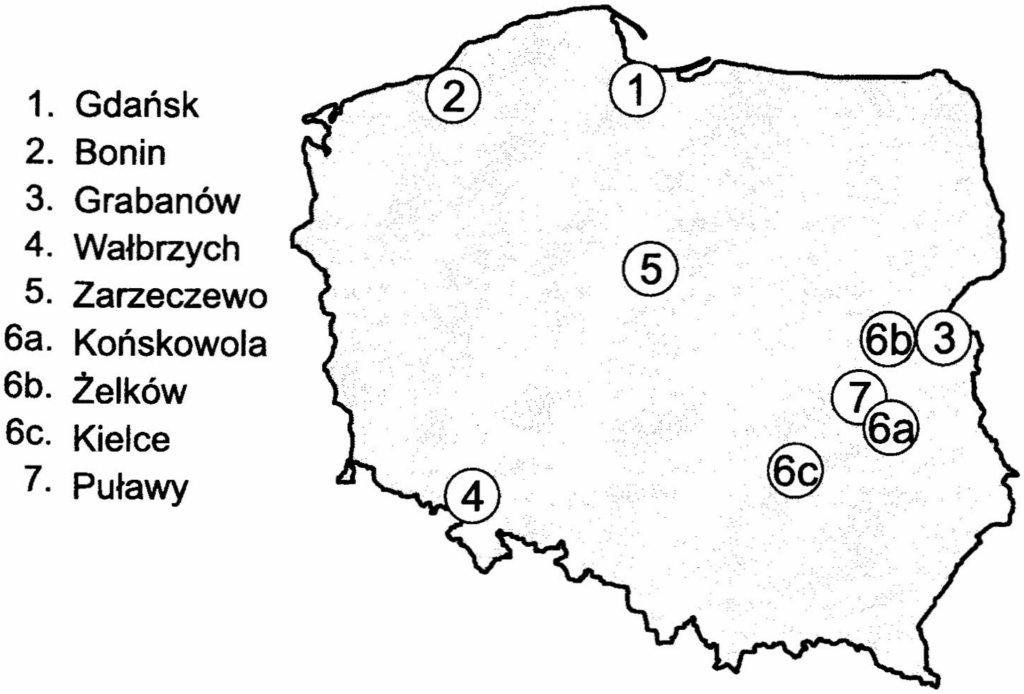
Two testing methods were applied:
Method I – consisted in making counts of Varroa jacobsoni females found on the bottom boards: a) those which were dead following the introduction of the tested formulas to the colonies and b) those which remained alive after six weeks of exposure to the formulas. The number of the latter was determined by three fumigations of the colonies with an amitraz-containing preparation. This method was used in Apiculture Division apiaries.
Method II – consisted in the assessment of colony infestation based on bees sampled before formula application and upon its removal. The method (field efficacy) was used in the remaining apiaries. The bees were sampled by the beekeepers and mailed to the Apiculture Division in Puławy, where the invasion level was estimated using the shaking method (De Jong 1982). Exceptionally low efficacy was found in the apiary in Wałbrzych where the whole analysis was done by the staff of the Advisory Services.
RESULTS
Results obtained in the apiaries of Apiculture Division in Puławy have shown that the experimental formulas had different efficacy (Table 1) which was more dependent on the concentration of the a.i. in the surface layer than on the total amount of bromfenvinphos per strip. The formulas which contained from 10 to 20% of bromfenvinphos in the surface layer had an average efficacy of 55,3%. (Table 2.) The remaining versions containing from 20 to 60 mg of a.i. per strip with concentration 30 to 60% of a.i. in the surface layer had very high efficacy.
Similar good results were obtained in other test apiaries located out of Puławy (Table 3). The formulas containing from 30 to 60 mg of bromfenwinphos per strip with 30 to 60% of a.i. in the surface layer had a very high efficacy regardless of site or year of testing (from 93.2% in 1994 to 98.9% in 1997). Exceptionally low efficacy was found in the apiary in Wałbrzych where the whole analysis was done by the staff of the Advisory Services, and the reasons for such a result are unknown.
In 1999 the efficacy of Apifos (Biowet, Puławy) from serialized, commercial production was tested. It averaged 99,9% in an apiary in which the same formula was applied in the previous year. As a result, the average infestation of bees in the colonies in 1999 before the introduction the Apifos strips in 1999 was as low as 0.1%
Apifos turned out to be a fast-acting agent. As soon as 3 weeks from introducing the strips to colonies an average of 91.6 to 98.3% of mites present in the colonies were dead, the efficacy reaching nearly 100% after 6 weeks (Table 4).
strona 212Table 1 Efficacy of test formulas as affected by total content of bromphenvinphos in the strip and its concentration in the surface micro layer. Years 1995 and 1996 (Method I) Skuteczność doświadczalnych wersji preparatu w zależności od zawartości w pasku bromfenwinfosu i jego stężenia w warstwie powierzchniowej ( lata 1995 i 1996 -metoda I)
| Bromphenvinphos — Bromfenwinfos: Mg/strip — Mg/pasek | Bromphenvinphos — Bromfenwinfos: Concentration in the surface layer % | Efficacy % — Skuteczność %: Mean — Średnia | Efficacy % — Skuteczność %: Range — Zakres | Number of colonies — Liczba rodzin |
|---|---|---|---|---|
| 20 | 20 | 88,4 | 48,2 – 100 | 7 |
| 20 | 40 | 100 | 100 – 100 | 9 |
| 20 | 60 | 100 | 100 – 100 | 6 |
| 40 | 10 | 51,2 | 6,5 – 98,6 | 9 |
| 40 | 30 | 80,4 | 64,9 – 100 | 8 |
| 40 | 60 | 98,6 | 87,7 – 100 | 9 |
| 60 | 10 | 26,4 | 2,4 – 49,0 | 9 |
| 60 | 30 | 100 | 100 – 100 | 6 |
| 60 | 45 | 97,0 | 80,0 – 100 | 10 |
| 60 | 60 | 100 | 100 – 100 | 7 |
Table 2 Efficacy of test formulas as affected by the concentration of bromfenvinphos in the Surface micro-layer. Years 1995 and 1996 (method I) Skuteczność wersji doświadczalnych preparatu w zależności od koncentracji bromfenwinfosu w warstwie powierzchniowej pasków. (lata 1995 i 1996 – metoda I)
| Concentration in the Surface layer – % — Koncentracja w warstwie powierzchniowej – % | Efficacy – Skutecznoś %: Mean — Średnia | Efficacy – Skutecznoś %: Range — Zakres | Average in groups — Średnia dla grup % |
|---|---|---|---|
| 10 | 26,4 | 2,4 – 49,0 | 55,3 A |
| 10 | 51,2 | 6,5 – 98,6 | |
| 20 | 88,4 | 48,2 – 100 | |
| 30 | 80,4 | 64,9 – 100 | 90,6 B |
| 30 | 100 | 100 – 100 | |
| 40 | 100 | 100 – 100 | 98,5 B |
| 45 | 97,0 | 80,0 – 100 | |
| 60 | 100 | 100 – 100 | 99,6 B |
| 60 | 98,6 | 87,7 – 100 | |
| 60 | 100 | 100 – 100 |
Table 3 Efficacy of test formulas which contain from 20 to 60 mg of bromphenvinphos in 1 strip and with a concentration of a.i. of 25 – 60% in the surface layer. Years from 1994 to 1999 – Skuteczność wersji doświadczalnych preparatu posiadających od 20 do 60 mg bromfenwinfosu w 1 pasku i koncentrację s.a. w warstwie powierzchniowej 25-60%
| Apiaries — Pasieki | Efficacy — Skuteczność %: 1994 | 1995 | 1996 | 1997 | 1999 | Number of colonies — Liczba rodzin | Mean — Średnia % |
|---|---|---|---|---|---|---|---|
| 1. Gdańsk — Exp.Station | 93,2 | – | – | – | – | 5 | 93,2 |
| 2. Bonin * — Exp.Station | 99,6 | – | 97,4 | – | – | 77 | 98,5 |
| 2. Grabanów — Exp.Station | 100 | 96,3 | – | – | – | 69 | 98,2 |
| 4. Wałbrzych** — Exp.Station | – | – | 86,8 | – | – | 10 | 86,8** |
| 5. Zarzeczewo* — Exp.Station | – | – | 94,8 | – | – | 15 | 94,8 |
| 6 a,b and c — Kielce* + Żelków + Końskowola | – | – | – | 98,9 | – | 4 | 98,9 |
| 7. Apiculture Division — Oddział Pszczelnictwa Puławy | – | – | 99,5 | 99,6 | 99,9 | 97 | 99,7 |
| Number of colonies — Liczba rodzin | 39 | 55 | 122 | 53 | 38 | 307 | |
| Average efficacy — Średnia skuteczność | 97,5 | 96,3 | 94,6 | 98,9 | 99,9 | 97,4 |
- – the test was joined by individual beekeepers
** – the whole analysis was done by the staff of the Advisory Services Centre
Table 4 Percentage of dead Varroa jacobsoni females in successive weeks after introduction of formula to colonies – Procent martwych samic V. jacobsoni po kolejnych tygodniach od wprowadzenia preparatu do rodzin
| Year — Rok | 1 | 2 | 3 | 4 | 5 | 6 | 7 |
|---|---|---|---|---|---|---|---|
| 1996 | 44,0 | 83,8 | 91,6 | 95,1 | 97,7 | 98,9 | 99,5 |
| 1999 | 26,3 | 92,4 | 98,3 | 98,4 | 99,8 | 99,8 | 99,8 |
The bees scraped off the surface layer very quickly both from the 1999 commercial Apifos strips and from the earlier investigated trial versions, which however, did not affect their Varroa-killing efficacy.
CONCLUSIONS
The efficacy of Apifos reached over 99% after the colonies were exposed to the chemical-containing strips for 6 weeks.
As much as 30 mg of bromfenvinphos per strip with 30 % of a.i. in the surface micro layer would assure the high efficacy of the formula. The amount of 60 mg bromfenvinphos per strip in the serialized, commercial Apifos is excessive but justified since it makes up for the loss of the surface layer scraped off by bees.
BIBLIOGRAPHY
Cieslak L., Konopacka Z., Londzin W., Śledzinski B. (1995)- Bromfenvinphos – a miticide for the control of fluvalinate-resistant Varroa jacobsoni.
Colombo M., Lodesani M., Spreafico M. (1993)- [Resistance of Varroa jacobsoni to fluvalinate. Preliminary results of investigationns conducted in Lombardy] Ape Nostra Amica, 15(5):12-15 (Apicult. Abstr.1018/94)
De Jong D., De Andrea Roma, Goncalves L.S. (1982)- A comparative analysis of shaking solutions for the detection of Varroa jacobsoni on adult honeybees. Apidologie, 13(3):297-306
Milani N. (1995)- The resistance of Varroa jacobsoni Oud. to pyrethroids: a laboratory assay. Apidologie, 26:415-429
SKUTECZNOŚĆ WARROABÓJCZA APIFOSU
Konopacka Z., Bieńkowska M., Gerula D.
Streszczenie
W latach 1994-97 badano w Oddziale Pszczelnictwa ISK warroabójczą skuteczność różnych wersji technologicznych preparatu , zawierającego bromfenwinfos (związek fosforoorganiczny) dostarczony przez Instytut Przemysłu Organicznego w Warszawie w ramach badań nad Apifosem. Preparaty miały postać pasków z polietylenu o wymiarach 220 x 45 x 1 mm, powleczonych powierzchniowo płynną kompozycją substancji aktywnej, plastyfikowanego polichlorku winylu i octanu etylu.
Jeden pasek w zależności od wersji technologicznej zawierał od 20 do 60 mg s.a. i od 10 do 60 % s.a. w warstwie powierzchniowej w różnych kombinacjach. Na rodzinę pszczelą stosowano 2 paski .
strona 215Badania prowadzono w pasiekach Oddziału Pszczelnictwa oraz w pasiekach kilku ODR- ów i pszczelarzy prywatnych.
Zastosowano 2 metody badań
Metoda I – polegała na liczeniu samic Varroa jacobsoni osypujących się na osiatkowane wkładki dennicowe: a) martwych po wprowadzeniu do rodzin testowanych preparatów b) pozostających przy życiu po okresie ekspozycji preparatów. Liczbę tych ostatnich określano przez trzykrotne odymianie preparatem zawierającym amitraz.
Metoda II – polegała na określaniu porażenia rodzin na podstawie próbek pszczół pobranych przed wprowadzeniem preparatu do rodzin oraz po ich usunięciu. Tę metodę zastosowano w pasiekach poza Puławami. Właściciele pasiek pobrane próbki pszczół przesyłali do Oddziału Pszczelnictwa, gdzie określano ich porażenie przez V.jacobsoni metodą flotacyjną.
W obu metodach obliczono skuteczność preparatu wyrażoną w procentach.
Preparaty eksperymentalne zawierające w warstwie powierzchniowej 10 % s.a. miały niezadawalającą i niewyrównaną średnią skuteczność – od 26,4 do 51,2 % ( w poszczególnych rodzinach nawet poniżej 10%) niezależnie od ogólnej ilości s.a. w pasku, a preparat zawierający 20% s.a. w warstwie powierzchniowej miał skuteczność 88,4 %. Świadczyło to o dużym znaczeniu stężenia s.a. w warstwie powierzchniowej dla skuteczności preparatu. Skuteczność tych wersji technologicznych różniła się istotnie od pozostałych i zdecydowano nie zajmować się nimi w dalszych latach badań. Pozostałe preparaty zawierające od 30 do 60 mg bromfenwinfosu przy 30 do 60 % stężenia s.a. w warstwie powierzchniowej miały bardzo wysoką skuteczność niezależnie od miejsca i metody badań, przekraczającą znacznie 90%. W wielu rodzinach wynosiła ona 100 %. (Wyjątek stanowił wynik uzyskany w ODR Wałbrzych, gdzie oznaczanie skuteczności wykonał personel Ośrodka we własnym zakresie). Nie stwierdzono statystycznie istotnych różnic między skutecznością tych wersji technologicznych.
W 1999 roku badano skuteczność Apifosu (Biowet Puławy) z produkcji seryjnej przeznaczonej na sprzedaż (zawierającego 60 mg bromfenwinfosu na 1 pasek ) wynosiła ona 99,8 % (tab.1) a w 9/10 rodzin -100 %.
Apifos okazał się środkiem działającym szybko. Już po 3 tygodniach osypało się od 91,6 do 98,3 % samic pasożyta obecnych w rodzinie, a po 6 tygodniach skuteczność była bliska 100 % (tab.2).
Pszczoły szybko zdzierały warstwę powierzchniową pasków zarówno z serii Apifosu produkcji 1999, jak i wersji technologicznych badanych wcześniej, co jednak nie miało wpływu na ich skuteczność warroabójczą.
Słowa kluczowe: Varroa jacobsoni, zwalczanie, Apifos, bromfenwinfos, skuteczność warroabójcza.
Errata — błędy druku znalezione podczas digitalizacji
- s. 209, streszczenie: „miligram” → milligram
- s. 210: „poliethylene” → polyethylene
- s. 210: „miligram” → milligram
- s. 212, tab. 2, 2×: „Skutecznoś %” → Skuteczność %
- s. 213, tab. 3: „2. Grabanów” → 3. Grabanów
- s. 213, tab. 4: „succiding” → succeeding
- s. 214, piśmiennictwo: „investigationns” → investigations