

THE BLOOMING, NECTAR SECRETION AND FORAGING BY BEES OF THREE SPECIES OF AGASTACHE
tekst: Bolesław Jabłoński, Zbigniew Kołtowski
Pszczelnicze Zeszyty Naukowe, Rok XLIV, Nr 2, 2000 — Bolesław Jabłoński, Zbigniew Kołtowski
strona 239PSZCZELNICZE ZESZYTY NAUKOWE Rok XLIV, Nr 2 2000
Bolesław Jabłoński, Zbigniew Kołtowski
Research Institute of Pomology and Floriculture, Apiculture Division, Kazimierska 2 Str., 24-100 Puławy, POLAND e-mail: zbigniew.koltowski@man.pulawy.pl
Summary
About 20 species of perennials growing mostly in Northern America belong to the genus Agastache (family Labiatae). All of them are good or very good honey-yielding plants and some are cultivated specially as bee forage. The abundance of nectar secretion and bee foraging on flowers of the 3 best species: A. foeniculum (Pursh.) Kuntze, A. rugosa (Fisch. et C.A. Mey.) Kuntze and A. nepetoides (L.) Kuntze were estimated in years 1997-1999 in Puławy. The present practical methods in bee botany were used in those investigations.
It was found that A. foeniculum blooms in Poland from mid-June to the end of July, A. rugosa – from the beginning of July to mid-August, and A. nepetoides – from the third decade of July to the end of August. One flower of the first species secreted on average 0.49 mg of sugars, the second – 0.33 mg and the third one – 0.38 mg. Sugar yield in nectar for the whole blooming period per 1 hectare amounted to 745 kg, 538 kg and 394 kg for A. foeniculum, A. nepetoides and A. rugosa, respectively. Flowers were foraged by bees from the morning to the evening. At around noon 30-50 honeybees, nectar and pollen collectors, worked per 1 m². The Agastache flowers were also readily visited by bumblebees and by solitary bees. All of these three species can be recognized in Polish conditions as very good honey plants. However A. nepetoides proved to be a short-living perennial plant.
Keywords: Agastache, blooming, nectar secretion, foraging by bees.
INTRODUCTION
About 20 species of perennials belong to the genus Agastache (family Labiatae). They are grown in North America from the southern part of Canada to Mexico, and one species in East Asia. All of them supply nectar and pollen to bees and apicultural literature informs that five of them are good or very good honey-yielding plants. These are following: Agastache foeniculum (Pursh.) O. Kuntze, A. urticifolia (Benth.) O. Kuntze, A. nepetoides (L.) O. Kuntze, A. rugosa (Fisch. et C.A. Mey) O. Kuntze and more seldom A. scrophularifolia (Wilde) O. Kuntze. For several years some studies have been conducted in the United States of America on possibilities of using these plants not only in beekeeping production (Pellet 1947, Ayers & Widrlechner 1994 a, b, c) but also as a herbal and industrial product
strona 240(Nykänen et al. 1989, Wilson et al. 1992, Fuentes-Granados et al. 2000). Lately in Russia some species of Agastache (probably A. nepetoides) are mentioned as melliferous and therapeutic plants (Šibajev 1997).
The beekeeping value of the two best American species A. foeniculum (Pursh.) Kuntze, and A. nepetoides (L.) Kuntze, and one Asiatic species A. rugosa (Fisch. et C.A. Mey.) Kuntze were estimated in Puławy in years 1997-1999. The present report shows results of the studies obtained in the years 1997-1999.
MATERIAL AND METHODS
The samples of seeds of Agastache foeniculum and A. rugosa reached Puławy in the eighties from Botanical Garden in Warsaw and from Norway, and A. nepetoides straight from the USA in 1993. The plants grew on light podsolic soil, rated class IV on the land valuation scale, cultivated similarly as in the garden. Seeds of Agastache foeniculum and A. rugosa were sowed in spring directly into the field in rows 40 cm wide. Seeds of A. nepetoides, which germinate weakly in the field, were planted from seedlings produced in a greenhouse. Cultivation work was limited to manual removing of weeds. Typical observations of some details of blooming biology and bee foraging on flowers were executed in the second or the third year of vegetation, during full blooming period. The investigations of abundance of nectar secretion (by pipette method) were conducted, too. Number of flowers produced per unit of field surface was fixed at the latter part of the blooming period.
RESULTS
The investigated species bloomed in Puławy on average from mid-June to the end of October. The blooming period of each investigated species lasted about 5-6 weeks. A. foeniculum blooms in Poland as the first, and A. nepetoides as the last one. All of them produced over 10⁵ flowers per 1 square meter of plot (Table 1).
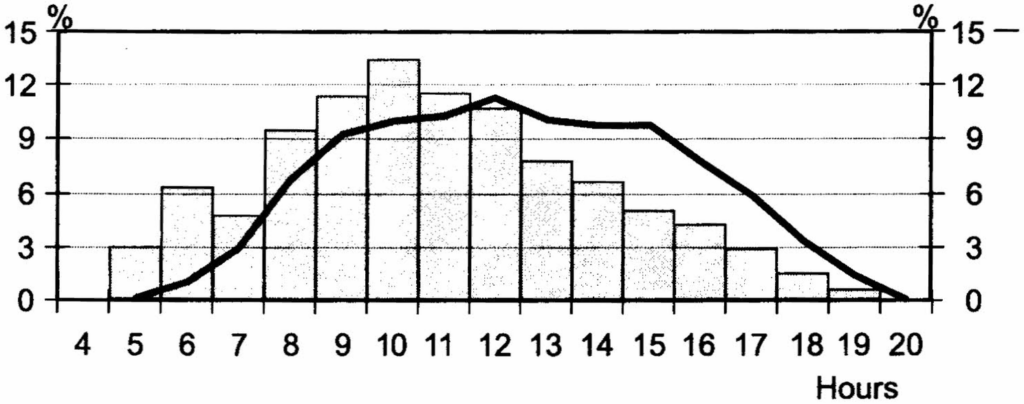
It was found that examined species are characterised by the same diurnal dynamics of blooming (with its top intensity between 9 and 12 a.m.) and similar course of foraging flowers by insects during the day (with top between 9 a.m. and 3 p.m.) – Fig.1. The Agastache flowers secrete nectar and deliver pollen for bees just after starting to bloom. The length of their life is in most cases one day only. In the second day their corollas fade and drop down. Agastache flowers were readily foraged, besides of honeybees collecting nectar and pollen (cream-white coloured loads), by bumblebees and some solitary bees. About 30 to 40 honeybee foragers worked simultaneously per 1 square meter of plot during top hours of foraging.
strona 241Table 1 The time and blooming abundance of the 3 species of Agastache in Puławy in years 1997-1999 – Pora i obfitość kwitnienia 3 gatunków kłosowca w Puławach w latach 1997-1999
| Species of plant / Gatunek rośliny | Year of study / Rok badań | Time of blooming / Pora kwitnienia | Number per 1 m² / Liczba na 1 m²: plants / roślin | Number per 1 m² / Liczba na 1 m²: sprouts / pędów | Number per 1 m² / Liczba na 1 m²: flowers in 10³ / kwiatów w tys. |
|---|---|---|---|---|---|
| Agastache foeniculum (Pursh.) O. Kuntze | 1997 | 19.06 – 8.08 | 71 | 142 | 150.1 |
| 1998 | 10.06 – 25.07 | 25 | 153 | 164.6 | |
| 1999 | 18.06 – 30.07 | 62 | 120 | 138.7 | |
| Average / Średnio | 16.06 – 31.07 | 53 | 138 | 151.1 | |
| Agastache rugosa Fisch. et C.A. Mey. | 1997 | 9.07 – 27.08 | 64 | 118 | 149.6 |
| 1998 | 2.07 – 5.08 | 95 | 125 | 94.8 | |
| 1999 | 5.07 – 15.08 | 80 | 80 | 85.2 | |
| Average / Średnio | 5.07 – 17.08 | 80 | 108 | 109.9 | |
| Agastache nepetoides (L.) O. Kuntze | 1997 | 28.07 – 26.08 | 4 | 17 | 183.2 |
| 1998 | 23.07 – 5.09 | 6 | 13 | 108.0 | |
| 1999 | 29.07 – 30.08 | 6 | 16 | 120.4 | |
| Average / Średnio | 27.07 – 31.08 | 5 | 15 | 137.2 |
One flower of investigated Agastache species secreted on average 0.40(0.22-0.68) mg of sugars with their concentration in nectar from 33 to 67% (Table 2). Yield of sugars in nectar for the whole blooming period per 1 hectare was on average 745 kg, 538 kg and 394 kg for A. foeniculum, A. nepetoides and A. rugosa respectively. A. rugosa distinguishes itself by the best persistence as a perennial plant, while A. nepetoides in Puławy showed clear features of a biennial. If sowed directly into the field it germinated weakly, unevenly and grew very slowly at the beginning.
Table 2 The abundance of nectar secretion and sugar yield of the 3 species of Agastache examined in Puławy in years 1997-1999 / Obfitość nektarowania i wydajność cukrowa 3 gatunków kłosowca badana w Puławach w latach 1997-1999
| Species of plant / Gatunek rośliny | Year of study / Rok badań | Sugars concentration in nectar in % / Koncentracja cukrów w nektarze w % | Mass of sugars per 10 flowers in mg / Ilość cukrów z 10 kwiatów w mg: min – max / min.-maks. | Mass of sugars per 10 flowers in mg / Ilość cukrów z 10 kwiatów w mg: average / średnio | Sugars efficiency in kg/ha / Wydajność cukrów w kg/ha |
|---|---|---|---|---|---|
| Agastache foeniculum (Pursh.) O. Kuntze | 1997 | 33 – 57 | 1.7 – 5.5 | 3.49 | 524 |
| 1998 | 45 – 70 | 3.6 – 8.1 | 5.70 | 938 | |
| 1999 | 67 – 73 | 4.4 – 6.7 | 5.58 | 774 | |
| Average / Średnio | 48 – 67 | 3.2 – 6.8 | 4.92 | 745 | |
| Agastache rugosa Fisch. et C.A. Mey. | 1997 | 28 – 69 | 1.9 – 5.5 | 2.43 | 513 |
| 1998 | 44 – 56 | 1.9 – 5.3 | 3.29 | 312 | |
| 1999 | 28 – 70 | 2.7 – 5.3 | 4.20 | 358 | |
| Average / Średnio | 33 – 65 | 2.2 – 5.4 | 3.31 | 394 | |
| Agastache nepetoides (L.) O. Kuntze | 1997 | 45 – 65 | 2.7 – 5.3 | 4.23 | 775 |
| 1998 | 31 – 69 | 1.9 – 3.8 | 2.83 | 306 | |
| 1999 | 42 – 57 | 3.4 – 6.0 | 4.44 | 534 | |
| Average / Średnio | 39 – 64 | 2.7 – 5.0 | 3.83 | 538 |
CONCLUSIONS
Each from the 3 investigated species of Agastache blooms abundantly through 5-6 weeks of summer time, whereas A. foeniculum from mid-June, A. rugosa from the beginning of July and A. nepetoides from the end of July.
All of the 3 investigated species supply large quantities of nectar to bees willingly collected by insects and also some quantities of pollen.
strona 243A. foeniculum and A. rugosa are direct-seeded crops and they are quite persistent. They can be suitable for cultivation on not very poor soils to improve bee forage flow. A. nepetoides should be tested for this purpose yet.
REFERENCES
Ayers G.S., Widrlechner M.P. (1994)- The genus Agastache as bee forage: a historical perspective. Am. Bee J., 134(5): 341-348.
Ayers G.S., Widrlechner M.P. (1994)- The genus Agastache as bee forage: an analysis of reader returns. Am. Bee J., 134(7): 477-483.
Ayers G.S., Widrlechner M.P. (1994)- The genus Agastache as bee forage: an analysis of reader returns. Am. Bee J., 134(9): 621-627.
Fuentes-Granados R., Widrlechner M.P., Wilson L.A. (2000)- Inheritance studies of aromatic compounds in Agastache foeniculum (Pursh) Kuntze. J. Essent. Oil Res., 12:581-594.
Nykänen J., Holm Y., Hiltunen R. (1989)- Composition of the essential oil of Agastache foeniculum. Planta Medica, 55:314-315.
Pellet T.C. (1947)- Anise-hyssop wonder honey plant. Am. Bee J., 86:508-509.
Šibajev W.W. (1997)- Lofant – medonos i apteka na griadkie. Pčelovodstvo, 54(2):20-21.
Wilson N.A., Senechal N.P., Widrlechner M.P. (1992)- Headspace analysis of the volatile oils of Agastache. Journal of Agricultural and Food Chemistry, 40:1362-1366.
KWITNIENIE, NEKTAROWANIE I OBLOT PRZEZ PSZCZOŁY TRZECH GATUNKÓW KŁOSOWCA (AGASTACHE KUNTZE)
Jabłoński B., Kołtowski Z.
Streszczenie
Do rodzaju Agastache (rodzina Labiatae) należy około 20 gatunków bylin występujących głównie w Ameryce Północnej. Wszystkie są dobrymi lub bardzo dobrymi roślinami miododajnymi. Niektóre opłaca się uprawiać specjalnie na pożytek pszczeli. W latach 1997-1999 w Puławach oceniano obfitość nektarowania i oblot przez pszczoły 3 najlepszych gatunków: A. foeniculum (Pursh.) Kuntze, A. rugosa (Fisch. et C.A. Mey.) Kuntze i A. nepetoides (L.) Kuntze. W badaniach posługiwano się aktualnie stosowanymi w botanice pszczelarskiej metodami.
Stwierdzono, że A. foeniculum kwitnie u nas od połowy czerwca do końca lipca, A. rugosa – od początków lipca do połowy sierpnia, a A. nepetoides – od trzeciej dekady lipca do końca sierpnia. Jeden kwiat pierwszego gatunku wydzielał średnio 0,49 mg cukrów, drugiego 0,33 mg, a trzeciego – 0.38 mg. Wydajność cukrów w nektarze za cały okres kwitnienia w przeliczeniu na 1 ha wynosiła dla A. foeniculum – 745 kg, A. nepetoides – 538 kg i A. rugosa – 394 kg. Oblot kwiatów przez pszczoły trwał od rana do wieczora. W
strona 244środkowej porze dnia pracowało na 1 m² 30-50 zbieraczek nektaru i pyłku. Kwiaty Agastache były chętnie odwiedzane także przez trzmiele i pszczoły samotnice. Wszystkie trzy gatunki można uznać w naszych warunkach za bardzo dobre rośliny pożytkowe. A. nepetoides okazał się jednak byliną krótkotrwałą.
Słowa kluczowe: kłosowce, kwitnienie, nektarowanie, oblot przez pszczoły.