

EFFECT OF THE ARTIFICIAL DECAPPING OF BROOD ON THE QUALITY OF BEES (APIS MELLIFERA L.)
tekst: Adrian Siceanu
Pszczelnicze Zeszyty Naukowe, Rok XLI, 1997 — Adrian Siceanu
strona 109PSZCZELNICZE ZESZYTY NAUKOWE Rok XLI 1997
Adrian Siceanu
Institute of Beekeeping Research & Development, Bucharest 1, 42 Ficusului Bv., 71544 Romania.
Summary
The most serious honeybee diseases (varroasis, American foul brood and chalk brood) affect the brood in its capped stage.
Therefore a method was worked out to decap artificially brood without a deleterious effect in brood to facilitate application of required treatments.
The decapping of brood is effected by soldering with melted beeswax and snatching. For this purpose, a “decapping element” ( a textile fabric) is dipped in melted beeswax and is put over the capped brood area of the comb, to melt and incorporate the caps. The snatching of the decapping elements after cooling takes off the caps of brood cells.
Bees recap the cells with live brood during the next 12 to 24 h with regard to the brood age and the strength of the colony.
The effect of artificial decapping of the brood was estimated by comparision of emerged experimental bees to those reared in normal conditions. No significant differences were noticed between the two groups of bees.
Keywords: brood, decapping, diseases
INTRODUCTION
The honeybee is an insect with complete metamorphosis. Brood cells are capped before pupation at the end of the larval period.
The most serious honeybee diseases (varroasis, American foul brood and chalk brood) affect brood at capped stage.
The drugs used for the control of these diseases do not penetrate the caps of the cells in which the reproductive cycle of the parasite takes place.
Recently, a method the artificial deccaping of brood cells was worked out in the Institute of Beekeeping Research & Development in Bucharest, in to facilitate the application of required treatments without damage to live organisms.
Consequently, the entire capped brood surface is decapped in a diseased colony for this purpose recap the cells with live brood after 12 to 24 hours, with regard to the brood age and the strength of the colony (Siceanu, 1996).
Dead brood is rapidly identified and removed from the cells, especially if a beekeeper sprays sugar syrup over the artificially decapped brood (Siceanu, 1996, unpublished).
The effect of artificial decapping of brood was estimated by comparing the bees emerged experimentally to those reared in normal conditions.
strona 110MATERIAL AND METHOD
The investigation was conducted on 10 bee colonies of Apis mellifera carpatica race in the summer of 1996.
In each colony, a compact capped brood comb, without empty cells, was selected. Two square brood areas containing 400 brood cells each were selected from a capped brood ellipse on a one of each comb. These two square brood areas were marked by the removal of brood from two rows of cells and around them, using tweezers.
Then, the brood in one area was artificially decapped, whereas the other area remained unmodified (control area). The caps were removed by soldering with melted beeswax and by snatching.
The following method was applied: The comb was placed in a horizontal position. A piece of cloth (decapping element) was introduced in melted beeswax. Then, the decapping element was placed over the corresponding brood area. The reffer, the cloth was slightly rubbed with a sponge dipped in melted beeswax and then introduced in a plastic bag. The beeswax film on the cloth melted and incorporated the caps . After cooling, the pieces of cloth were snatched by removing the caps and leaving the brood decapped.
After decapping, the corresponding combs were reintroduced in bee colonies.
Insulating caps made of wire net with 2 mm meshes were applied on the decapped brood areas, and on the control areas after 24 h.
Afterwards, the emergence was observed daily. We marked 200 bees in each insulator with different colors and released the others. The following were noted:
- brood recapping;
- percentage of emerged bees;
- bees’ longevity by counting the rate of disappearance of bees from a hive, every 10 days;
- behaviour of marked bees and their flight activities.
RESULTS AND DISCUSSIONS
Brood Recapping
The decapping allowed us to estimate of the brood age . All the stages of brood development were noticed on all the decapped areas. The age differed 3 and 4 days between the brood on each decapped area. Only in two colonies, the decapped areas included freshly capped brood in the vicinity of that about to emerge. Instead, there were marked differences between the colonies, the time of the expected emergence varied from a few hours to 5 days.
Immediately after the decapping, there were bees which were about to
strona 111emerge in two colonies. The bees emerged without necessity to gnaw the caps. The emerged bees (17 in colony 2 and 23 in colony 5) were marked.
Six hours after decapping, we noted that bees recapped all the cells containing brood 9 and 12 days old. The other cells, with older brood, were at various recapping stages. The cells with brood 20 and 21 days old were not approached. These observations confirm the results of previous findings (Siceanu, 1996), showing that the stimulus substance produced by brood which determines capping or recapping was secreted in a larger quantity in the first days after capping and its secretion decreased the metamorphosis.
After 24 hours, the percentage of recapped cells varied from 82% to 100%,( an average of 93%). The observations conducted the following days revealed that the brood which was on the last days of its metamorphosis and which was not recapped, continued its development and emerged.
Percentage of emerged bees
From the decapped areas emerged 97.4% of bees( from 94% to 100%).
In the controls, 99.2% of bees emerged (between 98% and 100%), the difference was +1.8%.
Bees’ longevity is shown in Fig.1.
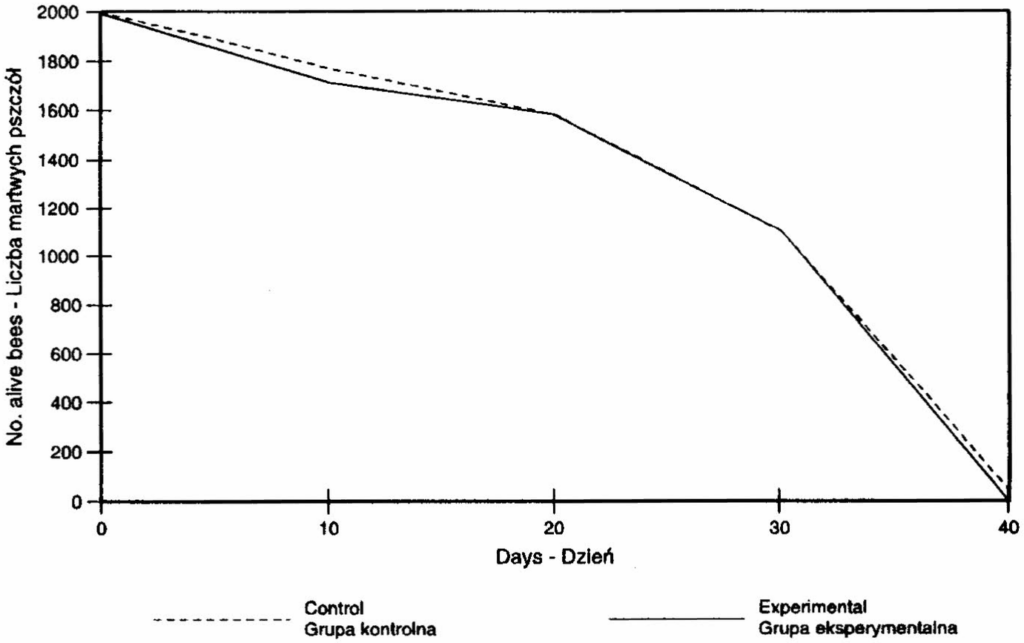
Showed the following results:
Analysis of variance showed no significant differences between the control colony and the experiment al ones after 10 days (F (1.046) less than F (1:18)0,05 ( 4.41), after 20 days (F (0.075) less than F (18:1)0.05 (2.24), and after 30 days F (0.003) less than F (18:1) 0,05 (2.24).
strona 112The results obtained proved that the artificial decapping of brood did not influence the bees’ longevity.
No significant differences were noticed in the behaviour of the comb and the flight activity of the experimental and control bees. We noticed similar behaviour patterns of bees with similar age in each colony. The first flights of marked bees was around the age of 15 days and no differences were noticed between the experimental and control sample.
CONCLUSIONS
After artificial decapping of brood, bees recapped more rapidly the younger brood (9 to 12 days old) than the older one, while the brood around to emerge (20 – 21 days old) was not recapped.
The average percentage of emerged bees from the brood artificially decapped and then recapped by bees was 97.4% ( 94% – 100%), it is 1.8% less than in the control bee colony in which the average was 99.2% ( 98% -100%).
One artificial decapping of brood, does not influence the longevity of bees. Analysis of variance did not show significant differences in the longevity of 10-, 20-,30- day-old experimental and control bees.
REFERENCES
SICEANU, A. (1996) – The artificial decapping of the honeybee brood for the control of the Varroa jacobsoni Oud., parasite. Apiacta XXXI, 45-50.
WPŁYW SZTUCZNEGO ODSKLEPIANIA CZERWIU NA JAKOŚĆ PSZCZÓŁ (APIS MELLIFERA L.)
A. Siceanu
Streszczenie
Większość poważnych chorób pszczół (warroza, zgnilec amerykański, grzybica) atakuje czerw w stadium jego zakrycia w komórkach plastra. Celowe dlatego stało się opracowanie metody sztucznego odsklepiania czerwiu bez jego zabijania co ułatwiłoby stosowanie zalecanych preparatów leczniczych.
Odsklepianie czerwiu było prowadzone przy użyciu rozpuszczonego wosku pszczelego i zrywanie zasklepu. Do tego celu wykorzystano “element odsklepiający” (tkanina tekstylna) zanurzony w płynnym wosku, następnie umieszczany na powierzchni plastra z zasklepionymi komórkami czerwiu, co powodowało przyklejanie się tej tkaniny do zasklepów komórek. Po zastygnięciu wosku, tkanina była odrywana od powierzchni plastra, a wraz z nią odrywały się zasklepy pozostawiając odkryte komórki z czerwiem. Pszczoły ponownie zasklepiały komórki z czerwiem po 12-24 godz., a szybkość zasklepiania zależała od wieku czerwiu i siły rodziny.
Porównano procent wygryzających się pszczół z komórek odsklepianych i nieodsklepianych. Był on zbliżony i wynosił średnio 97,4% z komórek odsklepianych i 99,2% z komórek nieodsklepianych.
Słowa kluczowe: czerw, odsklepianie, choroby.
Errata — błędy druku znalezione podczas digitalizacji
- s. 109, streszczenie: „comparision” → comparison
- s. 109: „deccaping” → decapping
- s. 111: „experiment al” → experimental