

CORRELATION BETWEEN STAMEN HEAD TRAITS AND POLLINATION ABUNDANCE FOR 10 MEADOW SPECIES
tekst: Elżbieta Weryszko-Chmielewska, Ewa Bartyś
Pszczelnicze Zeszyty Naukowe, Rok XLIV, Nr 2, 2000 — Elżbieta Weryszko-Chmielewska, Ewa Bartyś
strona 267PSZCZELNICZE ZESZYTY NAUKOWE Rok XLIV, Nr 2 2000
Elżbieta Weryszko-Chmielewska, Ewa Bartyś
Department of Botany, University of Agriculture, Akademicka 15, 20-950 Lublin, Poland
Summary
Legth and width of stamen heads, as well as number and weight of pollen grains produced by a stamen were compared in 1997-1998 for the following species flowers: Cardamine pratensis L., Cerastium arvense L., Geum rivale L., Glechoma hederacea L., Lychnis flos-cuculi L., Menyanthes trifoliata L., Potentilla anserina L., Verbascum phoeniceum L., Veronica chamaedrys L., and Viscaria vulgaris Röhl. Correlation coefficients between parameters under study, as well as between number of stamen and number and weight of pollen grains produced by a flower, were calculated. High positive correlation between width of stamen and number and weight of pollen grains produced by a flower, were calculated. High positive correlation between width of stamen head and number of pollen grains from a stamen (0.824), as well as between number of pollen grains and weight of pollen produced by a flower (0.941) was found. Number of pollen grains and their weight were strongly positively correlated with number of stamens in a flower. The highest number and weight of pollen grains in a stamen was found for Verbascum phoeniceum, in the case of Geum rivale both weight and number of grains in a flower reached the highest values.
Keywords: stamen head size, number of stamens, number of pollen grains, pollen weight, correlation, meadow plants.
INTRODUCTION
Multi-species communities of meadow plants are characterised by continuous flowering from spring till autumn and they are valuable nutritional source for insects (Maurizio 1959, 1960, Berner and Müller 1967).
Among wild species, herbs produce the highest amounts of pollen (Rawski 1948). The same author found that pollen-producing plants offer different pollen quantities for insects during vegetation: in spring 30%, in summer 52% and in autumn 18%.
Pollen yield depends first of all on the pollen weight produced by a flower and number of flowers per area unit (Jabłoński et al. 1985). Pollen weight estimation is important from the point of view of value evaluation for insects. Moreover, it is necessary to study the number of pollen grains produced by a stamen and a flower in research upon plant pollination process (Nepi and Pacini 1993, Robertson and Lloyd 1993). Allogamic and autogamic
strona 268plants differ to each other with the fact that the latter produce much less pollen grains (De Vries 1971).
Comparative studies aiming to find the qualitative relations between number and weight of pollen grains per stamen and flower, length and width of stamen heads, and number of stamen heads in flowers of 10 meadow species characterised by different systematic origin were presented in the paper.
MATERIAL AND METHODS
The length and width of stamen heads as well as number and weight of pollen grains produced by a stamen in 1997-1998 was studied using the following species: Cardamine pratensis L., Cerastium arvense L., Geum rivale L., Glechoma hederacea L., Lychnis flos-cuculi L., Menyanthes trifoliata L., Potentilla anserina L., Verbascum phoeniceum L., Veronica chamaedrys L. and Viscaria vulgaris Röhl.
Number of stamen heads and number and weight of pollen grains per a flower were also recorded. Correlation coefficients between parameters studied were calculated. Moreover, measurements of the diameter for 30 flowers chosen by chance for each species were also made and number of stamens was counted. In inflorescences, flowers from their central part were selected. Size of stamen heads was estimated for 20 stamens situated in analogous whorls of different flowers.
Number of pollen grains produced by a stamen head was calculated for 5-7 stamens for each species studied. Semi-permanent smear preparations in glicerogel were made for particular stamen heads.
Pollen weight was estimated by means of Warakomska (1972) method modified by Szklanowska (1995). Stamens were collected in swelled buds directly before flowers open. For each species, 4 samples 200 stamens each, from different flowers were prepared.
RESULTS
Number of pollen grain produced by a stamen, differed markedly in particular species (Table 1). The highest pollen grain number was found in Verbascum phoeniceum L. stamen (14928), then in Potentilla anserina L. (8420). Stamens of Glechoma hederacea L. and Cerastium arvense L. were characterised by low number of pollen grains (400 and 903, respectively).
The largest weights of pollen per stamen were found for Verbascum phoeniceum L. (0.12 mg), and equal quantities occurred for Cardamine pratensis L., Veronica chamaedrys L. and flowers of Menyanthes trifoliata L. characterised by short pistils (0.06 mg). In that species flowers producing long pistils, pollen weight per a stamen was higher (0.07 mg). The lowest value for
strona 269Table 1 Comparison of mean number of pollen grains and pollen weight per a stamen and a flower and some traits of stamen for studied taxons – Porównanie średniej liczby i masy ziarn pyłku z pręcika i kwiatu oraz niektóre cechy pręcikowia badanych gatunków roślin
| Species / Gatunek | Number of pollen grain per a stamen / Liczba ziarn pyłku z pręcika | Weight of pollen per a stamen / Masa pyłku z pręcika (mg) | Length of stamen head / Długość główki pręcika (mm) | Width of stamen head / Szerokość główki pręcika (mm) | Size coefficient for stamen head* / Współczynnik kształtu główki pręcika* | Number of stamena in a flower / Liczba pręcików w kwiecie | Number of pollen grains in a flower / Liczba ziarn pyłku z kwiatu | Weight of pollen in a flower / Masa pyłku z kwiatu (mg) | Weight of 100 000 pollen grains / Masa 100 000 ziaren pyłku (mg) |
|---|---|---|---|---|---|---|---|---|---|
| 1. Lychnis flos-cuculi | 3397,2 | 0,04 | 1,27 | 0,81 | 1,58 | 10,00 | 32030,00 | 0,40 | 1.177 |
| 2. Viscaria vulgaris | 3116,8 | 0,02 | 1,72 | 0,75 | 2,30 | 10,00 | 29655,00 | 0,22 | 0.642 |
| 3. Cerastium arvense | 903,2 | 0,02 | 1,19 | 0,74 | 1,62 | 10,00 | 7632,50 | 0,23 | 2.214 |
| 4. Cardamine pratensis | 1349,8 | 0,06 | 1,73 | 0,72 | 2,50 | 6,00 | 7539,00 | 0,35 | 4.445 |
| 5. Potentilla anserina | 8419,6 | 0,05 | 1,90 | 0,91 | 1,31 | 19,19 | 61830,57 | 0,90 | 0.594 |
| 6. Geum rivale | 2522,4 | 0,04 | 1,20 | 0,67 | 1,80 | 98,32 | 274574,14 | 3,60 | 1.586 |
| 7. Verbascum phoeniceum | 14928,0 | 0,12 | 1,15 | 2,30 | 0,50 | 5,00 | 72022,50 | 0,60 | 0.804 |
| 8. Veronica chamaedrys | 3191,2 | 0,06 | 2,03 | 0,95 | 2,14 | 2,00 | 6008,00 | 0,12 | 1.880 |
| 9. Glechoma hederacea | 400,4 | 0,01 | 0,99 | 1,27 | 0,78 | 4,00 | 1756,00 | 0,05 | 2.498 |
| 10. Menyanthes trifoliata (słupek krótki) | 2832,4 | 0,06 | 2,44 | 1,22 | 2,00 | 5,00 | 14465,00 | 0,29 | 2.118 |
| 11. Menyanthes trifoliata (słupek długi) | 2499,2 | 0,07 | 2,25 | 1,01 | 2,25 | 5,00 | 12905,00 | 0,37 | 2.801 |
- ratio of the head length to width – stosunek długości do szerokości główki pręcikowej
Table 2 Correlation coefficient for stamen traits compared for 10 taxons studied – Współczynniki korelacji porównywanych cech pręcikowia dla 10 badanych gatunków
| Traits studied / Badane cechy | X1 | X2 | X3 | X4 | X5 | X6 | X7 |
|---|---|---|---|---|---|---|---|
| Y – number of pollen grain per a stamen – liczba ziarn pyłku z pręcika | 0,5686** | – 0,4779** | – 0,0891 | 0,8245** | – 0,0598 | 0,1924 | 0,0596 |
| X1 – weight of pollen per a stamen – masa pyłku z pręcika | – 0,0745 | 0,3062* | 0,4451** | – 0,1624 | – 0,0220 | – 0,0253 | |
| X2 – size coefficient – współczynnik kształtu | 0,6400** | – 0,6816** | 0,0338 | – 0,0846 | – 0,0145 | ||
| X3 – lenght of stamen head – długość główki pręcika | – 0,0621 | – 0,3264* | – 0,3255* | – 0,3016* | |||
| X4 – width of stamen head – szerokość główki pręcika | – 0,2974* | – 0,0831 | – 0,1897 | ||||
| X5 – number of stamena in a flower – liczba pręcików w kwiecie | 0,9425** | 0,9822** | |||||
| X6 – number of pollen grains in a flower – liczba ziarn pyłku z kwiatu | 0,9410** | ||||||
| X7 – pollen weight in a flower – masa pyłku z kwiatu | – |
- – significance at α≤ 0.05 – istotność α≤ 0,05 ** – significance at α≤ 0.01 – istotność α≤ 0,01
pollen weight parameter was recorded for Glechoma hederacea L. (0.01 mg), Cerastium arvense L. and Viscaria vulgaris Röhl. (0.02 mg each) (Table 1).
Stamen heads differed with their length and width as well as with the ratio of these values. Shape coefficients were calculated for each taxon – the ratio of stamen head length to width – describing its elongation extent.
Stamen head length ranged from 0.99 to 2.44 mm, and the width from 0.67 to 2.30 mm. Stamens of Glechoma hederacea L. were characterised by the shortest head length, and the longest heads occurred in Menyanthes trifoliata L., then in stamens of Veronica chamaedrys L.. The shortest head width was found in Geum rivale L. and the longest one in Verbascum phoeniceum L. flowers.
Stamen heads of the most elongated shape appeared to occur in Cardamine pratensis L., then in Viscaria vulgaris Röhl. as well as in one of the forms of Menyanthes trifoliata L. flowers with shape coefficients of 2.50, 2.30 and 2.35, respectively. Stamen heads with almost equal length and width were found in Glechoma hederacea L. (0.78) and Potentilla anserina L. (1.31).
Investigating the pollination abundance of a single flower, number of stamens and number of pollen grains produced by a flower as well as pollen weight were recorded. Due to great range of stamen number (2-98), high differences between taxons in relation to pollen grain number (1 756-274 574) and pollen weight (0.05-3.60 mg) were found (Table 1).
Geum rivale L., and then Potentilla anserina L. were characterised by the highest number of stamens and at the same time by maximum pollen grain number and pollen weight per a flower. Number of pollen grains in Geum rivale L. was 4.4-fold higher than in Potentilla anserina L., 3.8-fold higher than in Verbascum phoeniceum L., and 15.6-fold higher than in Glechoma hederacea L., that is the species producing the lowest amounts of pollen. Pollen weight in a single flower of Geum rivale L. was 4 times higher than of Potentilla anserina L., 6 times higher than of Verbascum phoeniceum L. and 72 times higher than of Glechoma hederacea L.
In order to find the dependence between different parameters of stamen and number of grains and weight of pollen produced by a stamen and a flower, correlation coefficients were calculated (Table 2). On a base of the results, significant positive correlation between the number of pollen grains per stamen and the weight of pollen per stamen (0.5686) as well as the number of pollen grains and the width of stamen head (0.8245) was found. Moreover it was proved that the weight of pollen per stamen was characterized with positive correlation with the length (0,3062) and width (0.4451) of stamen head. Slightly negative correlation between number of stamens in a flower and length of stamen head (-0.3264) and its width (-0.2974) was observed.
strona 272Calculations revealed that there was very strong positive correlation between number of pollen grains per flower and stamen number (0.9425), pollen weight per a flower and stamen number (0.9822), and number of grains and pollen weight per flower (0.9410).
Large stamen heads in Verbascum phoeniceum L. produced the highest amounts of pollen grains of the highest weight. Menyanthes trifoliata L. stamens with the largest heads and Veronica chamaedrys L. with relatively large heads also produced great pollen weight at mean pollen grain number. High pollen grain number and large pollen weight was found in quite large stamens of Potentilla anserina L. Mean stamen heads of Glechoma hederacea L. (Table 1) produced the lowest number of pollen grains and pollen weight.
Weight of 100 000 pollen grains was calculated on the basis of results obtained. It follows from the data that great number of pollen grains occurring in a stamen head was accompanied by lower weight of particular grains, which is probably associated with their smaller size.
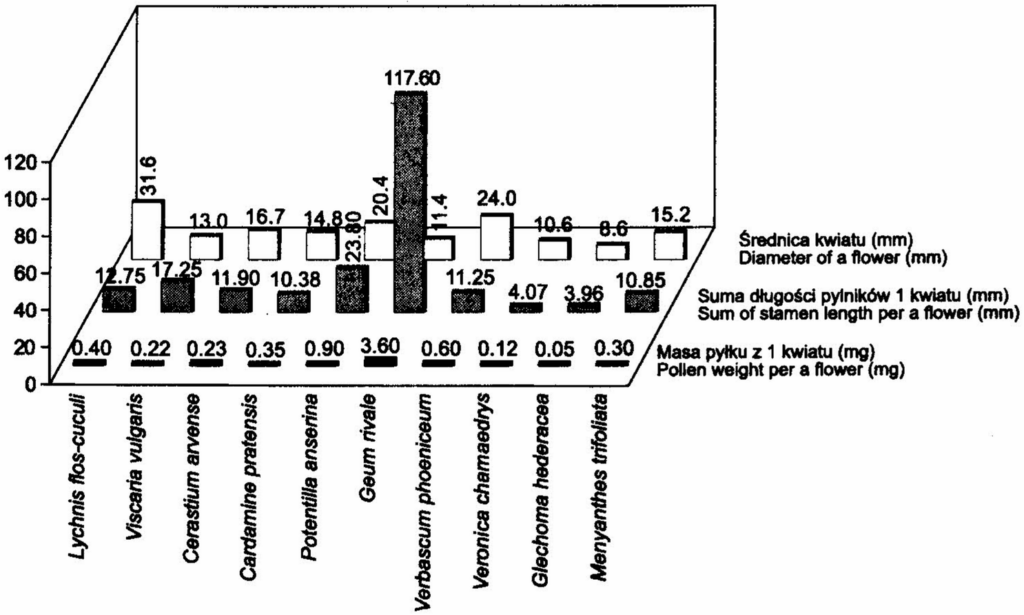
Wartości wydrukowane nad słupkami (jak w druku, z kropką dziesiętną):
| Gatunek / Taxon | Diameter of a flower (mm) | Sum of stamen length per a flower (mm) | Pollen weight per a flower (mg) |
|---|---|---|---|
| Lychnis flos-cuculi | 31.6 | 12.75 | 0.40 |
| Viscaria vulgaris | 13.0 | 17.25 | 0.22 |
| Cerastium arvense | 16.7 | 11.90 | 0.23 |
| Cardamine pratensis | 14.8 | 10.38 | 0.35 |
| Potentilla anserina | 20.4 | 23.80 | 0.90 |
| Geum rivale | 11.4 | 117.60 | 3.60 |
| Verbascum phoeniceum | 24.0 | 11.25 | 0.60 |
| Veronica chamaedrys | 10.6 | 4.07 | 0.12 |
| Glechoma hederacea | 8.6 | 3.96 | 0.05 |
| Menyanthes trifoliata | 15.2 | 10.85 | 0.30 |
In order to estimate the size and to compare the efficiency of stamen functioning, sum of anther length per flower was calculated. It was found that flowers were characterised by the highest pollen weight at maximum values of that parameter (Geum rivale L., Potentilla anserina L.), and with the lowest pollen weight values at minimum sum of anther length (Glechoma hederacea L.) (Fig. 1).
strona 273No regular dependence between flower diameter and sum of the anther length, as well as pollen weight per flower was observed (Fig. 1).
DISCUSSION
Number of pollen grains produced by a single flower of entomogamic taxons ranged within 1 756-274 574 and mainly depended on number of stamens in a flower. Number of pollen grains produced by a stamen in particular species amounted to 400-14 928 and depended first of all on stamen head width.
Many previous articles upon the number of pollen grains produced by plants are associated with anemophilous species (Pohl 1937, Agnihotri and Singh 1975, Smart et al. 1979, Subba – Reddi and Reddi 1986, Molina et al. 1996). It was proved in numerous papers that number of pollen grains produced by a stamen positively correlated with its head size, namely the length (De Vries 1971, Agnihotri and Singh 1975, Subba – Reddi and Reddi 1986, Molina et al. 1996).
Number of pollen grains produced by Myosotis colensoi flower (35 000) counted by Robertson and Lloyd (1995) and that calculated by Nepi and Pacini (1993) for Cucurbita pepo flower (16 487) are in a range of mean values found for species studied in present paper.
Authors of the present paper proved that number of pollen grains produced by a flower positively correlated with pollen weight. Subba – Reddi and Reddi (1986) found that number of pollen grains in stamen head was inversely proportional to pollen grain size, and thus species with the largest stamens and small pollen grains were characterised by the highest sporomorph productivity. Present study results also confirm such dependence.
CONCLUSIONS
- Taxons studied showed close positive correlation between number and weight of pollen grains per stamen and per flower as well as negative dependence between pollen grain number per stamen and 100 000 grains weight.
- Pollen weight per stamen displayed positive dependence with length and width of stamen head; pollen grain number strongly depended on anther width.
- High positive correlation between number of stamens in a flower and weight of pollen produced by it as well as number of pollen grains in a flower was found. Flowers with numerous stamens and the highest sum of anther length (Geum rivale L.) were characterised by the highest pollination abundance.
REFERENCES
Agnihotri M.S., Singh B.P., (1975)- Pollen production and allergenic significance of some grasses around Lucknow. Jour. Palynol. 11: 151-154.
Berner U., Müller H., (1967)- Die Bienenweide. Verlag Eugen Ulmer, Stuttgart.
De Vries A.Ph., (1971)- Flowering biology of wheat, particularly in view of hybrid seed production – a review. Euphytica 20: 152-169.
Jabłoński B., Skowronek J., Szklanowska K., (1985)- Wartość pszczelarska, zapylanie i plonowanie niskoerukowych odmian rzepaku ozimego. Pszczel. Zesz. Nauk. 29: 339-358.
Maurizio A., (1959-1960)- Blüte, Nektar, Pollen, Honig. Deutsche Bienenwirtschaft.
Molina R.T., Rodriguez A.M., Palacios I.S., Lopez F.G., (1996)- Pollen production in anemophilous trees. Grana 35: 38-46.
Nepi M., Pacini E., (1993)- Pollination, Pollen Viability and Pistil Receptivity in Cucurbita pepo. Ann. Bot. 72: 527-536.
Pohl F., (1937)- Die Pollenerzeugung der Windblütler. Eine vergleichende Untersuchung mit Ausblicken auf die Bestäubung der tierblütigen Gewächse und die pollenanalytische Waldgeschichte. Beihefte Bot. Zentralblatt 56A: 365-470.
Rawski W., (1948)- Wartość pożytkowa roślin dzikich i uprawnych. Cz.III. Wyd.”Exlibris”, Warszawa.
Robertson A.W., Lloyd D.G., (1993)- Rates of pollen deposition and removal in Myosotis colensoi. Funct. Ecol. 7: 549-559.
Smart I.J., Tuddenham W.G., Knox R.B., (1979)- Aerobiology of grass pollen in the city atmosphere of Melbourne: Effects of weather parameters and pollen sources. Austral. J. Bot. 27: 333-342.
Subba – Reddi C., Reddi N.S., (1986)- Pollen production in some anemophilous angiosperms. Grana 25: 55-61.
Szklanowska K., (1995)- Pollen flowers of crowfoot family (Ranunculaceae L.) from some natural plant communities. In: Changes in fauna of wild bees in Europe. Banaszak (ed.), Pedagogical Univ., Bydgoszcz: 201-214.
Warakomska Z., (1972)- Badania nad wydajnością pyłkową roślin. Pszczel. Zesz. Nauk. 16: 63-89.
strona 275KORELACJA MIĘDZY CECHAMI PRĘCIKOWIA A OBFITOŚCIĄ PYLENIA 10 GATUNKÓW ROŚLIN ŁĄKOWYCH
Weryszko-Chmielewska E., Bartyś E.
Streszczenie
W latach 1997-1998 porównywano długość i szerokość główek pręcikowych oraz liczbę i masę ziarn pyłku wytwarzaną przez pręcik w kwiatach następujących gatunków: Cardamine pratensis L.- rzeżucha łąkowa, Cerastium arvense L. – rogownica polna, Geum rivale L. – kuklik zwisły, Glechoma hederacea L. – bluszczyk kurdybanek, Lychnis flos-cuculi L. – firletka poszarpana, Menyanthes trifoliata L. – bobrek trójlistkowy, Potentilla anserina L. – pięciornik gęsi, Verbascum phoeniceum L. – dziewanna fioletowa, Veronica chamaedrys L. – przetacznik ożankowy, Viscaria vulgaris Röhl. -smółka pospolita.
Obliczono współczynniki korelacji między badanymi parametrami, a także między liczebnością pręcikowia oraz liczbą i masą ziarn pyłku wytwarzanego przez kwiat.
Stwierdzono wysoką dodatnią korelację między szerokością główki pręcikowej a liczbą ziarn pyłku z pręcika (0,824) oraz między liczbą ziarn pyłku i masą pyłku wytworzonego przez kwiat (0,941). Liczba ziarn pyłku oraz ich masa są silnie dodatnio skorelowane z liczbą pręcików w kwiecie.
Największą liczbę i masę ziarn pylku z pręcika stwierdzono u Verbascum phoeniceum, natomiast w przypadku Geum rivale zarówno masa jak i liczba ziarn w przeliczeniu na kwiat osiągnęły najwyższe wartości.
Słowa kluczowe: rozmiar główek pręcikowych, liczba pręcików, liczba ziarn pyłku, masa pyłku, korelacja, rośliny łąkowe.
Errata — błędy druku znalezione podczas digitalizacji
- s. 267, streszczenie: „Legth” → Length
- s. 269, tab. 1: „stamena” → stamens
- s. 270, tab. 2: „lenght” → length
- s. 270, tab. 2: „stamena” → stamens
- s. 273: „Lloyd (1995)” → Lloyd (1993)
- s. 275, streszczenie: „pylku” → pyłku