

CONTAMINATION OF FOUNDATION WITH FLUVALINATE IN POLAND IN 1990-1999
tekst: Marek Kubik, Janusz Nowacki, Andrzej Pidek
Pszczelnicze Zeszyty Naukowe, Rok XLIV, 2000 — Marek Kubik, Janusz Nowacki, Andrzej Pidek
strona 15PSZCZELNICZE ZESZYTY NAUKOWE Rok XLIV 2000
Marek Kubik^x, Janusz Nowacki, Andrzej Pidek
Research Institute of Pomology and Floriculture, 96-100 Skierniewice, Pomologiczna street 18, Poland
Recived – 13 January 2000
Summary
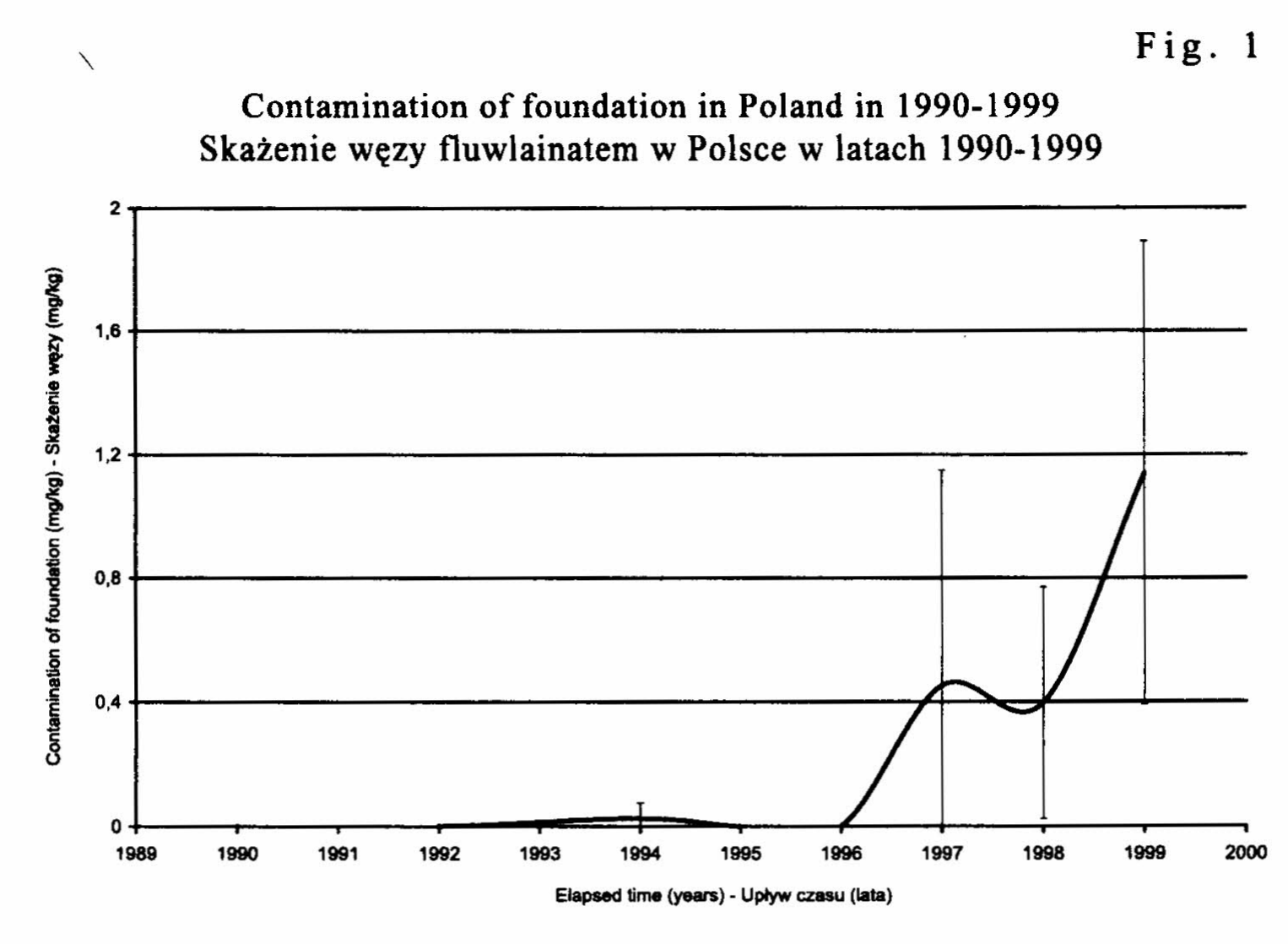
The residue of fluvalinate was determined by gas chromatography in thirty one samples of foundation obtained as a gift from producers and distributors of bee products through the Country. The first traces of the acaricide were detected in foundations made from wax harvested in 1994. Since 1997 it was detected in most of the samples analyzed and its concentration increased gradually over the years – in 1999 average contamination of foundation with fluvalinate was higher than 1 mg/kg. It is concluded that a constant presence of highly contaminated combs in a hive may lead to induction of mite resistance to fluvalinate and contamination of honey as well.
Keywords: fluvalinate, contamination, foundation, varroatosis.
^x – The author to whom all correspondence should bee directed.
INTRODUCTION
Fluvalinate was introduced in late 80s to control very dangerous parasitic bee disease caused by Varroa jacobsoni Oudemans (Koeniger 1986, Barbina et al. 1990, Liu 1992, Lodesani at al. 1992). The pest, when not controlled, can kill a colony within two years.
There were many of substances used for control of the disease – amitraz, bromopropylate, cumaphos, flumetrin, malation, formic acid and other, fluvalinate among them. Application of the fluvalinate is simple – plastic or wooden stripes soaked with known amounts of acaricide are inserted into a hive and kept there for several weeks – so it turned to be a very convenient and effective method for control of Varroa jacobsoni (Faucon and Flamini 1989).
Fluvalinate is nontoxic for bees (Barvaron and Bornenck 1986) and doesn’t have any known negative side effects. Population growth, foraging activity, adult worker longevity, brood survival, adult bee population, pollen load weight and honey production in experimental colonies treated with
strona 16fluvalinate were the same as in healthy control ones (Westcott and Winston 1999).
Fluvalinate is soluble in fats and waxes and non-volatile, therefore it accumulates easily in beeswax. Faucon and Flamini (1990) found that after its first application the contamination of wax was 2.27 mg/ kg, but Kubik et al. (1995, 1996) reported that wax collected from hives treated with fluvalinate can contain up to several mg/kg of the acaricide and Lodesani et al. (1992) detected as much as 70 mg/kg. Solubility of fluvalinate in water is very low (about 0.002 mg/l, Farm Chemical Handbook, 1986 p. c 111), but it is much higher in honey (up to 1 mg/kg, Wallner 1992). Through the process of diffusion the acaricide migrates from the comb wax into the stored honey (Wallner 1999).
Prolonged presence of fluvalinate in hive environment can generate resistance of Varroa jacobsoni to this acaricide, especially when it is not used properly (Sanford 1995). According to Vandame et al. (1995), there were nineteen reports on occurrence of resistant strains of varroa up to the date and since then there were many more such finding reported.
According to Wallner (1995), the main source of contamination of bee products is a permanent presence of fluvalinate in the wax. In has been reported that this compound breaks down completely in the hive conditions within 24 weeks (Thrasyvalou 1992). Balayanis and Santas (1992) have found that fluvalinate content in the wax stored in the hive dropped to 0.5 ppb within 28 weeks. Fluvalinate is also relatively stable at elevated temperature, so melting the wax during production of foundations does not change the situation. Such treatments of melted wax as an ozonation or oxidation with H2O2 were also ineffective (Vesely et al. 1994).
The aim of this work was to determine the level of contamination of foundation with fluvalinate in order to get dependable data on possibility of honey contamination and generation of resistance of the pest to this chemical.
MATERIALS AND METHODS
Collecting samples. Thirty one samples of foundations weighting from 100 to 200 g were collected as voluntary gift from producers and distributors of bee products and from some beekeepers. Only foundations with a known origin of wax used for their production and time of its harvesting were collected. The samples were marked and kept at -20°C until analyzed.
Purification and determination of fluvalinate in wax. The samples of foundations (100-200 g) taken from refrigerator were crushed to fine particles and carefully mixed. Two 1 g subsamples taken from each sample were homogenized with 25 ml of acetone (nanograde – Baker) and mixed for one hour. Then 25 ml of 2% water solution of NaCl was added and the resulting
strona 17precipitate was separated by filtration. Filter was washed twice with 15 ml of 50% acetone-water mixture. The filtrate and washing solution were combined and passed through SP-500 disposable column (Baker), preconditioned previously accordingly to the producer’s recommendations. The column was then washed with 6 ml of 50% acetone followed by 6 ml of water and dried under N2. Fluvalinate was eluted with 6 ml of hexane-ethyl ether (1:1, v/v) solution. The eluate was evaporated to dryness under reduced pressure, the dry residue dissolved in known volume of n-hexane and samples of this solution were analyzed on gas chromatograph HP 5890 (Hewlett Packard) equipped with a capillary column HP-5, 30 m × 0.32 mm, film thickness 0.25 μm, and ECD detector. Carrier gas was helium – 3 ml/min and make up gas – nitrogen – 60 ml /min. Temperature of injector was 280°C, temperature of detector 300°C.
Each subsample was analyzed at least twice. The results presented on table and figure represent arithmetical mean ± SD.
The recovery rate was determined by addition of a known amount of fluvalinate standard (a gift from associate professor B. Śledziński, IPO) to 1 g sample of wax uncontaminated with fluvalinate. The recovery rate determined this way was 53 ±17.1%
RESULTS AND DISCUSSION
The first consistent presence of fluvalinate residues was detected in foundations produced from wax harvested in 1997 (Fig. 1). A small contamination (0.05 mg/kg) was detected also in foundations produced from wax harvested three years earlier (1994), but it was only in one of three samples and was not confirmed in the next year.
The contamination of individual samples varied greatly; for example in 1997 there were samples where fluvalinate level was below the detection and samples containing as much as 1.49 mg/kg of acaricide, what is reflected in high values of SD.
Pidek (1998) reported that during 1991-1996 fluvalinate used for a control of warroa mites was applied mainly (in 60% of apiaries) in the form of home made wooden strips soaked with Klartan whereas commercially produced Apistan and Fluvarol preparations were used in only by 5.5% of beekeepers.
Londzin and Śledziński (1996) reported that Fluvarol is ineffective in control of warroa in Poznań area. Konopacka also corroborated the decrease of efficacy of fluvalinate in apiaries where it was used for several years at al. (1998). Decreased effectiveness of this acaricide was also frequently reported in private communications.
strona 18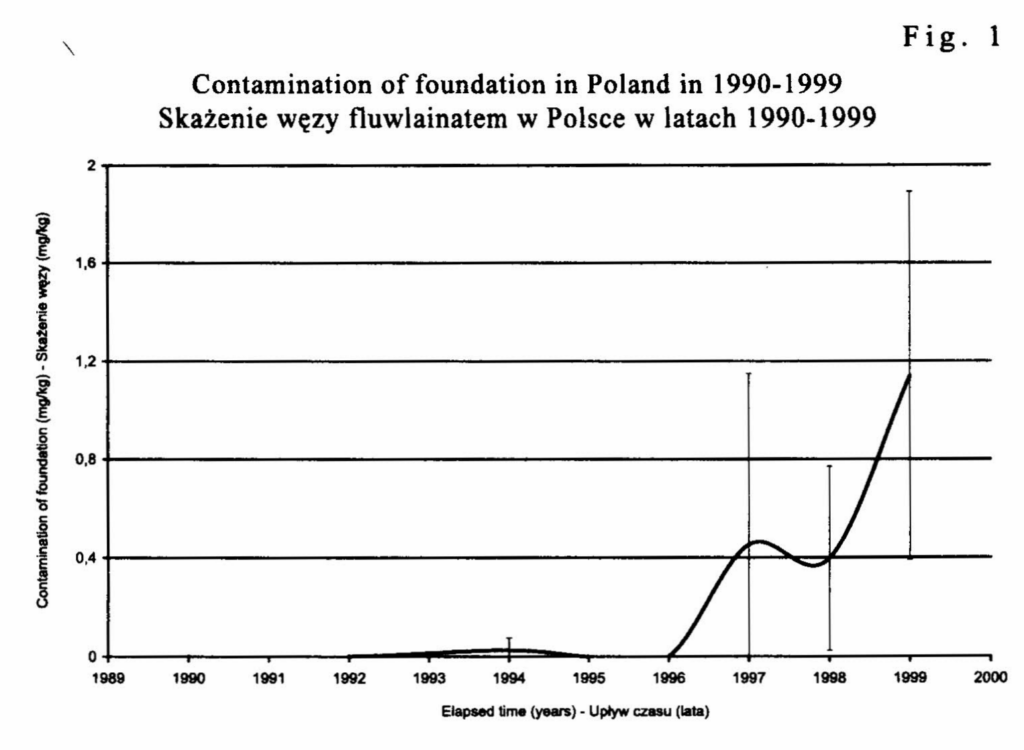
The main reason of ineffective treatment of warroa mites in infested colonies may be bad quality of the strips, containing too small amount of acaricide. Another possibility was inadequate placement of fluvalinate-containing strips inside the hive. It has been demonstrated that effectiveness of two strips of o Apistan in contamination of freshly built wax was the greatest when the source of fluvalinate was separated by only one super from the place of building (Kubik at al. 1995). Similar results was obtained by Romaniuk and Witkiewicz (2000). The authors demonstrated that the Apifos strips can kill 93% of parasites when inserted in close vicinity of a feeding vessel, but can be totally ineffective when placed in the place between last and before the last combs.
The third reason of decreased efficacy of fluvalinate against varroa mites may be generation of resistance to the acaricide. Resistance of varroa to Apistan was first reported from Italy (Milani and Ritter 1996; Milani 1997). The reason of generation of resistance varroa is mostly application of acaricide in sublethal levels – to small to kill all of the mites but high enough to kill the less resistant and allows to survive the more resistant ones. Situation like this takes place especially when the source of fluvalinate is permanently present in the hive. Such is a case when combs are contaminated with fluvalinate.
Very alarming is fast increase of contamination of foundation during the last three years. In 1996 fluvalinate was below the detection limit but in 1999
strona 19it average level was almost 1.2 mg/kg. That means that the wax – the source of foundation – is contaminated with fluvalinate to the similar level. It is to small amount to cause mortality of parasites, the more so that fluvalinate in a foundation and in combs is not distributed evenly. But a permanent presence of fluvalinate in hive makes the conditions favorable for generation of resistance of varroa mites to this compound.
There must be one more thing taken into considerations. It is the contamination of honey. It was shown, that fluvalinate contaminate not only wax, but propolis and honey too. Contamination of honey is approximately two orders less than contamination of wax, so when residues of fluvalinate in wax is 8 ppm, residues in honey is about 0.08 ppm.
Results obtained in this work do not allow us to distinguish in Poland the territories more or less contaminated foundation. To prepare picture like this it should be more data of contamination of the wax or foundation with fluvalinate, accessible.
The obtained data allow us to conclude that a new acaricide should be introduced for varroa control because the mites became resistant to fluvalinate. Introduction of a new preparate against varroa is also welcomed because fluvalinate contaminates also honey (Kubik et al. 1995; Kubik et al. 1996).
ACKLOWLEDGEMENT – The authors thank very much all bee product dealers for cooperation and sending us the samples of foundation.
LITERATURE
Balayannis P.G., Santas L.A. (1992)– Dissipation of malathion and fluvalinate resiudes from honey. J. Apic. Res., 31: 70-76.
Barbina M. T., De Paoli M. and Valentino A. (1990)- Determination of tau fluvalinate residues in honey. Pestic. Sci., 28: 197-202.
Barnavon M. Bornenck R. (1986)- Toxicite des insecticides sur les abeilles. Apiacta, 2: 3.
Faucon J.P., Flamini C., (1989)- Treatments of varroa disease. Comparative study of slow release inserts: preliminary trials. Bulletin des G.T.V. 1: 49-57.
Koeniger N. (1986)- Transport und Verteilung von Akaricden im Binenvolk unter Ausutung des Naturlichen Korperkontaktes der Bienen. Apidologie, 17: 387-383.
Konopacka Z., Bieńkowska M., Kubik M. (1998)- Skuteczność fluwalinatu w pasiekach po okresie wieloletniego stosowania tej substancji aktywnej w walce z warrozą. Materiały z XIV Naukowej Konferencji „Warroza pszczół, gospodarka pasieczna”, ART Olsztyn, 14-19.
strona 20Kubik M., Nowacki J., Marcinkowski J., Pidek A., Michalczuk L. (1996)- Penetration of fluvalinate into bee products II. The role of fluvalinate vapour. J. Fruit Ornam. Plant Res., 4: 55- 68.
Kubik M., Nowacki J., Michalczuk L., Pidek A., Marcinkowski (1995)- J. Penetration of fluvalinate in bee-products. J. Fruit Ornam.Plant Res., 3: 13-22.
Liu T.P. (1992)- Fluvalinate and his after-effect.Amer. Bee J., 6: 398.
Lodesani M., Pellacani A., Bergomi S., Carpana E., Rabitti T., Lasagni P. (1992)- Residue determination for some products used against Varroa infestation in bees. Apidologie, 23: 257-272.
Londzin W., Śledziński B. (1986)- Oporność roztocza Varroa jacobsoni na środki warroabójcze zawierające fau-fluvalinat. – Medycyna wet., 52: 526-528.
Milani N. (1997)– Imkern mit fluvalinat resistententen Varroamilben. Deutsches Bienen Journal, 1: 5-6.
- Milani N., Ritter W. (1996)– Erstes Auftreten einer Resistanz gegen Varroabekampfungsmittel. Biene, 132: 4-5.
Pidek A. (1998)- Metody leczenia warrozy pszczół w Polsce w latach 1991-1996. Pszczeln. Zesz. Nauk., 42: 169-176.
Romaniuk K., Witkiewicz W. (2000)- Skuteczność preparatu Apifos w zwalczaniu inwazji Varroa jacobsoni u pszczół. Pszczeln. Zesz. Nauk. suplement to vol 1.79-81. XXXV Naukowa Konferencja Pszczelarska w Puławach 8-9 marca 2000.
Sanford M.T. (1995).- Use it right or lose it. Apis 13: 1-3.
Thrasyvalou A. (1992).- Residues of insecticides/accaricides in honey: how dangerous are they and was to reduce them. Melissokomiki Epitheroisi, 6: 296-302.
Vandame R., Colin M.E., Belzuces L.P., Jourdan P. (1995)- Resistance of varroa to fluvlainate. Carnets du CADI 46(supplement): 5-11.
Vesely V., Machova M., Hessler J., Hotomska V., Lenicek J. (1994)- Reduction of fluvalinate residues in bees wax by chemical means. J. Apic. Res., 33: 185-187.
Wallner K. (1995)- Secondary effects in the control of varroa mites: the situation concerning residues in several bee products. Bienenvater, 116: 172-177.
Wallner K. (1999)– Varroacides and their residues in bee products. Apidologie, 30: 235-248.
strona 21SKAŻENIE WĘZY FLUWALINATEM W POLSCE W LATACH 1990-1999
M. Kubik, J. Nowacki, A. Pidek
Streszczenie
Celem stwierdzenia czy możliwe było uodpornienie roztoczy Varroa jacobsoni na fluvalinat oznaczono pozostałości tego akarycydu w węzie pochodzącej z terenu naszego kraju, z lat 1990-1999. Założono bowiem, że po kilku latach stosowania tego związku, dobrze rozpuszczalnego w wosku, mogło dojść do akumulacji takich ilości, które były w stanie doprowadzić do ciągłej obecności w ulu subletalnych ilości wolnego fluvalinatu, które drogą selekcji, zgodnej z mechanizmem dryfu genetycznego, mogły doprowadzić do wytworzenia się populacji roztocza znacznie mniej wrażliwego na preparaty oparte na fluwalinacie.
Ponieważ fluwalinat jest bardzo trwały chemicznie i nie ulega rozpadowi podczas przetapiania, uznaliśmy, iż znajomość skażenia węzy będzie dobrym wskaźnikiem skażenia wosku.
Pozostałości fluwalinatu oznaczano metodą chromatografii gazowej, po wyekstrahowaniu preparatu acetonem i dalszym oczyszczeniu metodą Solid Phase Extraction. Przebadano 31 próbek węzy nadesłanej nieodpłatnie przez różne instytucje, jak i osoby prywatne.
Fluwalinat pojawił się w węzie w roku 1994. Jednakże był to fakt incydentalny. O stałej obecności tego akarycydu w wosku, można mówić dopiero od roku 1997, od kiedy nastąpił szybki wzrost pozostałości do około 1 mg/kg.
Uzyskane wyniki pozwalają więc przypuszczać, iż występująca na terenie Polski populacja roztocza Varroa jacobsoni jest już w pewnym stopniu uodporniona na fluwalinat. Należy więc dążyć do szybkiej wymiany fluwalinatu na nowy preparat, skuteczny do walki z pasożytem. Być może takim preparatem będzie warrosekt.
Słowa kluczowe: fluwalinat, skażenie, węza, warroza.
Errata — błędy druku znalezione podczas digitalizacji
- s. 15: „Recived” → Received
- s. 15: „should bee directed” → should be directed
- s. 15: „wooden stripes” → wooden strips
- s. 15: „malation” → malathion
- s. 15, 17, 18: „at al.” → et al.
- s. 16: „In has been reported” → It has been reported
- s. 16: „weighting from” → weighing from
- s. 16: „Balayanis” → Balayannis
- s. 18: „of o Apistan” → of Apistan
- s. 18, ryc. 1: „fluwlainatem” → fluwalinatem
- s. 18, 19: „to small” → too small
- s. 19: „it average level” → its average level
- s. 19: „ACKLOWLEDGEMENT” → ACKNOWLEDGEMENT
- s. 19, piśmiennictwo: „resiudes” → residues
- s. 19, piśmiennictwo: „Akaricden” → Akariciden
- s. 19, piśmiennictwo: „Binenvolk” → Bienenvolk
- s. 19, piśmiennictwo: „Ausutung” → Ausnutzung
- s. 20, piśmiennictwo: „fau-fluvalinat” → tau-fluvalinat
- s. 20, piśmiennictwo: „resistententen” → resistenten
- s. 20, piśmiennictwo: „Resistanz” → Resistenz
- s. 20, piśmiennictwo: „accaricides” → acaricides
- s. 20, piśmiennictwo: „fluvlainate” → fluvalinate