

HOW MANY INDIVIDUALS SURVIVE WINTER IN INTACT COLONIES OF APIS MELLIFERA L. (HYMENOPTERA, APIDAE)?
tekst: Vladimír Ptáček, K. Čermák
Pszczelnicze Zeszyty Naukowe, Rok XLIV, Nr 2, 2000 — V. Ptáček, K. Čermák
strona 15PSZCZELNICZE ZESZYTY NAUKOWE Rok XLIV, Nr 2 2000
V. Ptáček, K. Čermák*
Masaryk University, Fac. Sci., Kotlářská 2, 611 37 Brno, Czech Rep.
- Bee Research Institute in Dol, 252 66 Libčice n. Vlt., Czech Rep.
Summary
From the 25 carnica colonies wintered in vertically orientated hives of the inner dimension 320 mm x 320 mm x 1220 mm which were supplied with ready stores (and so considered as „intact”) 4 colonies died in January 1998 because of improper stores organisation. The analyses of the dead clusters brought following respective amounts of bees: 13.772 (the swarmed one) 16.309, 19.180 and 22.964 (average weight 1 663 g). Those values are higher in comparison with those obtained by killing 284 colonies during the steps against Varroa which were undertaken in former Czechoslovakia in the years 1982 and 1983. (In the second case the average colony weight was as high as 820 g). Our data show that no stimulative feeding or other measures are necessary to obtain colonies of sufficient winter strength. According to the authors’ experience with wintering bees in larger hives (435 mm by 435 mm by 700 mm of internal dimensions) and Farrar’s management methods even more numerous colonies for winter can be obtained. Having discussed the obtained data and their own experience the authors conclude that: a) genetic limits enable to keep stronger colonies than it is common even without any special late summer treatment, b) the prevalent vertical dimension and square hive bodies are ideal for successful wintering of honey bee colonies, c) the least dimension of a hive space may limit a winter colony population.
Keywords: honey bee, Apis mellifera L., wintering, colony cluster.
INTRODUCTION
The size of a winter cluster generally is supposed to be one of the main factors affecting both the success of a colony in surviving the coldest period of a year as well as its early spring development resulting in the gross yearly productivity. Therefore, many attempts have been made in developing the best ways of colony management in order to ensure their successful wintering in the maximum possible strength.
In the USA and Canada currently (but not always) two or even three hive bodies of the Langstroth standard dimension are considered as an appropriate space for so called „normal colony” in winter (Farrar, 1968, and others). In Europe many colonies still enter winter in single chambers, or if they are given more space similarly to the American approach, the technique of preparing
strona 16colonies for wintering remains different. Whereas Americans from Demuth’s time (Root, 1959) used to leave ample stores of sealed honey toward the end of a season, Europeans mostly take away all honey replacing it by feeding sugar solution later.
The opinions about numbers of bees in wintering colonies differ considerably. Whereas many Europeans rely on a special treatment (e.g. on stimulative feeding) in order to obtain larger brood nests and consequently populations of young workers during late summer, the others adhere to the opinion that the bee amount in colonies is based on their internal factors and any efforts to affect it bring no result (Wille, 1983)
This paper brings some data from the analyses of clusters in colonies that died during winter and thus enabled a more accurate investigation of their strength. The gained data are then compared with those obtained from colonies killed deliberately in order to stop spreading of Varroa jacobsoni in former Czechoslovakia and finely some experiences of authors in implementation of Farrar’s methods are added with the aim to contribute to general understanding of wintering honey bee colonies.
MATERIAL AND METHODS
Colonies perished of starvation
Bees were kept in magazine hives on frames 300 mm (width) x 310 mm (height) in combination with the shallow equipment (300 mm by 170 mm). Each chamber contained 8 frames 28 mm thick with 10 mm bee spacers. Hive bodies were double-walled with 50 mm thick insulation layer of foam polystyrene. The sealed honey amount in large and shallow combs was 2 and 1 kg respectively.
During the active period in 1997, 25 productive colonies were kept in 2 deep brood chambers divided by bee excluder from supers of different dimensions equivalent to 2 deep ones at least. Toward the end of the honey flow (round July 15) most of colonies were reorganised according to the following scheme: the bee excluder was removed and one shallow chamber containing 8 kg of sealed honey was put just above the brood chambers as the main food reserve. At the very top a deep chamber containing round 8 kg of unsealed honey was placed. As colonies had some honey in brood chambers, too, the total winter reserves could be estimated at 20 kg. Besides the reduced main bottom entrance the upper one (25 mm diameter hole) was left open in the second brood chamber in the middle of its front wall.
Bees were expected to move the unsealed honey from the top honey chamber into the brood nest during the fall time, and the mostly empty chamber was supposed to be put away then. The intent was to leave 2 and ½ hive bodies for each colony. However, as bees mostly had not met our
strona 17expectation and let the honey at the top nearly untouched, the top deep chamber was left on colonies through the winter.
In the middle of January 1988 bees of 3 colonies used the short spell of warm weather to shift their position upwards, left the brood chambers and clustered just in the top deep chamber. Finally they died due to the lack of stores despite the fact that they had 8 kg of sealed honey only several cm below the cluster. The 4th dead colony was a swarmed one, which was left on to much space and similarly clustered above the stores. As the colonies were not managed in any way to affect their winter population they could be considered as intact from this point of view. We used the offered possibility to obtain more information about them.
Dead bees fallen on the bottom and adhering to combs were put together. A sample of several hundred bees was taken for determination of the weight of individual bees. The other part of cluster – bees remaining in cells – was removed from the combs in laboratory and similarly a sample was taken from this part of the cluster, too. As soon as we knew the weight of each part of a cluster, and the weight of samples taken from them, as well as the numbers of bees in samples, we were able to estimate the number of bees in each portion of a cluster and finally also the total number of bees wintering in each colony.
Colonies killed as a part of anti-varroa measures
In the autumn 1982 and spring 1983 in several regions of Czechia all honey bee colonies were killed in the efforts of the Bee Research Institute at Dol to stop the invasion of Varroa jacobsoni. As fortunately the weight of killed colonies was recorded we can use the obtained data now to illustrate the amount of bees which occupied hives in common bee-keeping practice. The summarised data are shown in Fig. 1 where each apiary is represented by a column the height of which means the average weight of colonies and the figures below the columns are the numbers of colonies killed in the given apiary.
The Farrar’s approach
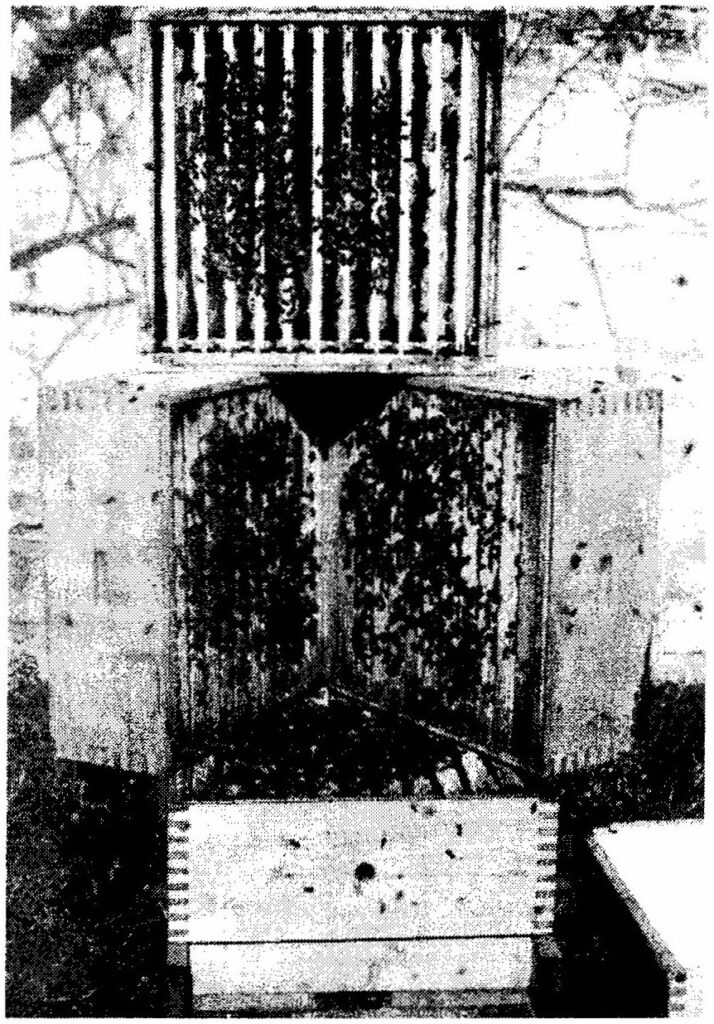
In early eighties several people in Czechia, including the authors of this article, started to test the Farrar’s (1968) method of keeping strong colonies by means of ample space and stores of pollen and honey. The common carnica colonies were kept in shallow single-walled equipment (so called „Optimal” hive) adapted to the frame dimension of 420 x 170 mm with 11 combs in each hive body. Colonies were wintered in 4 chambers on 25-30 kg of stores. The size of such colony inspected on April 14, 1981 is shown in Fig. 2.
strona 18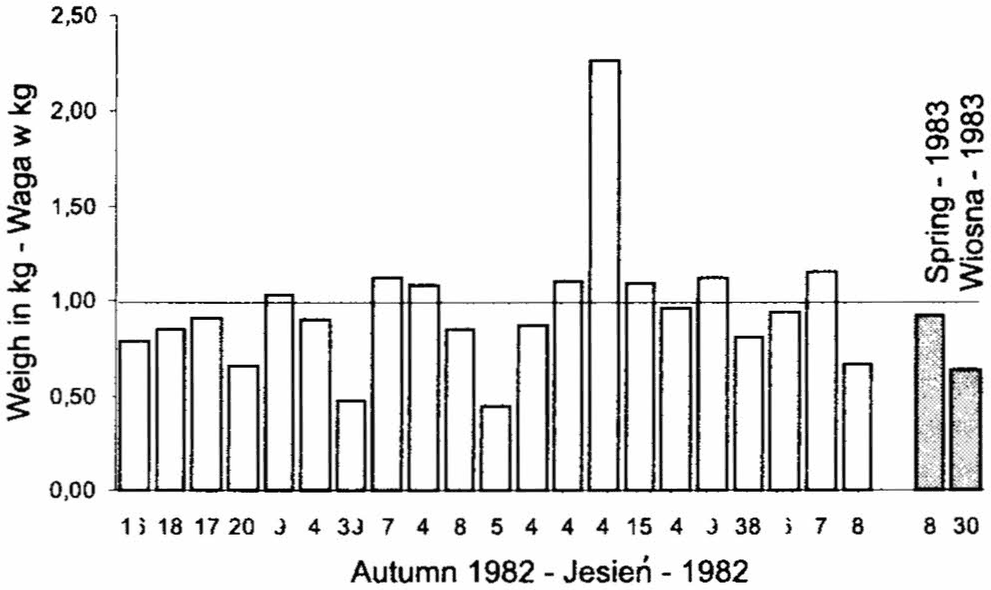
RESULTS AND DISCUSSION
The data obtained by investigation of 4 dead intact colonies are summarised in Table 1. In columns marked with „A” are presented data for portions of bees either fallen on bottoms or adhering on combs, and in those marked with „B” for bees which were inside the cells.
Table 1. The estimated size of 4 dead colonies Szacunkowa wielkość czterech spadłych rodzin
| Hive number / Numer rodziny | Colony weight A [g] | Colony weight B [g] | Bee weight A [mg] | Bee weight B [mg] | Est. bee number in hives A | Est. bee number in hives B | Bee number in samples A | Bee number in samples B | Total numbers of bees in hives |
|---|---|---|---|---|---|---|---|---|---|
| 1 | 1 333 | 687 | 92 | 87 | 14 489 | 7 897 | 411 | 167 | 22 964 |
| 3 | 1 280 | 628 | 106 | 98 | 12 075 | 6 343 | 533 | 229 | 19 180 |
| 17 | 898 | 528 | 98 | 81 | 9 163 | 6 519 | 343 | 286 | 16 309 |
| 11* | 678 | 578 | 99 | 91 | 6 918 | 6 352 | 256 | 246 | 13 772 |
A bees out of cells – pszczoły na plastrach B bees inside cells – pszczoły w komórkach plastrów *The swarmed colony – Rodzina wyrojona The average colony weight – Średni ciężar rodziny = 1 663 g. (The weight of bees in samples is not included in the table above so the mean value is slightly higher than the average from the shown figures.) The average colony population – Średnia liczebność rodziny = 18 056 bees / pszczół
The weight found per one bee was near 100 mg in the case of bees out of combs (A) which was expected, and seems to be a bit lower in the case of bees taken from cells (B), probably due to their desiccation during the laboratory work. The heaviest bees in the colony No. 3 may not be an accident. This colony had largest pollen reserves distributed equally in combs occupied by the cluster and bees might have eaten pollen instead of honey before they died. The total amount of bees estimated for three normal colonies 1, 3, 17 was 22.964, 19.180 and 16.309, respectively. The smallest was the colony No. 11, which swarmed earlier in the season.
Table 2 brings data illustrating the organisation of the clusters. As it is obvious, 50 – 65 % of bees were found outside of the cells. This might be even more in living colonies, which (according to bee keeping textbooks) should have a more loosened centre. However, in a starving colony, bees occupy all cells inside the cluster in order to reduce its dimension and consequently the
strona 20losses of temperature. The comparatively small number of inter-comb spaces, which were occupied by the clusters, may support this opinion. So the colony No.1 which had nearly 23 thousand of bees clustered in 6 spaces only and colonies Nos. 17 and 11 even in 5. The exception was the No. 3, which occupied the largest space (but with the same proportion of A and B bees as No.1). The reason for that might be probably the large pollen reserves which prevented tighter clustering.
Table 2. The structure of the clusters – Struktura kłębu zimowego
| Colony number / Numer rodziny | A – bees out of cells / pszczoły na plastrach | B – bees inside cells / pszczoły w komórkach plastrów | % of A / % A | Numbers of spaces between combs taken by clusters / Liczba uliczek międzyramkowych zajęta przez kłąb |
|---|---|---|---|---|
| 1 | 14 900 | 8 064 | 64.9 | 6 |
| 3 | 12 608 | 6 572 | 65.7 | 8* |
| 17 | 9 504 | 6 805 | 58.3 | 5 |
| 11** | 7 174 | 6 598 | 52.1 | 5 |
*Pollen in combs – Pyłek w plastrach **The swarmed colony – Rodzina wyrojona
The phenomenon studied shows that no comb space with insufficient stores should be left on the top of a hive for winter. The wintering bees are able to shift their position vertically (if they do not have any brood) into the warmest sector of the hive where they may die when the following period of cold is long. For a winter cluster any stores below it are useless before it is warm enough to allow bees to transport honey from below.
To illustrate the event completely it remains to add that other 21 colonies survived in similarly organised hives successfully because they remained clustered below the main stores all the winter thus having the main honey reserves still at disposal in the proper position.
According to the numbers of 16-23 thousand of wintering bees the colonies investigated can be considered as middle strong. Even the colony that swarmed still was able to develop a population of 13 thousand bees, what is even above the level that is common in practice (see below). Comparing similar strong but survived colonies we can estimate that 20 thousand of bees would control round 16 combs of the larger dimension (2 deep chambers or 133 dm² of combs) after they release the cluster. Such colonies developed explosively in the given kind of hive. Therefore, as it can be concluded, sufficient space and stores round 20 kg left in the hive of the given shape are
strona 21enough to allow the colony of carniolan bee to build up 16-23 thousand of wintering bees.
Now, in this context, let us compare the above-discussed data with those collected by registration of the weight of deliberately killed colonies. As it can be seen at Fig. 1, the differences are considerable. The line at the 1-kg level enables easier estimation of individual values.
Only in 8 from 23 apiaries (35%) the average weight of colonies reached over the 1-kg level. The extreme exceptions were 4 colonies at the level of 2,27 kg. Totally 284 colonies were killed with the average weight of 0,82 kg per colony. This would correspond well with the known founding of Kündig (1972) who reported values ranging from 750 to 1.800 g with averages just round 1 kg. The average weight of those 4 dead colonies (see Tab.1) equals to 1,66 kg which is twice as high as what was common in our country in early eighties. However, as these data as well as those 4 extremes in Fig.1 show, much better than common results are possible.
The approach according to Farrar (1968) consists in giving bees more space and stores than it is usual. Since 1980 the authors have been keeping at least a part of their colonies according to Farrar’s instructions. They came to the experience that similar colony population as was reported from USA is possible in our carnica bee, too. Fig 2 shows one from several first colonies kept in shallow magazines and wintered on 44 frames 420 by 170 mm. The hive was checked on April 14, 1981, and in the very cold spring with night sub zero temperatures the colony occupied well 3 upper hive bodies reaching even to the bottom one. The estimated weight of the colony was approximately 3 kg of bees.
Evaluating experience in wintering carniolan bees 25 seasons in different hive systems we can conclude that the hive space may affect the strength of wintered colonies limiting it by its least dimension. As anybody can observe on his own bees, under lowering temperature a colony makes the cluster. The shape of the cluster is the more spherical, the fewer bees it has, and the lower the temperature is. Strong colony’s cluster shape is more elongated in the vertical dimension similar to a reversed pear. From above, any cluster looks more or less round. The more bees form a cluster the larger is its horizontal diameter and the longer it is.
In the common bee keeping Central European practice considerable numbers of colonies are wintered in one comparatively shallow hive body – let us say 11 combs 420 x 250 mm. In this situation the dimension 250 mm would be limiting for the spherical cluster, which could not be larger than those 250 mm and would then hardly use more than 7 combs. This model situation might be the reality in most of the colonies killed in 1982 and 1983, which had the population under or round 1 kg. In our country the frame size 390 by 240 mm
strona 22has been used most often and prevailing numbers of colonies are wintered in one hive body only.
If a colony has the unlimited vertical dimension, the least horizontal dimension would limit the size of the cluster. On, let us say, 8 combs in several hive bodies a cluster could use all 7 spaces between combs and its shape would be vertically elongated. This would enable to winter colonies with 15-20 thousand of bees. The length of frames overreaching the width of the hive space has no positive effect here, as this is the comb space uncontrolled by bees in winter. The length of frames would become limiting for a colony population if it is shorter than the width of the hive space given by the number of combs. Then, several side combs would be out of the space covered by clustered bees. The ideal hive for wintering middle strong colonies is that (described above) with several square hive bodies having at least 8 combs in each. Colonies (should) have ample stores above the cluster and winter movement upward corresponds to the bee nature.
The largest colonies can be wintered in equivalently large hives. This is the third case where colonies have 11 frames 420 mm long in square bodies and several chambers make the vertical dimension large enough to hive the strongest colonies. Clusters of such top colony use all 10 spaces between combs and after their release the bees control round 200 dm² of comb area. Such colonies also do not require any stimulative treatment, just space and stores. Not all carniolan colonies can use the maximum dimension hive but only large hives give the possibility of true evaluation of what actually is inherited.
CONCLUSIONS
Evaluating the discussed data and experiences we can conclude that:
a) genetic limits permit to keep much stronger carniolan colonies than it is common;
b) to obtain vigorous colonies any late summer treatment is not necessary;
c) ample hive space and stores properly organised are important factors besides the others commonly accepted;
d) the prevalent vertical dimension and square hive bodies are ideal for successful wintering of honey bee colonies;
e) the least dimension of a winter hive space may limit the bee population.
ACKNOWLEDGEMENTS
Our cordial thanks for technical assistance belong to Doležalová B., i.m., and Jedličková I.
strona 23REFERENCES
Kündig W. (1972)- Wie wenig Bienen überwintern. Schweizerische Bienenzeitung 1: 18-20.
Farrar C. I. (1968)- Productive management of honey-bee colonies. Amer. Bee J., 108(8): 3-10.
Root A. I. (1959)- ABC and XYZ of bee culture. A. I. Root Company, Medina, Ohio, U.S.A., 289-295.
Wille H. (1983)- Überlegungen zur Prüfung von Bienenfuttermitteln. Schweizerische Beienenzeitung, 4: 166-179.
ILE OSOBNIKÓW PRZEŻYWA ZIMĘ W RODZINACH APIS MELLIFERA L. (HYMENOPTERA, APIDAE)?
Ptáček V., Čermák K.
Streszczenie
Z 25 rodzin Apis mellifera carnica zimowanych w ulach-stojakach o wewnętrznych wymiarach 320 mm x 320 mm x 1220 mm, które były zaopatrzone w gotowe zapasy pokarmu 4 rodziny spadły w styczniu 1998 z powodu niewłaściwego rozłożenia go w plastrach. Analiza pszczół w spadłych rodzinach wykazała odpowiednio następujące ilości pszczół: 13.772 (wyrojona) 16.309, 19.180 i 22.964 (o przeciętnej wadze 1663 g). Te wartości są wyższe, niż uzyskane w dawnej Czechosłowacji w latach 1982-1983, gdy w trakcie zabiegów przeciw Varroa przeanalizowano 284 zabitych rodzin, których przeciętna waga nie przekraczała 820 g. Nasze wyniki wskazują, że ani podkarmianie pobudzające, ani inne środki nie są niezbędne do uzyskania rodziny o wystarczającej sile do przezimowania. Na podstawie doświadczenia autorów z zimowaniem pszczół w większych ulach (o wewnętrznych rozmiarach 435 mm x 435 mm x 700 mm) prowadzonych zgodnie z metodami Farrar’a, stwierdzono że przed zimą można uzyskać nawet bardziej liczebne rodziny. Analizując uzyskane wyniki autorzy są zdania, że a) możliwości genetyczne pszczół umożliwiają uzyskanie bardziej silnych rodzin, niż dotychczas, bez jakiegokolwiek specjalnego ich traktowania późnym latem, b) pionowy rozmiar i kwadratowe ściany ula są idealne dla pomyślnej zimowli rodziny pszczoły miodnej, c) wymiary ula mogą jedynie w niewielkim stopniu wpływać na liczebność zazimowanej rodziny.
Słowa kluczowe: pszczoła miodna, Apis mellifera L., zimowanie, rodzina, kłąb.
Errata — błędy druku znalezione podczas digitalizacji
- s. 16: „finely some experiences” → finally some experiences
- s. 17: „January 1988″ → January 1998
- s. 17: „to much space” → too much space
- s. 18, ryc. 1: „Weigh in kg” → Weight in kg
- s. 23, piśmiennictwo: „Beienenzeitung” → Bienenzeitung