

EGG WEIGHT VARIABILITY IN HONEY BEE (APIS MELLIFERA) QUEENS
tekst: Elżbieta Król
Pszczelnicze Zeszyty Naukowe, Rok XL, 1996 — Elżbieta Król
strona 33PSZCZELNICZE ZESZYTY NAUKOWE Rok XL, Nr 2 1999
Elżbieta Król
Bee Research Department, Agricultural University Al. 29 Listopada 52, 31-425 Kraków, POLAND
Summary
Egg weight variability was studied in five full-sister honey bee (Apis mellifera) queens of the carnica race. The eggs were weighed every five days, from the fifth to the eightieth (max.) day of ovipositing. All weighed eggs were no older than 16 h. Egg weight in honey bee queens was found to have great intra- and inter-individual variability. In two queens the average weight of eggs was negatively correlated with their number. The weight of the eggs did not seem to be dependent on sudden changes in meteorological conditions.
Keywords: Apis mellifera carnica, egg weight variability, egg number.
INTRODUCTION
The weight of eggs laid by honey bee (Apis mellifera) queens is an important life-history parameter and has impact on beekeeping. It has been suggested that queens reared from heavier eggs are heavier and have more ovarioles than those from lighter eggs (Borodacheva 1973). Bilash et al. (1985) reported that colonies headed by queens reared from heavier eggs produce more honey than those headed by queens reared from lighter eggs. Despite these potential consequences, knowledge of egg weight variability in the honey bee is still relatively scant .
It is known that eggs laid by A. m. mellifera queens are different in size from eggs laid by laying workers (Woyke 1994), as in A. florea (Woyke and Wongsiri 1992). The sizes of fertilized and unfertilized eggs deposited by two A. m. ligustica queens during 2.5 months were reported not to differ (Henderson 1992). The size of fertilized eggs seems to depend on the queen’s race. Eggs laid by A. m. mellifera queens (Hejtmanek 1961, Woyke 1994) were a little larger than those in A. m. carnica (Jordan 1961), while eggs laid by A. m. ligustica (Henderson 1992) were a little larger than those in A. m. mellifera. Among the factors influencing egg size or weight, both genetic factors (Tabor and Roberts 1963) and non-genetic ones such as egg laying rate, season and colony size (Hejtmanek 1961, Jordan 1961,
strona 34Borodacheva 1974, Henderson 1992) are mentioned. Alhaddad and Darchen (1995) are of the opinion that the weight of eggs might depend on the weather. It is also documented that the size of eggs in A. mellifera changes during the incubation period (Woyke, 1996), as in three Asian honey bee species (Woyke 1993).
The aim of this paper was to study: 1) changes in the weight of eggs laid by honey bee queens at the beginning of oviposition, 2) the relationship between egg weight and number, and 3) the relationship between egg weight and meteorological conditions.
MATERIAL AND METHODS
The experiment was carried out at an apiary in Cracow from June to October 1995, on five full-sister honey bee queens of the carnica race. Each queen, eight days old, was instrumentally inseminated with the semen of one unrelated drone (all drones originated from one colony). Three days after insemination, on 9 July, the queens were introduced into colonies which had been dequeened for 10 h. Each colony was hived in one standard 10-frame box (frames 360 x 260 mm). The colonies were of approximately equal strength in terms of number of workers, area of brood (5-7 frames) and honey and pollen reserves (3-5 frames). From 12 July the colonies were checked daily for the presence of eggs.
The eggs laid by the queens were weighed every five days, from the fifth to a maximum of the eightieth day of ovipositing. The day before weighing the eggs, at 16:00 h the queen was put on an empty comb covered on either side with a queen excluder. The comb with the queen was placed into the centre of the nest. The next morning at 8:00 h the queen was released; thus the eggs laid on the comb were not older than 16 h.
The eggs (max. 129) were pulled out of the comb cells with a small paintbrush and inserted into tightly closed vials (20 eggs per one vial). Then the eggs were immediately weighed individually on a Mettler UMT2 balance (± 0.0001 mg). After weighing, the eggs remaining in the comb were counted, in order to calculate the total number of eggs laid by the queen during the isolation period.
All the meteorological data (average, minimum and maximum daily ambient temperature; daily precipitation) for June-October 1995 were obtained from a weather station near the apiary.
The results are presented as averages ± standard deviations; n refers to the sample size. All statistical calculations were done according to Sokal and Rohlf (1981). The normality of the eggs weight distributions was checked by Shapiro-Wilk statistics. Data on the weight of eggs laid by individual queens on succceding days of ovipositing were analyzed with the Kruskal-Wallis test. The relationship
strona 35between the weight and number of eggs was described by Pearson correlation coefficients (r). The significance of r was checked by the F-test. In all the tests, differences were accepted as significant at p ≤ 0.05.
RESULTS
All queens began ovipositing between 16 and 21 July. Information on this and on the queens’ condition is given in table 1.
T a b l e 1. Characteristics of the honey bee queens used in the experiment. Charakterystyka matek pszczelich użytych w doświadczeniu.
| Queen no. Matka nr | Beginning of ovipositing Początek czerwienia | End of measurements Koniec pomiarów | Additional information Informacje dodatkowe |
|---|---|---|---|
| 1 | 16 VII | 28 IX | queen in good condition matka w dobrej kondycji |
| 2 | 17 VII | 3 X | queen with an injured leg matka z uszkodzoną nogą |
| 3 | 16 VII | 28 IX | 3 X – supersedure of the queen 3 X – cicha wymiana matki |
| 4 | 20 VII | 17 IX | 22 IX – queen crushed by a frame 22 IX – matka zgnieciona ramką |
| 5 | 21 VII | 3 X | queen in good condition matka w dobrej kondycji |
The results of egg weight measurements are given in table 2. Queens were isolated 75 times altogether, but only 63 instances resulted in laying eggs. In 58 trials the queens laid more than 10 eggs. Among the 58 egg weight frequency distributions tested, only 9 were normal distributions (queen no. 1, 65th day of ovipositing; queen no. 2, 15th and 80th day of ovipositing, queen no. 3, 15th and 70th day of ovipositing; queen no. 4, 20th, 30th, 40th and 60th day of ovipositing). All the other distributions were skewed to the right (see Fig. 1 for an example).
strona 36T a b l e 2. Characteristics of eggs laid by queens nos. 1-5 on succeeding days of ovipositing Charakterystyka jaj składanych przez matki nr 1-5 w kolejnych dobach czerwienia
| Queen no. Matka nr | Day of ovipositing Doba czerwienia | n | Egg weight (mg) Masa jaj (mg): X | Egg weight (mg) Masa jaj (mg): SD | Egg weight (mg) Masa jaj (mg): min | Egg weight (mg) Masa jaj (mg): max | Total number of eggs Całkowita liczba jaj |
|---|---|---|---|---|---|---|---|
| 1 | 5 | 0 | – | – | – | – | 0 |
| 1 | 10 | 106 | 0,1460 | 0,0140 | 0,1078 | 0,1716 | 375 |
| 1 | 15 | 104 | 0,1489 | 0,0171 | 0,0293 | 0,1671 | 440 |
| 1 | 20 | 105 | 0,1605 | 0,0086 | 0,1221 | 0,1782 | 250 |
| 1 | 25 | 104 | 0,1610 | 0,0102 | 0,1149 | 0,2010 | 422 |
| 1 | 30 | 104 | 0,1617 | 0,0150 | 0,0891 | 0,1790 | 377 |
| 1 | 35 | 103 | 0,1613 | 0,0123 | 0,1200 | 0,1864 | 609 |
| 1 | 40 | 101 | 0,1666 | 0,0106 | 0,1251 | 0,1877 | 640 |
| 1 | 45 | 87 | 0,1752 | 0,0139 | 0,0983 | 0,2004 | 246 |
| 1 | 50 | 0 | – | – | – | – | 0 |
| 1 | 55 | 129 | 0,1836 | 0,0147 | 0,1070 | 0,2199 | 230 |
| 1 | 60 | 47 | 0,1826 | 0,0140 | 0,1349 | 0,2000 | 58 |
| 1 | 65 | 14 | 0,2051 | 0,0085 | 0,1877 | 0,2127 | 17 |
| 1 | 70 | 0 | – | – | – | – | 0 |
| 1 | 75 | 1 | 0,2127 | – | 0,2127 | 0,2127 | 2 |
| 1 | 80 | 0 | – | – | – | – | 0 |
| 2 | 5 | 108 | 0,1529 | 0,0123 | 0,1109 | 0,1799 | |
| 2 | 10 | 105 | 0,1422 | 0,0122 | 0,0728 | 0,1615 | 220 |
| 2 | 15 | 106 | 0,1550 | 0,0099 | 0,1196 | 0,1890 | 390 |
| 2 | 20 | 104 | 0,1604 | 0,0091 | 0,1267 | 0,1936 | 140 |
| 2 | 25 | 108 | 0,1542 | 0,0128 | 0,0994 | 0,1781 | 278 |
| 2 | 30 | 111 | 0,1527 | 0,0154 | 0,0943 | 0,1751 | 484 |
| 2 | 35 | 104 | 0,1515 | 0,0109 | 0,1330 | 0,1977 | 473 |
| 2 | 40 | 104 | 0,1595 | 0,0112 | 0,1033 | 0,1800 | 396 |
| 2 | 45 | 63 | 0,1617 | 0,0138 | 0,1076 | 0,1856 | 96 |
| 2 | 50 | 51 | 0,1530 | 0,0104 | 0,1158 | 0,1687 | 61 |
| 2 | 55 | 102 | 0,1499 | 0,0128 | 0,1106 | 0,1732 | 509 |
| 2 | 60 | 86 | 0,1609 | 0,0096 | 0,1217 | 0,1789 | 108 |
| 2 | 65 | 0 | – | – | – | – | 0 |
| 2 | 70 | 3 | 0,1507 | 0,0145 | 0,1362 | 0,1652 | 6 |
| 2 | 75 | 0 | – | – | – | – | 0 |
| 2 | 80 | 24 | 0,1608 | 0,0070 | 0,1474 | 0,1701 | 35 |
| 3 | 5 | 103 | 0,1476 | 0,0152 | 0,0892 | 0,1698 | – |
| 3 | 10 | 0 | – | – | – | – | 0 |
| 3 | 15 | 100 | 0,1522 | 0,0129 | 0,1057 | 0,1773 | 425 |
| Queen no. Matka nr | Day of ovipositing Doba czerwienia | n | Egg weight (mg) Masa jaj (mg): X | Egg weight (mg) Masa jaj (mg): SD | Egg weight (mg) Masa jaj (mg): min | Egg weight (mg) Masa jaj (mg): max | Total number of eggs Całkowita liczba jaj |
|---|---|---|---|---|---|---|---|
| 3 | 20 | 62 | 0,1451 | 0,0150 | 0,0819 | 0,1701 | 82 |
| 3 | 25 | 104 | 0,1555 | 0,0117 | 0,1075 | 0,1772 | 153 |
| 3 | 30 | 104 | 0,1415 | 0,0151 | 0,0922 | 0,1668 | 485 |
| 3 | 35 | 103 | 0,1557 | 0,0125 | 0,1059 | 0,1763 | 374 |
| 3 | 40 | 111 | 0,1484 | 0,0195 | 0,0815 | 0,1806 | 178 |
| 3 | 45 | 88 | 0,1581 | 0,0185 | 0,1018 | 0,1824 | 215 |
| 3 | 5 | 3 | 0,154 | 0,015 | 0,097 | 0,170 | 51 |
| 3 | 55 | 28 | 0,1524 | 0,0220 | 0,1135 | 0,1762 | 28 |
| 3 | 60 | 13 | 0,1637 | 0,0177 | 0,1123 | 0,1849 | 14 |
| 3 | 65 | 108 | 0,1767 | 0,0101 | 0,1292 | 0,1967 | 178 |
| 3 | 70 | 73 | 0,1828 | 0,0092 | 0,1616 | 0,2023 | 89 |
| 3 | 75 | 11 | 0,1862 | 0,0148 | 0,1455 | 0,1971 | 15 |
| 3 | 80 | 0 | – | – | – | – | 0 |
| 4 | 5 | 105 | 0,1480 | 0,0100 | 0,1098 | 0,1677 | – |
| 4 | 10 | 104 | 0,1525 | 0,0113 | 0,1186 | 0,1863 | 350 |
| 4 | 15 | 104 | 0,1425 | 0,0132 | 0,0983 | 0,1650 | 650 |
| 4 | 20 | 104 | 0,1576 | 0,0089 | 0,1276 | 0,1757 | 475 |
| 4 | 25 | 3 | 0,1520 | 0,0106 | 0,1404 | 0,1612 | 3 |
| 4 | 30 | 106 | 0,1526 | 0,0118 | 0,1024 | 0,1873 | 654 |
| 4 | 35 | 104 | 0,1558 | 0,0117 | 0,1278 | 0,1799 | 488 |
| 4 | 40 | 120 | 0,1476 | 0,0171 | 0,0919 | 0,1742 | 208 |
| 4 | 45 | 39 | 0,1512 | 0,0180 | 0,0571 | 0,1668 | 39 |
| 4 | 50 | 118 | 0,1526 | 0,0153 | 0,0750 | 0,1731 | 602 |
| 4 | 55 | 103 | 0,1542 | 0,0112 | 0,1151 | 0,1748 | 603 |
| 4 | 60 | 104 | 0,1540 | 0,0133 | 0,1131 | 0,1876 | 451 |
| 5 | 5 | 104 | 0,1671 | 0,0142 | 0,1143 | 0,1909 | 140 |
| 5 | 10 | 104 | 0,1635 | 0,0131 | 0,1156 | 0,1850 | 700 |
| 5 | 15 | 102 | 0,1599 | 0,0144 | 0,1042 | 0,1845 | 430 |
| 5 | 20 | 0 | – | – | – | – | 0 |
| 5 | 25 | 6 | 0,1854 | 0,0069 | 0,1794 | 0,1983 | 6 |
| 5 | 30 | 103 | 0,1895 | 0,0124 | 0,1350 | 0,2104 | 460 |
| 5 | 35 | 102 | 0,1708 | 0,0114 | 0,1347 | 0,1938 | 536 |
| 5 | 40 | 103 | 0,1685 | 0,0191 | 0,1119 | 0,2004 | 475 |
| 5 | 45 | 107 | 0,1740 | 0,0182 | 0,0937 | 0,2023 | 315 |
| 5 | 50 | 86 | 0,1910 | 0,0152 | 0,1371 | 0,2179 | 122 |
| 5 | 55 | 101 | 0,1896 | 0,0147 | 0,1353 | 0,2235 | 236 |
| 5 | 60 | 0 | – | – | – | – | 0 |
| 5 | 65 | 0 | – | – | – | – | 0 |
| 5 | 70 | 0 | – | – | – | – | 0 |
| 5 | 75 | 1 | 0,2322 | – | 0,2322 | 0,2322 | 1 |
n – number of weighed eggs, – liczba zważonych jaj X – average weight of eggs, – średnia masa jaj SD – standard deviation, – odchylenie standardowe min – minimum weight of eggs, -minimalna masa jaj max – maximum weight of eggs – maksymalna masa
strona 38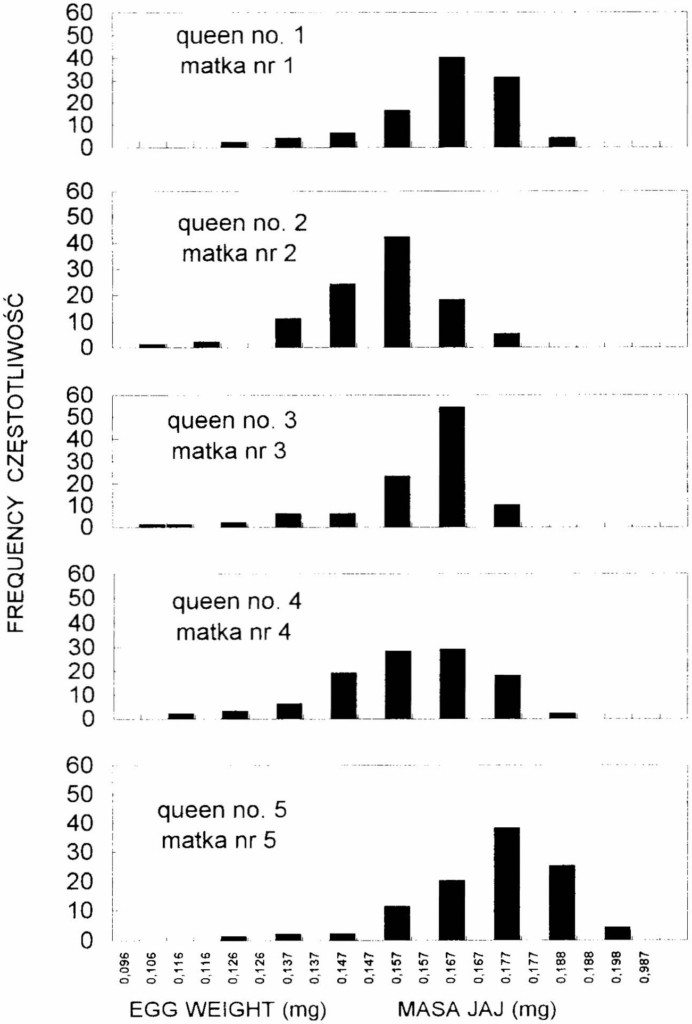
The eggs laid by a single queen within the 16 h isolation period varied considerably in weight. The heaviest eggs were on average 1.8 ± 0.6 times heavier than the lightest ones (n = 58). The ratio of maximum to minimum egg weight ranged from 1.1 (queen no. 1, 65th day of ovipositing) to 5.7 (queen no. 1, 15th day of ovipositing).
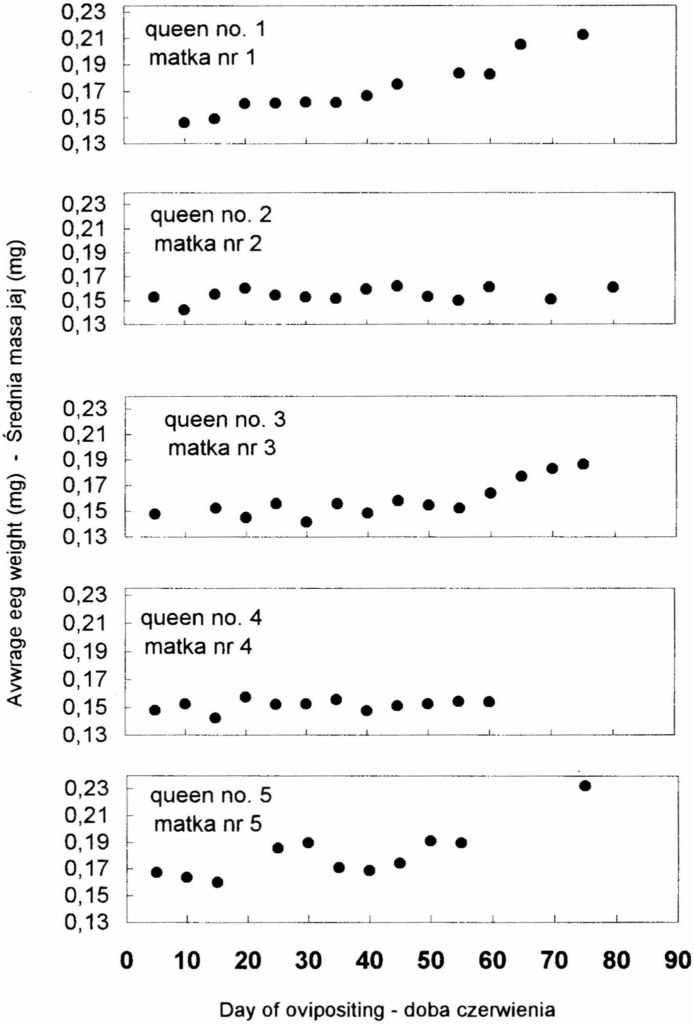
In each queen the average weight of eggs changed during the studied period (p < 0.05). No pattern in these changes common to all studied queens was observed (Fig. 2). Queens nos. 1, 3 and 5 tended to lay heavier eggs at the end of the season, while in queens nos. 2 and 4 the egg weights at the end of the season were similar to those at the beginning.
In queens nos. 1 and 5, average egg weight was negatively correlated with total egg number (r = -0.76, p = 0.004; r = -0.64, p = 0.035). For queens nos. 2, 3 and 4 the correlation was not significant (r = -0.31, p = 0.307; r = -0.45, p = 0.125; r = 0.03, p = 0.929).
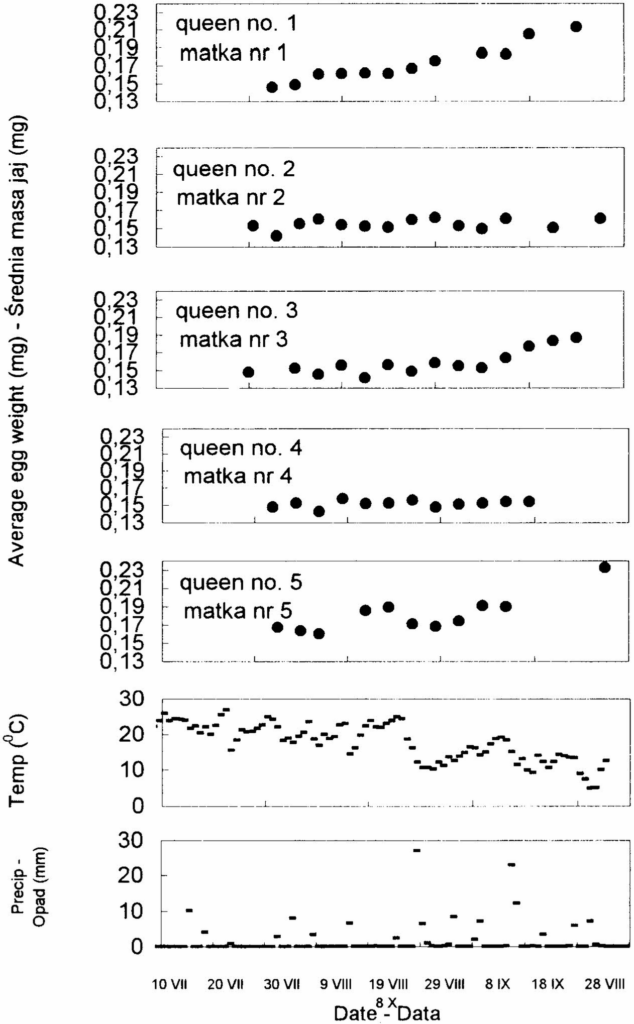
None of the sudden changes in ambient temperatures or precipitation resulted in a change of average egg weight simultaneously in all studied queens (Fig. 3).
DISCUSSION
The results show that there is considerable variability in the weight of eggs laid by honey bee queens. This variability was observed at all studied levels: 1) in eggs laid by a single queen within the 16 h isolation period, 2) in eggs laid by a single queen on succeeding days of oviposition, and 3) in eggs laid by different but closely related queens. This suggests that an appreciable amount of egg weight variability may have been caused not by genetic, but by environmental factors. If so, heritability of egg weight might be expected to be rather low. Hejtmanek (1961) and Jordan (1961) reported that egg size seems to be dependent to a large extent on egg laying rate, season and colony size. Taber and Roberts (1963) suggested that egg weight and egg size are controlled mainly by genetic factors, although environmental factors also contribute to the total variability. In none of these papers was the heritability of egg size or egg weight in fact estimated, so further study is clearly required.
Most of the egg weight frequency distributions studied in this paper were skewed to the right. Virgin queens and laying workers are similar in this regard (E. Król, unpubl. data). This skewness to the right may have resulted from the presence of unviable eggs, which are likely to be smaller than viable ones. On the other hand, it is known that even very small eggs are able to develop. Du Praw (1961) found that one egg laid by a queen was almost half the size of an egg laid 90 min. earlier , and both developed normally and hatched almost simultaneously. Does the weight of an egg affect the adult worker, that is, its body size, condition, behaviour or
strona 42longevity? If so, egg weight variability would generate phenotypic variation within a colony, which might have a certain adaptive value. K. Bienefeld (personal communication) suggests, for example, that egg size variation tends to increase variation in undertaking different tasks at different ages, via adult size variation. Thus, further studies should focus on the correlation between egg weight and life-history traits.
The results of egg weight vs. egg number studies are not consistent. In this study, for two queens the eggs were heavier and their numbers were fewer. For three other queens such a correlation was not found. Hejtmanek (1961), Jórdan (1961) and Borodacheva (1974) demonstrated a decrease in egg size with an increase in egg laying rates, while Roberts and Taber (1965) found no correlation between these two parameters. This discrepancy may result from the fact that the number of eggs found in the comb at the moment of releasing the queen might not be equal to the number of eggs laid by it during the isolation period. Some eggs can be eaten by workers (Woyke 1977). Moreover, when we take the comb from the nest after several hours of queen isolation, we know nothing about the real time spent laying eggs. To assess the egg weight vs. egg laying rate relationship, direct observations of both the queen and the eggs are needed.
CONCLUSIONS
- Egg weight in honey bee queens is characterized by great intra-individual variability (differences in weights of eggs laid by a queen within a 16 h isolation period, and changes in weights during the succeeding days of ovipositing) and by great inter-individual variability (differences in the weights of eggs laid by close related queens).
- The weight of the eggs may depend on the queen’s egg laying rate, but to verify this direct observations are needed.
- Egg weight does not seem to be dependent on sudden changes in meteorological conditions such as ambient temperatures or precipitation.
ACKNOWLEDGMENTS
I thank M. Woyciechowski, M. Jacobs, M. Góral, J. Sroka and A. Omastka for their help.
strona 43REFERENCES
Alhaddad S., Darchen B. (1995) – The influence of meteorological conditions on the feeding and egg laying of the queen honey bee. C. R. Acad. Sci. Paris, Life sciences, 318: 245-248.
Bilash G. D., Borodacheva V. T., Timosinova A. E. (1985) – Quality of artificially reared queen bees. Proc XXIXth Int Congr Apicult, Budapest 1983, Apimondia Publ House, Bucharest: 114-118.
Borodacheva V. T. (1973) – Ves yaits i kachestvo matok i pchel. Pchelovodstvo 93 (9): 12-13 (in Russian).
Borodacheva V. T. (1974) – Izmenenie vesa yaits u medonosnoi pchely v techenie sezona. Trudy Nauchno-Issledovatelskovo Instituta Pchelovodstva: 105-110 (in Russian).
Du Praw E. J. (1961) – A unique hatching process in the honeybee. Trans. Amer. Micros. Soc. 80: 185-191.
Hejtmanek J. (1961) – The variability in honey bee eggs. Ved. Pr. Vyzk. Ustavu Vcelarsky CSAZV 1960, 2: 169-196 (in Czech, Eng summary).
Henderson C. E. (1992) – Variability in the size of emerging drones and of drone and worker eggs in honey bee (Apis mellifera L.) colonies. J. apic. Res., 31 (3/4): 114-118.
Jordan R. (1961) – Relations between egg size and the rate of egg laying. Bienenvater, 82: 132-134.
Roberts W. C., Taber S. (1965) – Egg-weight variance in honey bees. Ann. Entomol. Soc. Am., 58: 303-306.
Sokal R. R., Rohlf F. J. (1981) – Biometry, 2nd edn. Freeman, New York.
Taber S., Roberts W. C. (1963) – Egg weight variability and its inheritance in the honey bee. Ann. Entomol. Soc. Am., 56: 473-476.
Woyke J. (1977) – Cannibalism and brood-rearing efficiency in honeybee. J. apic. Res., 16 (1) : 84-94.
Woyke J. (1993) – Size change of eggs during the ircubation period in three Asian honey bee species. Proc 1st Symp Asian Honey Bees and Mites, Bangkok, 197-205.
Woyke J. (1994) – Comparison of the size of eggs from Apis mellifera L queens and laying workers. Apidologie, 25: 179-187.
Woyke J. (1996) – Size change of honeybee eggs during incubation period. III. polsko-niemieckie sympozjum, Olsztyn 1996, Streszczenia Referatów: 92.
Woyke J., Wongsiri S. (1992) – Occurrence and size of laying worker eggs in Apis florea colonies. J. apic. Res., 31 (3/4): 124-127.
ZMIENNOŚĆ MASY JAJ U MATEK PSZCZOŁY MIODNEJ (Apis mellifera)
E. Król
Streszczenie
Celem pracy było zbadanie: 1) zmienności masy jaj składanych przez matki pszczele w początkowym okresie czerwienia, 2) zależności między masą jaj a ich liczbą, oraz 3) zależności między masą jaj a warunkami meteorologicznymi.
Badania przeprowadzono w okresie od czerwca do października 1995, w pasiece doświadczalnej Zakładu Pszczelnictwa AR w Krakowie. Do doświadaczenia użyto 5 matek
strona 44pszczelich rasy carnica, będących pełnymi siostrami. Każdą z matek unasieniono spermą niespokrewnionego z nią trutnia. Trutnie użyte do inseminacji były braćmi. Jaja składane przez matki ważono regularnie (± 0.0001 mg) co 5 dni, od 5. do maksymalnie 80. doby czerwienia. Każdorazowo ważono nie więcej niż 129 jaj, złożonych nie wcześniej niż 16 h przed ważeniem. Jaja zważone oraz te które pozostały na plastrze, stanowiły całkowitą liczbę jaj złożonych przez matkę w czasie 16 h izolacji.
Wszystkie matki rozpoczęły czerwienie między 16 a 21 lipca (Tab. 1). Wyniki pomiarów masy jaj przedstawiono w tabeli 2. Większość przebadanych rozkładów częstości masy jaj była prawoskośna (Rys. 1). Jaja składane przez matkę w czasie 16 h izolacji różniły się masą. Dla 58 przebadanych rozkładów masy jaj, stosunek masy jaja najcięższego do najlżejszego wynosił średnio 1.8 ± 0.6. Średnia masa jaj składanych przez matki zmieniała się w czasie (Rys. 2). Trzy matki miały tendencję do składania coraz cięższych jaj w ciągu sezonu; u dwóch pozostałych matek tendencji takiej nie zaobserwowano. U dwóch matek średnia masa jaj negatywnie korelowała z liczbą jaj złożonych w czasie 16 h izolacji; u trzech matek korelacji między masą jaj a ich liczbą nie stwierdzono. Nagła zmiana temperatury otoczenia lub ilości opadów nie powodowała zmiany masy jaj u wszystkich matek równocześnie (Rys. 3), co sugeruje brak bezpośredniego wpływu warunków meteorologicznych na masę składanych jaj.
Jaja składane przez matki pszczele charakteryzują się dużą zmiennością wewnątrzosobniczą (różnice w masie jaj składanych przez matkę w czasie 16 h izolacji; zmiany masy jaj w ciągu sezonu) oraz międzyosobniczą (różnice w masie jaj składanych przez matki blisko spokrewnione). Istnieją przesłanki by twierdzić, że masa jaj zależy od tempa ich składania. Masa jaj nie wydaje się bezpośrednio zależeć od warunków meteorologicznych.
Słowa kluczowe: Apis mellifera carnica, zmienność masy jaj, liczba jaj.
Errata — błędy druku znalezione podczas digitalizacji
- s. 33: „Tabor” → Taber
- s. 34: „succceding” → succeeding
- s. 39, rys. 2: „Avwrage eeg” → Average egg
- s. 40, rys. 3: „28 VIII” → 28 IX
- s. 42: „Jórdan” → Jordan
- s. 43, piśmiennictwo: „ircubation” → incubation
- s. 43, streszczenie: „doświadaczenia” → doświadczenia