

POLLEN IMAGE OF POLLEN LOADS COLLECTED IN THE VICINITY OF THE FERTILISER PLANT IN PUŁAWY
tekst: Zofia Warakomska, Janina Muszyńska
Pszczelnicze Zeszyty Naukowe, Rok XLIV, Nr 2, 2000 — Zofia Warakomska, Janina Muszyńska
strona 217PSZCZELNICZE ZESZYTY NAUKOWE Rok XLIV, Nr 2 2000
Zofia Warakomska, Janina Muszyńska*
Akademia Rolnicza, Katedra Botaniki, ul. Akademicka 15, 20-950 Lublin *Instytut Sadownictwa i Kwiaciarstwa, Oddział Pszczelnictwa, ul. Kazimierska 2, 24-100 Puławy
Summary
The purpose of the study was to examine the food base available to bees close to the Fertiliser Plant in Puławy (Z.A.) and to determine whether in that particular neighbourhood it was possible to make use of honeybees to monitor environmental contamination.
The studies were conducted in 1995 and 1996. A total of 33 pollen-load samples were taken from colonies placed in four honeycomb, polystyrene mating hives which were put in the immediate neighbourhood of the Z. A. The pollen analysis was conducted on the basis of Zander’s palynological typology (1935-51) according to Warakomska’s method (1985).
The results indicated that in 1995 and 1996 the food basis consisted of weeds, herbs, arable plants and tree plants. The results obtained allow us to affirm that the terrain of Z.A. has a sufficient food base for honeybees and is suitable for conducting the monitoring of environmental contamination with the use of the pollen loads.
Keywords: pollen loads, pollen analysis, monitoring, contamination.
INTRODUCTION
Industrial development and new technologies can result in unfavourable changes to the natural environment. Many methods of studying these changes have been devised: one method is to evaluate the reaction of plants to possible contamination. One way of obtaining plant material for analysis is to monitor the neighbourhood of a factory with the help of honeybees (Höffel 1983, Muszyńska 1995, Muszyńska, Warakomska 1999). Pollen that is carried to a hive can be a source of detecting contaminants like heavy metals, pesticides, and radioactive substances. However, to apply that method, it is necessary to have bee-attracting plants near the hives.
The purpose of this study was to identify a food base for bees in the vicinity of a big fertilizer plant.
strona 218MATERIALS AND METHODS
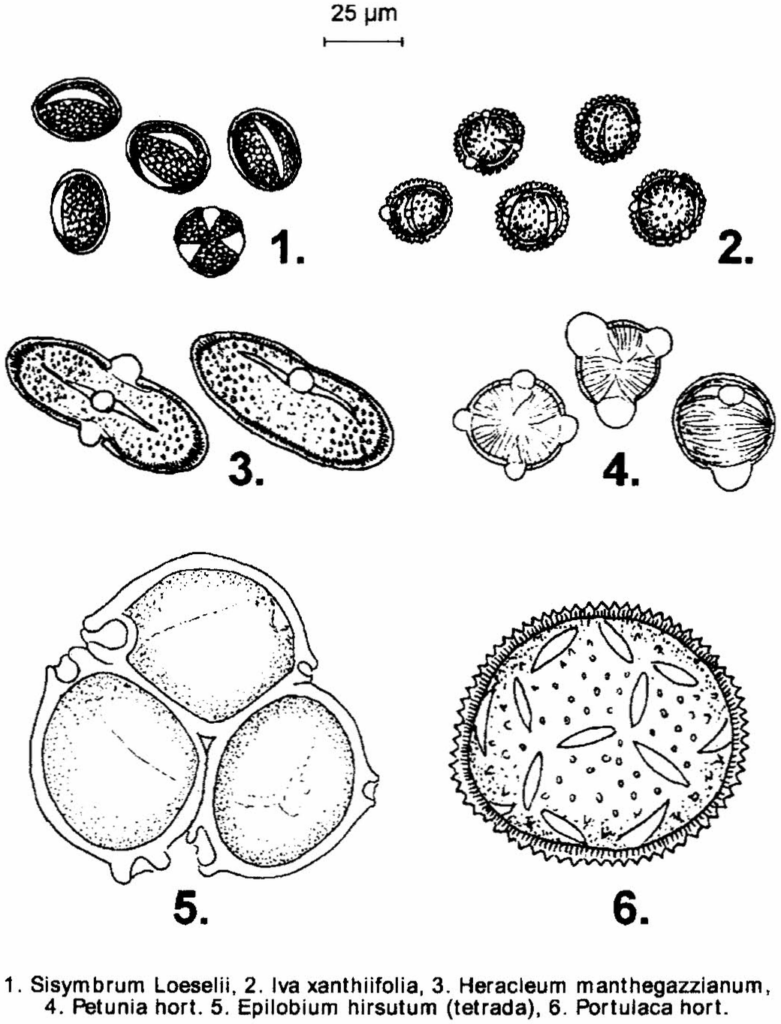
The studies were conducted in 1995 and repeated in 1996. Pollen loads were obtained from little colonies placed in 4-frame mating hives. Shaking inserts 4.8 mm in diameter and 1.7 mm thick were applied. The hives were situated in the neighbourhood of the Fertiliser Plant in Puławy. The pollen loads were collected for at least 5 days. In 1995 on the following dates: July 17, July 27, August 7, August 23, September 1, September 17. 22 samples were obtained altogether. In 1996, 11 samples were collected on July 20, July 27, and August 2. The inspection of vegetation in the studied area was conducted during the time of collection and the flowers were used to make a comparative preparation of pollen. The pollen analysis was conducted according to Warakomska’s method (1985 and 1999). From a dry pollen load a 4-gram sample was obtained and soaked day and night in 10-ml distilled water and glycerine in the ratio of 1 to 1, as well as a few drops of 5-percent
strona 219sodium hydroxide, which made the grains of pollen swell. Microscope preparations in the form of a smear were made from the stirred suspension for analysis. The palinological classification was based on Zander’s studies conducted between 1931 and 1951, as well as Louveaux et al. (1970) and Sawyer (1981). While marking the grains of pollen both available keys and glycero-gelatine comparative preparations were used. The pollen species that were the most interesting were drawn with the help of a microscope with the zoom set on 10 by 40. (Fig. 1.)
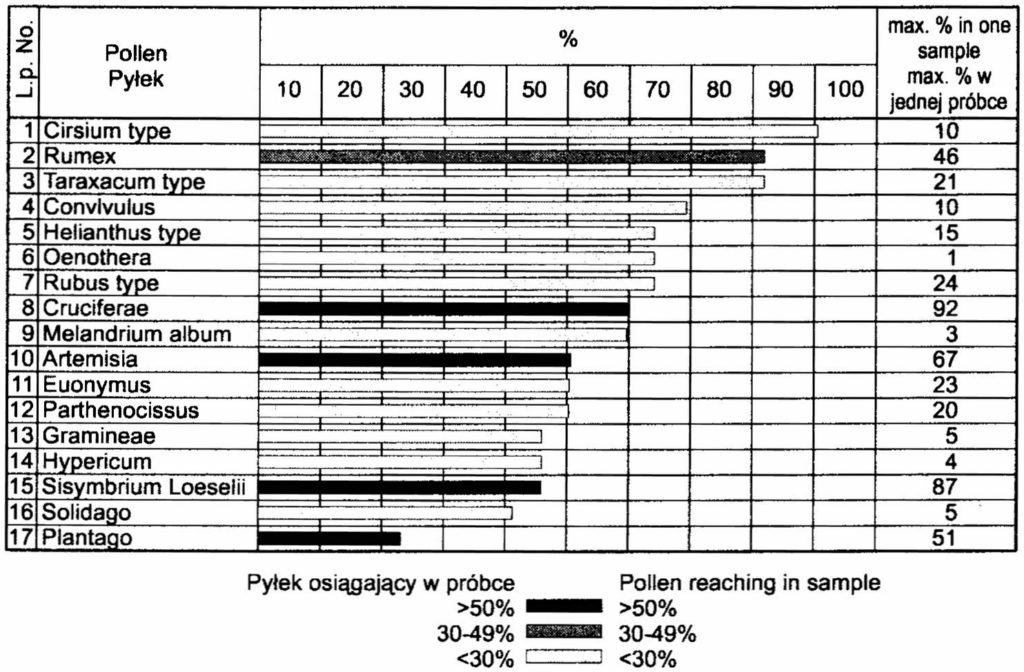
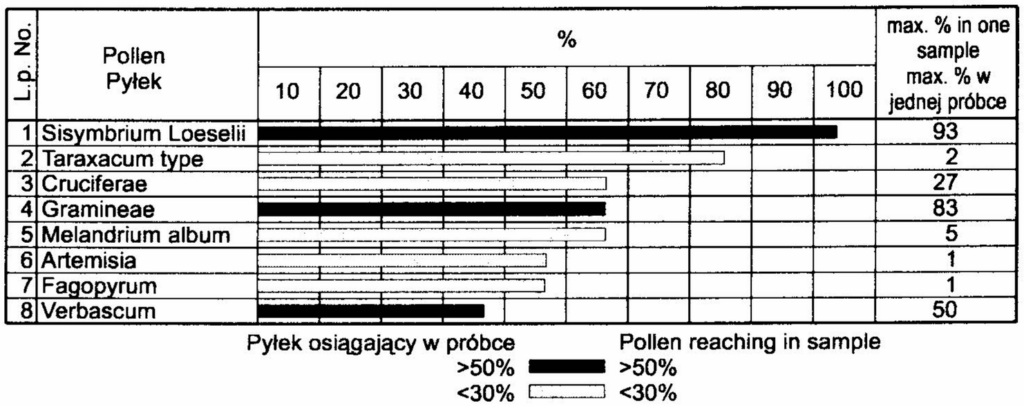
A percentage composition of the grains of pollen was calculated for each preparation. The highest percentage of pollen in individual samples was divided into 3 groups: above 50 percent, between 30 and 49 percent, and below 30 percent. Plants containing a very low percentage are discussed separately. These species of plants forming a pollen base were grouped according to their usefulness, and presented in the form of a graph.
RESULTS
After 2 years, the main flow came from both ruderal and wild weeds. Artemisia, Gruciferae, Gramineae (Table 1 and 2) showed an above 50% representation in at least one sample.
| L.p. / No. | Pollen / Pyłek | max. % w jednej próbce / max. % in one sample |
|---|---|---|
| 1 | Cirsium type | 10 |
| 2 | Rumex | 46 |
| 3 | Taraxacum type | 21 |
| 4 | Convlvulus | 10 |
| 5 | Helianthus type | 15 |
| 6 | Oenothera | 1 |
| 7 | Rubus type | 24 |
| 8 | Cruciferae | 92 |
| 9 | Melandrium album | 3 |
| 10 | Artemisia | 67 |
| 11 | Euonymus | 23 |
| 12 | Parthenocissus | 20 |
| 13 | Gramineae | 5 |
| 14 | Hypericum | 4 |
| 15 | Sisymbrium Loeselii | 87 |
| 16 | Solidago | 5 |
| 17 | Plantago | 51 |
| L.p. / No. | Pollen / Pyłek | max. % w jednej próbce / max. % in one sample |
|---|---|---|
| 1 | Sisymbrium Loeselii | 93 |
| 2 | Taraxacum type | 2 |
| 3 | Cruciferae | 27 |
| 4 | Gramineae | 83 |
| 5 | Melandrium album | 5 |
| 6 | Artemisia | 1 |
| 7 | Fagopyrum | 1 |
| 8 | Verbascum | 50 |
Among Cruciferae, Sisymbrium Loeselii pollen was identified separately, since these plants bloomed there on a large scale. Similarly a high representation, (although smaller in the form of a smear) was found in case of Cirsium type, Convolvulus, Helianthus type, Melandrium album, Oenothera, Pathenocissus, Rubus type, Rumex, and Taraxacum type. Plantago and Verbacums revealed little representation, but below 50 percent in one smear. Other species absent in Table number 1 and 2 had representation below 50%. Rarely found pollen shows the diversity of a food base. It was found in different groups of plants, such as: arable – Cucumis, Phacelia, Zea; decorative – Aster type, Lilium, Malva, Pelargonium, Petunia, Portulaca; ruderal weeds – Arctium, Geum, Heracleum manthegazzianum, Impatiens, Iva, Lamium type, Solidago; herbs – Calluna, Calystegia, Campanula, Chrysanthemum leucanthemum, Epilobium hirsutum, Heracleum type, Melilotus, Potentilla type, Trifolium repens; trees and bushes – Euonymus hort., Lonicera, Rosa, Tilia.
It is necessary to stress that the bees’ pollen food base was studied both at the height of summer and at the end of it. During the spring, different species of plants could be found in the pollen loads. It turned out that in both years the bees collected pollen from the same groups of plants (Table 3).
The main base consisted of weeds and ruderal plants that grew profusely near the factory. Almost half came from herbs and arable plants from surrounding households. Trees and decorative plants occurred to a smaller extent.
strona 221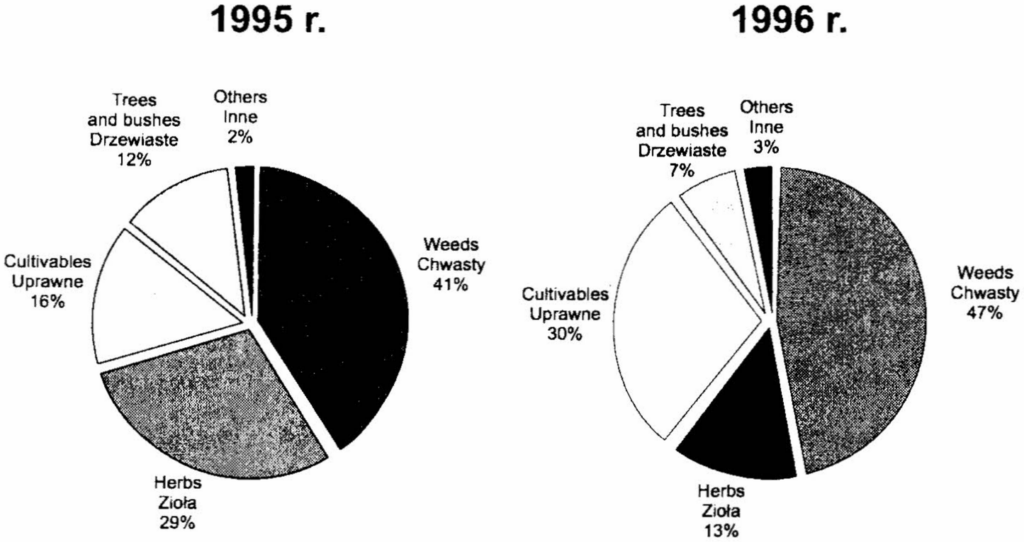
1995 r.
| Group | Grupa (pol.) | % |
|---|---|---|
| Weeds | Chwasty | 41 |
| Herbs | Zioła | 29 |
| Cultivables | Uprawne | 16 |
| Trees and bushes | Drzewiaste | 12 |
| Others | Inne | 2 |
1996 r.
| Group | Grupa (pol.) | % |
|---|---|---|
| Weeds | Chwasty | 47 |
| Cultivables | Uprawne | 30 |
| Herbs | Zioła | 13 |
| Trees and bushes | Drzewiaste | 7 |
| Others | Inne | 3 |
CONCLUSIONS
In the described conditions of the experiment, the main food base for the bees during the summer of 1995 and 1996 was made up of different weeds from Asteraceae, Cichoriaceae and Cruciferae families, which provided the bees with a great amount of pollen.
The results indicate that plant resources sufficient to monitor contamination with the help of bees can be found in the neighbourhood of the Fertiliser Plant in Puławy (Z.A.). Pollen that is collected by bees can be used to monitor possible contamination during the time of plants’ vegetation.
REFERENCES
Höffel I., (1983)- The ecological importance of honeybees in industrialized urban area. V-éme Symposium Intern. sur la Pollinisation. CNRA, Versailles, France:107.
Louveaux J., Maurizio A., Vorwohl G., (1970)- Les méthodes de la mélisso-palynologie. Apidologie, 1(2):211-227.
Muszyńska J., (1995)- Produkty pszczele jako wskaźnik skażeń środowiska. Medycyna Wet. 51(8):457-458.
Muszyńska J., Warakomska Z. (1999)- Honeybees in monitoring of the environment’s contamination: I. The numerousness of monitoring apiary giving samples of pollen loads, which are representative for a neighbourhood rich in pollen flow. Pszczel. Zesz. Nauk. 43:197-208.
strona 222Sawyer R., (1981)- Pollen identification for beekeepers. Cardiff Press, 111 pp.
Warakomska Z., (1985)- The composition of polliniferous plants of the Kraków region in the microscopic analysis of pollen loads of the honeybee. In: Changes in fauna of wild bees in Europe. Pedag. Univ. Bydgoszcz: 215-220.
Warakomska Z., (1999)- Rośliny ogrodowe i ruderalne Puław w obrazie pyłkowym obnóży pszczelich. Bibl. Fragm. Agron. 6:137-144.
Zander E., (1935-1951)- Beiträge zur Herkunftsbestimmung bei Blütenhonig. I-V, Berlin – Jena.
OBRAZ PYŁKOWY OBNÓŻY PSZCZELICH ZEBRANYCH W POBLIŻU ZAKŁADÓW AZOTOWYCH S.A. W PUŁAWACH
Warakomska Z., Muszyńska J.
Streszczenie
Celem pracy było poznanie bazy pokarmowej pszczół w pobliżu Zakładów Azotowych S.A. w Puławach i ustalenie czy w tej okolicy istnieje możliwość wykorzystania pszczół do pozyskiwania materiału wyjściowego do badań monitoringowych skażenia środowiska.
Badania prowadzono w latach 1995 i 1996. Obnóża pyłkowe pozyskiwano od rodzinek osadzonych w czteroplastrowych styropianowych ulikach weselnych ustawionych w bezpośrednim sąsiedztwie fabryki. Łącznie otrzymano 33 próby obnóży z okresu pełni i późnego lata. W roku 1995 w sześciu terminach zbioru otrzymano 22 próby obnóży, a w roku 1996, w trzech terminach otrzymano jedenaście prób, w których wyróżniono odpowiednio 50 i 29 taksonów pyłku. Analizę pyłkową wykonano w oparciu o typologię palinologiczną Zandera (1931-51) według metody Warakomskiej (1985) Stwierdzono, że bazę pokarmową pszczół stanowiły (w procentach) w obu latach odpowiednio: chwasty 41, 47; zioła 29, 13; rośliny uprawne 16, 30; rośliny drzewiaste 12, 7; inne 2, 3. Obecność pyłku przekraczającą w jednej próbie połowę udziału wykazały: Artemisia, różne Cruciferae, Gramineae, Plantago, Sisymbrium Loeselii, Verbascum. Rośliny o wysokiej frekwencji w całości zbiorów, dostarczyły w poszczególnych próbkach dużych lub niewielkich ilości pyłku. Ponad 50% frekwencji ziarn pyłku wykazały: w 1995 roku – Cirsium typ, Convolvulus, Cruciferae, Helianthus typ, Melandrium album, Oenothera, Rubus typ, Rumex, Taraxacum typ; w 1996 roku Cruciferae, Gramineae, Melandrium album, Sisymbrium Loeselii, Taraxacum typ.
Stwierdzony obraz pyłkowy prób obnóży był zgodny z wynikami z lustracji dokonanej na terenie ZA i pobranymi próbkami pyłku z kwitnących tam roślin. Rzadki i ciekawy pyłek pochodził z roślin: Lilium, Pelargonium, Petunia, Portulaca. Uzyskane wyniki pozwalają stwierdzić, że teren ZA ma wystarczającą bazę pokarmową dla pszczół i nadaje się do prowadzenia monitoringu skażeń środowiska przy wykorzystaniu obnóży pyłkowych.
Słowa kluczowe: Obnóża pyłkowe, analiza pyłkowa, monitoring, zanieczyszczenia środowiska.
Errata — błędy druku znalezione podczas digitalizacji
- s. 218, ryc. 1: „Sisymbrum” → Sisymbrium
- s. 218, ryc. 1: „manthegazzianum” → mantegazzianum
- s. 219: „palinological” → palynological
- s. 219: „Gruciferae” → Cruciferae
- s. 219, tab. 1: „Convlvulus” → Convolvulus
- s. 220: „manthegazzianum” → mantegazzianum
- s. 220: „Pathenocissus” → Parthenocissus
- s. 220: „Verbacums” → Verbascum