

ECOLOGICAL FEATURES OF FLOWERS INCLUDING NECTARY STRUCTURE OF CHOSEN SPECIES FROM LAMIACEAE FAMILY
tekst: Elżbieta Weryszko-Chmielewska
Pszczelnicze Zeszyty Naukowe, Rok XLIV, Nr 2, 2000 — Elżbieta Weryszko-Chmielewska
strona 223PSZCZELNICZE ZESZYTY NAUKOWE Rok XLIV, Nr 2 2000
Elżbieta Weryszko-Chmielewska
Department of Botany, Agricultural University, Akademicka 15, 20-950 Lublin
Summary
Studies upon the following species were carried out in 1996: Hyssopus officinalis L. fl. rosea, Mentha spicata L. var. crispata (Benth.) Danert, Nepeta foliosa Moris, Ocimum basilicum L., and Origanum vulgare L. Dates of flowering, length and type of a corolla and morphological features of nectaries: size, shape and number of stomata were investigated. Corolla length for studied taxons lined up in a following decreasing sequence 17,05-3,66 mm – Nepeta foliosa, Hyssopus officinalis, Ocimum basilicum, Origanum vulgare, Mentha spicata – different from the decreasing sequence of nectary height 1300-350 µm: Ocimum basilicum, Nepeta foliosa, Hyssopus officinalis, Mentha spicata, Origanum vulgare. Dependence between the form of corolla and nectary shape was found. In the largest nectaries, a small number of secretional stomata (4-6) was observed. It varied in medium-sized and small nectaries (7-18). Stomata occurred usually on the thicker part of the nectary, asymmetrical disc facing the lower lip of the corolla.
Keywords: flowering, nectary morphology, Nepeta, Hyssopus, Ocimum, Origanum, Mentha
INTRODUCTION
Flowers of Lamiaceae representatives are counted among those pollinated by bees (Melittophilae) in the morphological and ecological division system of entomogamic flowers (Kugler 1970). This is due to their numerous characteristic traits: symmetry, opportunity for insects landing on corolla elements, blue or purple colour, nectar production, pollination mechanism and characteristic flavour.
Plants of Lamiaceae family secrete large amounts of nectar (Demianowicz et al. 1960, Jabłoński 1989, 1994). Comparison of nectar production for many Mediterranean plant species (76) has led to conclusion that Lamiaceae plants produced nectar the most abundantly (Petanidou and Smets 1995). Those authors also found that flowers with corolla tubes longer than 4 mm secreted more nectar than flat ones.
Dafni et al. (1988) found positive correlation between nectary size and weight of the nectar secreted by flowers of several Lamiaceae species.
strona 224Present studies were undertaken in order to compare the dependence between corolla size for five Lamiaceae species and the size of their nectaries. Elements of nectary gland structure were also analysed.
MATERIAL AND METHODS
Observations of flowering length for five Lamiaceae species were carried out in the Botanical Garden, UMCS, Lublin within the 1996 vegetation season.
Studies included the following taxons: Nepeta foliosa Moris, Hyssopus officinalis L. fl. Rosea, Ocimum basilicum L., Origanum vulgare L., and Mentha spicata L. var. crispata (Benth.) Danert.
Flowers were gathered on the day of flowering, being previously marked at the stage of swelled bud for corolla size and nectary morphology measurements. They included: length of corolla and its tube, area of tube longitudinal section as well as diameter of the lowest and the longest nectary. Corolla and nectary parameters were determined on the basis of 25-30 flowers of each species, but measurements of corolla tube section were done for 20 flowers.
The detailed observations of nectary morphology were performed using scanning electron microscope (SEM). Distribution and number of stomata taking part in nectar secretion was evaluated on the basis of 3 preparations (nectaries) for each species.
Nectaries with ovaries were pre-fixed in 4% glutaraldehyde in 0.1 M phosphate buffer, pH 7.2. Then, they were fixed in 1% osmium tetraoxide and dehydrated in alcohol and 100% acetone. After drying at critical point in liquid CO2, they were coated with gold using CS 100 Sputter Coater. Observations were done using scanning electron microscope BS 300 Tesla.
RESULTS
Flowering period
Species of Lamiaceae family were characterised by extended flowering (Tab. 1). Nepeta foliosa and Ocimum basilicum flowered in June-September and the periods lasted 90 and 95 days, respectively. Hyssopus officinalis flowering period occurred in July-September (80 days), Origanum vulgare in July-October (100 days), and Mentha spicata in August-October (60 days).
Morphological traits of flowers
Flowers of taxons studied were different with regard to corolla size (Tab. 2) and its colour (Tab. 3).
strona 225Table 1 Blooming calendar of five species from Lamiaceae family Kalendarz kwitnienia pięciu gatunków rodziny Lamiaceae
| Species – Gatunek | VI | VII | VIII | IX | X |
|---|---|---|---|---|---|
| Nepeta foliosa Moris. | █ | █ | █ | █ | |
| Ocimum basilicum L. | █ | █ | █ | █ | |
| Origanum vulgare L. | █ | █ | █ | █ | |
| Hyssopus officinalis L. fl. rosea | █ | █ | █ | ||
| Mentha spicata L. var. crispata (Benth.) Danert. | █ | █ | █ |
Table 2 Morphological features of corolla and nectary for five species of Lamiaceae family – Cechy morfologiczne kwiatów i nektarników dla pięciu gatunków rodziny Lamiaceae
| Species / Gatunek | Petal length – Długość płatków kor. (mm) | Corolla tube: Length – Rurka kwiatowa: Długość (mm) | Corolla tube: Section area – Rurka kwiatowa: Przekrój (mm2) | Nectary traits: Diameter – Kształt nektarników: Średnica (µm) | Nectary traits: Min. height – wysokość (µm) | Nectary traits: Max height – wysokość (µm) | Nectary traits: Number of stomata – Liczba aparatów szpar. |
|---|---|---|---|---|---|---|---|
| Nepeta foliosa Moris | 17,05 | 11,75 | 9,82 | 1052 | 418 | 746 | 4-6 |
| Hyssopus officinalis L. fl. rosea | 11,86 | 7,14 | 5,72 | 802 | 348 | 626 | 17-18 |
| Ocimum basilicum L. | 9,62 | 5,18 | 7,90 | 1520 | 1300 | 1300 | 4-5 |
| Origanum vulgare L. | 6,19 | 4,13 | 3,98 | 545 | 350 | 350 | 15-18 |
| Mentha spicata L. var. crispata (Benth.) Danert. | 3,66 | 2,35 | 1,94 | 690 | 380 | 380 | 7-8 |
Table 3 Comparison of colours, and corolla and nectary symmetry for five species of Lamiaceae family – Porównanie koloru oraz symetrii kwiatów i nektarników dla pięciu gatunków rodziny Lamiaceae
| Species – Gatunek | Corolla colour / Kolor płatków korony | Corolla symmetry / Symetria kwiatów | Nectary shape / Kształt nektarników |
|---|---|---|---|
| Nepeta foliosa Moris | violet-blue | zygomophic | asymmetric disc |
| Hyssopus officinalis L. fl. rosea | rosy | zygomorphic | asymertic disc |
| Ocimum basilicum L. | white | zygomorphic | irregular disc |
| Origanum vulgare L. | rosy-violet | slightly zygomorphic | regular disc |
| Mentha spicata L. var. crispata (Benth.) Danert. | white-violet | almost radial | regular disc |
Taking into account the petal and corolla tube length as well as area of its longitudinal section, taxons can be lined up due to the following decreasing
strona 226sequence: Nepeta foliosa, Hyssopus offcinalis, Ocimum basilicum, Origanum vulgare and Mentha spicata.
Plants of individual species also differed for their flower symmetry (Tab. 3). Three of the species with the largest flowers also showed evident zygomorphic symmetry; in Origanum vulgare slightly marked zygomorphy (slightly two-lip corolla) occurred; Mentha spicata flowers were characterised by almost radial symmetry with uniform petal length and little wider petal lobe of upper lip.
Morphology of nectaries
Nectaries of Lamiaceae family flowers have the shape of a disc that surrounds the basis of a four-segmented ovary (Phot. 2, 3, 4, 6). They were of different size in observed species (Tab. 2) and showed non-uniform development of their particular parts penetrating between ovary segments from outside (Phot. 2-4). All those above traits influenced the symmetry of nectaries.
Three types of nectaries were distinguished:
— irregular disc – three evident relieves interpetalous in relation to ovary segments occur in the nectary – Ocimum basilicum (Phot. 3);
— asymmetric disc – only one clear relief being at the same time the highest part of the gland occurs in nectary – Nepeta foliosa, Hyssopus officinalis (Phot. 1, 2);
— regular disc – nectary is symmetrical, its parts are uniformly developed – Mentha spicata (Phot. 4), or it forms small relief – Origanum vulgare (Phot. 4, 5).
Dependence between nectary shape and corolla form was observed. Hyssopus officinalis and Nepeta foliosa characterized with a distinct two-lip corolla had the nectary forming large relief on the lower lip side. Ocimum basilicum with atypical structure and large upper lip formed nectary possessing three evident relieves. Slightly zygomorphic flower of Origanum vulgare had its nectary with very tiny relief. Almost radial flower of Mentha spicata had the nectary of regular disc shape.
Nectary glands with the highest diameter and height were found in Ocimum basilicum and Nepeta foliosa, then in Hyssopus officinalis, Mentha spicata and Origanum vulgare. No positive dependence between corolla size and nectary dimensions was observed – flowers of Nepeta foliosa with corolla twice as large as in Ocimum basilicum formed much smaller nectaries (Tab. 2). A lack of clear correlation between corolla length and nectary dimensions was also present comparing flowers of Origanum vulgare with Mentha spicata.
strona 227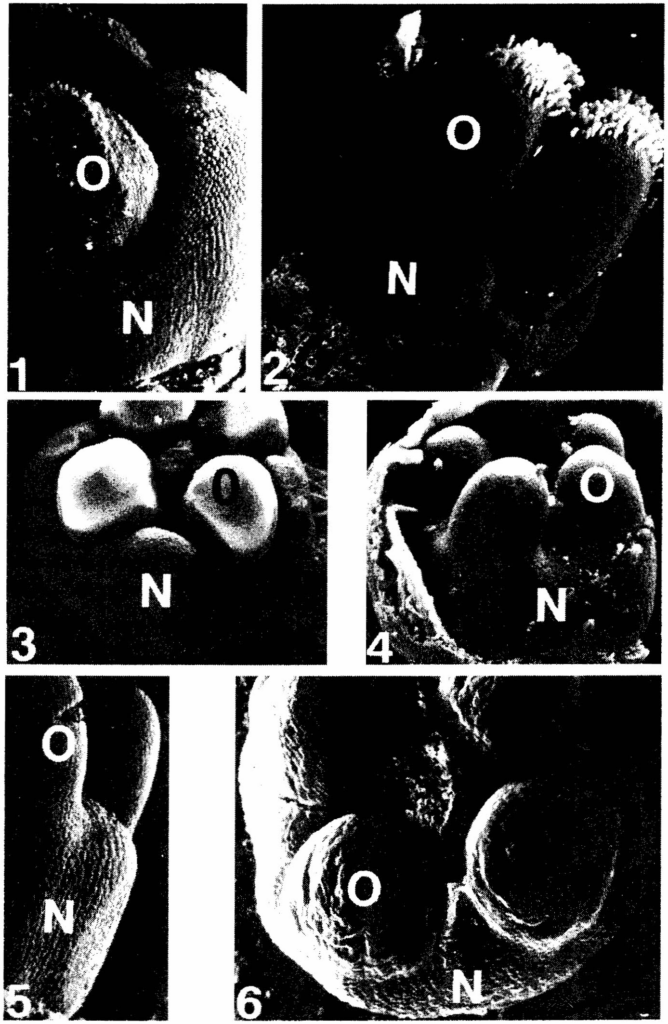
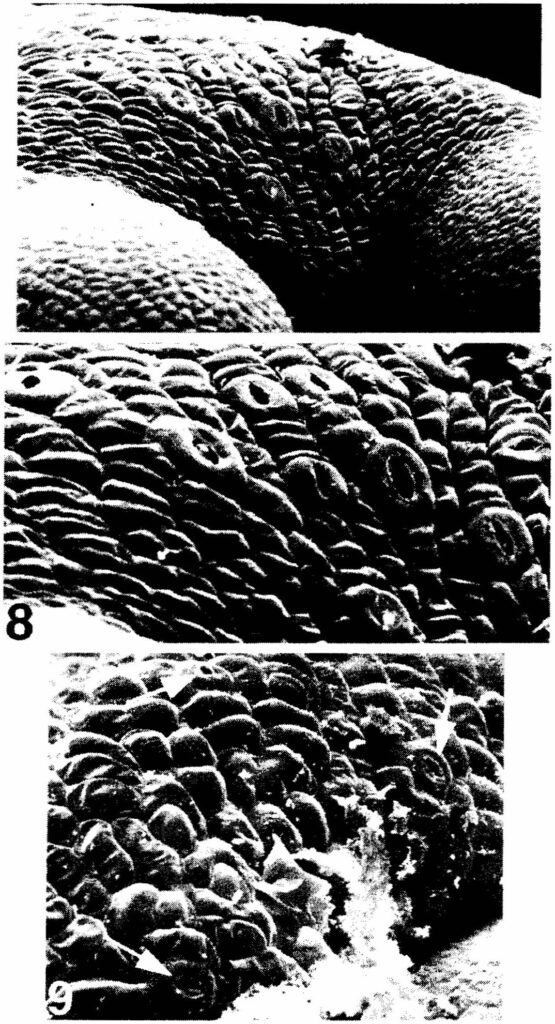
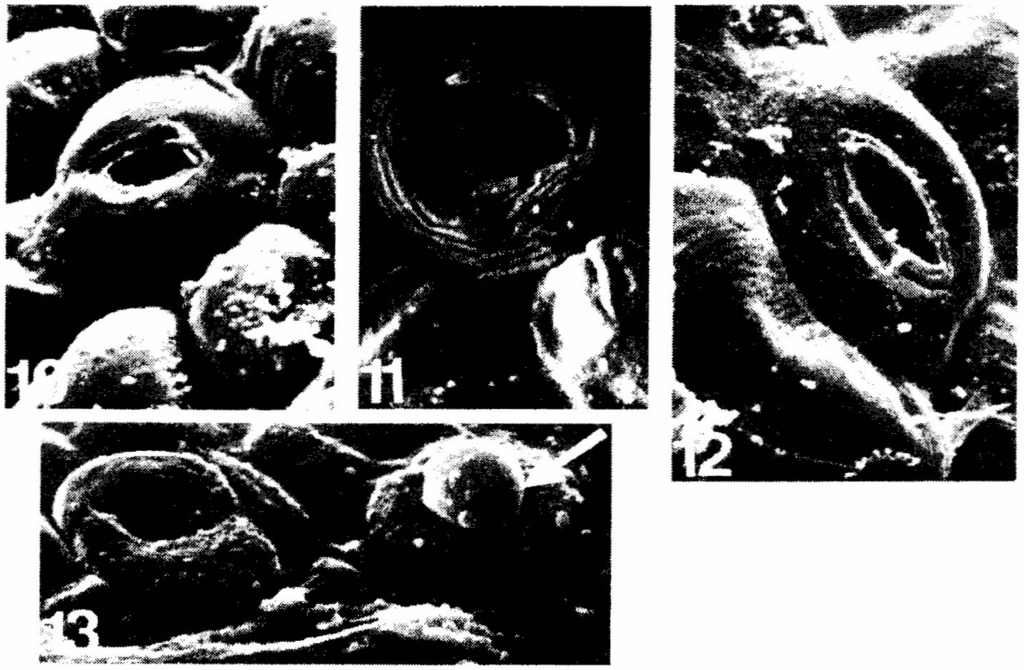
Nectar secretion in Lamiaceae is through modified stomata (Phot. 10-12). They are situated almost exclusively on relieves of nectary gland (Phot. 1, 7) facing the lower lip of corolla.
Stomata occur the most frequently close to each other in numerous groups forming stomatal spots (Phot. 7, 8, 9). The least number of stomata (4-6) was observed in nectaries with the largest size (Ocimum basilicum, Nepeta foliosa) (Tab. 2). A few stomata (7-8) were also found in nectary of Mentha spicata. Much more stomata were found in Hyssopus officinalis (17-18) and Origanum vulgare (15-18). In the latter, presence of two stomatal spots occurring on neighboring segments of nectary and consisting of various numbers of stomata (12 and 6, or 10 and 5) was found.
Stomata were placed on the same level as other epidermis cells in the most of species studied (Phot. 9-12). Only in the nectary of Origanum vulgare, stomata characterised by larger size and clearer cell relief were observed (Phot. 7, 8).
DISCUSSION
The length of corolla tube in flowers from Lamiaceae family significantly varied (2.35-11.75mm). Dafni (1991) proved for 13 other species of the same family with corolla tube length between 4.3-21.3 mm that flowers with much larger corolla secreted more nectar which was characterised by higher energetical value (1.06-187.9 J).
strona 230Three types of nectary structure with different symmetry were distinguished in the taxons studied in the present paper. Other authors found that nectaries in Lamiaceae can be of various forms (Frei 1955, Kulijev 1959). Dafni et al. (1988) observed 9 another representatives of Lamiaceae family and found that in one case the nectary was of symmetrical disc shape and others were of asymmetry associated with the presence of one relief.
No dependence between the size of individual nectary and length of corolla tube nor between nectary dimensions and number of stomata was observed in present study results.
Many authors confirm positive dependence between nectary size and abundance of nectar secreted in closely related plants characterised by similar anatomical type of nectary (Dafni et al. 1988, Kertesz 1996).
Teuber et al. (1980) found in several Medicago sativa varieties and clones that plants with medium and large number of stomata in nectary produced the most nectar. Davis and Gunning (1991) observed significant differences regarding the number of modified stomata in nectaries of flowers originating from Vicia faba. In a single variety the number varied from 19 to 29. Authors found positive correlation between number of modified stomata on the nectary top and amount of sugars in nectar.
No nectaring abundance of plants was studied in presented work, but from the literature data (Rawski 1948) it follows that flowers of Lamiaceae family secrete large (Nepeta foliosa, Hyssopus officinalis, Mentha spicata) or moderate amounts of nectar (Ocimum basilicum, Origanum vulgare). Comparison of secreted nectar weight estimated for some species studied by other authors suggests that it is associated with nectary size, because relatively large nectary glands in flowers of Hyssopus officinalis secret more nectar (Demianowicz et al. 1960) than much smaller nectaries of Origanum vulgare (Jabłoński 1990). In papers published, no numerical data referring to the abundance of nectar secretion by Ocimum basilicum characterised by largest nectaries as well as Mentha spicata L. var. crispata and Nepeta foliosa were found.
CONCLUSIONS
- Nectary size is not correlated with corolla dimensions in Lamiaceae family species analyzed.
- Taxons of Lamiaceae family form morphologically different nectaries, which is associated with the level of corolla zygomorphy.
- Secretional stomata in Lamiaceae nectaries form stomatal spots occurring on gland relieves situated on the lower lip of corolla.
REFERENCES
Dafni A., (1991)- Advertisement, flower longevity, reward and nectar protection in Labiatae. 6th Pollination Symposium, Acta Horticulturae 288: 340-346.
Dafni H., Lensky Y., Fahn A., (1988)- Flower and nectar characteristics of nine species of Labiatae and their influence on honeybee visits. Jour. Apicult. Res. 27 (2): 103-114.
Davis A.R., Gunning B.E.S., (1991)- The modified stomata of the floral nectary of Vicia faba L. 2. Stomatal number and distribution as selection criteria for breeding for high nectar sugar production. 6 th Pollination Symposium Acta Horticulturae 288: 329-334.
Demianowicz Z., Hłyń M., Jabłoński B., Maksymiuk I., Podgórska J., Ruszkowska B., Szklanowska K., Zimna J., (1960)- Wydajność miodowa ważniejszych roślin miododajnych w warunkach Polski. Cz. I. Pszczeln. Zesz. Nauk. 2: 87-104.
Frei E., (1955)- Die Innervierung der floralen Nektarien dikotyler Pflanzenfamilien. Ber. Schweiz. Bot. Ges. 65: 94-96.
Jabłoński B., (1990)- Nektarowanie lebiodki pospolitej. Pszczelarstwo 41(5): 7-8.
Kertesz R., (1996)- Stomatal Number of the Floral Nectary of some Fabaceae Species in Relation to Nectar Production. Intern. Conf. Reproductive Biology, Royal Bot. Gad. London: 38.
Kugler H., (1970)- Blütenökologie., G. Fischer Verlag – Stuttgart.
Kulijew A., (1959)- Morfołogiczeskaja evolucja nektarnikov u pokrytosiemiannych rastienij. Tipografia Az.S.C.H.I., Kirowobad, 138.
Petanidou T., Smets E., (1995)- The potential of marginal lands for bees and apiculture nectar secretion in Mediterranean shrublands. Apidologie 26 (1): 39-52.
Rawski W., (1948)- Pożytek pszczeli. Cz. III. Wartość pożytkowa roślin dzikich i uprawnych. Wyd. Ex Libris sp. z o.o., Warszawa.
Tauber L.R., Albertsen M.C., Barnes D.K., Heichel G.H., (1980)- Structure of floral nectaries of alfalfa (Medicago sativa L.) in relation to nectar production. Am. J. Bot. 67 (4): 433-439.
strona 232CECHY EKOLOGICZNE KWIATÓW Z UWZGLĘDNIENIEM BUDOWY NEKTARNIKÓW WYBRANYCH GATUNKÓW Z RODZINY WARGOWYCH (LAMIACEAE)
Weryszko-Chmielewska E.
Streszczenie
Przeprowadzono badania wielkości korony oraz morfologii nektarników pięciu gatunków z rodziny Lamiaceae: Nepeta foliosa Moris, Hyssopus officinalis L. fl. rosea, Ocimum basilicum L., Origanum vulgare L., Mentha spicata L. var. crispata. Długość rurki korony badanych gatunków zawarta była w przedziale 2,35 – 11,75 mm, natomiast maksymalna wysokość nektarnika wynosiła 350-1300 µm. Długość korony badanych taksonów podana w szeregu malejącym: kocimiętka, hyzop, bazylia, lebiodka, mięta nie odpowiadała malejącym wielkościom nektarników: bazylia, kocimiętka, hyzop, mięta, lebiodka. Stwierdzono zależność między stopniem grzbiecistości korony a kształtem nektarnika. Szparki wydzielnicze (4-18) tworzyły skupienia na uwypukleniach nektarników, zwróconych ku wardze dolnej korony.
Słowa kluczowe: kwitnienie, morfologia nektarników, Nepeta, Hyssopus, Ocimum,Mentha.
Errata — błędy druku znalezione podczas digitalizacji
- s. 225, tab. 3: „zygomophic” → zygomorphic
- s. 225, tab. 3: „asymertic” → asymmetric
- s. 226: „offcinalis” → officinalis
- s. 230: „secret more” → secrete more
- s. 231, piśmiennictwo: „Gad.” → Gard.
- s. 231, piśmiennictwo: „Kirowobad” → Kirowabad