

THE INFLUENCE OF NOSEMA APIS ON MATURATION AND FLIGHT ACTIVITY OF HONEY BEE DRONES
tekst: Adam Tofilski, Joanna Kopel
Pszczelnicze Zeszyty Naukowe, Rok XL, 1996 — Adam Tofilski, Joanna Kopel
strona 55PSZCZELNICZE ZESZYTY NAUKOWE Rok XL, Nr 2 1996
Adam Tofilski, Joanna Kopel
Bee Research Department, Agricultural University Al. 29 Listopada 52, 31-425 Kraków, POLAND
Summary
The experiment tested whether honey bee (Apis mellifera) drones infected by Nosema apis mature earlier than healthy drones. It also studied the influence of N. apis on the number and duration of flights, and the time of day flights commenced. N. apis did not influence the maturation of drones (measured as age at first flight longer than 25 minutes). Nor did N. apis influence the duration of their flights. During one of the five days of observation the flights of the infected drones were fewer than those of the healthy drones. On the first day of flight the infected drones flew at earlier hours than the healthy drones did.
Keywords: maturation, drone flights, Apis mellifera, Nosema apis,
INTRODUCTION
Interactions between parasites and their hosts are often very complex. Not only does the parasite affect the host; the host also tries to affect the parasite or at least to diminish the negative effects of infection. The response of a host to an infection is not only by means of the immune system (Pathak 1993) but also by changes in its behavior. For example, Bombus terrestris workers infected by Conopidae larvae spend their nights at a lower ambient temperature, in which the parasites develop more slowly and often die (Müller, Schmid-Hempel 1993).
Another response to infection can be earlier maturation. If the infection happens before maturation and can lead to the death of the host, earlier maturation increases the chance of successful reproduction. The phenomenon of earlier maturation induced by the presence of parasites has been observed in some species of snails (e.g. Michalakis, Hochberg 1994; Jokela, Lively 1995).
This experiment studied the influence of the parasite Nosema apis on the maturation and behavior of honey bee (Apis mellifera) drones. N. apis is a microsporidium infecting the midgut epithelial cells of the honey bee. It shortens the lifespan of infected workers (Hassanain 1953; Moffet, Lawson 1975) and drones (Tofilski unpubl. data). The
strona 56aim of this study was to verify the hypothesis that drones infected by N. apis mature earlier than healthy drones, and to measure number, duration and time of commencement of flights of healthy and infected drones.
MATERIAL AND METHODS
The experiment was carried out in June 1995 in an apiary in the vicinity of Kraków, Poland, using Apis mellifera carnica. Drones that emerged on 11 July in one colony were randomly assigned to two groups and marked with individually numbered colored discs. There were 100 drones in each group. The drones from the experimental group were closed on a comb in a cage with about 120 workers and placed in the colony. The comb was supplied with a mixture of sugar solution and homogenized guts of workers infected by N. apis. To prevent infection of the other workers in the colony the cage had double wire mesh. The drones from the control group were in similar conditions except that the sugar solution in the comb contained no N. apis spores. After 24 hours the drones from both groups were released to the colony and the cages with workers that had attended the drones were removed. The hive entrance was watched during the following days and the departures and returns of the drones were recorded. The number of marked drones was too large and it was impossible to record all departures and returns of drones when most of them started their flights on 20 June. In order to make further observations, possible some drones were removed from the colony. Data collected during 20 June as well as data concerning the removed drones were excluded from analysis. The observations were stopped on 21 June because later the weather was unsuitable for drone flights. Similarly to Witherell (1971) it was assumed that flights shorter than 25 minutes were orientation flights and that flights longer than 25 minutes were mating flights. If at least one flight of a drone was longer than 25 minutes it was removed from the colony in the evening and refrigerated for later analysis.
The abdomens of the drones were homogenized in 1 ml distilled water. This suspension was used to count N. apis spores in a Bürker haematocytometer in a total volume of 2.5 x 10⁻² mm³. If at least one spore was found the drone was assumed to be infected.
In statistical analysis of data concerning first flight longer than 25 minutes Yates corrected chi-square test was used. All other data were analyzed using Mann-Whitney U test. All data are reported as means ± SD
RESULTS AND DISCUSSION
Of 104 drones assessed, 57 were healthy and 47 were infected. The
strona 57infected drones contained 1.67 x 10⁷ ± 1.10 x 10⁷ spores and the values ranged from 3.60 x 10⁵ to 4.34 x 10⁷ spores.
The age at first orientation flight of healthy and infected drones was 8.28 ± 1.75 days and 8.43 ± 1.72 days respectively. The difference is not statistically significant (P=0.66). At age of 10 days 94 % of healthy drones and 88 % of infected drones were flying at least one time longer than 25 minutes. The difference is not statistically significant (P=0.49). These results do not support the hypothesis that the infected drones mature earlier than healthy drones.
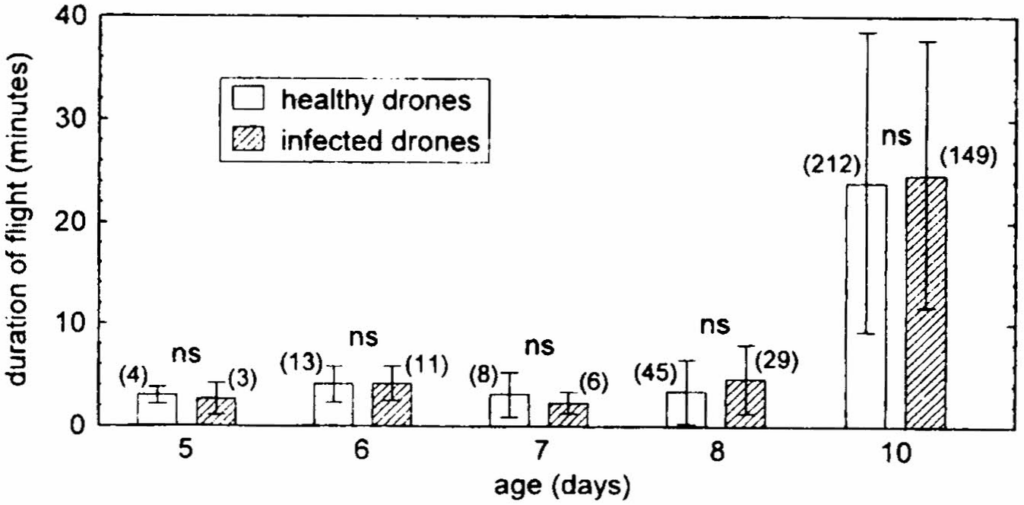
Flight duration did not differ between healthy and infected drones (Fig. 1). The number of flights during the first four days of flight did not differ between healthy and infected drones; however, on the sixth day the healthy drones flew more often than infected drones did (Fig. 2). Similar results obtained Schneider (1986 from Ritter 1988) who found that infestation of drones by Varroa jacobsoni did not influence the duration of flight however it reduced the frequency of flight.
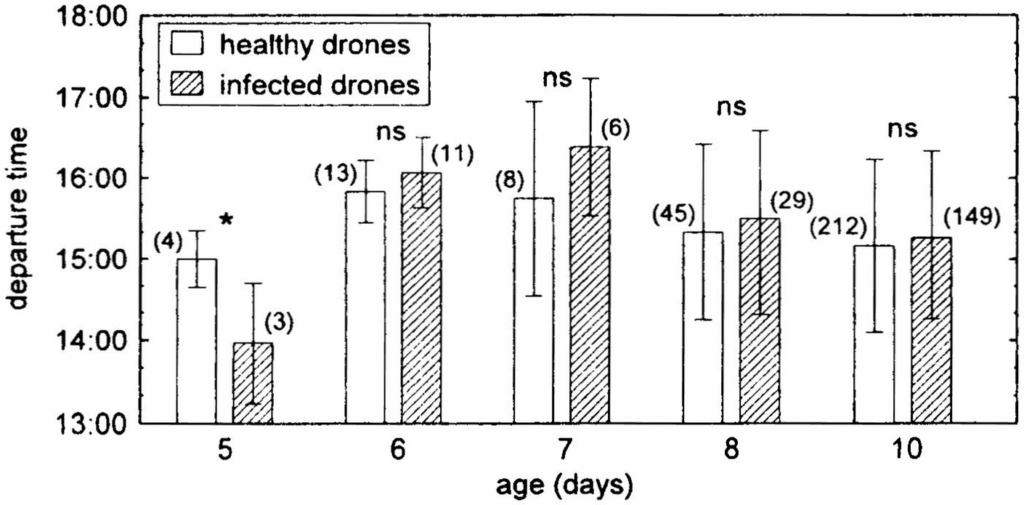
During the first day of flight, the healthy drones flew later than the infected ones did; on other days, the time of day of flight for healthy and infected drones did not differ statistically (Fig. 3). Because N. apis develops in midgut it can cause digestion problems and infected drones can commence their flights earlier in order to defecate.
strona 58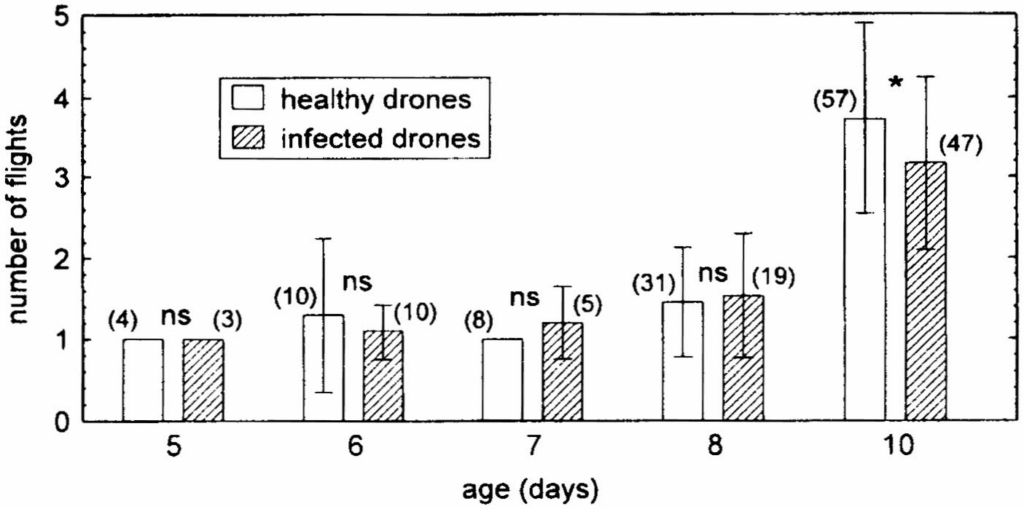
CONCLUSIONS
1.N. apis did not influence the maturation of drones measured as age at first flight longer than 25 minutes. 2.N. apis did not influence the duration of single flights of infected drones. 3.The flights of infected drones were fewer than those of healthy drones.
REFERENCES
Jokela J., Lively C.M. (1995) – Parasites, sex, and early reproduction in a mixed population of freshwater snails. Evolution, 49:1268-1271.
Hassanain M.H. (1953) – The effects of infection of Nosema apis on the activities and the longevity of the worker honeybee. Ann. apl. Biol., 40:418-423.
Michalakis Y., Hochberg , M.E. (1994) – Parasitic effects on host life-history traits: a review of recent studies. Parasite, 1:291-294.
Moffet J.O., Lawson F.A. (1975) – Effects of nosema infection on O₂ consumption by honey bees. J. econ. Ent., 68:627-629.
Müller C.M., Schmid-Hempel P. (1993) – Exploitation of cold temperatures as defense against parasitoids in bumblebees. Nature, 363:65-67.
Pathak J.P.N. (1993) – Cell-mediated defence reactions in insects. In: Pathak J.P.N. (ed) Insect immunity. Kluwer Academic Publishers, Dordrecht, pp 47-58.
Ritter W. (1988) – Varroa jacobsoni in Europe, the tropics, and subtropics. In: Needham G.R., Page R.E., Delfinado-Baker M., Bowman C.E. (eds) Africanized honey bee and bee mites. Ellis Horwood Ltd., Chichester, pp 349-359.
Witherell P.C. (1971) – Duration of flight and of interflight time of drone honey bees, Apis mellifera. Ann. Entomol. Soc. Am., 64:609-612
WPŁYW SPOROWCA PSZCZELEGO NA DOJRZEWANIE I LOTY TRUTNI PSZCZOŁY MIODNEJ
A. Tofilski, J. Kopel
Streszczenie
Testowano hipotezę zakładającą że trutnie pszczoły miodnej (Apis mellifera) zarażone sporowcem pszczelim (Nosema apis) dojrzewają wcześniej niż trutnie zdrowe. Badano też wpływ sporowca pszczelego na liczbę lotów, długość lotów i porę odbywania lotów przez trutnie. Trutnie które wygryzły się jednego dnia w jednej rodzinie pszczelej podzielono losowo na dwie grupy i oznaczono indywidualnie opalitkami. Trutnie z grupy eksperymentalnej zamknięto ze 120 robotnicami w izolatorze na jednym plastrze. Plaster zawierał mieszaninę roztworu cukru i roztartych przewodów pokarmowych robotnic chorych na nosemosę. Trutnie z grupy kontrolnej zamknięto w podobnym izolatorze z tym że udostępniony im syrop cukrowy nie zawierał spor pasożyta. W kolejnych dniach obserwowano wylotek i notowano wyloty i powroty trutni. Loty dłuższe niż 25 min. uznano za loty godowe (Witherell 1971). Aby zbadać stopień rozwoju choroby liczono spory w komorze Bürker’a.
strona 60Nie stwierdzono aby trutnie chore odbywały pierwsze loty godowe wcześniej niż trutnie zdrowe, uznano więc że choroba nie przyspiesza dojrzewania trutni. Długość lotów trutni chorych i zdrowych nie różniła się istotnie (Ryc. 1). Nie stwierdzono też istotnych różnic w liczbie lotów trutni chorych i zdrowych w czasie pierwszych czterech dni lotów. Natomiast szóstego dnia lotów trutnie chore latały rzadziej niż trutnie zdrowe (Ryc. 2). Trutnie chore latały o wcześniejszej porze od trutni zdrowych tylko pierwszego dnia lotów, w pozostałe dni pora lotów trutni chorych i zdrowych nie różniła się istotnie (Ryc. 3).
Słowa kluczowe: dojrzewanie, loty trutni, Apis mellifera, Nosema apis
Errata — błędy druku znalezione podczas digitalizacji
- s. 59, piśmiennictwo: „apl.” → appl.