

GAINING BUMBLE BEE FAMILIES BY A MODIFIED LABORATORY METHOD
tekst: Monika Maciejewska, Zdzisław Wilkaniec
Pszczelnicze Zeszyty Naukowe, Rok XLII, 1998 — Monika Maciejewska, Zdzisław Wilkaniec
strona 313PSZCZELNICZE ZESZYTY NAUKOWE Rok XLII, Nr 1 1998
Monika Maciejewska, Zdzisław Wilkaniec
Department of Useful Insects Breeding, Faculty of Biology and Animal Husbandry August Cieszkowski University of Agriculture in Poznań, Wojska Polskiego 71C 60-625 Poznań, Poland
Summary
Summary Bumble bee families were gained by a laboratory method of breeding. The mothers were kept in incubators in especially prepared plastic boxes in the presence of 3-4 honey bee workers. They were provided with candy of pollen, honey and sugar syrup. When they reached the adequate stage of development, the families were transferred from the incubator to small hives and they were placed in the field. Families in which sexual generations appeared were transferred to isolators of polyethylene net, where the process of females insemination took place, and they were buried in boxes filled with peat mixed with earth. In late autumn, the females were removed from the boxes and put into other boxes with pearlite and placed in a cooler at 2°C. An analysis of nests was carried out in order to define the number of individuals in the particular families. Detailed observation of the developing bumble bee families permitted to determine the average length of the particular periods in the development of the families.
Key words: bumble bees, families, breeding
INTRODUCTION
Bumble bees (Bombus Latr.), next to the honey bee, belong to the main pollinators of entomogamic plants. They have the ability to pollinate plants that are not accessible to honey bees, but have a high economic importance like e.g. red clover (Trifolium pratense L.), lucerne (Medicago sative L.), or vetch (Vicia villose Roth.). The yields of red clover in Poland depend in 71% on the work of bumble bees ( Sowa et al.1983, Bilinski 1993).
The adaptation of bumble bees to the pollination of deep flower calyxes consists in their long tongue that in the workers of bumble bee Bombus lucorum is 6.4 mm long, and in Bombus hortorum it reaches even 12.4 mm (Banaszak 1993). In nature, there occur plants closely depending on the pollinating activity of bumble bees producing the so called bumble bee flowers that need heavy insects like bumble bees to pollinate them.
These flowers include touch-me-not (Impatiens nolitangere), iris (Iris pseudoacours), lungwort (Pulmanaria officinalis), comfrey (*Symphytum
strona 314officinale*) or aconite (Aconitum callibotryon). The latter one is so closely connected with bumble bees that the range of its occurrence on the globe overlaps with the range of bumble bees. Therefore, bumble bees are fruits of many plant species both the cultivated and the wildly growing ones. During the recent years, the bumble bee families have been utilized by gardeners for the pollination of some vegetables grown under cover, like tomato, strawberry, paprica and others. In result of the activity of these insects, not only the yield of the pollinated plants is increased, but also their quality is improved (Dobromilska et al.1995, Wysocka-Owczarek 1994, Shipp et al. 1994). Furthermore, bumble bees adapt themselves better then the honey bee to closed spaces. Therefore, the demand for bumble bee families increases from year to year and that is why they are bred for purely commercial purposes. Such countries as the Netherlandsm, Denmark and Belgium are potentates in this field. Because of the applied mechanization and chemisation of agriculture, the ploughing of baulks and waste land, the burning out of fallows and railway embankments, as well as because of the specializations in plant production, the wildly living populations of Apoidea keep constantly decreasing, since their natural habitats and food bases are being destroyed. An alternative for the continually decreasing number of the wildly living Apoidea is the breeding of bumble bee families in controlled conditions. In Poland, dr Bilinski deals with this problem and he indicates the basic principles of the breeding and utilization of bumble bees (Bilinski 1981) and described laboratory mathod of their breeding, it which we have modyficated. The objective of this work is to bring closer the biology of these insects in the laboratory method of breeding so that people who want to deal with the breeding of these useful insects are able to achieve the expected results in the form of greater and stronger families without any harm to this species.
METHODS
The experiment on bumble bee breeding utilized 10 mothers in 1995, 24 mothers in 1996, and 27 mothers in 1997.The females were placed in plastic boxes measuring 12.5 cm x 12.5 cm x 11.5 cm and lined with cardboard. The lids of the boxes were provided with fine mesh nests for ventilation. The containers with the bumble bee females were placed in incubators at 31°C and about 70% relative humidity. They were supplied with sugar syrup in 1:1 weight proportion on Patri dishes of 5 cm diameter. In the feeders, a floater made of comb foundation was inserted in order to prevent the insects from drowning. On a micro slide, candy was served prepared of ground pollen load with an addition of honey. The food was replaced every 2-3 days at red light in order to decrease the anxiety of the bumble bee females.
strona 315Furthermore, each mother was given 3-4 newly emerged honey bee workers (Apis mellifera) that were supplemented if necessary until the emerging of the first bumble bee workers. These honey bees had the task of stimulating the bumble bee mothers to the building of nests. All observations referring to the development of nests were recorded during food replacement. After the emerging of the first generation of workers, the whole families were transferred to small hives. The hives were made of soft fibreboard. The dimensions of the hives were: 20 cm x 23 cm x 12 cm, and they had double walls in order to prevent excessive overheating or cooling of the nests. The construction of the hives was base on those invented and used by Wójtowski and Wilkaniec (1969). One third of the height of the hives was filled with broken up hygienic cotton wool to fulfil the function of nest material. Each hive was provided with two feeders suspended about 4 cm below the sugar syrup and the ground dry flower pollen. After 2-3 days, the hives were carried over to an apiary near the laboratory of the Department. Then, when the number of hives increased, they were transported to the experimental station in Stobnica. There, the hives were fixed to wooden poles, about 30 cm above the ground. The selected surrounding area was covered with trees or shrubs in order to protect the hives against excessive isolation and overheating. During the distribution of the hives, attention was payed that the neighbouring hives had their outlets oriented in different directions in order to prevent the straying of the workers returning home. All families were originally fed every second day, and then, after the family development, the feeding was carried out twice a day. Around the hives, from time to time, a preparation (Mrówkofon) was spread against ants.
In this way, the families were kept for about 2 months until the appearance of sexual generations among them. The above description referring to the field part of the experiment is an innovation in the method of laboratory breeding of bumble bees.
When young mothers and drones were noticed in the families, the hives were carried over to isolators. The isolators were sewn of polyethylene net and spread on zinc plated metal pipes. The dimensions of the isolators were : 1.75 m high; 2.20 m long; and 1.60 m wide. The floor was also of polyethylene net. One wall was provided with a long zipper permitting to enter inside the isolators. The isolators were equipped with boxes filled with earth mixed with garden peat and covered with moss. In these boxes, young inseminated bumble bee mothers buried themselves for the time of winter sleep. Every few days, jars with fresh cut flowers (pollen and nectar flowers) were put into the isolators. Furthermore, sugar-water syrup and flower pollen were regularly supplied on Petri dishes as before. In 1997, on the roof of the isolators, a transparent plate of plastic was fixed in order to protect the isolators against rainfalls.
strona 316In late autumn, when there were no insects inside, the isolators were dismantled, and transferred to plastic boxes filled in 1/3 of their height with pearlite. These boxes were placed into the cooler at 2°C. The hives with nests were brought to the Department laboratory in order to identify the number of individuals in the particular bumble bee families. This was done by counting all cocoons from which the insects emerged.
RESULTS
The gaining and development of bumble bee families in the particular years of experiment had different forms and proceeded at a different speed. During the breeding, some of the mothers died for unknown reasons, therefore, not all of them developed full families. In 1995, a record was kept of the noticed first laid eggs and the emerging of the first workers. In the successive two years, also the appearance of the first larvae was recorded. It was noted that part of the eggs was dried, it referred mainly to eggs laid in some distance from the pollen candy, directly on the carton. Also some larvae died and were thrown away from the cells. The bumble bee mothers started laying eggs several days after having been placed in the incubator. In 1995, it was after 10 days, in 1996 – 7 days, and in 1997 – 18 days. It means that in 1996, they were in the most adequate physiological stage for nest building.
On the average, the first larvae were noticed after 21 days in 1996, and 27 days in 1997, counting from the moment of the settlement of the females. The first workers emerged after 42 days in 1995, after 31 days in 1996, and after 40 days in 1997. It is shown in figure 1.
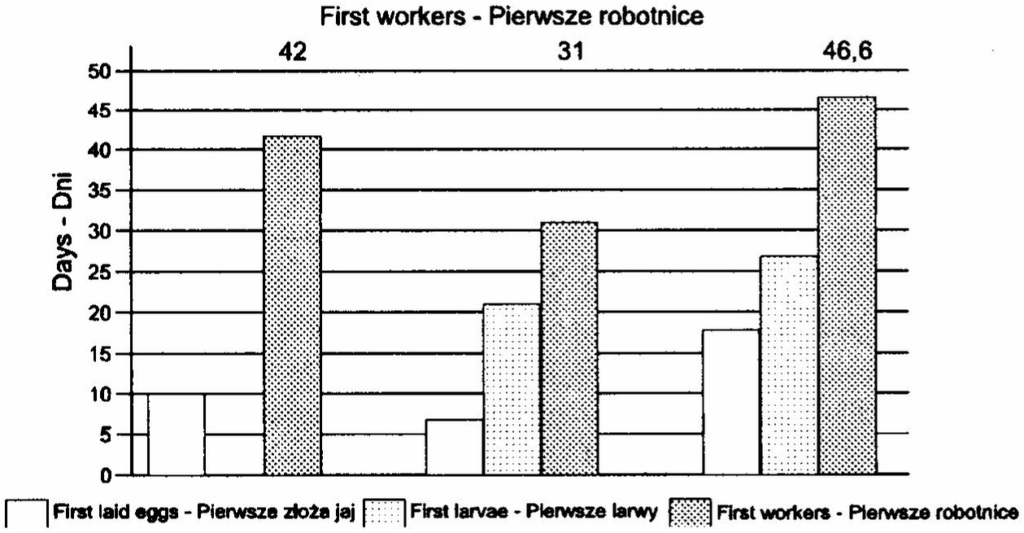
Fig. 1. Average development of bumble bee families in laboratory conditions from the moment of settlement. – Średni rozwój rodzin trzmielich w warunkach loboratoryjnych od momentu zasiedlenia
strona 317The families were transferred to the hives and placed in the apiary on the average after 50, 52 and 60 days respectively, when they had several or about a dozen of workers. The critical moment was the placement of the bumble bee family in the field. Some of the mothers died or ceased to lay eggs. Therefore, not all families were maintained and developed sexual generations. The percentage of females who started the building of nests in relation to the number of the settled females was the following in the successive years: 1995 – 90%; 1996 – 90,3%; and 1997 – 68,9%. On the other hand, the percentage of families placed in the field, i.e. females who bred workers, in relation to females who started nest building was similar in the particular years and showed: 77.8%, 71.4% and 75%.The percentage of families placed in the field who gave a sexual generation was in 1995 – 71,4%, in 1996 – 50%, and in 1997 – 66.7% ( table 1).
Table 1
Development of bumble bee families in the years 1995 – 1997 Rozwój rodzin trzmielich w latach 1995-1997
| Year – Rok | 1995 | 1996 | 1997 |
|---|---|---|---|
| Number of mothers settled by the laboratory method. Liczba matek zasiedlonych metodą laboratoryjną. |
10 | 31 | 29 |
| Number of mothers who started nest building. Liczba matek które rozpoczęły budowę gniazda. |
9 | 28 | 20 |
| % | 90 | 90.3 | 68.9 |
| Number of families placed in the field. Liczba rodzin wystawionych w terenie. |
7 | 20 | 15 |
| % | 77.8 | 71.4 | 75 |
| Number of families that produced sexual generations. Liczba rodzin które wydały pokolenie płciowe. |
5 | 10 | 10 |
| % | 71.4 | 50 | 66.7 |
Table2
Average number of individuals in bumble bee families in the years 1995-1997 Średnia liczebność rodzin trzmielich w latach 1995-1997
| Year Rok |
Number of nests Liczba gniazd |
Number of workers and males Liczba robotnic i samców |
Number of females Liczba samic |
Total Ogółem |
|---|---|---|---|---|
| 1995 | 5 | 196.4 | 12.2 | 208.6 |
| 1996 | 10 | 150 | 11.5 | 181.7 |
| 1997 | 10 | 163.4 | 13.3 | 162 |
The average general number of individuals in the families calculated on the basis of empty cocoons oscillated between 162 individuals in 1997 and
strona 318208,6 individuals in 1995. The mean number of females bred in families was similar in the particular years and ranged from 11,5 to 13,3 ( table 2 ).
CONCLUSIONS
- The transferring of bumble bee families from hives after the breeding of the first generation of workers and placing them in the field significantly reduces the labour consumption connected with breeding.
- The procedure of transferring bumble bee families in the initial developmental phase into hives and placing them in the field is the cause of mortality and disappearance of a certain number of females. In result, on the average, 50 – 71,4% of families placed in the field produce a sexual generation.
- The differentiation in the successive years of studies referring to the average length of the particular periods in the development of bumble bee families in constant conditions of the incubator probably indicates the influence of the individual characteristic features of the settled females.
REFERENCES
Banaszak J. (1993)- Trzmiele Polski. Wydawnictwo Uczelniane WSP Bydgoszcz.
Biliński M. (1981)- Zasady chowu i wykorzystania trzmieli. Prace Inst. Sad. Kwiac., Ser.F, Instrukcje Upowszechn., 20: 1-4.
Biliński M. (1993)- Gniazda trzmieli w naturze. Postępy apidologii w Polsce Wyd. Uczeln. WSP. Bydgoszcz : 119 – 134.
Dobromilska R. i in. (1995)-Wpływ zapylania kwiatów przez trzmiela ziemnego (Bombus terrestris) na plon i jakość owoców papryki. Nowe technologie a jakość plonu warzyw. Akademia Rolnicza we Wrocławiu, 151-154.
Shipp J.L., Whittfield G. H., Papadopoulus A. P. (1994)- Effectiveness of the bumble bee, Bombus impatiens Cr. (Hymenoptera: Apoidea) , as a pollinator of greenhouse sweet pepper. Scienta Horticulture, 57: 29-39.
Sowa S. i in. (1983)- Liczebności i skład gatunkowy owadów zapylających koniczynę czerwoną (Trifolium pratense L.) w Polsce w latach 1972-1975. Biul. IHAR 151: 147-162.
Wójtowski F., Wilkaniec Z. (1969)- Próby hodowli pszczół miesiarek i murarek (Hymenoptera, Apoidea, Megachilidae) w pułapkach gniazdowych. Rocz. Wyż. Szkoły Rolniczej w Poznaniu , XLII: 153 -165.
strona 319Wysocka – Owczarek M. (1994)- Wpływ wybranych czynników na skuteczność zapylania kwiatów oraz jakość i wysokość plonu pomidorów szklarniowych. Inst. Warzyw. Skierniewice, Mater. z Sympozjum 30-lecia, 49-56.
POZYSKIWANIE RODZIN TRZMIELI ZMODYFIKOWANĄ METODĄ LABORATORYJNĄ
Monika Maciejewska, Zdzisław Wilkaniec.
Streszczenie
Trzmiele (Bombus Latr.) należą, obok pszczoły miodnej, do głównych zapylaczy roślin entomofilnych. Posiadają one zdolność zapylania roślin niedostępnych dla pszczoły miodnej, a ważnych gospodarczo, jak np. koniczyna czerwona, lucerna siewna czy wyka kosmata. Zatem trzmiele są owadami niezbędnymi dla istnienia, lub też wydania nasion czy owoców, wielu gatunków roślin, zarówno uprawnych jak i dziko rosnących.
W ostatnich latach rodziny trzmieli wykorzystywane są przez ogrodników do zapylania niektórych warzyw uprawianych pod osłonami jak: pomidor, truskawka, papryka i inne. W efekcie działalności tych owadów uzyskuje się nie tylko wzrost plonu zapylanych roślin, ale również podniesienie jego jakości. Zapotrzebowanie na rodziny trzmieli jest z roku na rok coraz większe i w związku z tym prowadzi się ich chów w celach czysto komercyjnych. Celem doświadczeń prowadzonych w Katedrze Hodowli Owadów Użytkowych Akademii Rolniczej w Poznaniu i w stacji terenowej katedry w latach 1995-1997, było pozyskanie, wychów i analiza rozwoju rodzin trzmieli przy zastosowaniu i modyfikacji laboratoryjnej metody chowu tych owadów.
Rodziny trzmieli pozyskiwano w wyniku zastosowania laboratoryjnej metody chowu, przetrzymując matki w cieplarkach w specjalnie przygotowanych pudełkach plastikowych w obecności 3 – 4 młodych robotnic pszczoły miodnej, zabezpieczając im świeży pokarm w postaci ciasta z pyłku kwiatowego z miodem oraz syropu cukrowego. Po założeniu gniazd przez samice i wychowaniu pierwszego pokolenia robotnic, rodzinki z cieplarki przenoszono do ulików wypełnionych do 1/2 watą ,stanowiącą materiał gniazdowy i po 2 – 3 dniach przewożono je do stacji terenowej katedry, gdzie ustawiano na terenie porośniętym drzewami i krzewami. Przez cały czas, od umieszczenia rodzin w ulikach do zakończenia ich rozwoju, podawano im w podkarmiaczkach syrop cukrowy i pyłek kwiatowy w postaci sypkiej.
Rodziny, w których pojawiły się pokolenia płciowe, przenoszono do izolatorów z siatki polietylenowej, gdzie przebiegał proces unasieniania samic, a następnie zagrzebywania się ich w skrzynkach wypełnionych torfem zmieszanym z ziemią. Późną jesienią samice wyjmowano ze skrzynek, przekładano do pudełek z perlitem i umieszczano w chłodni w temp. 2°C . W doświadczeniu wykorzystywano głównie gatunek trzmiela ziemnego (B. terrestris), sporadycznie trafiały się matki trzmiela kamiennika (B. lapidarius) i trzmiela rudego (B. pascuorumm). W 1995 roku zasiedlono 10 matek, z których 90% podjęło budowę gniazda, a z nich 57,1% wydało pokolenie płciowe. W 1996 roku wartości te kształtowały się odpowiednio: 31 matek, 87% i 32,3% ; a w 1997 roku – 29 matek, 62% i 34,4%. W ciągu całego okresu badań prowadzono szczegółowe obserwacje nad przebiegiem rozwoju rodzin od zasiedlenia matek, aż do zakończenia rozwoju. Określono średnią liczbę dni od zasiedlenia do podjęcia czerwienia przez matki, wylęgu pierwszych larw, pierwszych robotnic oraz średnią liczbę wychowanych samic, samców i robotnic. Określono liczbę samic diapauzujących i tych, które nie zapadły w stan diapauzy.
strona 320Zastosowane w doświadczeniach przenoszenie rodzin trzmielich rozwijających się w cieplarkach do ulików po wychowaniu pierwszych robotnic, znacznie zmniejszyło pracochłonność laboratoryjnej metody chowu, a rodzinki trzmieli, po umieszczeniu ich w warunkach naturalnych, charakteryzowały się dynamicznym rozwojem.
Słowa kluczowe: trzmiele, rodziny, chów.
Errata — błędy druku znalezione podczas digitalizacji
- s. 313: „sative” → sativa
- s. 313: „villose” → villosa
- s. 313: „pseudoacours” → pseudacorus
- s. 313: „Pulmanaria” → Pulmonaria
- s. 314: „paprica” → paprika
- s. 314: „Netherlandsm” → Netherlands
- s. 314: „mathod” → method
- s. 314: „mesh nests” → mesh nets
- s. 314: „Patri” → Petri
- s. 315: „was base on” → was based on
- s. 315: „excessive isolation” → excessive insolation
- s. 316, ryc. 1: „loboratoryjnych” → laboratoryjnych
- s. 318, piśmiennictwo: „Scienta Horticulture” → Scientia Horticulturae
- s. 318, piśmiennictwo: „Liczebności i skład” → Liczebność i skład
- s. 319, streszczenie: „pascuorumm” → pascuorum