

TEMPERATURE IN WINTER CLUSTER BEE COLONY WINTERING IN A HIVE OF COLD COMB ARRANGEMENT
tekst: Bożena Chuda-Mickiewicz, Jarosław Prabucki
Pszczelnicze Zeszyty Naukowe, Rok XL, 1996 — Bożena Chuda-Mickiewicz, Jarosław Prabucki
strona 71PSZCZELNICZE ZESZYTY NAUKOWE Rok XL, Nr 2 1996
Bożena Chuda-Mickiewicz, Jarosław Prabucki
Department of Apiculture, Agricultural University ul. Doktora Judyma 20, 61-466 Szczecin, POLAND
Summary
Observations made on temperature distribution during the period of bee winter reposing showed that the bee colony wintering in a one-trunk hive with cold set of combs did not move its thermal centre. Some slight visible movements of the thermal centre are observed in the vertical plane within the same beeway between combs. At the minus temperature, the thermal centre does not show any changes in its location. At the plus temperature, the thermal centre moves slightly up and down within the same beeway between combs reaching the highest level at the hive board towards the end of the winter. The cluster temperature is subjected to the influence of outer temperature of the hive. Bees act by rising the average cluster temperature by 0.39°C as the cluster temperature decreases by 1°C (in the range from 8.2 to -9.1 °C).
<u>Keywords::</u> honey bee, wintering, cluster, temperature
INTRODUCTION
Thermoregulative mechanisms developed in the honeybee (Apis mellifera L.) allow its colonies to inhabit areas of climate with frosty winters (Ruttner 1988). In low temperatures, bees come together forming a cluster in order to reduce heat losses and to maintain the temperature securing their survival. The size of the formed cluster is positively correlated with the outer temperature (Chuda-Mickiewicz 1994 a-b, Chuda-Mickiewicz at al. 1993, Severson and Erickson 1990, Owens 1971). The shape of the cluster depends on the hive construction – its hight, set of combs and the cluster thermal centre location. In many-box hives with cold structure at the centre located in the central or upper box, the cluster assumes the oval or reversed cone shape (Owens 1971, Severson and Erickson 1990, Szabo 1993 a-b). Also the quoted authors demonstrated, that as the wintering period passes away to secure feeding requirements of bees, the cluster moves gradually up the brood nest. In the one-trunk Wielkopolski hive, the shape is influenced by location of the thermal centre. If bees form the cluster in the central space of the brood nest, it assumes the oval form, whereas it has the bell-like shape when the cluster is formed in the lower space of the hive (Chud
strona 72a-Mickiewicz 1994a-b, Chuda-Mickiewicz et al. 1993). Its location in the brood nest is not subjected to changes during the whole wintering period. Loosening of the cluster caused by the increase of the outer temperature is used by bees to transfer reserves to the area where bees wintering (Chuda-Mickiewicz 1994b).
Material and Methods. The studies were carried out in the apiary of the Apiculture Department, Agricultural University of Szczecin, in winter 1994/95 in a Wielkopolski hive (frames 360 x 260 mm) with cold structure of the brood nest.
Temperature measurements were done with the help of a KSP computerised measuring system. Thermistors were placed in the brood nest of a bee colony in beeways between combs. Altogether, all temperature measurements were taken from 96 thermistors arranged in three levels. Analysis of the results consisted in plotting the isolines in two planes, horizontal and vertical, which were running through the warmest spot in the cluster. Thus, the cluster behaviour was observed in changing conditions of the surroundings, and its density and location as well as shape was determined.
The aim of the studies was to make sure of how the wintering bee cluster behaves in a hive with cold structure of the brood nest; whether it behaves in similar way as in the colony wintering in a hive with warm structure, or in markedly different one.
Results. Cross-sections presented in Fig.1 show typical arrangement of isolines from October to April in two planes: A – horizontal, and B – vertical. The horizontal planes inform us about location of the thermal centre in the second beeway (18 October 1994) and about its persistence throughout October up to the end of April with small tendencies to move towards the third beeway in December. This slight horizontal shift is connected with translocation of the thermal centre of cluster (8 December 1994) towards the lowest level of thermistors. On the other hand, its return back to the second beeway is related to the cluster movement towards the hive board (31 December 1994 – 1 April 1995) and to translocation of the thermal centre towards the front wall of the hive.
Thus, the cluster wintering in a hive with cold structure of the brood nest does not change its original location making only slight movements within one beeway. The cluster movements are conditioned by the outer temperature. The temperature below 0°C makes its movements impossible but generates crowding of the bees around the thermal centre (Fig.1, 12 November – 8 December 1994). The temperature over 6°C affects loosening of the cluster and its vertical and horizontal movements (Fig. 1, 31 December 1994 – 1 April 1995). Corroboration of these observations can be detected when analysing isolines in short period of time, from 9 to 22 November 1994, with not very broad spectre of the outer temperature ranging from 2.0 to 12.0°C (Fig. 2a-f).
strona 73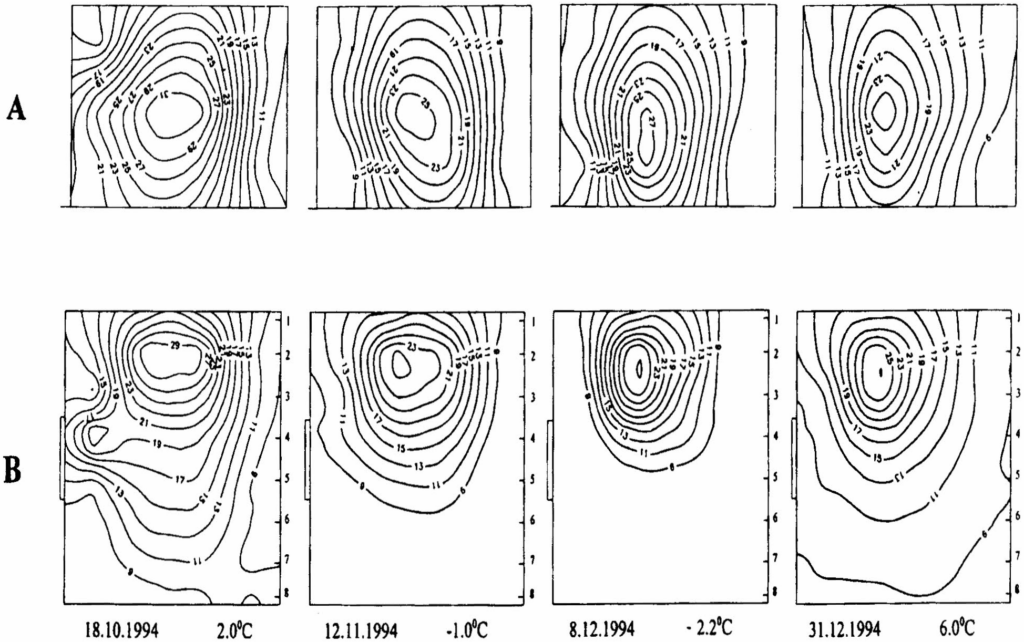
Fig.1. Cluster location and temperature in the nest in the 1994/95 winter Section: A – vertical longwise beeway, B – horizontal; below figs: date and outdoor temperature. Lokalizacja i temperatura kłębu w gnieździe zimą 1994/95 Przekroje: A – pionowy wzdłuż uliczki, B – poziomy; pod rycinami: data i temperatura zewnętrzna
strona 74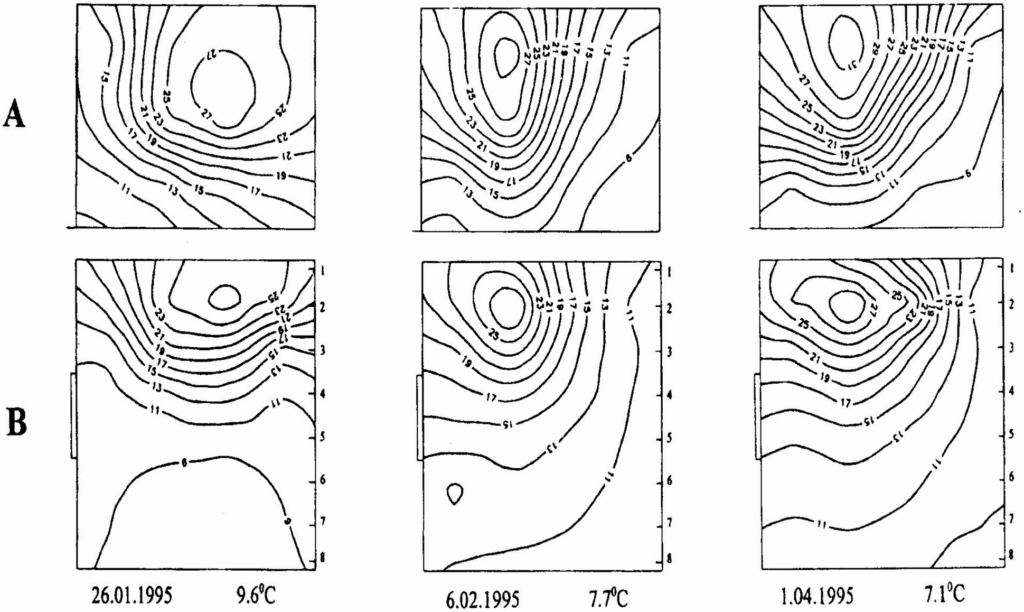
Fig.1. A Cluster location and temperature in the nest in the 1994/95 winter Section: A – vertical longwise beeway, B – horizontal; below figs: date and outdoor temperature. Lokalizacja i temperatura kłębu w gnieździe zimą 1994/95 Przekroje: A – pionowy wzdłuż uliczki, B – poziomy; pod rycinami: data i temperatura zewnętrzna
strona 75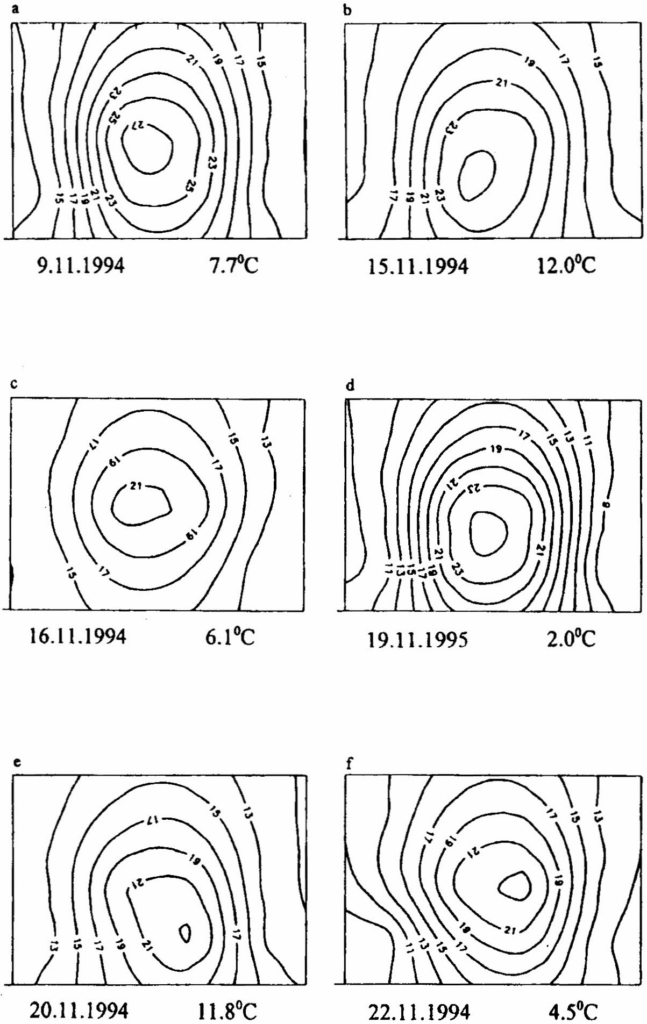
Fig.2. The arrangment of isotherms in the nest (vertical section longwise beeway) at positve outdoor temperature(a – f) Below figs: date and outdoor temperature Układ izoterm gniazda (przekrój pionowy wzdłuż uliczki) przy dodatniej temperaturze zewnętrznej (a – f) Pod rycinami: data i temperatura zewnętrzna
strona 76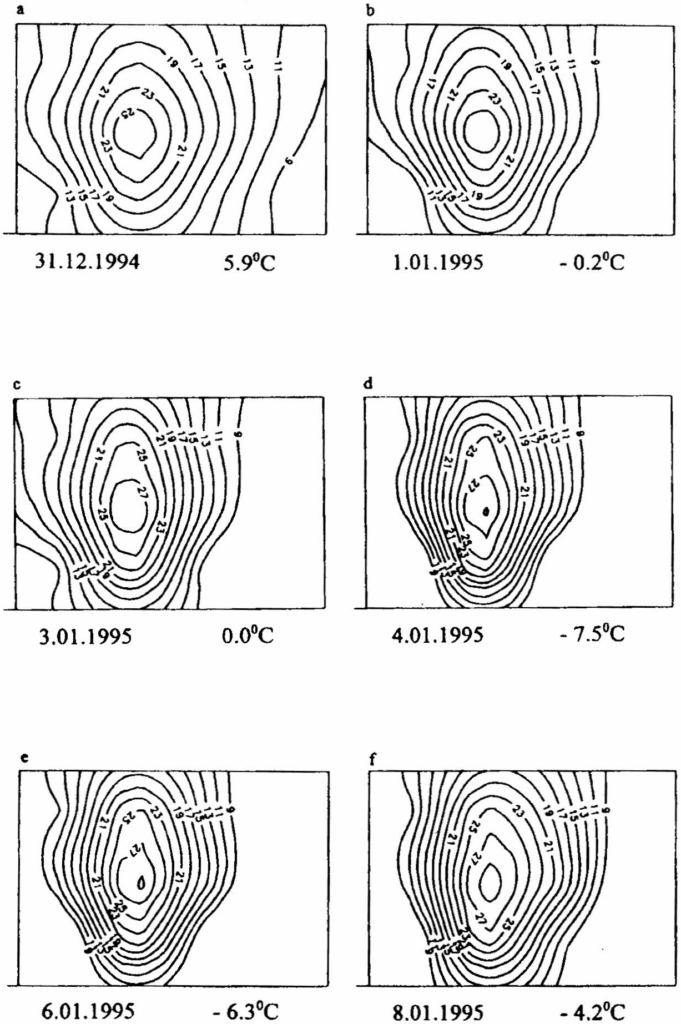
Fig.3. The arrangment of isotherms in the nest (vertical section longwise beeway) at negative outdoor temperature (a – f). Below figs: date and outdoor temperature Układ izoterm gniazda (przekrój pionowy wzdłuż uliczki) przy ujemnej temperaturze zewnętrznej (a – f). Pod rycinami: data i temperatura zewnętrzna
strona 77A clear translocation of the thermal centre occurs solely within the second beeway between combs. Movements of the thermal centre take place vertically between the first and the second level of thermistors. A quite different picture is given on Fig. 3a-f. The behavior of cluster presented here at the minus outer temperature ranging from 0.0 to -7.5°C shows the increasing density of isolates as the outer temperature drops. Also, a similar location of the thermal centre in relation to the plus temperature of 31 December 1994 (Fig. 3a) is noticed. The cluster mobility (activity) depends on the outer temperature. At above zero temperature, the average temperature of cluster remains at the level of 15 °C (Fig. 4), but displays the growing tendency even to 20 °C at the minus temperature. The temperature of the thermal centre is very stable and fluctuates near 30 °C (Fig. 4).
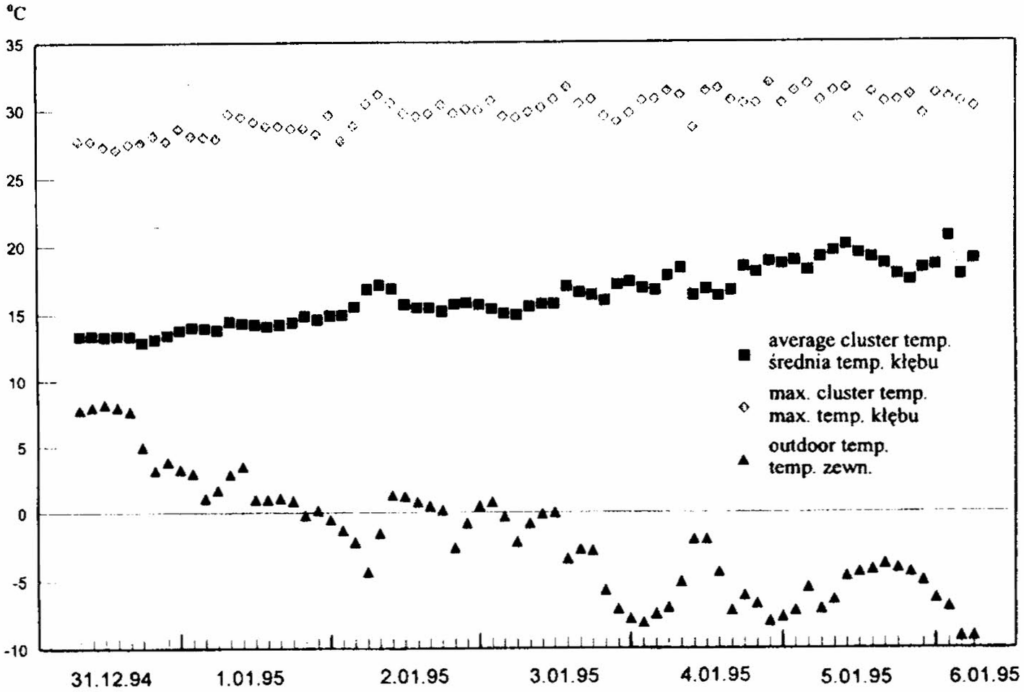
Fig. 4. Modelling of cluster temperature under influence of outdoor temperature Wpływ temperatury zewnętrznej na temperaturę kłęb
The influence of the hive ambient temperature on the temperature of the cluster is illustrated by a highly significant, negative correlation coefficient: r = -0.88. This correlation is expressed in the best way by the linear regression equation: y = 15.60 – 0.39x, the coefficient of which indicates that bees increase the cluster temperature by 0.39 °C on the average when outer temperature decreases by 1 °C.
strona 78CONCLUSIONS
1.A bee colony wintering in a hive with a cold set of frames does not shift its thermal centre in a significant way. Clear vertical and horizontal movements of the centre are observed permanently within the same byway between combs.
2.At the minus outdoor temperature, the thermal centre constantly remains in the same place not showing any movements. At the plus outer temperature, the thermal centre displays movements within one beeway between combs.
3.Temperature of the cluster is subjected to the influence of the outer temperature.
4.The cluster of wintering bees behaves the same in cold and warm structure of the brood nest.
REFERENCES
Chuda-Mickiewicz B.(1994 a) – Temperatura gniazda w okresie spoczynku zimowego pszczół, Zesz. Nauk AR Szczec. Zoot. 30(163): 37-43.
Chuda-Mickiewicz B.(1994 b) – Wpływ temperatury otoczenia ula na zachowanie kłębu zimującej rodziny pszczelej, Rozprawy – nr 162 AR Szczec.
Chuda-Mickiewicz B., Prabucki J., Kostrzewa Z. (1993) – Reakcja rodziny pszczelej na zmiany temperatury otoczenia, Pszczel. Zesz. Nauk 37: 51-63.
Owens C.D. (1971) – The termology of wintwring honey bee colonies, Tech. Bull. U.S. Dep. Agric. 1429: 1-32.
Ruttner W. (1988) – Biogeography and taxomomy of honey bee, Springer-Verlag, Berlin Heiderberg.
Sewerson D.W., Erickson E.J.Jr. (1990) – Quantification of cluster size and low ambiet temperature relationships in the honey bee, Apidologie 21: 135-142.
Szabo T.I. (1989 a) – Thermology of wintering honey-bee colonies in 4-colony packs. Cluster positions, Am. Bee J. 129(7): 472-473.
Szabo T.I. (1989 b) – Thermology of wintering honey-bee colonies in 4-colony packs. Colony population and honey production, *Am. Bee. J.*129(8): 554-555.
TEMPERATURA KŁĘBU ZIMUJĄCEJ RODZINY PSZCZELEJ W ULU O ZIMNEJ ZABUDOWIE GNIAZDA
B. Chuda-Mickiewicz, J. Prabucki
Streszczenie
Badania prowadzono zimą 1994/95 roku w Pasiece Zakładu Pszczelnictwa Akademii Rolniczej w Szczecinie, w ulu wielkopolskim o zimnej zabudowie gniazda.
Pomiary temperatury prowadzono za pomocą komputerowego systemu pomiarowego KSP. Czujniki temperatury rozmieszczone były w gnieździe rodziny pszczelej w uliczkach
strona 79międzyplastrowych. W sumie pomiary temperatury pochodziły z 96 termistorowych czujników umieszczonych na trzech poziomach. Analiza wyników polegała na wykreślaniu izolinii pozwalających na śledzenie zachowania kłębu w zmieniających się warunkach otoczenia i określania jego wielkości miejsca oraz kształtu.
Uwiązany w październiku 1994 r kłąb pszczół swoje centrum cieplne zawiązał na drugim poziomie drugiej uliczki międzyplastrowej. Pod koniec zimowli, w kwietniu 1995 roku, kłąb zajmował najwyższy poziom gniazda ale tej samej uliczki. W między czasie w miarę wzrostu temperatury zewnętrznej, powyżej 0⁰C, rozluźniał się i ponownie skupiał zmieniając nieznacznie lokalizację centrum cieplnego w pionie i w poziomie pomiędzy najbliższymi czujnikami. Przy temperaturze ujemnej centrum cieplne nie zmieniało swego położenia, pozostając stale w jednym miejscu.Temperatura otoczenia ula odziaływała na ciepłotę kłębu, jej spadkowi o 1⁰C towarzyszły wzrost temperatury kłębu o 0,39⁰C.
Uzyskane wyniki pozwalają na stwierdzenie, że zimująca rodzina pszczela tworzy kłąb mogący się nieznacznie przemieszczać w obrębie jednej uliczki międzyplastrowej. Ruchy kłębu, jego rozluźnianie, można obserwować przy dodatniej temperaturze zewnętrznej. Przy temperaturze ujemnej kłąb pozostaje w jednym miejscu wykazując tendencję silniejszego skupiania się.
<u>Słowa kluczowe:</u> pszczoła miodna, kłąb, zimowla, temperatura
Errata — błędy druku znalezione podczas digitalizacji
- s. 71: „at al.” → et al.
- s. 71: „hight” → height
- s. 75, fig. 2: „19.11.1995″ → 19.11.1994
- s. 75, 76, fig. 2, 3: „arrangment” → arrangement
- s. 75, fig. 2: „positve” → positive
- s. 77, fig. 4: „temperaturę kłęb” → temperaturę kłębu
- s. 78: „byway” → beeway
- s. 78, piśmiennictwo: „termology” → thermology
- s. 78, piśmiennictwo: „wintwring” → wintering
- s. 78, piśmiennictwo: „Ruttner W.” → Ruttner F.
- s. 78, piśmiennictwo: „taxomomy” → taxonomy
- s. 78, piśmiennictwo: „Heiderberg” → Heidelberg
- s. 78, piśmiennictwo: „Sewerson” → Severson
- s. 78, piśmiennictwo: „ambiet” → ambient
- s. 79, streszczenie: „W między czasie” → W międzyczasie
- s. 79, streszczenie: „odziaływała” → oddziaływała
- s. 79, streszczenie: „towarzyszły” → towarzyszył