

STUDIES ON THE WORKER BEE RESPONSE TO SOUNDS UNDER LABORATORY CONDITIONS
tekst: Michał Rybak, Janina Muszyńska
Pszczelnicze Zeszyty Naukowe, Rok XLII, 1998 — Michał Rybak, Janina Muszyńska
strona 41PSZCZELNICZE ZESZYTY NAUKOWE Rok XLII, Nr 1 1998
Michał Rybak, Janina Muszyńska
Research Institute of Pomology and Floriculture, Apiculture Division Kazimierska 2 Str., 24-100 Puławy, POLAND, e-mail: opisik@man.pulawy.pl
Summary
A laboratory-based study was conducted at the Bee Division, Institute of Pomology and Floriculture in Puławy in the years 1995-1997.
Its objective was to test the response of worker bees to external acoustic sounds and to find sounds which have a clear impact on their behaviour.
Worker bees placed in a cage were tested for their reaction to sounds emitted at frequency ranges of 20Hz to 25 kHz (two shapes: sinusoid and rectangle and at two amplitude levels 0.5 and 2.0 V).
The bees responded most clearly to sounds at frequency ranges of 450 – 800 Hz and 70 – 120 Hz. The former frequency range yielded decreased motive activity whereas the response to the latter was increased liveliness. A method was developed and implemented for the quantitative assessment of changes in the motive activity of bees elicited by sounds at frequency ranges of 450 to 800 Hz and 70 to 120 Hz. A decline in bee motive activity in response to the emission of 800 Hz sounds is shown by a pronounced decrease in the number of bees which leave the cage. The effect of the 70 to120 Hz sounds was much less conspicuous.
<u>Keywords</u>: sounds, emision, motive activity, worker bees
INTRODUCTION
It is a common knowledge that individuals of the honey bee i.e. worker bees, queens and drones make sounds that are situation-specific. Among the best known and described in detail are sounds emitted by queens: quacking, tooting, piping (Michelsen et al. 1986, 1987). Likewise, whole bee colonies produce sound patterns typical of the situations in which they find themselves: absence of the queen, swarming mood, state of peril (Krupicka 1976, Diatlein 1985, Bromenshek and Lockwood-Ogan 1990, Chuda-Mickiewicz et al. 1992)
However, very little is known about how acoustic stimuli influence the behaviour of honey bee individuals and that of whole colonies. The manner in
- This work was supported by KBN grant Nr PB 993/PO6/95/08
which those stimuli are received and their significance in the life of bees are not adequately understood yet. The recent studies have indicated that worker bees receive acoustic stimuli not only by means of the rather primitive tibia organ but also through antennae (Dreller and Kirchner 1995). Attempts have also been made to quiet bees down using sounds but no satisfactory results were obtained. The device used in those attempts was not effective enough to make a smoker redundant (Lord et al. 1985).
The aim of the present study was to test the response of worker bees to external acoustic stimuli and to find sounds which distinctly influence the behaviour of bees.
METHODS
The laboratory-based study was conducted at the Bee Division, Institute of Pomology and Floriculture in the years 1995 – 1997.
In order to generate sounds for this study an experimental set-up was used made up of the following components (Phot. 1.):
- function generator from a METEX MS1410 set-up
- 200 mHz frequency meter from a METEX MS1410 set-up
- Dual channel oscilloscope HC 3502C2
- Acoustic amplifier in-house made for the study
- Multimeter METEX MS 3805
- Set of two speakers ZGC 40-8-513 TONSIL
- Dynamic speaker 0.5 W
In the first stage of the study i.e. from the beginning of July to the end of September 1995 ca. 50 worker bees were collected from the last comb in the nest and placed in a specially designed cage. It was a polyurethane foam frame 24 x 13 x 5 cm closed on both sides with a plastic mesh. The cage was kept in room temperature for 10 days and at that time it was repeatedly exposed to different sounds. During the observation the bee-containing cage was placed between two speakers 25 cm apart in a sound- proof box. The following sound parameters were used:
— frequency: range from 25 to 1,000 Hz every 25 Hz, 1,000 to 2,000Hz every 100 Hz, 2,000 to 10,000 Hz every 500 Hz, 10,000 to 20,000 every 1,000 Hz
— shape – sinusoid and rectangle
— amplitude – magnitude of electric signal measured directly at the clamps of the speaker 0.5-2.0 V
strona 43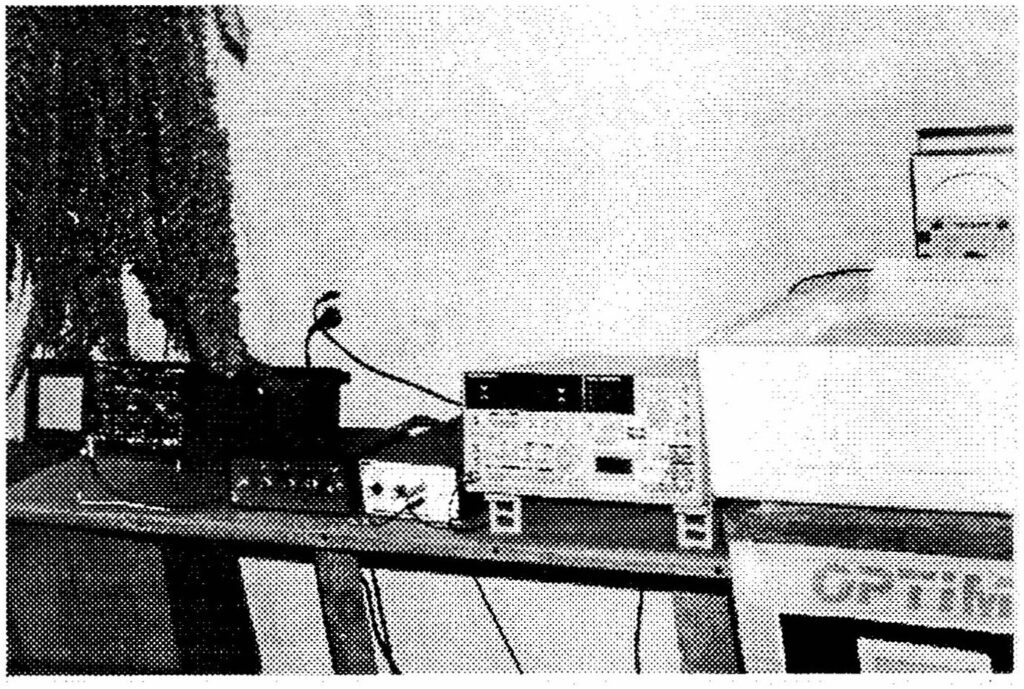
Phot. 1
Experimental sound- generating and measuring apparatus Zestaw badawczy aparatury do wytwarzania i pomiarów dźwięków
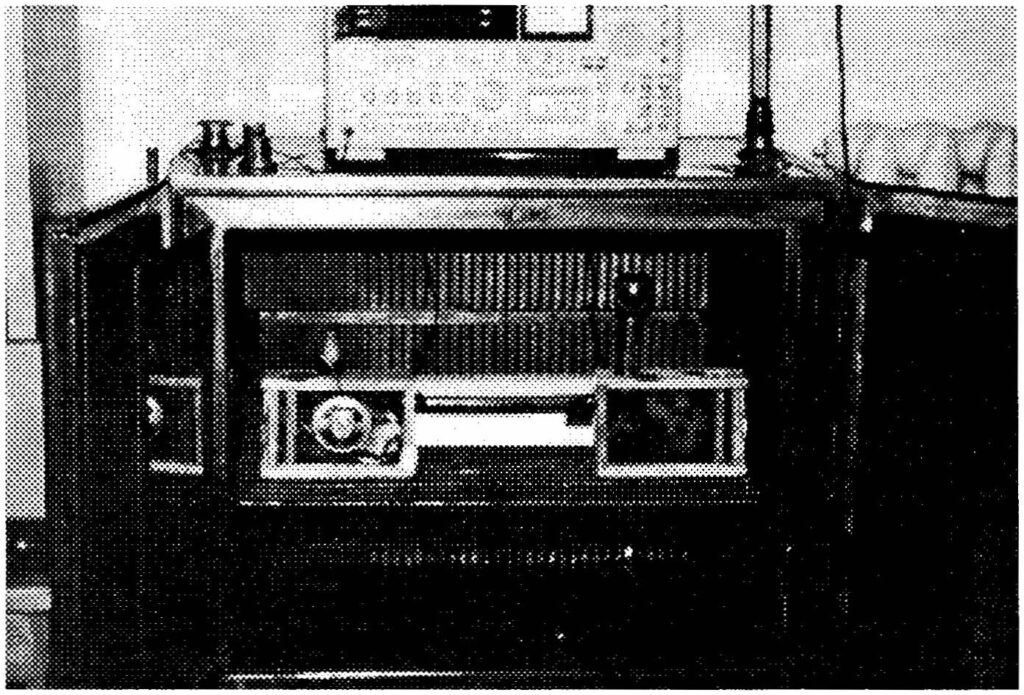
Phot 2
Experimental set-up for the second stage of the study Zestaw obserwacyjny drugiego etapu badań
strona 44A sound exposure of 1 min. duration was used for each of the frequencies, shapes and amplitudes. There was a 5 min pause between successive sound events. During the exposure the bees response was scored on a 0 to 5 points scale, 5 points being the normal level of motive activity and 0 points standing for maximum decline in motive activity (the bees freeze). Diverse behaviour patterns of individual worker bees were considered. The records were entered on a special sheet. Observation intervals were condensed in the areas of increased responsivity. A total of 850 documented observations were made.
In the years 1996 -1997 sounds estimated the bees in the first stage were picked out for trials of the second stage. Worker bees were examined for their tendency to leave the cage. The bees under scrutiny were placed in two Liebefeld cages connected with a transparent tube (10 mm inner diameter) through which they could freely move in both directions (Phot. 2.). The distance between cages was 200 mm. A dynamic speaker of 0.5 W output and 5 cm in diameter was mounted outside one of the cages. For the duration of the experiment the bee-containing cage was placed in an incubator at a temperature of 24°C. All sounds were emitted at the same volume level of 80 dB measured at a distance of 0.5 m from the speaker.
Bees for the study were sampled from honey-producing colonies, from the last comb in the nest. The observations were made both in winter i.e. from 30th Nov. to 30th April in the years 1995/96 and 1996/97 (winter bees) and in the honey-producing season i.e. from 30th April to 30th Sept. in the years 1996 and 1997. In either season the bees were sampled at one month intervals.
The bees were placed for 24 hr in an incubator and then exposed to sounds. On each observation date three-minute long sound events were applied followed by a 1 min intervening period of silence. That cycle constituted an experiment series. On a given date three experiment series were repeated for each of the sounds with a pause of 5 min after each repeat. During the sound event and during the silence period which followed the bees were evaluated for the propensity to leave the cage based on the counts of bees that came out of cages. The data were put together and analysed using Duncan test.
RESULTS
- Search for sounds which have a distinct impact on the behaviour of bees
The results from the first stage of the study showed that at some frequency ranges the sounds do influence the behaviour of bees. It should be stressed that the impact can take different forms e.g. increase or decrease in motive activity, excitation or intensification of information transmitting process which consists in bees touching one another with their antennae. Motive activity was found to
strona 45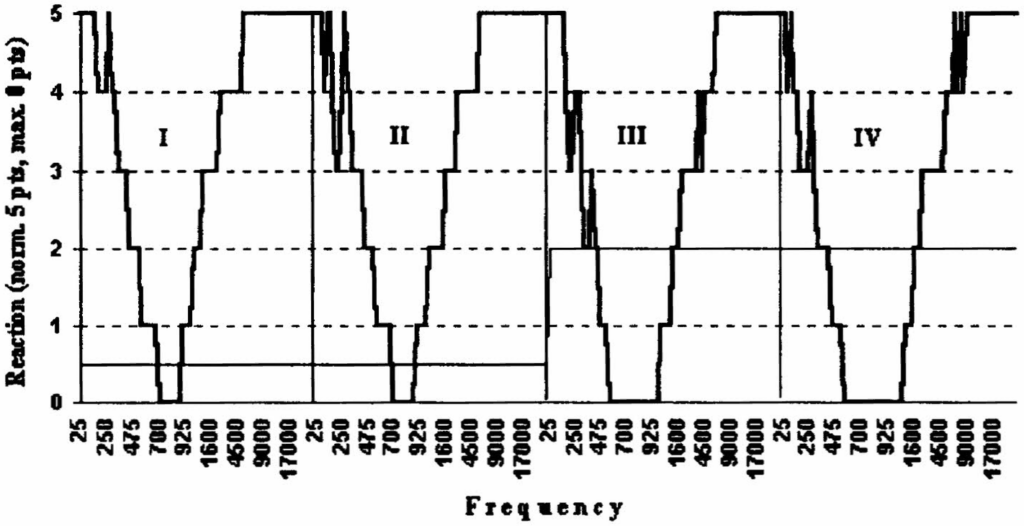
Fig. 1 Reaction of worker bees to sounds of different shape and amplitude (I – sinusoid 0.5 V, II – rectangle 0.5 V, III – sinusoid 2.0 V, IV – rectangle 2.0 V) Reakcja pszczół robotnic na dźwięki dla różnych kształtów i amplitudy bodźca dźwiękowego (I – sinusoida 0,5 V, II- prostokąt 0,5 V, III – sinusoida 2,0 V, IV prostokąt 2,0 V)
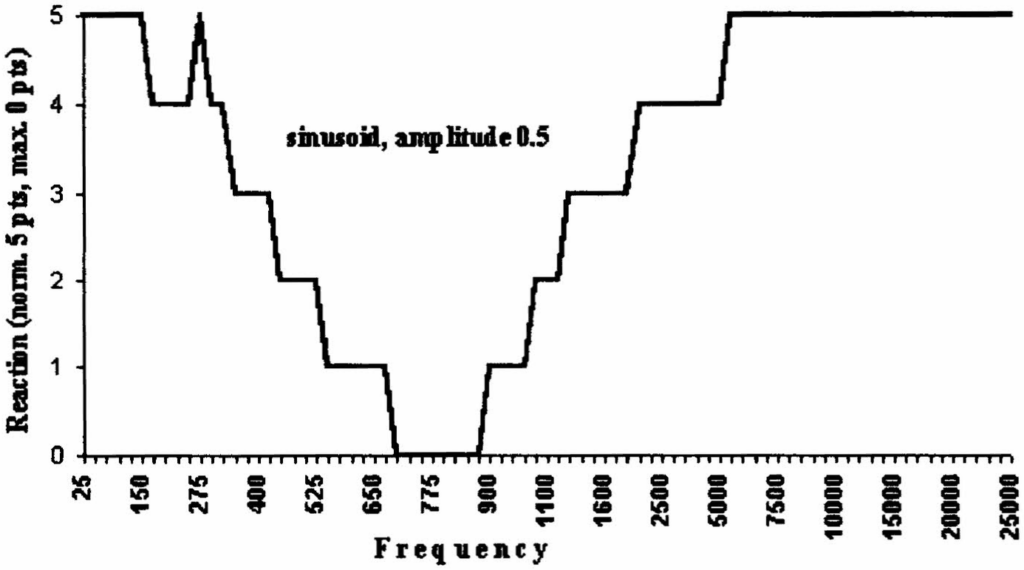
Fig. 2 Effect of sounds on the reduction in bee motive activity with respect to a sinusoid-shaped sound at an amplitude of 0.5 V Wpływ dźwięków na zmniejszenie reakcji ruchowej pszczół dla dźwięku o kształcie sinusoidy przy amplitudzie 0,5 V
strona 46be the most conspicuously affected by sounds. Hence it was motive activity that was taken as the basis for evaluating the impact of sounds on worker bees.
Based on 850 observations it was found that sounds with a frequency range of ca. 500 to 900 Hz elicit symptoms of reduced motive activity whereas sounds which fall within the frequency range of ca. to 120 Hz cause bees to be less lively. In addition, the symptoms of reduced motive activity in worker bees are more conspicuous than those of increased activity.
The effect of sound stimuli on the reduction of motive activity in bees was shown on charts (Fig. 1 and 2)
The chart in Fig. 1 illustrates comprehensively the results of the study. It shows that at a higher sound amplitude (III and IV) there is an expansion of the increased responsiveness area, especially at the peaks, as related to sounds of lower amplitude (I and II). The chart also shows that the shape of sound signals (sinusoid -I and III – vs. rectangle -II and IV) affects but slightly the magnitude of response elicited in bees. Fig. 2 shows a zoomed-in fragment of the frequency scale of Fig. 1. It can be seen easily that the area that yielded the greatest response is contained within the 650 – 850 Hz frequency range.
- Detailed assessment of bee response to selected sounds
The second stage of the study was concerned with the effect of sounds of 70, 120, 450 and 800 Hz on the propensity of the bees to leave the cage during the emission of the sound and during the silence period following the emission. Attention was paid to behaviour of bees in the cages with and without a loudspeaker. The data are presented in Table 1 (winter bees) and in Table 2 (summer bees).
Table 1
Response of winter bees to sounds (data from the years 1995/96 and 1996/97) Reakcja pszczół zimowych na dźwięki (wyniki z lat 1995/96 oraz 1996/97)
| Frequency Częstotliwość (Hz) | No. repeats Licz. powt. | No. of bees leaving the cage — Liczba pszczół opuszczających klateczkę: With loudspeaker / Z głośnikiem — During emission / W czasie emisji | With loudspeaker / Z głośnikiem — During silence / W czasie ciszy | Without loudspeaker / Bez głośnika — During emission / W czasie emisji | Without loudspeaker / Bez głośnika — During silence / W czasie ciszy |
|---|---|---|---|---|---|
| 800 | 13 | 46,3 a | 87,4 b | 71,0 ab | 91,8 b |
| 450 | 8 | 57,5 a | 100,7 b | 102,1 b | 89,1 ab |
| 120 | 10 | 91,4 a | 98,1 a | 113,1 a | 122,4 a |
| 70 | 7 | 72,8 a | 68,1 a | 74,5 a | 91,1 a |
Table 2
Response of summer bees to sounds (data from the years 1996 and 1997) Reakcja pszczół letnich na dźwięki (wyniki z lat 1996 oraz 1997)
| Frequency Częstotliwość (Hz) | No. repeats Licz. powt. | No. of bees leaving the cage — Liczba pszczół opuszczających klateczkę: With loudspeaker / Z głośnikiem — During emission / W czasie emisji | With loudspeaker / Z głośnikiem — During silence / W czasie ciszy | Without loudspeaker / Bez głośnika — During emission / W czasie emisji | Without loudspeaker / Bez głośnika — During silence / W czasie ciszy |
|---|---|---|---|---|---|
| 800 | 9 | 44,7 a | 73,5 a | 88,3 a | 76,3 a |
| 450 | 9 | 53,7 a | 73,0 a | 71,0 a | 74,7 a |
| 120 | 9 | 64,0 a | 64,7 a | 75,7 a | 74,8 a |
It was found that during the emission of the sounds 800 Hz and 450 Hz in frequency the cage with a louspeaker was left by significantly fewer worker bees than during the silent period. The data also indicate that the response of winter bees elicited by those conditions is more conspicuous than that of summer bees. The sounds of 120 Hz and particularly of 70 Hz in frequency failed to elicit any significant change in winter bees. Consequently, the frequency of 70 Hz was discarded from the experiments with summer bees.
DISCUSSION
The data from this study indicate that sounds are more easily employed to inhibit the motive activity in bees than to arouse it. At present, the fact is difficult to account for. It can only be conjectured that stimuli other than acoustic e.g. chemical are more relevant for inducing motive activity in bees.
There can be several reasons for the observed differences between the studied bee generations in their responsiveness to sounds of 800 and 450 Hz in frequency. One of the reasons can be variation in the uniformity of bee samples taken for observation. The data obtained for winter bees were much more homogeneous that those for summer bees even though the study was conducted over two years on several dates in each year. Another reason may lie in the differences in responsiveness or in the level of response to sounds that exist between the bee generations examined. It is generally known that bees of the winter generation differ from summer bees for several physiological traits and for some metabolic processes (Konopacka and Muszyńska 1975, Fluri et al. 1977). Thus it can be reasonably supposed that responsiveness to sounds is also part of those differences.
strona 48CONCLUSIONS
a/ A sound of 800 Hz reduces the motive activity in bees which is particularly conspicuous for the winter generation
b/ A sound of 450 Hz elicits a response similar to that of 800 Hz but of a lesser intensity
c/ Sounds of 120 and 70 Hz fail to affect significantly the motive activity of both summer and winter bees
REFERENCES
Bromenshenk J. J., Lockwood-Ogan N. (1990) -Sonic digitizer as an alternative method to assess honey bee (Hymenoptera: Apidae) colony dynamics. J. econ Ent. 83(5): 1791-1794
Chuda-Mickiewicz B., Kostrzewa Z., Prabucki J. (1992) – Próba określenia stanu biologicznego rodziny pszczelej poprzez analizę jej widma akustycznego. Zesz. Nauk. Akademi Rolniczej w Szczecinie 151: 13-20
Dietlein D. G. (1985) – A method for remote monitoring of activity of honeybee colonies by sound analysis. J. apic. Res. 24(3): 176-183
Dreller C., Kirchner W. H. (1995) – The sense of hearing in honey bees. Bee Wld. 76(1): 6-17
Fluri P. H., Wille L., Lüscher G. M. (1977) – Juvenile hormone, vitellogenin and haemomcyte composition in winter worker honeybees (Apis mellifera). Experienta 33: 1240-1241
Ishay J.S., Sadeh D. (1982) – The sounds of honey bees and social wasps are always composed of a uniform frequency. J.Acoust.Soc.Am. 72(3):671-675
Kirchner W.H. (1993a) – Acoustical communication in honeybees. Apidologie, 24:297-307
Konopacka Z., Muszyńska J., Szczepański K. (1975) – Ocena przydatności niektórych cech fizyko-chemicznych i anatomicznych dla charakterystyki kondycji robotnic pszczoły miodnej. Pszczeln. Zesz. Nauk. 19: 39-52
Krupicka P. (1976) – Zvukova analyza pri prognoze rojeni vcelstv. Vedecke prace VUVč v Dole : 63-73
Lord W. G., Bambara S. B., Ambrose J. T. (1985) – Effect of bee calm device on honey bee aggressiveness. Am. Bee J. 4: 251-253
Michelsen A., Kirchner W. H., Andersen B. B., Lindauer M. (1986) – The tooting and quacking vibration signals of honeybee queens: qantitative analysis. J. Comp. Physiol. A 158: 605-611
strona 49Michelsen A., Towne W. F., Krichner W. H., Kryger P. (1987) – The acoustic near field of a dancing honeybee. J. Comp. Physiol. A 161: 633-643
Nieh J. (1993) – The stop signal of honey bees: reconsidering its message. Behav.Ecol.Sociobiol. 33(1)51-56
Ohtani T., Kamada T. (1980) – Worker piping’: The piping sounds produced by laying and guarding worker honeybees. *J.apic.Res.*19(3):154-163
BADANIA NAD REAKCJĄ PSZCZÓŁ ROBOTNIC NA DŹWIĘKI W WARUNKACH LABORATORYJNYCH
Michał Rybak, Janina Muszyńska
Streszczenie
Wiadomo powszechnie, że pojedyncze osobniki pszczoły miodnej tj.: robotnice, matki pszczele i trutnie emitują w określonych sytuacjach i różne rodzaje dźwięków (Michelsen i wsp 1986; Ishay, Sadeh 1982; Ohtani, Kamada 1980). Najbardziej znane i szczegółowo opisane są dźwięki emitowane przez matki pszczele (kwakanie, trąbienie, piszczenie) (Michelsen i wsp. 1986). Stwierdzono, że istnieją takie grupy dźwięków, na które pojedyncze osobniki pszczoły miodnej reagują zmianą zachowania. Wiadomo np., że pszczoły robotnice reagują na docierające do nich bodźce dźwiękowe pochodzące od matek oraz innych pszczół robotnic (Ohtani, Kamada 1980; Michelseni wsp. 1986; Nieh 1993). Podobnie z zachowania matek wynika, iż słyszą one i reagują na dźwięki emitowane przez inne matki obecne w gnieździe (Michelsen i wsp. 1986 a;b; Kirchner 1993 a). Dźwięki emitowane przez pojedyncze pszczoły robotnice w różnych sytuacjach stanowią jedną z form przekazywania informacji w rodzinie pszczelej. Przekaz ten ma mały zasięg jednak szybko dociera do osobników zdolnych do odebrania tego bodźca (Kirchner 1993 a). Dobrym przykładem na potwierdzenie tej opinii są dźwięki emitowane przez pszczoły podczas tańców werbujących, na które reaguje określona grupa robotnic. Zastosowanie dźwięków w praktyce pasiecznej nie powinno napotykać na techniczne trudności. Otwartą sprawą pozostaje jednak to jakie bodźce dźwiękowe należy zastosować by powodowały one określoną zmianę w zachowaniu rodzin pszczelich. By np. wywoływały zmianę w aktywności zbieraczej rodzin pszczelich lub ich agresywności. Były wprawdzie podejmowane próby uspakajania pszczół za pomocą dźwięków (Lord i wsp. 1985), jednak nie przyniosły zadawalających wyników. Zastosowanie urządzenia nie pozwoliło bowiem na rezygnację z posługiwania się podkurzaczem. Znalezienie dźwięków skutecznie modyfikujących zachowanie rodzin pszczelich umożliwiłoby wprowadzenie do praktyki pszczelarskiej nowej technologii pasiecznej.
Celem niniejszych badań było sprawdzenie reakcji pszczół robotnic na zewnętrzne bodźce akustyczne oraz znalezienie takich dźwięków, które w sposób wyraźny wpływają na zachowanie pszczół.
Badania prowadzono w Oddziale Pszczelnictwa ISK w Puławach w latach 1995 – 1997, w warunkach laboratoryjnych.
Do wytwarzania dźwięków na potrzeby niniejszych badań użyto zestawu aparatury składającego się z następujących elementów:
- Generator funkcji z zestawu METEX typ MS1410
- Częstotliwościomierz 200 MHz z zestawu METEX typ MS1410
- Oscyloskop dwukanałowy HC 3502C2
- Wzmacniacz akustyczny specjalnie wykonany w Oddziale Pszczelnictwa dla potrzeb tych badań
- Multimetr METEX typ MS 3805
- Zespół głośników 2x ZGC 40-8-513 TONSIL
- Głośnik dynamiczny 0,5 W
W trakcie prowadzonych badań oceniano reakcję pszczół robotnic umieszczonych w klateczce na dźwięki w zakresie częstotliwości od 20 Hz do 25 kHz (dla dwóch kształtów: sinusoidy i prostokąta oraz przy dwóch poziomach amplitudy 0,5 i 2,0 V). Najbardziej wyrazistą reakcję pszczół stwierdzono przy dźwiękach o częstotliwości 450 – 800 Hz oraz 70 – 120 Hz. Pierwszy z wymienionych przedziałów częstotliwości dźwięków, powoduje ograniczenie aktywności ruchowej pszczół, drugi zaś jej nieznaczne zwiększenie (Fig 1 i Fig 2).
Następnie opracowano i wdrożono metodę ilościowej oceny zmiany w aktywności ruchowej pszczół pod wpływem dźwięków o częstotliwości 450 – 800 Hz oraz 70 – 120 Hz. Przeprowadzone badania wykazały, że dźwięki o częstotliwości 800Hz powoduje znieruchomienie znacznej liczby pszczół w klateczce z głośnikiem i w ten sposób ogranicza ich skłonność do opuszczania klateczki (Tabl 1 i 2). Należy przy tym podkreślić, że pszczoły pokolenia zimowego reagują na dźwięki w sposób wyraźniejszy niż pszczoły pokolenia letniego.
<u>Słowa kluczowe</u>: dźwięki, emisja, aktywność ruchowa,pszczoły robotnice.
Errata — błędy druku znalezione podczas digitalizacji
- s. 41, keywords: „emision” → emission
- s. 41: „Diatlein” → Dietlein
- s. 41: „Bromenshek” → Bromenshenk
- s. 42: „200 mHz” → 200 MHz
- s. 46: „ca. to 120 Hz” → ca. 70 to 120 Hz
- s. 47: „louspeaker” → loudspeaker
- s. 47: „homogeneous that” → homogeneous than
- s. 48, references: „Akademi” → Akademii
- s. 48, references: „haemomcyte” → haemocyte
- s. 48, references: „Experienta” → Experientia
- s. 48, references: „qantitative” → quantitative
- s. 49, references: „Krichner” → Kirchner
- s. 49, streszczenie: „Michelseni” → Michelsen i