

REPEATABILITY OF VARROA DEFENCE TRAITS IN APIS MELLIFERA CARNICA
tekst: Raj Kumar Thakur, Kaspar Bienefeld, Roland Keller
Pszczelnicze Zeszyty Naukowe, Rok XL, 1996 — Raj Kumar Thakur, Kaspar Bienefeld, Roland Keller
strona 191PSZCZELNICZE ZESZYTY NAUKOWE Rok XL, Nr 2 1996
Raj Kumar Thakur, Kaspar Bienefeld, Roland Keller
Länderinstitut für Bienenkunde, Friedrich Engels Str-32, D-16540-Hohen – Neuendorf, GERMANY
Summary
Observations revealed the involvement of a small percentage (20 % to 40%) of marked bees in the processes of uncapping and removing artificially mite infested brood cells. A number of these bees were found to be highly active in performing the above processes. The repeatability of uncapping was estimated at 0.10 (duration), 0.13 (frequency) and 0.26 (intensity); the repeatability of removing was estimated at 0.04 (duration), 0.12 (frequency) and 0.17 (intensity), and the repeatability of grooming behaviour was estimated at 0.42 (intensity).
Keywords: Apis mellifera carnica, Varroa jacobsoni, removing, grooming
INTRODUCTION
Until now little information was available on the repeatability of Varroa defense traits in the honey bee. Repeated measurements facilitate the partitioning of phenotypic variance within and between individual bees which gives a ratio of variance components called the repeatability (Falconer 1981). The repeatability of the colony specific rate of damaged mites for different periods of the year was estimated by Büchler (1993). The repeatability of brood removal using different methods, e.g brood punctured by needle, the use of normal wax brood frame or Jenter frame infested with one mite per cell and the removal of a freeze-killed brood was estimated at 0.54, 0.38, 0.16 and 0.10 respectively (Hoffman 1996). Possibility of common genetic control for the uncapping and removal behaviour of freeze-killed brood by bees and good repeatability of the measurements was demonstrated by Milne (1982), who also estimated the heritability of uncapping and removal behaviours of bees with regard to a freeze-killed brood (Milne 1985). In order to organise performance testing in practical bee-breeding it is of value to know how often measurements should be repeated in order to obtain a sufficient evaluation of traits.
Present studies were aimed at estimating the repeatability of Varroa
strona 192defense traits in individual bees, such as the uncapping and removal of mite infested brood cells, and the nest-mate grooming of infested bees. Page et al (1987) reported that special tasks in the colony are mostly performed by specialists. Since a bee colony is a composite of several patrilines which may have different threshold levels of expressing Varroa defense traits, the performance of a colony may be a composite effect of these different patrilines. Thus, selection response is expected to be much higher when selection is made directly according to the individual bee’s expression of these special behaviours. For this reason, individually well performing workers were selected and stimulated to lay eggs. The sperm of the resulting drones was used in the insemination of queens raised from already selected stock. Using the above method, it is useful to estimate the individual’s repeatability of Varroa defense traits. Moreover, repeatability sets the upper level of the heritability and, consequently, the estimation of this parameter is useful when population structure is not sufficient to calculate the inheritance of the characters (Falconer 1981).
MATERIAL AND METHODS
Seventy colonies were screened for possible damage caused by mites found on the bottom board. Six colonies were selected according to varying percentages of damaged mites. The brood frames, containing ready to open broods from the colonies with different percentages of damaged mites, were separately placed in an incubator (34.5°C, 50-60% RH). The newly emerged workers (50) from each colony were individually marked, maintained in a frame cage with a sliding panel of glass on one side and metal gauze on the opposite side. The cage, with four bee frames and one adjacent brood frame was placed in a polystyrene box. This six frame polystyrene mating box was prepared three days prior to the start of the test. An infra-red video camera was placed in front of the glass panel (Thakur et al 1996). The experiments were conducted twice, each time with 300 bees from the selected colonies during May-July, 1996 (20.05.1996-11.07.1996).
The positions of the freshly capped artificially infested brood cells (n=20, 1st experiment; n=15, 2nd experiment) were marked on a polythene sheet. The mites were collected by dusting bees with powder sugar (Rath and Drescher 1990). Parallel control cells were prepared in a similar way to the infested cells but were not infested with mites. The brood frame containing a partially artificially mite infested brood and control cells were placed inside the cage for the recording of the process of uncapping and removal of infested brood cells by marked bees. The average time one bee spent in uncapping or removing per infested cell, the frequency of working on each cell and the average intensity were each considered as a behavioural unit for repeatability estimations. The intensity was evaluated subjectively on
strona 193a scale from 1-5 both in uncapping and removing behaviours. In the experiments, the simultaneous uncapping of two cells was not observed and, therefore, the performance of one bee per cell was considered as a statistically useful unit.
Nest-mate grooming as a part of grooming behaviour ( Peng et al 1987), was observed in individually infested bees (n=25) where mites were present on the thorax or abdomen. The grooming test was repeated three times in each experiment. The intensity of a groomer was also evaluated subjectively on a scale from 1-5. In some cases the duration and frequency of grooming behaviour could not be recorded because groomers were not constantly in the camera’s field of observation. In order to obtain an estimate of the repeatability of nest-mate grooming, the behavioural unit was estimated according to the average intensity of a groomer during each replication. Moreover, the intensity of a groomer was evaluated according to its effectiveness at repeatedly attacking mites attached to bees and the speed at which a groomer chased the escaping mites. The methodological deficiency of the camera could have resulted in an inaccurate estimation of the duration and frequency of nest-mate grooming but not, to such an extent, the estimation of the intensity, therefore, the repeatability of grooming with respect to duration and frequency was not calculated. For the above reason, only the bees which participated in nest-mate grooming were considered and the inactive bees were excluded. The activities in each test were constantly video-recorded over a period of six days. Grooming test observations were recorded over a period of upto 10 hours in each replication. Data was subjected to statistical analysis using SAS (1988) restricted maximum likelihood procedures. The statistical model used for partitioning the source of variance was as follows :
y = Ce + Li + B (Li) + e
Ce = Cell/time effect
Li = Line effect
B(Li) = Bee nested within Line
e = Error
y = Duration and intensity respectively of uncapping and removing per cell
strona 194Repeatabilities of uncapping, removing and grooming were calculated using the Falconer equation (1981):
r = S²B(Li) / ( S²Li + S²B(Li) + S²Ce + S²e )
Standard error (s.e.) of repeatabilities was estimated using the formula given by Dickersion (1960).
RESULTS AND DISCUSSION
Long term analysis of recordings revealed the involvement of a limited percentage of marked bees in the processes of uncapping and removing. In both the experiments, 20% of the bees were involved in uncapping 30% (6/20, 1st experiment) and 26.6% (4/15, 2nd experiment) of the artificially Varroa infested cells (Fig.1). The percentage of bees which participated in the removal of these cells varied from 30% to 40% respectively in the two experiments. None of the control cells were uncapped in either of the experiments. According to these observations, the repeatability of the uncapping trait was found to be 0.15 (average time), 0.26 (intensity) and 0.13 (frequency) respectively (table 1). The repeatability of removal behaviour was found to be 0.04 (average time), 0.17 (intensity) and 0.12 (frequency) respectively. The repeatability of grooming behaviour was estimated at 0.42 (intensity).
T a b l e 1 Repeatability of different Varroa defense traits.
| Average time+ S.E ^a) | Frequency+ S.E ^b) | Intensity +S.E ^c) | |
|---|---|---|---|
| Uncapping | 0.10+0.019 | 0.13+0.017 | 0.26+0.025 |
| Removing | 0.04+0.014 | 0.12+0.018 | 0.17+0.021 |
| Grooming | 0.42+0.19 |
^a) – Average time a bee spent in uncapping and removing per varroa infested cell.
^b) – How often every cell is worked upon by uncappers and removers.
^c) – Individuals intensity of uncapping and removing a cell. In grooming it represents intensity of a nest mate groomer per replication.
strona 195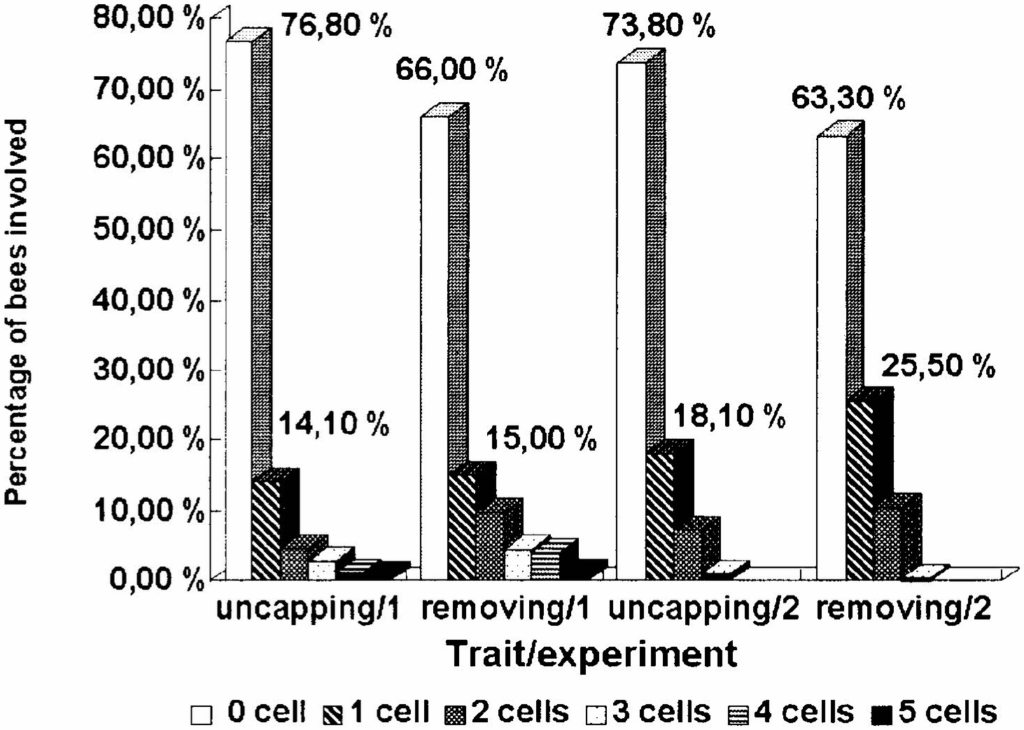
Fig. A. Percentage of marked bees involved in uncapping and removal of artificially Varroa infested cells. X-axis represents uncapping and removing no cell, 1 cell, 2 cells 4 cells and 5 cells, respectively. Y-axis represents percentage of bees involved.
The results in figure 1 indicate a good repeatability of uncapping and removing because a number of bees were active in uncapping and removing in several cells, whereas other bees were inactive during the whole experiment. However, the estimate of the repeatability of these traits was found to be small since it is difficult to determine whether these two traits should be quantified according to the duration of involvement in these processes, the frequency or the intensity. For example, one bee which spends a long time opening one cell is involved in the uncapping of other cells for a shorter duration but it is still efficient. Although bees were active for a short period, they initiated the uncapping process, which shows that they were capable of detecting either the presence of mites in an infested cell or certain signals faster than other bees and they should therefore be considered efficient.
A rapid process was observed where an infested larva was removed immediately after uncapping and then discarded, whereas a longer process was observed where the infested larva was digested by the bees within the cell. Sometimes the infested brood was removed in less than 20 seconds when it was directly pulled out after uncapping and the bees involved in this
strona 196process were also included contrary to the method of Milne (1985). In some cases more than one bee was involved in the process where half of the larva was pulled away by one worker and the rest was removed by another worker. Moreover, the removal was initiated by short visits of removers. In addition, the calculations were estimated to be low because only few individuals were found to be engaged in the above processes which limited the variance component between bees, and consequently the repeatability.
The mechanism a bee uses to detect mite infested larva or pupa is still unknown (Boeking and Drescher 1994). The infested brood at the time of uncapping and removal was not dead as in a freeze-killed or pinned brood. Certain stimuli trigger the opening and removal of mite infested cells. These stimuli seemed to be perceived by only few individuals effectively. Sometimes different uncappers and removers could be seen to be competing with each other while opening and removing a particular cell, whereas other bees showed no interest in these cells whatsoever. It has been assumed that the removal of larvae and pupae in Apis cerana is due to the presence of foreign bodies, such as a mite under a capped cell which could alter the behaviour of larvae or pupae. Alteration in behaviour of larvae or pupae could be signaled by sound (Tewarson et al 1992). Scent cues adhering to the mites are also considered to be responsible for the uncapping of artificially mite infested cells (Rosenkranz et al 1993). Depending on the cause of uncapping and removal of freeze-killed or pinned brood it seems to be somewhat different compared to the hygienic behaviour of bees in relation to the uncapping and removal of Varroa infested cells, as reported earlier (Milne 1982, 1985; Hoffman 1996). The signals which lead to the detection and removal of frozen pupae are not necessarily the same as those which lead to the detection and removal of mite-infested pupae (Spivak 1996).
Nest-mate grooming was also expressed by some individuals repeatedly and the repeatability was estimated to be somewhat higher than in other Varroa defense traits. The distinct reaction of nest-mate groomers to grooming dancers was observed, as reported by Peng et al (1987) in Apis cerana. However, the restricted field of observation and the resulting small sample size of bees resulted in a comparatively large standard error of the estimate. Recently, a new infra-red camera has been developed within the institute with the capacity to include the whole of the brood frame within its field of observation. This new device will facilitate a more detailed observation of activities.
strona 197ACKNOWLEDGEMENTS
We thank R. Büchler and C. Rowlands for comments on the earlier version of the manuscript. Raj K. Thakur wishes to express his thanks to DAAD for financing his research stay in Germany and to Savita for her inspiration and sacrifices during the course of investigations.
REFERENCES
Boeking O., Drescher W.(1994) – Rating of signals that trigger Apis mellifera L bees to remove mite-infested brood. Apidologie 25: 459-461.
Büchler R. (1993) – Rate of damaged mites in natural mite fall with regard to seasonal effects and infestation development. Apidologie 24:492-493.
Dickerson S. E. (1960) – Techniques for research in quantitative animal genetics. American Society of Animal Science. Technical Bulletin, 56
Falconer D. S. (1981) – Introduction to quantitative genetics. Longman Group Ltd. London and New York, 170 pp.
Hoffman S. (1996) – Beurteilung von Körperputz- und Bruthygienverhalten der Bienen unter Versuchs und Praxisbedingungen. Deutsches Bienen Journal 4:306-309.
Milne C. P. jr. (1982) – Laboratory measurement of brood disease resistance in honeybee. 1. Uncapping and removing of freeze-killed brood by newly emerged workers in laboratory test cages. Journal of Apicultural Research 21:111-114.
Milne C. P. jr. (1985) – Estimates of the heritabilities of and genetic correlation between two components of honey bee (Hymenoptera: Apidae) hygienic behavior: Uncapping and removing. Annals of Entomological Society of America 78:841-844.
Peng Y.S., Fang Y., Xu S., Ge L. (1987) – The resistance mechanism of the Asian honey bee, Apis cerana Fabr., to an ectoparasitic mite Varroa jacobsoni Oudemanns. Journal of Invertebrate Pathology 49:54-60.
Rath W., Drescher W. (1990) – Response of Apis cerana Fabr towards brood infested with Varroa jacobsoni Oud and infestation rate of colonies in Thailand. Apidologie 21:311-321.
Page R. E., Robinson G.E., Fondrk M. K.(1989) – Genetic specialists, kin selection and nepotism in honey-bee colonies. Nature 338:576-579.
Rozenkranz P., Tewarson N.C., Singh A., Engels W. (1993) – Differential hygienic behavior towards Varroa jacobsoni in capped worker brood of Apis cerana depends on alien scent adhering to the mites. Apidologie 32:89-93.
SAS Institute (1988) – SAS user’s guide. SAS Institute, Cary, NC.
Spivak M (1996) – Honey bee hygienic behaviour and defense behavior against Varroa jacobsoni. Apidologie 27:245-260.
Tewarson N.C., Singh A., Engels W.(1992) – Reproduction of Varroa jacobsoni in colonies of Apis cerana indica under natural and experimental conditions. Apidologie 23: 161-171.
Thakur R.K., Bienefeld K., Keller R. (1996) – Observations on Varroa defensive behavior of A. mellifera carnica against Varroa jacobsoni with the help of Infra Red photography. Apidologie 27:284-286.
strona 198POWTARZALNOŚĆ ZACHOWAŃ OBRONNYCH PSZCZOŁY MIODNEJ (APIS MELLIFERA CARNICA) PRZECIW VARROA JACOBSONI
R. K. Thakur, K. Bienefeld, R. Keller
Streszczenie
Pszczoły zwalczają pasożyta Varroa jacobsoni zachowując się w różny sposób. Zachowania te do tej pory określano pośrednio, na podstawie naturalnego osypu uszkodzonych roztoczy. Wydaje się jednak, że konieczne jest bezpośrednie określanie czyszczącego zachowania się pszczół. Przeprowadzono je techniką pomiaru w podczerwieni za pomocą kamery video. Obserwacje znakowanych pszczół różnego pochodzenia, które powtórzono i konfrontowano z komórkami zainfekowanymi w plastrach lub innymi robotnicami porażonymi Varroa wskazują, iż istnieją indywidualne różnice w zachowaniu się robotnic. Dotyczą one: zachowań czyszczących porażonych pszczół (tańce strząsające), samooczyszczania i czyszczenia wzajemnego pszczół, chwytania i uszkadzania roztoczy znajdujących się na zewnątrz i wewnątrz komórki, jak i otwieraniu porażonych komórek. Różnice pomiędzy spokrewnionymi osobnikami wskazują, że powyższe zachowania uwarunkowane są także na genotypowo.
Słowa kluczowe: Apis mellifera carnica, Varroa jacobsoni, zachowania obronne
Errata — błędy druku znalezione podczas digitalizacji
- s. 194: „Dickersion” → Dickerson
- s. 197, piśmiennictwo: „Oudemanns” → Oudemans
- s. 197, piśmiennictwo: „Rozenkranz” → Rosenkranz