

PRELIMINARY STUDIES ON THE EFFECT OF BAYCOX ON NOSEMA APIS Z. IN THE HONEYBEE (APIS MELLIFERA L.) UNDER LABORATORY CONDITIONS
tekst: Paweł Chorbiński, Barbara Tomaszewska
Pszczelnicze Zeszyty Naukowe, Rok XL, 1996 — Paweł Chorbiński, Barbara Tomaszewska
strona 155PSZCZELNICZE ZESZYTY NAUKOWE Rok XL, Nr 2 1996
Paweł Chorbiński, Barbara Tomaszewska
Faculty of Veterinary Medicine, Department of Epizootiology and Clinic of Infections Diseases, Pl. Grunwaldzki 45, 50-366 Wrocław, POLAND
Summary
The effect of Baycox (the active agent – toltrazuril) on the provoked invasion of Nosema apis Z. in honeybee was studied under laboratory conditions. The effect of increasing doses of Baycox on mortality of bees, and sugar syrup and water consumption was monitored. In toxicity studies, the doses of 25, 50, 100, 200, 400, 800 and 1600 ppm of toltrazuril were used. In studies on the development of the Nosema apis invasion in bees the food was supplemented with 25 and 50 ppm of Baycox. The mortality of bees, the sugar and water consumption and mean number of spores was monitored on the 3rd, 5th, 7th and 10th day after invasion. The physiological condition of the midgut of the experimental bees was examined histologically. It was found that Baycox in doses of 25 and 50 ppm of toltrazuril was not toxic to bees. The addition of Baycox in such doses of the active agent did not have a significant inhibitory effect on the development of the parasite N. apis in the midgut epithelial cells in the honey bee.
Keywords: honey bee, toxicity, toltrazuril, Baycox, Nosema apis.
INTRODUCTION
Nosemosis is of the most important sanitary problems in apiaries especially that the infection of 50% of bees in spring may lead to the destruction of a whole colony (Škrobal, Krieg 1984). The loses due to nosemosis may increase when combined with diseases of unknown ethiology, possibly of virus origin (Jeliński 1986; Kohlich, Derakshifar 1988), or with warrosis (Romaniuk, Wawrzyniak 1991).
The role of Fumagillin, used for 40 years in therapy of nosemosis is unqestionable. Nevertheless, there are studies carried out on the possibility of using other protozoocidial drugs against the invasion of Nosema apis. Several jonophore antibiotics were tried as alternative drugs to the commonly used Fumagillin (Pokorna 1987; Tomaszewska et al. 1988; Chorbiński, Tomaszewska 1992). These studies, however, did not bring positive results although the parasites
155
strona 156of the genus Eimeria are, like N.apis, intracellular parasites and show specificity to the midgut epithelium.
The poultry coccidiosis is successfully treated with the coccidiostatic Baycox (Mazurkiewicz et al. 1991) produced by the Bayer company. Baycox contains 2,5% of the active agent – toltrazuril, the 1-[3-methyl]-4-(4′-trifluormethyl-thiophenoxy) -phenyl]-3-methyl-1,3,5-triazin-2,4,6(1H, 3H, 5H)-trion. Baycox is water soluble and the doses used in poultry keeping are 25 or 75 mg of active agent per 1 litre of water depending on the duration of the treatment.
The aim of the present study was to determine the effect of Baycox on the development of the Nosema apis invasion in experimentally infected bees under laboratory conditions. The effect of different doses of Baycox on phisiological condition of bees was also investigated.
MATERIAL AND METHODS
The bees for study were obtained from the apiary of the Department of Epizootiology. The bees derived from bee colonies free of Nosema apis as ascertained in a prior routine check. The bees were brushed from the last honeycomb. The experimental and control groups consisted of 50 insects each and were kept in the incubator at 31°C. In the studies were replicated 3 times and divided into two stages. In the first stage, the effect of increasing doses of Baycox on bee mortality and syrup and water consumption was investigated. Toltrazuril in doses of 25, 50, 100, 200, 400, 800 and 1600 ppm was given in 50% sugar syrup. The control group consisted of healthy bees fed with 50% sugar syrup (Control). In the second stage, the effect of Baycox in selected doses of 25 and 50 ppm of ative agent on the development of provoked N.apis invasion was monitored. The worker bees were infected with a single dose of 64 x 104 spores/ml applied in 2,5 ml of 50% sugar syrup. During the remaining days of the experiment the bees were fed syrup that contained 25 or 50 ppm of toltrazuril. The control groups consisted of:
- infected bees fed pure sugar syrup (positive control – Control-P);
- healthy bees fed pure sugar syrup (negative control – Control-N);
- healthy bees fed syrup supplemented with of Baycox (Control-B).
The number of dead bees and syrup and water consumption were monitored every 24 hours during the 10-day experimnent. The results were analysed satistically using analysis of variance (at alpha = 0.05) and the Abbot formula. The number of spores was counted on the 3rd, 5th, 7th and 10th day of the experiment in infected bees treated with Baycox as well as in control bees.
At similar intervals, the condition of the midgut was examined histhologically in groups of bees which were prepared especially for this
156
strona 157purpose. The paraffin technique, staining which Novum asane, and the Giemza method were applied. The groups of bees for the histological study (Baycox 25 ppm-H and Baycox 50 ppm-H) had their own control groups, the infected as well the healthy ones , labelled as Control: P-I-H, P-II-H, N-I-H, N-II-H. One group of each class was prepared for each day of the experiment. 30 bees of each group were selected for the histological study. The bees were put to sleep, decapitated and the midgut was removed. The midgut was fixed in Carnoy liquid and preserved in paraffin. The character oblesions in epithelial cells, condition of peritrophic membranes and the rate of the parasite multiplication were studied.
In total, 85 groups of experimental and control bees were used in this study.
The mean number of spores per one bee in infected bees treated with Baycox and in groups of control infected untreated bees was compared every day during the experiment. The differences were analysed statistically using analysis of variance (at alpha = 0.05).
RESULTS
Baycox in doses of 25 – 400 ppm of the active agent did not cause significant increase in mortality of experimental bees. A sligtly higher mortality rate, was observed only in the group treated with 50 ppm of toltrazuril and, on the 10th day, in the group treated with 400 ppm of toltrazuril. The very high doses of 800 and 1600 ppm caused the increase in mortality rate of experimental bees from 4th day onwards. On the 10th day, the mortality in the group treated with the highest dose reached 98% (Fig. 1). A slight increase in water intake during the first three days occurred in bees treated with 100, 200 and 400 ppm of toltrazuril.
157
strona 158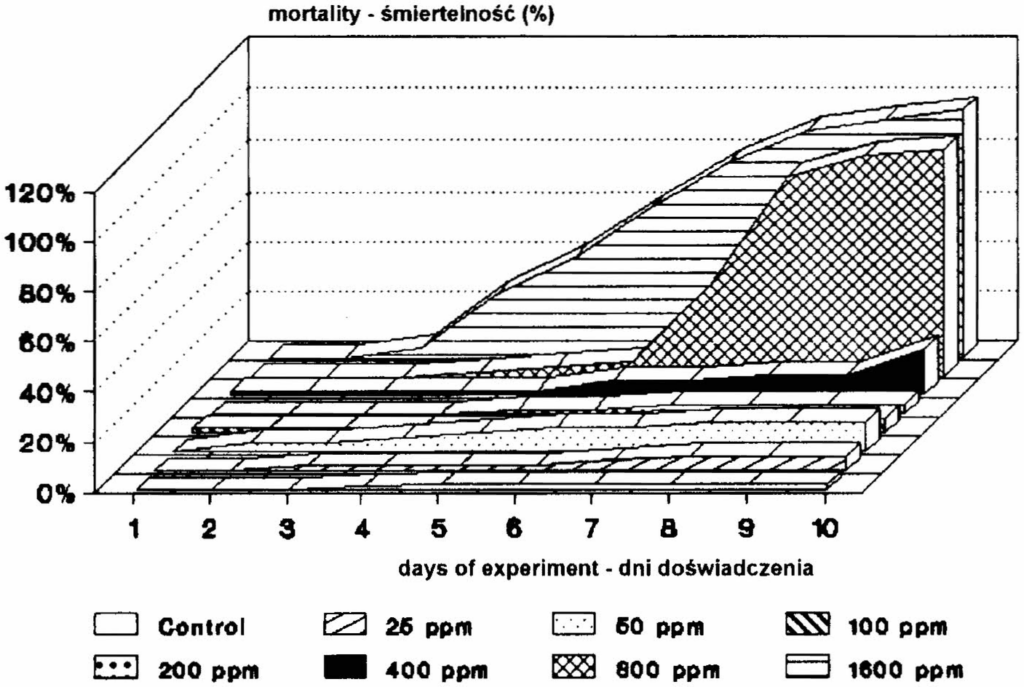
Fig. 1. Percent of cummulative mortality of bees fed syrup with Baycox. Ogólny procent śmiertelności pszczół otrzymujących w syropie dodatek Baycoxu.
The mortality of infected bees treated with Baycox in doses of 25 and 50 ppm of the active agent was higher than that in healthy bees (Control-N). Significant differences occurred between the group treated with syrup with 50 ppm toltrazuril (Baycox 50 ppm) and the group of healthy untreated bees (Control-N) and the group of healthy bees treated with both doses of toltrazuril (Control-B). Similar differences occurred between the infected untreated group (Control-P) and the aforementioned control groups (Control-N and Control-B). This may be explained by the effects of Nosema invasion which was not inhibited by Baycox (Fig. 2).
158
strona 159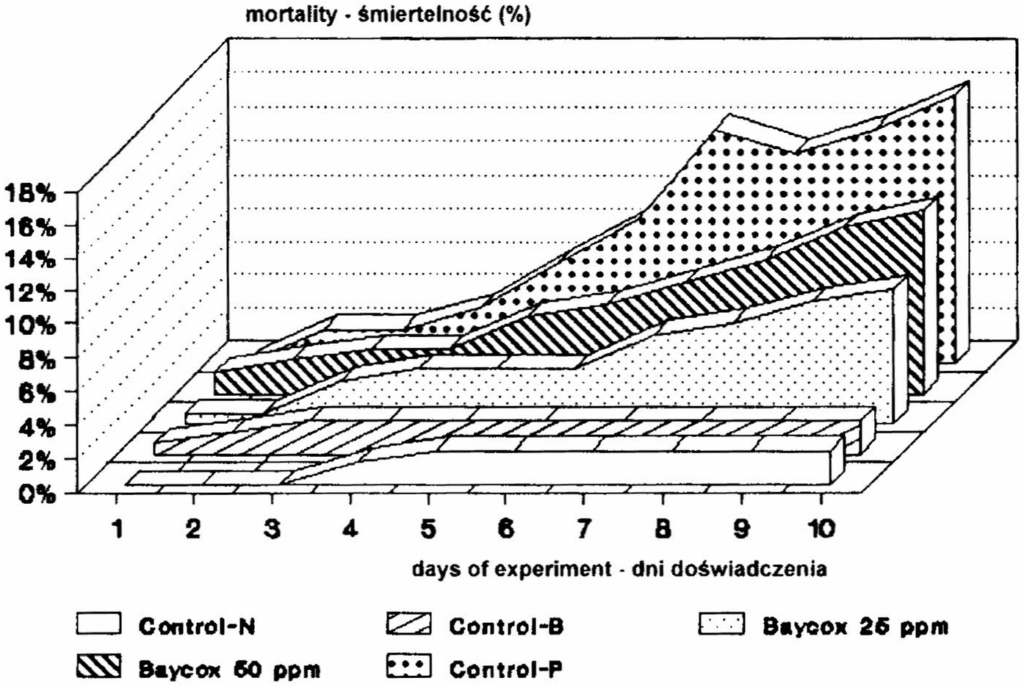
Control-N – uninfected bees + syrup – pszczoły niezarażone + syrop Control-B – uninfected bees + syrup + Baycox – pszczoły niezarażone + syrop + Baycox Control-P – infected bees + syrup – pszczoły zarażone + syrop
Fig. 2. Percent of cummulative mortality rate of infected bees fed syrup with Baycox. Ogólny procent śmiertelności zarażonych pszczół otrzymujących w syropie dodatek Baycoxu.
No significant differences were found in consumption of syrup and water by bees treated with 25 and 50 ppm toltrazuril although an increase in sugar syrup demand occurred on the 3rd day in bees treated with 50 ppm of toltrazuril (Fig. 3). Water consumption is presented in Fig. 4.
159
strona 160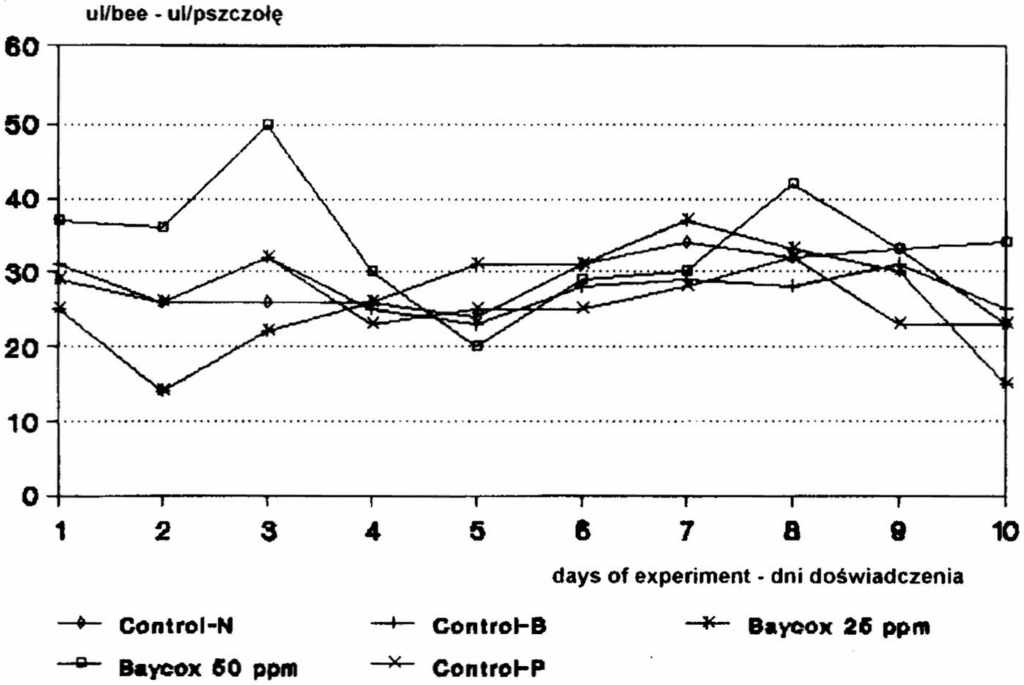
Control-N – uninfected bees + syrup – pszczoły niezarażone + syrop Control-B – uninfected bees + syrup + Baycox – pszczoły niezarażone + syrop + Baycox Control-P – infected bees + syrup – pszczoły zarażone + syrop
Fig. 3. Sugar consumption syrup by infected bees fed syrup with Baycox (in μl/bee). Spożycie pokarmu cukrowego przez zarażone pszczoły otrzymujące w pokarmie dodatek Baycoxu (w μl/pszczołę).
160
strona 161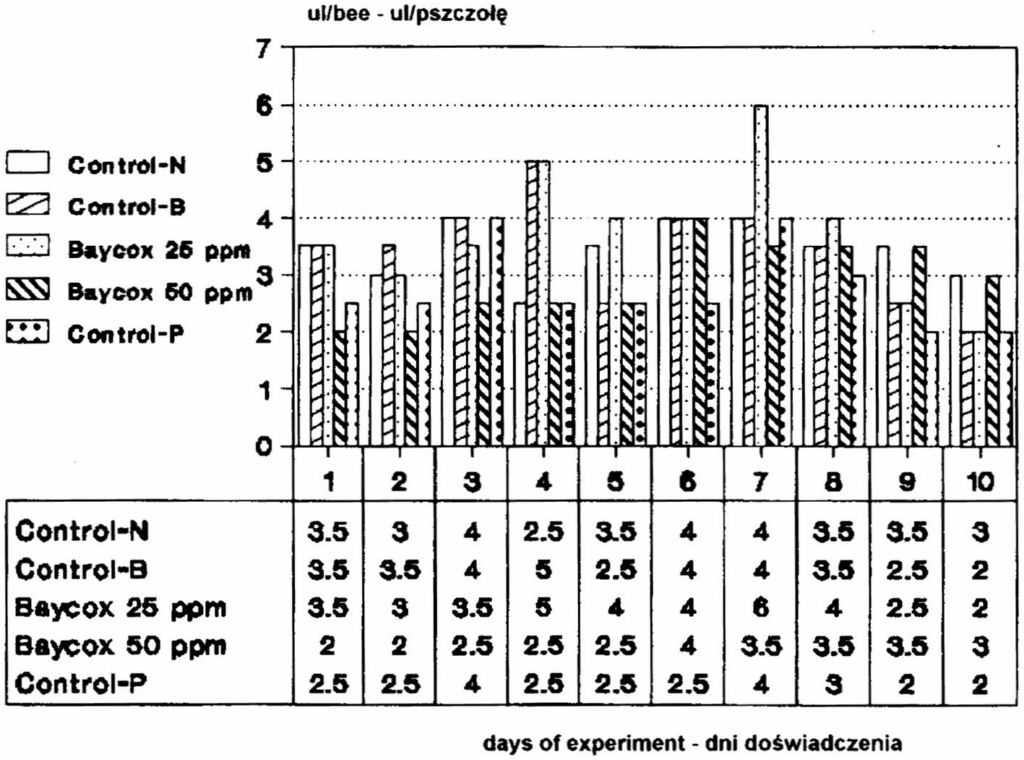
| 1 | 2 | 3 | 4 | 5 | 6 | 7 | 8 | 9 | 10 | |
|---|---|---|---|---|---|---|---|---|---|---|
| Control-N | 3.5 | 3 | 4 | 2.5 | 3.5 | 4 | 4 | 3.5 | 3.5 | 3 |
| Control-B | 3.5 | 3.5 | 4 | 5 | 2.5 | 4 | 4 | 3.5 | 2.5 | 2 |
| Baycox 25 ppm | 3.5 | 3 | 3.5 | 5 | 4 | 4 | 6 | 4 | 2.5 | 2 |
| Baycox 50 ppm | 2 | 2 | 2.5 | 2.5 | 2.5 | 4 | 3.5 | 3.5 | 3.5 | 3 |
| Control-P | 2.5 | 2.5 | 4 | 2.5 | 2.5 | 2.5 | 4 | 3 | 2 | 2 |
days of experiment – dni doświadczenia
Control-N – uninfected bees + syrup – pszczoły niezarażone + syrop Control-B – uninfected bees + syrup + Baycox – pszczoły niezarażone + syrop + Baycox Control-P – infected bees + syrup – pszczoły zarażone + syrop
Fig. 4. Water consumption by infected bees fed syrup with Baycox (in μl/bee). Spożycie wody przez zarażone pszczoły otrzymujące w pokarmie dodatek Baycoxu (w μl/pszczołę).
The number of spores per one bee decreased in bees fed with both doses of the active agent as compared to control groups (Control-P-I and Control-P-II). The significant difference (decrease) occurred between the group treated with 25 ppm of toltrazuril (Baycox 25ppm) and the control group (Control-P-I) on the 5th day only. Significant decrease in number of spores in group treated with 50 ppm of active agent as compared to control group (Control-P-II) occurred in 7th day. The number of spores in the Baycox 50 ppm group was higher than in the control group but the difference was not significant. Quite unexpectedly though, the number of spores in control infected untreated bees (Control-P-I) decreased on the 7th day of the experiment (Fig. 5).
161
strona 162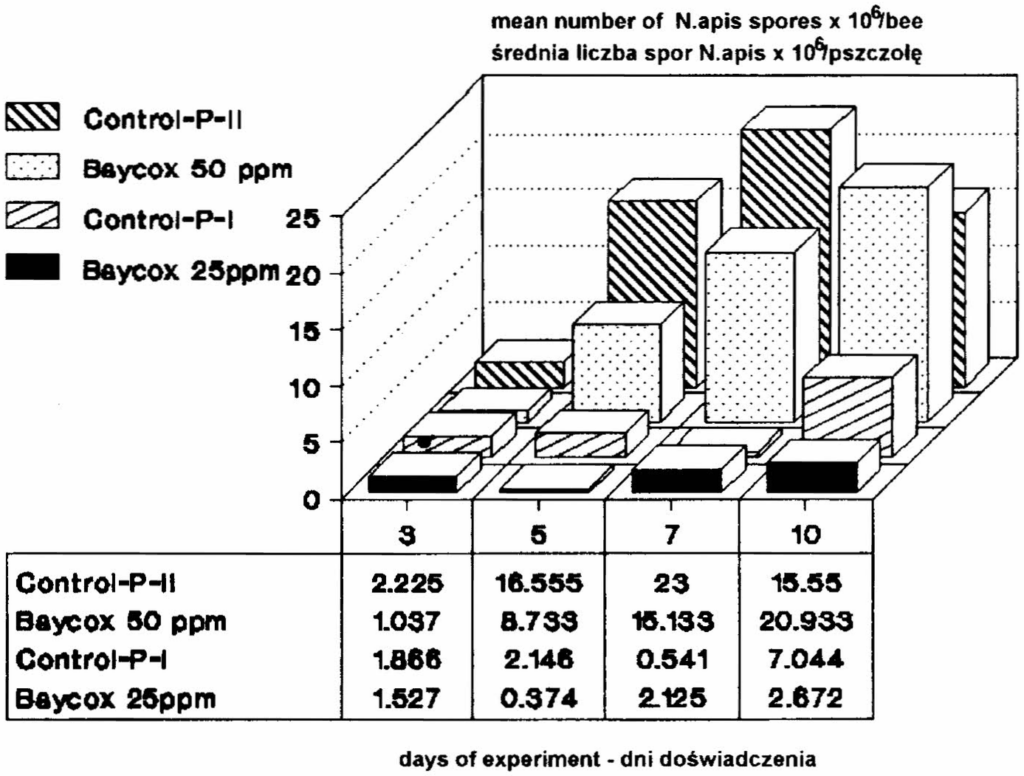
| 3 | 5 | 7 | 10 | |
|---|---|---|---|---|
| Control-P-II | 2.225 | 16.555 | 23 | 15.55 |
| Baycox 50 ppm | 1.037 | 8.733 | 15.133 | 20.933 |
| Control-P-I | 1.866 | 2.146 | 0.541 | 7.044 |
| Baycox 25ppm | 1.527 | 0.374 | 2.125 | 2.672 |
days of experiment – dni doświadczenia
Control-P-I or II – infected bees + pure sugar syrup – pszczoły zarażone + czysty syrop cukrowy
Fig. 5. Mean number of spores in infected bees fed syrup with Baycox. Średnia liczba spor u zarażonych pszczół otrzymujących w pokarmie dodatek Baycoxu.
The prolonged (10-day) consumption of food supplied with toltrazuril in both doses did not affect the condition of midgut cells and formation of peritrophic membrane in bees. The multiplication of Nosema apis in epithelial cells started on the 5th day of the experiment in groups treated with Baycox, as well as in both control groups of infected untreated bees. On the 7th and 10th day, the number of parasite infected cells increased in all groups of infected bees, treated as well as untreated (Baycox 25 ppm-H, Baycox 50 ppm-H, Control-P-I-H, Control-P-II-H).
The disintegration of the typical midgut structure manifested in thickening of the gut folds which was due to filling of the epithelial cells with increasing number of Nosema apis spores. The histhological picture of midgut in bees treated with both doses of Baycox did not differ from that in bees of control groups on successive days of the experiment. This would suggest the lack of activity of Baycox against the parasite developmental stages in the midgut epithelial cells in the honeybee.
162
strona 163CONCLUSIONS
- Baycox in doses of 25 and 50 ppm of active agent was not toxic to bees during 10 days of the experiment.
- Baycox at doses of 25 and 50 ppm of active agent have no significant inhibitory effect on the development of Nosema apis in midgut epithelial cells of the honeybee.
REFERENCES
Chorbiński P., Tomaszewska B. (1992) – Wstępne badania nad wpływem salinomycyny i narazinu na pszczoły zarażone eksperymentalnie Nosema apis Z. Pszczel.Zesz.Nauk., 36:102-108.
Jeliński M. (1986) – Lata ze znacznymi stratami wśród pszczół podczs zimowli i na wiosnę. Pszczelarstwo, 37(11):12-13.
Kohlich A., Derakhshifar I. (1988) – Rätselhaftes Bienensterben in der Steiermark. Bienenvater, 109(3):75-78.
Mazurkiewicz M., Gaweł A., Majdański F., Giebel O., Markiewicz M. (1991) – Skuteczność Baycoxu w terapii i zapobieganiu kokcydiozie u drobiu. Zesz.Nauk. AR we Wrocławiu, Weterynaria XLIX, 203:133-144
Pokorna S. (1987) – Vliv terapeutik a podminek vnejśiho prostředi na vyvoj prvoka Nosema apis Z. Vd.PrVuVč v Dole 9:155-166.
Śkrobal D., Krieg P. (1984) – Přiciny zimnich ztrat včelstev. Včelařstvi, 37(11):242-243.
Romaniuk K., Wawrzyniak S. (1991) – Inwazja Nosema apis u pszczół porażonych roztoczem Varroa jacobsoni. Med.Wet., 47(2):62-64.
Tomaszewska B., Lonc E., Dyda D. (1988) – Laboratory treatment of Nosema apis with lasalocid and monensin. Angew.Parasit., 29:85-88.
WSTĘPNE BADANIA NAD WPŁYWEM PREPARATU BAYCOX NA INWAZJĘ NOSEMA APIS Z. U PSZCZOŁY MIODNEJ (APIS MELLIFERA L.) W WARUNKACH LABORATORYJNYCH
P. Chorbiński, B. Tomaszewska
Streszczenie
Celem badań było określenie w warunkach laboratoryjnych wpływu preparatu Baycox (substancja czynna toltrazuril) na rozwój inwazji u pszczół zarażonych eksperymentalnie sporami Nosema apis, a także określenie wpływu zróżnicowanych dawek tego preparatu na ich organizm. Preparat Baycox podawano niezarażonym pszczołom w syropie cukrowym w dawkach 25, 50, 100, 200, 400, 800 i 1600 ppm substancji czynnej. Nie stwierdzono toksycznego działania preparatu w dawkach od 25 – 400 ppm. Następnie obserwowano wpływ preparatu Baycox w wybranych dawkach 25 i 50 ppm substancji czynnej na rozwój inwazji u doświadczalnych pszczół. Pszczoły zarażano jednorazowo dawką 64 x 10⁴ spor ml podanych w 2,5 ml 50% syropu cukrowego. Przez
163
strona 164pozostałe dni doświadczenia pszczoły otrzymywały w pokarmie dodatek 25 i 50 ppm toltrazurilu. Liczbę spor u pszczół zarażonych i otrzymujących w pokarmie dodatek Baycoxu jak i u pszczół kontrolnych określono w 3, 5, 7 i 10 dniu doświadczenia. Wyniki poddano obliczeniom statystycznym. Obserwowano także stan jelita środkowego zarażonych pszczół otrzymujących dodatek Baycoxu posługując się metodami histologicznymi (technika parafinowa, barwienie azanem Novum i metodą Giemzy). Badania histologiczne wykonywano także w 3, 5, 7 i 10 dniu po zarażeniu.
Łącznie w doświadczeniu użyto 85 grup pszczół doświadczalnych i kontrolnych.
W wyniku badań stwierdzono, że preparat Baycox w stężeniach 25 i 50 ppm substancji czynnej podawany doświadczalnym pszczołom przez 10 dni nie wykazuje w stosunku do nich działania toksycznego. Dodatek preparatu Baycox w stężeniach 25 i 50 ppm w warunkach laboratoryjnych nie wykazuje znaczącego wpływu na hamowanie rozwoju pasożyta Nosema apis w komórkach nalonkowych jelita środkowego pszczoły miodnej.
Słowa kluczowe: pszczoła miodna, toksyczność, toltrazuril, Baycox, Nosema apis.
164
Errata — błędy druku znalezione podczas digitalizacji
- s. 155: „Infections Diseases” → Infectious Diseases
- s. 155: „ethiology” → etiology
- s. 155: „unqestionable” → unquestionable
- s. 155: „jonophore” → ionophore
- s. 156: „phisiological” → physiological
- s. 156: „ative agent” → active agent
- s. 156: „64 x 104″ → 64 x 10⁴
- s. 156: „experimnent” → experiment
- s. 156: „satistically” → statistically
- s. 156: „Abbot formula” → Abbott formula
- s. 156: „histhologically” → histologically
- s. 157: „staining which Novum asane” → staining with Novum azan
- s. 157: „Giemza” → Giemsa
- s. 157: „oblesions” → of lesions
- s. 157: „sligtly” → slightly
- s. 158, ryc. 1: „cummulative” → cumulative
- s. 159, ryc. 2: „cummulative” → cumulative
- s. 162: „histhological” → histological
- s. 163, piśmiennictwo: „podczs” → podczas
- s. 164, streszczenie: „nalonkowych” → nabłonkowych