

PRELIMINARY INVESTIGATIONS INTO THE BEHAVIOUR OF HONEYBEES UNDER APITRON CONDITIONS
tekst: Adrian Siceanu, Aurel Malaiu, Eliza Cozma, Marian Mihãitã, Ion Guresoaie
Pszczelnicze Zeszyty Naukowe, Rok XLI, 1997 — Adrian Siceanu, Aurel Malaiu, Eliza Cozma, Marian Mihãitã, Ion Guresoaie
strona 91PSZCZELNICZE ZESZYTY NAUKOWE Rok XLI 1997
Adrian Siceanu, Aurel Malaiu, Eliza Cozma, Marian Mihãitã, Ion Guresoaie
Institute for Beekeeping Research & Development, 42 Ficusului Blv.,sector 1, Bucharest, ROMANIA
Summary
An apitron set modelled on a DOL (Czech) was built in the Institute of Beekeeping Research & Development in Bucharest,
Experiments involved 4 honeybee colonies introduced into the flight tunnel at the beginning of December. A temperature of 25°C to 30°C and a relative humidity of 35% to 40% were established.
The relative humidity inside hives 60% to 70% was obtained by placing bee colonies above water trays covered with a wire net.
The flight activity of honeybees and the brood rearing activity depended on various stimulation schemes.
The best results were obtained when bee colonies were fed a concentrated mixture of pollen and honey and when hazel tree (Corylus avellana L.) branches were introduced in the apitron. The flowers of these small hazel tree branches opened and attracted bees after about 24 h.
Keywords: apitron, honeybee, behaviour, Romania
INTRODUCTION
Natural evolution. of the honeybee colonies is closely related to the environment. The protein and dextrose (glucose) supply are the main factors affecting their development. The melliferous resource (a main honey flow) closely related to geographic areas varies greatly according to the climate conditions. The changes in weather also influence the honeybee capacity for utilisation of melliferous resources.
The investigations conducted on bee colonies in their natural environment are subject to many errors; moreover, several difficulties of application appear. These disadvantages. can be prevented only in few cases. Additionally, the inactive season occurring in Romania influence research programmes.
Consequently, various flight chambers were designed and built to control these disadvantages,. These flight chambers should allow bees to eliminate the
strona 92excrement and to enable visits to several food sources. When these requirements are met nectar collection is stimulated.
The construction of illumination systems which facilitate the bee’s sight and orientation was the main problem.
The first flight tunnel, which ensured the requirements was invented by Renner (1955). The illumination sources were fluorescent lamps, adapted to the human sight. Nye (1962) increased the light intensity of the source up to 2,368 light units and Nelson and Jay (1967) increased the light intensity to 4,520 units. This ensured a higher activity of bees; however, the electric energy consumption was very high.
Van Praagh and Velthuis (1971) and Van Praagh (1972) introduced ultraviolet lamps. Their wavelength spectrum ranged between 300 and 500 nm, with a peak at 360 nm. The phase connection of these UV lamps increased the number of cycles from. 50 to 120 per second to 300 cycles per second. This reduced significantly the electrecity consumption and produced a more suitable illumination for the bee’s requirements.
Vesely (1977) made a remarkable contribution to settle the exploitation conditions for the flight tunnel built in Dol, Czech. His device respected the theoretical principles of the bee’s sight physiology described of the by Van Praagh (1972).
MATERIAL AND METHODS
A. Technical characteristics of the apitron
The apitron was installed in the main hall of the Institute for Beekeeping Research & Development in Bucharest and finished in 1986.
The constructive arrangements established by Van Praagh (1972) were applied. These arrangements were based on the 3 theoretical principles of the bee sight physiology, namely: the correction of light spectrum and of the angular distribution of light and the increase in the frequency of light waves.
The external 5.5 x 10 x 5-m tunnel made of bricks was lined with aluminium creased foil.
The inner 8 x 4 x 3-m tunnel consists of a metallic structure covered with a gauze fabric.
The illumination unit was fixed on a metallic structure and contained 105 fluorescent (UV) Philips TLA /05/40 W tubes mounted in groups of three and connected in phase.
The inner tunnel was illuminated indirectly; the light directed on the aluminium foil was reflected towards the interior.
The connection and disconnection of the illumination unit was operated manually or automatically using a programmable clock.
strona 93The control desk of the illumination unit was assembled in a laboratory and considered as the waiting-room of the apitron.
The heating unit consisted of radiators positioned below the floor along the walls.
The airing was performed through 4 airing opening in the ceiling.
The acclimatisation unit has not been finished yet; therefore, adjustment of temperature and humidity and the ail. draught has not been automated yet.
A video system was introduced to monitor experiments and to record on video tapes.
B. The exploitation of the apitron
Cunducting the experiments
The investigations were conducted on 4 bee colonies from December 1996 till February 1997. Queen rearing experiments were started on 10 January with one more rearing colony without a queen.
The strength of the colonies introduced was similar. Each colony had about 1 kg of bees which occupied 5 combs in a multiple storey hive.
Microclimate conditions
Along the entire duration of the experiments, a temperature of 25 – 30°C and a relative humidity of 35% to 40%, and a 12-hour light/ dark cycle (between 7 a.m. and 7 p.m.). were maintained inside the apitron. These conditions were maintained to induce the conditioned reflex of returning of honeybees to the hive before light was switched off.
After a grooming flight the colonies were transferred inside observed hives with a transparent wall. Inside these hives, a 60% to 70% humidity was maintained by placing the chambers over water trays covered with a wire net.
bees feeding
The glucosic food was administered inside each hive by placing a syrup jar covered with a gauze and turned upside-down over an orifice of a corresponding size in the crown board.
All colonies received daily 200 mL of a 1:1 honey syrup.
The protein feed was ensured inside and outside the hive. The external protein feed source consisted of introduced hazel tree branches (Corylus avellana L.) with about 300 inflorescenses. A tray with ground pollen with an area of 25 square dm was also administered.
The protein feed was given into hives as follows:
- Colony 1 was fed a concentrated mixture of pollen and honey. Honey was used as an attractive substance. The mixture was put on a small tray over the frames with food available at discretion.
- Colony 2 fed continuously flat cakes made of sugar sherbet, honey and 10% ground pollen.
- Colony 3 was fed with ground pollen, without honey. Pollen was also put in a small tray placed over the frames.
- Colony 4 did not receive any protein food inside the hive: therefore, it only used the external source of food.
The following observations were made:
- the flight activity of bees;
- the bee approach to the food sources;
- the evolution of the brood rearing measured by the total brood area every other 12 days.
Queen rearing
The rearing colony was fed at discretion with a concentrated mixture of ground pollen and honey to induce the development of hypopharingeal glands and the brood rearing activity.
After one week, the queen and the brood were removed. Then, two combs with honey and bee bread were introduced into an observed hive; all bees from a colony were shaken over those two combs (4 intervals). A rearing frame containing 36 queen cups with grafted larvae was introduced after 6 h. Then, after 10 days, the accepted queen cells were isolated in emergence cages. They received protein and glucose food daily.
The following observations were made:
- the bee’s behaviour;
- the percentage of accepted queen cells;
- the weight of the queens emerged.
Drone rearing
In each colony a building frame with drone cells was introduced.
The following observations were made:
- the construction of the drone cells;
- egg deposition and the acceptance of larvae for rearing.
The apitron floor was cleaned with a mixture of water and detergent twice a week. The flight chamber was washed every week by rubbing its walls with a soft brush previously dipped into a of water – detergent solution.
RESULTS AND DISCUSSIONS
The flight activity of the bees and their approach to the external food sources.
A few hours after introduction in the apitron, bees started their grooming flight which reached its climax during the second part of the day and on the next
strona 95day. During these two days, light was switched off manually in the evening, when the flights stopped in order to maintain the bee’s orientation.
On the third day of the experiment bee colonies were checked up and transferred to the observation hives. Then, a general cleaning was performed. No brood accepted for rearing in any of the colonies was found. Instead, small areas below 1 sq. dm. with eggs were noted.
Afterwards, bee colonies were fed according to the above mentioned procedure.
During the following days the bee’s flight was reduced markedly and bees did not approach the protein food sources placed outside the hive, although the inflorescence of the hazel tree branches was completely open and their pollen started to fall.
By daily introduction of hazel tree branches with fresh inflorescence and removing those already withered the presence of about 1,000 to 1,200 inflorescence in various stages of development was daily ensured. Starting from the Day 7 of the experiment, we noticed that bees begun to visit the hazel tree inflorescence and to collect pollen during an intense one-hour flight. The number of flights increased thereafter and the flights were performed sometimes in the morning and in the afternoon.
The pollen placed in the tray was not approached. Similarly, the inflorescence which was completely open was not approached either although itstill contained plenty of pollen. Probably, bees were mainly attracted by the volatile substances secreted by inflorescence and not by pollen.
After about two weeks, the flight activity of bees extented to all colonies. It began at about one hour after light was switched on and was carried out during the entire day. The most intense flights were recorded constantly during the second part of the day, when, besides intense visitations to the hazel tree inflorescence many bees performed a flight especially in the upper part of the flight tunnel. Bees still did not approach the ground pollen in the pollen tray. Also, we collected pollen from the hazel tree inflorescence, by jolting them. Moreover, we placed it near the visited inflorescence. However, it was not approached either.
The intensity of the bee’s flight was estimated by means of the approximate count of the bees which visited the hazel tree inflorescence, at a given moment. We noticed that their number varied between tens and 200 to 250 bees. The bee’s return to hives was regarded as satisfactory.
The switching of light at the same time each day induced in honeybees the conditioned reflex of returning to the hive. Very few bees remained in the flight tunnel or on the hazel tree inflorescence at night.
Starting from 10 February 1997, we stopped introducing hazel tree branches in the apitron, as an external protein food source. Only a small tray
strona 96containing ground pollen was kept inside the apitron.
Under these conditions, the bees approached the ground pollen thereafter and performed intense flow flights.
Therefore, we noticed that the presence of the hazel tree inflorescence had an inhibiting effect because bees had not been attracted by the ground pollen
The bee’s approach to the food sources inside a hive
With some exceptions, the bees consumed daily a 200 ml of administered honey syrup
Significant differences were observed in their approach to the protein food sources.
The bees were mostly attracted by honey and pollen mixture (colony 1), as they collected it permanently and they stored it in the combs.
The protein flat cake administered to colony 2 was also approached However, it was consumed for a longer period the amount stored in the combs was very reduced.
Colony 3 did not approach the ground pollen inside the hive.
An analysis of the hypopharingeal glands of the bees pointed out that bees which consumed the pollen and honey mixture (colonies 1 and 2) had hypopharingeal glands developed to level 3 and 4.
In bees which collected pollen from the hazel tree inflorescence, the hypopharingeal glands were not developed.
The comparative evolution of the brood rearing in 60 days (5 December, 1996 to 3 February, 1997) is shown in Table 1 and in Fig. 1.
The evolution of brood rearing depending on the proteining food which we administered inside the hive Zmiany w rozwoju czerwiu w zależności od dostępu pożywienia białkowego w ulu.
| Colony no. Rodzina nr | The type of proteinic food Typ pożywienia białkowego | Total brood (in square dm.) existing on / Powierzchnia czerwiu w dm 2: 05.12.1996 | 17. Dec 17.XII | 30. Dec 30.XII | 10. Jan 10.I | 22. Jan 22.I | 02. Feb 02.II | % |
|---|---|---|---|---|---|---|---|---|
| 1 | Conc. mixture of honey + pollen Mieszanina miodu + pyłku | 0 | 3,2 | 8 | 14 | 17,3 | 18,5 | 100 |
| 2 | Sugar + honey sherbet + 10 % pollen Cukier + miód + 10 % pyłku | 0 | 3 | 6,4 | 10,5 | 12,8 | 14 | 75,6 |
| 3 | Ground pollen Pyłek mielony | 0 | 1,5 | 3 | 4,8 | 6,8 | 6 | 32,43 |
| 4 | No protein food Pożywienie bezbiałkowe | 0 | 2 | 4,2 | 5 | 8,3 | 9,5 | 51,35 |
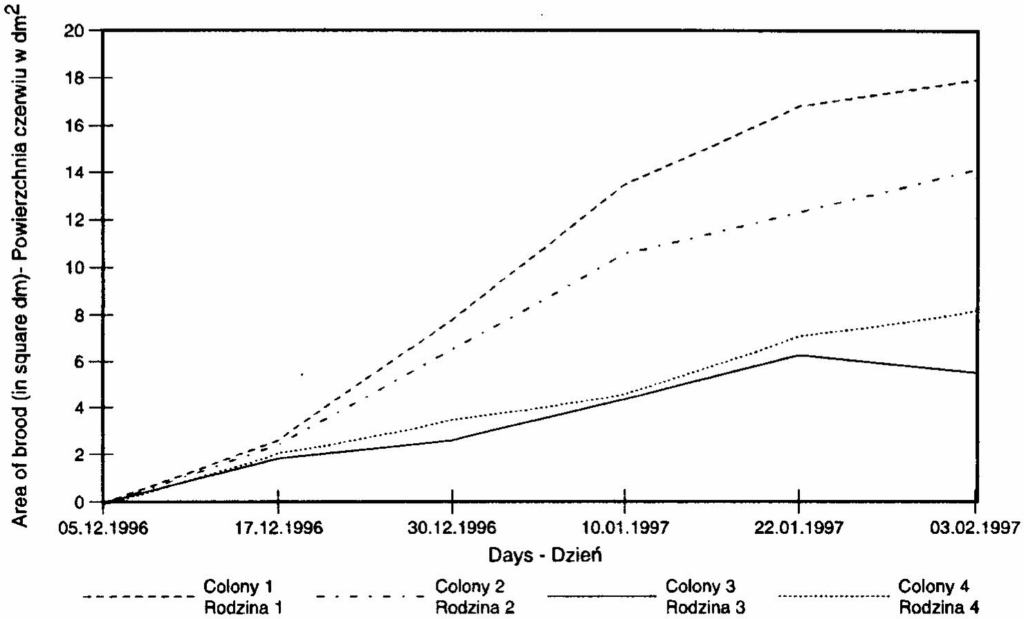
We noticed that the intensity of the brood rearing was strongly influenced by the type of protein food which was administered inside bee colonies.
In colony 1 fed ad libitum with a concentrated mixture of ground pollen and honey we noticed the highest intensity of brood rearing:18.5 sq.dm. (100%) at the end of the experimental period.
In colony 2 fed with pollen and sugar flat cakes that contained 10% of ground pollen, the area covered by the reared brood reached 14 sq.dm. (75.7%) it is 24.3% less than in colony 1.
In colony 3 fed only with ground pollen we obtained 6 sq.dm. (32.4%) reared brood area (67.6% less than in colony 1).
In colony 4, which was not administered any protein food, the reared brood area reached 9.5 sq.dm. (51.4%) (48.6% less than in colony 1).
Queen rearing experiment
The flight behaviour of bees without a queen and after introduction of the rearing frame included certain characteristics which were easy to notice within the limited flight space inside the apitron.
About one hour after the queen was removed bees manifested an intense „search” flight, along the entire flight tunnel. This „search” flight was continued until the introduction of the rearing frame with queen cells. The „search” flight stopped 10 to 15 minutes after the introduction of queen cells and bees intensely started to visit the hazel tree inflorescence. This latter flight was much more intense than in colonies without a queen. The flight was carried on until the queen cells were capped and then it was markedly reduced.
strona 98A similar behaviour of bees was observed after the completion of the queen rearing process when a comb with young larvae was introduced in the rearing colony to simulate the emergency rearing. Its removal after two days had a similar effect to the queen removal. The reintroduction of the respective comb calmed bees. As a result, they begun to approach the food source rapidly.
The percentage of acceptance of cells was 77.8%. The bees accepted for rearing 28 larvae out of the 36 grafted ones.
The weight of the emerged queens varied between 180 mg and 240 mg, with an average of 197 mg (n = 28).
The external appearance of the queen cells was similar to that reared during the season when plenty of good quality pollen and nectar flow were available., A maximum development of the hypopharingeal glands was noted in the bees consumed the mixture in the feeder.
No drone rearing was observed in any of the four bee colonies.
Only colony 1 built about 1 sq.dm. of drone cell combs near the old comb in the building frame.
In the newly built comb, the queen repeatedly deposited 40 to – 60 eggs while in the old comb no egg was deposited. Bees did not accept the hatched larvae for rearing. However, the results obtained confirmed a strong effect of the concentrated mixture of honey (attractive substance) and pollen on the brood rearing activity. It is suggested that bees forced to consume more pollen or a more valuable protein food would also rear drone brood.
From a pathological point of view, the appearance of the chalk brood in all four bee colonies was the only problem.
Microbiological examinations revealed the presence of Bacillus orpheus bacterium. beside Ascosphaera apis.
A combined treatment with streptomycin and Micocidin resulted in a limited and insignificant level of infection.
REFERENCES
NELSON, E.V., JAY, S.C. (1967) – Flight activity of honeybees in a flight and rearing room 1. The influence of light intensity. J.Apic. Res., 6(3): 179 – 183.
NYE, W.P. (1962) – Observation on the behaviour of bees in a control led-environment room. J. Apic. Res. 1:28-32.
RENNER, M. (1955) – Uber die Haltung von Bienen in geschlossenen, kunstlich beleuchteten Raumen. Naturwissen schaften 42 (19): 539-540
VAN PRAAGH, J.P., VELTHUIS (1971) – Is the lux an appropriate measure for brightness in a bee flight room? Bee World, 52(1): 25-26.
VESELY, V., (1977) – The first series of experiments on bee rearing in a close space with controlled climate – cited
strona 99WSTĘPNE BADANIA NAD ZACHOWANIEM SIĘ PSZCZÓŁ W WARUNKACH APITRONU
A. Siceanu, A. Malaiu, E. Cozma, M. Mihăită, I. Guresoaie
Streszczenie
W 1966 roku w Instytucie Badawczo Rozwojowym Pszczelnictwa w Bukareszcie zbudowany został apitron według modelu istniejącego w Dol w Republice Czeskiej.
Do doświadczenia wykorzystano 4 rodziny pszczele. Rodziny wstawiono do tunelu na początku grudnia. Wewnątrz utrzymywano temperaturę 25-30°C i wilgotność względna na poziomie 35-40%. Wewnątrz uli wilgotność względna wynosiła 60-70%, a utrzymywana była przez umieszczenie pod korpusami uli tac z wodą przykrytych siatką z tworzywa. Obserwowano aktywność lotną pszczół oraz wychów czerwiu w zależności od zmienianych warunków otoczenia.
Najlepsze wyniki uzyskano, gdy rodziny karmione były mieszaniną miodu i pyłku i wówczas gdy wewnątrz apitronu umieszczano gałęzie leszczyny (Corylus arellana L.). Kwiaty znajdujące się na małych gałęziach leszczyny najskuteczniej aktywizowały lot pszczół/.
Słowa kluczowe: apitron, pszczoły, aktywność, Rumunia.
Errata — błędy druku znalezione podczas digitalizacji
- s. 92: „electrecity” → electricity
- s. 93: „Cunducting” → Conducting
- s. 93: „ail. draught” → air draught
- s. 93: „inflorescenses” → inflorescences
- s. 94, 96, 98, 5×: „hypopharingeal” → hypopharyngeal
- s. 95: „itstill” → it still
- s. 95: „extented” → extended
- s. 96, podpis tabeli: „proteining food” → protein food
- s. 98, piśmiennictwo: „control led-environment” → controlled-environment
- s. 98, piśmiennictwo: „Uber” → Über
- s. 98, piśmiennictwo: „kunstlich” → künstlich
- s. 98, piśmiennictwo: „Raumen” → Räumen
- s. 98, piśmiennictwo: „Naturwissen schaften” → Naturwissenschaften
- s. 99, streszczenie: „Corylus arellana” → Corylus avellana