

GENETIC VERSUS ENVIRONMENTAL CUES USED IN THE RECOGNITION AND ACCEPTANCE OF TWO HONEYBEE SPECIES: APIS MELLIFERA AND APIS DORSATA IN THE SAME COLONY
tekst: Jerzy Woyke, Jerzy Wilde, Maria Wilde
Pszczelnicze Zeszyty Naukowe, Rok XLIV, Nr 2, 2000 — Jerzy Woyke, Jerzy Wilde, Maria Wilde
strona 67PSZCZELNICZE ZESZYTY NAUKOWE Rok XLIV, Nr 2 2000
Jerzy Woyke^a, Jerzy Wilde^b, Maria Wilde
Dabur Apiculture Centre, Jugedi, Chitwan, Nepal ^a Apiculture Division, Agricultural University, Warszawa, Poland ^b Apiculture Division, W. M. University, Olsztyn, Poland e-mail: woyke@alpha.sggw.waw.pl
Summary
The recognition of nestmates plays an important role in the evolution and social organisation of insects. We tested the recognition and acceptance question in two extremely genetically different populations of two Apis species. For this purpose, pieces of A. dorsata brood combs, or young workers, were introduced into A. mellifera colonies. In a reverse test, pieces of A. mellifera brood combs, or caged young workers, were introduced into A. dorsata nests. The results showed that A. mellifera very quickly destroyed the introduced A. dorsata brood. However, A. dorsata workers ready to emerge begged for food and were fed by A. mellifera workers. Consequently, emerging A. dorsata workers were accepted in A. mellifera colonies. The familiarisation of A. dorsata brood for 1 or 2 days increased the number of emerged and accepted adults by 9 – 11 times. The young A. dorsata workers which emerged in an incubator and were introduced into A. mellifera colonies were rejected. However, when such bees were at first kept in wire mesh cages for one day in A. mellifera colonies they were accepted. Apparently they became familiarised. A. dorsata workers survived in A. mellifera colonies for more than 50 days. They flew out and returned to A. mellifera hives. They were permitted by A. mellifera guard bees to enter the hives. A. dorsata workers served also as guard bees in A. mellifera hives. Apparently, they learned the template cues of the A. mellifera colony. The reciprocal test showed that A. dorsata did not destroy the A. mellifera brood introduced into their nests. However, A. dorsata did not accept the young A. mellifera workers, despite the fact that they were familiarised as brood for 10 days. Hence, the reciprocal reaction of the introduction of brood and workers of one species into the nests of the other is just the opposite. The results show that A. mellifera uses environmental cues to a great extent in the recognition and acceptance of the other adult species. A. dorsata uses genetic cues in the recognition and rejection of the other adult species.
Keywords: Apis dorsata, Apis mellifera, genetic cue, environmental cue, crossfostering, acceptance, recognition.
INTRODUCTION
The relationships between different species of honey bees are interesting from the behavioural point of view as well as from the phylogenetic one.
strona 68According to the Hamilton kinship theory (1964), the ability to recognise kin from non-kin, or more related animals from less related, played an important role in the evolution of a social organisation in social insects. Breed (1983) demonstrated that Apis mellifera attacked the introduced unrelated workers more frequently than the related ones, which had been kept previously in the same incubator conditions. Getz and Smith (1983) showed that honey bee workers attacked introduced half-sisters more frequently than full sisters, which had been kept previously in the same conditions. Moritz and Hillesheime (1990) determined that worker bees fed closely related bees more frequently than unrelated ones. All the authors concluded that honey bees used genetic cues in the recognition of A. mellifera workers. However, according to Downs and Ratnieks (1991) guard bees use non-heritable cues in recognition of conspecifics. Breed et al. (1995) showed that comb wax plays an important role in nestmates recognition in honey bees. It seems that both heritable and environmental cues are used by A. mellifera in nestmate recognition.
Sakagami (1959) and Dhaliwal and Atwal (1970) investigated heterospecific relations between two cavity-nesting species. A. mellifera and A. cerana. They introduced brood and workers of one species into the nests of the other. Pothichot et al. (1993) conducted interspecific queen rearing of A. cerana and A. mellifera, and Koeniger et al. (1996) of A. cerana and A. koschevnikovi. Koeniger et al. (1996) cross-fostered drones of Apis cerana and of Apis koschevnikovi. All these investigations concerned cavity-nesting bees.
We investigated the acceptance or rejection question in extremely genetically different species, the multicomb cavity-nesting A. mellifera and the monocomb free-living A. dorsata (Ruttner 1988)
MATERIALS AND METHODS
The investigations were conducted at the Dabur Apiculture Centre, Jugedi, Chitwan, Nepal from January to May 1999 and from October 1999 to June 2000. Ten experiments were conducted:
A. In order to investigate whether A. mellifera accepts A. dorsata brood, three experiments were conducted:
1. Introduction of young brood. Part of a brood comb was cut from an Apis dorsata nest. Three pieces measuring 5 x 11 cm containing 440 cells of young brood were selected. The brood consisted of half eggs and larvae and half of sealed young pupae. Next, sealed brood combs were removed from three A. mellifera colonies. Appropriate holes were cut in the centre of each comb and A. dorsata brood was inserted into the holes. The combs were returned to their colonies in the centre of the nests. The treatment of those combs by A. mellifera workers was checked 2.5 and 5 hours after introduction and 1 and 2 days later.
strona 692. Introduction of an old brood. A similar experiment was repeated, but this time using old sealed A. dorsata brood combs consisting of pupae with violet eyes and emerging workers were introduced into four A. mellifera colonies.
3. Familiarisation of A. dorsata brood in A. mellifera colonies. Two pieces of A. dorsata old brood (8 x 10 cm) were introduced into A. mellifera colonies. One piece was unprotected and the other was covered with wire mesh. In 3 colonies, the screens were removed after 24 hours and in 2 after 48 hours. The numbers of scratched cappings, removed pupae and emerged workers in unprotected and protected combs were compared.
B. In order to investigate whether A. mellifera accepts adult A. dorsata workers, the following five experiments were conducted:
4. Introduction of emerged A. dorsata workers into normal A. mellifera colonies. A. dorsata brood comb was put into an incubator. Workers, which emerged during the night, were added in the morning to two A. mellifera colonies, 25 to one and 35 to the other. Workers, which emerged during the day, were added in the evening, 45 to each of two other A. mellifera colonies. The survival rates of those workers were recorded.
5. Introduction of emerged A. dorsata workers into A. mellifera mating nuclei. Similarly, about 20 workers, which emerged during the night, were added in the morning to each of three mating nuclei. The mating hives were of the Kirchhain type with 3 trapezoid combs 13 x 9 x 8 cm. The survival rates of the workers were noted.
6. Introduction of emerged A. dorsata workers in small cages into A. mellifera colonies. Ten emerged A. dorsata workers were put into each of 6 small wire mesh cages 9 x 6 x 1 cm. They were located individually in the centre of six A. mellifera brood nests. Their survival rate was checked daily.
7. Introduction of emerged A. dorsata workers in large cages into A. mellifera colonies. Ninety five A. dorsata workers which emerged in the incubator were put into a large wire mesh cage 20 x 20 x 2.5 cm. The cage was located in the morning in the centre of A. mellifera nest. The number of survivors was counted the next day in the evening, when the cage entrance was opened. The number of surviving A. dorsata workers in the colony was checked periodically.
8. Behaviour of A. dorsata workers at hive entrances of A. mellifera colonies. The entrances of A. mellifera hives containing A. dorsata workers were observed periodically. The behaviour of guard bees towards both species was noted.
C. In order to investigate whether A. dorsata accepts A. mellifera brood or adult workers, the following two experiments were conducted:
9. Introduction of A. mellifera brood into A. dorsata nests. Sealed brood combs were removed from A. mellifera colonies. Three pieces 10 x 10 cm
strona 70were cut out. Two pieces contained old pupae and emerging workers. The third piece contained young pupae with pink eyes and a few 4-day old larvae. Next, appropriate holes were cut out in the brood area of three A. dorsata combs. The A. mellifera brood pieces were inserted into the three places. The three nests and combs were inspected daily.
10. Caged A. mellifera workers in A. dorsata nests. Per 10 A. mellifera workers which had emerged in an incubator were placed in 5 small wire mesh cages 9 x 6 x 1 cm. The cages with bees were introduced into 5 A. dorsata nests. Three repetitions were conducted within several days. The number of survivors was checked 1 and 2 days after introduction in the two first repetitions, and after 2 days in the third repetition.
RESULTS
1. Introduction of young A. dorsata brood into A. mellifera colonies
Table 1 Condition of A. dorsata brood in determined time (hours) after introduction into A. mellifera colonies. Averages from 3 colonies with young brood and 4 with old brood – Stan czerwiu Apis dorsata w określonych godzinach po umieszczeniu w gniazdach A mellifera. Średnie z 3 rodzin z młodym czerwiem i z 4 ze starszym
| Brood age / Wiek czerwiu | No cells / Szt. kom. | 2.5 | 5 | 24 | 48 |
|---|---|---|---|---|---|
| A. | Young brood – Czerw młody | ||||
| Eggs / Jaja | 80 | present obecne |
present obecne |
all eaten zjedzone |
– – |
| 1-3 d. larvae / 1-3 d. larwy | 80 | 80% eaten 80% zjedzone |
all eaten zjedzone |
– – |
– – |
| 4 d. larvae / 4 d. larwy | 60 | present obecne |
50% eaten 50% zjedzone |
all removed zjedzone |
– – |
| Sealed / Kryty | 220 | 10% scratched 10% zeskrobane |
25% scratched 25% zeskrobane 5% opened 5% otwarte |
all scratched zeskrobane 30% opened 30% otwarte |
15% opened rest empty 15% otwarte reszta puste |
| B. | Old brood – Czerw starszy | ||||
| Sealed / Kryty | 440 | 40% scratched 40% zeskrobane 15% opened, with emerging workers 15% otwarte z wygryzającymi się robotnicami |
40% opened with emerging workers 40% otwarte z wygryzającymi 10% emerged 10% wygryzione |
15% emerging 15% wygryz. 10% opened pupae, rest empty 10% otwarte reszta puste |
all cells empty wszystkie komórki puste |
Table 1 (A.) shows that 2.5 hours after the introduction of the young A. dorsata brood into A. mellifera colonies, 80% of 1-3 day-old larvae had disappeared. As far as we have seen the larvae were eaten. However, eggs, as well as larvae 4 day-old, were still present there. The sealings on capped brood were scratched in 10% of cases. Five hours after the introductions only 50% of 4 day-old larvae remained and some of them were damaged. However, the eggs were still present there. Wax was scratched from 25% of the caps of the sealed brood. About 5% of cells were opened, exposing white pupae. Other cells were empty (probably those containing larvae and prepupae). The next day after introduction, neither eggs nor larvae were found in the colonies. The wax was scratched from all the brood sealings. About 1/3^rd of sealed brood cells was opened. Part of the exposed pupae was eaten up. After two days all cells were opened, most of them were empty. Only about 15% of the damaged pupae remained in the three colonies. Thus, A. mellifera workers ate most of the 1-3 day-old A. dorsata larvae within 2.5 hours after introduction, eggs within 1 day and young pupae within 2 days.
2. Introduction of old A. dorsata brood into A. mellifera colonies
Table 1 (B.) shows that 2.5 hours after the introduction of old A. dorsata brood into A. mellifera colonies, the wax was scratched out from about 40% of sealings. About 15% of cells with emerging workers were opened. Five hours after the introduction 40% of brood cells were opened. A. mellifera workers pulled A. dorsata pupae out of the cells. However, they did not pull out opened A. dorsata workers ready to emerge. Those A. dorsata workers were asking for food by antennae movements and stretching their tongues. A. mellifera workers fed them. A. dorsata workers had already emerged from 10% of cells. Some of them were molested by A. mellifera. The A. mellifera workers pulled the lags or wing of A. dorsata workers. They approached A. dorsata workers and made movements which looked as if they were biting the body surface. However, they did not sting A. dorsata workers. At the same time, other A. mellifera fed other emerged A. dorsata workers.
The next morning many old pupae were found in front of the entrances. Some were close to emerging. They were moving legs and antennae. However, the wings were mostly not fully straightened. Apparently, they had been removed from the cells before being ready to emerge. A. mellifera workers pulling A. dorsata pupae out of the entrance, tried to fly out with them. However, often they were not able to lift them, and so left them in front of the entrances.
Inside the nests, all A. dorsata brood cells were opened the next day. Only 15% of cells contained emerging or ready-to-emerge A. dorsata workers. In 10% of cells, open pupae remained. All the other cells were empty. A. mellifera workers fed exposed A. dorsata workers ready to emerge from cells. Emerged A. dorsata workers moved freely on comb surface, only
strona 72sporadically being molested by A. mellifera workers. A. mellifera workers fed them. The next days, the molestation of A. dorsata by A. mellifera was noticed only rarely. Instead, the feeding of A. dorsata by A. mellifera was observed.
Table 2 Treatment of A. dorsata brood introduced into A. mellifera colonies. The brood was unprotected (NO) or protected with wire mesh for 24 or 48 h (YES). The number of scratched cappings (SC), removed pupae (RP) and emerged A. dorsata workers (EW) – Traktowanie czerwiu A. dorsata umieszczonego w rodzinach A. mellifera. Czerw albo nie był chroniony (Nie) albo był ochraniany siatką przez 24 lub 48 godz. (Tak). Liczba zeskrobanych zasklepów (SC), usuniętych poczwarek (RP) i wygryzionych robotnic A. dorsata (EW)
| Colony No / Nr rodziny | Protected / Chroniony, hours / godz. | 2.5 SC | 2.5 RP | 5 SC | 5 RP | 24 SC | 24 RP | 48 SC | 48 RP | 72 EW |
|---|---|---|---|---|---|---|---|---|---|---|
| 31 | No Nie | 79 | 15 | 135 | 38 | 344 | 217 | 365 | 356 | 42 |
| Yes Tak 24 | 32 | 2 | 55 | 22 | 63 | 42 | 69 | 65 | 295 | |
| 17 | No Nie | 93 | 25 | 150 | 74 | 281 | 156 | 360 | 265 | 50 |
| Yes Tak 24 | 27 | 5 | 47 | 32 | 85 | 68 | 97 | 74 | 278 | |
| 38 | No Nie | 82 | 31 | 179 | 74 | 342 | 211 | 358 | 217 | 38 |
| Yes Tak 24 | 15 | 3 | 18 | 11 | 21 | 13 | 23 | 21 | 543 | |
| Mean Średnia | No Nie | 85b | 24b | 155b | 62b | 322b | 195b | 361b | 279b | 43a |
| Yes Tak 24 | 25a | 3a | 40a | 22a | 56a | 41a | 63a | 53a | 372b | |
| 11 | No Nie | 98 | 47 | 220 | 88 | 462 | 330 | 512 | 352 | 45 |
| Yes Tak 48 | 15 | 3 | 22 | 11 | 24 | 15 | 28 | 22 | 503 | |
| 17 | No Nie | 106 | 36 | 217 | 87 | 403 | 266 | 431 | 277 | 44 |
| Yes Tak48 | 14 | 2 | 21 | 10 | 22 | 12 | 24 | 23 | 458 | |
| Mean Średnia | No Nie | 102b | 42b | 219b | 88b | 433b | 298b | 472b | 315b | 45a |
| Yes Tak48 | 15a | 3a | 22a | 11a | 23a | 14a | 26a | 23a | 481b |
Different letters behind the means indicate statistically significant differences Różne litery za średnimi oznaczają statystycznie istotne różnice
When A. mellifera colonies were examined, many A. dorsata workers were found on the surface of the introduced piece of A. dorsata comb, during the first two days after emerging. Although they left that piece during the examination, they were found there again in the next check. After few days, the congregation of A. dorsata workers on the piece of A. dorsata comb was not noticed.
A. dorsata workers survived in A. mellifera colonies for varying periods. The last A. dorsata workers were recorded in two colonies 10 and 12 days after their introduction. However, fig. 1 shows that they survived much longer
strona 73in colonies No. 3 and No. 13. The last A. dorsata workers were recorded there 69 and 45 days after their introduction, respectively. The shorter survival in the two first colonies might have been due to drifting, because the A. mellifera colonies were only 30 – 50 cm apart from the others.
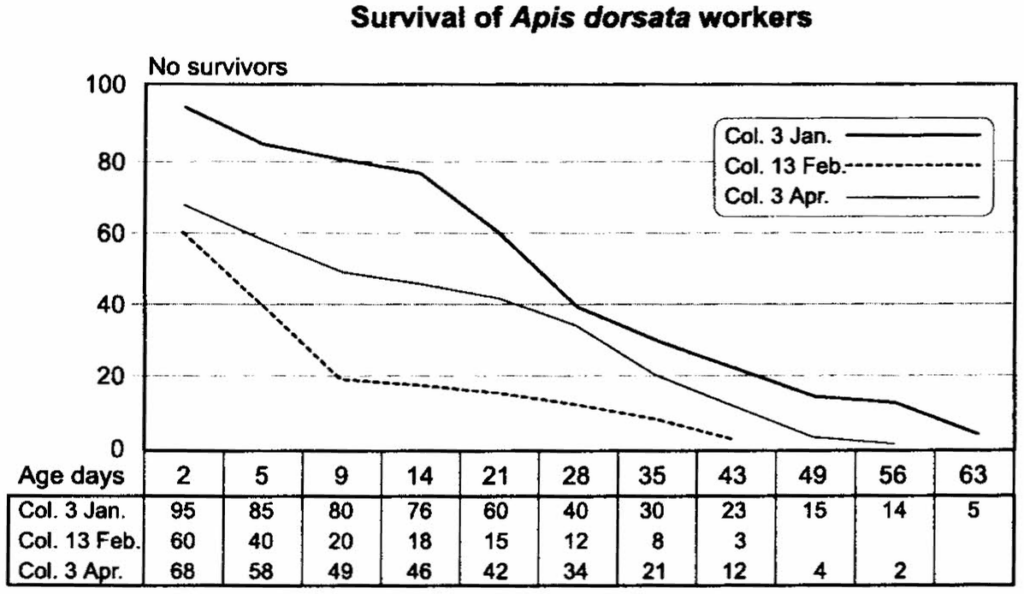
| Age days | 2 | 5 | 9 | 14 | 21 | 28 | 35 | 43 | 49 | 56 | 63 |
|---|---|---|---|---|---|---|---|---|---|---|---|
| Col. 3 Jan. | 95 | 85 | 80 | 76 | 60 | 40 | 30 | 23 | 15 | 14 | 5 |
| Col. 13 Feb. | 60 | 40 | 20 | 18 | 15 | 12 | 8 | 3 | |||
| Col. 3 Apr. | 68 | 58 | 49 | 46 | 42 | 34 | 21 | 12 | 4 | 2 |
Thus, A. mellifera workers remove A. dorsata pupae from brood cells within two days. However, they do not remove A. dorsata workers ready to emerge. Later both species co-exist peacefully.
3. Familiarisation of A. dorsata brood in A. mellifera colonies
Table 2 shows that fewer cappings on A. dorsata brood were scratched in pieces which had previously been protected with wire mesh for 24 hours than in unprotected ones. The results of all four checks (2.5 – 48 hours) were highly significantly lower for protected than for unprotected pieces of brood. Highly significantly, fewer pupae were removed from pieces previously protected for 24 hours than from unprotected ones. On average, 8.7 times more adult A. dorsata workers emerged from previously protected than from unprotected combs.
Equally significantly, in combs protected for 48 hours, fewer cappings were scratched and fewer pupae were removed from pieces previously
strona 74protected than from unprotected. On average, 10.7 times more adult A. dorsata workers emerged from combs protected for 48 hours than from unprotected ones.
The statistical comparison of results concerning brood combs protected for different time showed that significantly fewer cappings were scratched and fewer pupae were removed in combs protected previously for 48 than for 24 hours. Significantly more A. dorsata adults emerged from combs protected previously for 48 than 24 hours.
Thus the familiarisation of A. dorsata brood in A. mellifera colonies for 24 hours decreased the number of damaged brood and increased the number of emerged adults. Familiarisation for 48 hours decreased still further the number of damaged brood and increased the number of emerged adults.
4. Introduction of emerged A. dorsata workers into normal A. mellifera colonies
After young A. dorsata workers which emerged in an incubator were introduced into A. mellifera colonies, they were seen being pulled out of the entrances a few minutes later. Out of 25 and 35 introduced in the morning into two colonies, none remained in the colony until noon or until evening. Out of 45 introduced in the evening, none was found the next morning in the third colony. However, out of 45 introduced to the fourth colony 10 were detected the next morning. They were recovered also during inspections on three consecutive days. How long they survived was not recorded. Thus, A. mellifera mostly does not accept newly-emerged A. dorsata workers, and starts to remove them immediately. However, the few which do survive the first day may probably survive in the colony for some time.
5. Introduction of emerged A. dorsata workers into A. mellifera mating nuclei
When emerged A. dorsata workers were introduced in the morning into small mating nuclei, A. mellifera workers molested some of them. However, they were not removed immediately, as happened in normal colonies. Out of 21, 24 and 18 introduced workers, 14, 16 and 12 respectively were recovered in the nuclei the next morning. Thus, 67% of the introduced bees survived in all three nuclei. In the first nucleus, no A. dorsata workers were found after two days. In the second, 8 and 1 were found after two and three days respectively. In the third colony 12, 11, 6, 4, 2, and 1 workers were found 5, 9, 16, 17, 18 and 20 days respectively after their introduction. It was observed that a great part of the workers from the two first nuclei was lost due to drifting. Both nuclei were located very close (15 – 20 cm) to other mating hives. Thus, young A. dorsata workers survive in higher percentage in small colonies than in normal ones.
strona 756. Introduction of emerged A. dorsata workers in small cages into A. mellifera colonies
Out of 10 young A. dorsata workers introduced into A. mellifera colonies in small cages, a very different number survived for differing periods. In 6 repetitions, the last living bee was recorded at 0, 2, 4, 14, 24 and 70 days after the introduction. Distinct differences between the colonies were found. In colony No. 3, all 10 workers were still alive 27 days after their introduction, and the last living one was noted 70 days after the introduction. In colony No. 7 the last living bee was detected in two repetitions at 0 and 4 days after the introduction. Distinct differences in the care of caged workers were found between the honey flow period in January and the dearth period at the end of April. The last living bee in the two periods was found in colony No. 7 at 4 and 0 days after the introduction and in colony No. 8 at 21 and 2 days after the introduction, respectively.
7. Introduction of emerged A. dorsata workers in large cages into A. mellifera colonies
Out of 95 A. dorsata workers introduced in the morning into an A. mellifera colony in a large cage, 79 were alive on the second evening (after 32 hours). Following their release, 73 were recovered the next morning and 68 the second one. Figure 1 (No 3. Apr.) shows that 46 and 34 were found in the colony after 2 and 4 weeks respectively. The last one was recorded 58 days after the introduction. Thus, this is the most effective method of introducing A. dorsata workers into A. mellifera colonies.
8. Behaviour of A. dorsata workers at the hive entrances of A. mellifera colonies
A. dorsata workers were flying out and returning to A. mellifera hives. The A. mellifera guard bees usually allowed A. dorsata workers to enter the hives without any difficulty. Very occasionally returning A. dorsata workers were molested for a short time by A. mellifera workers before entering the hives. It is very interesting to note that some A. dorsata workers also served as guard bees. This activity was observed in bees older than two weeks. The A. dorsata guard bees were active at the entrance or on the landing board. In the latter case, they located themselves on the upper surface or on the front edge of the board. On the front edge, they sat head upwards. A. dorsata guard bees approached landing A. mellifera bees and checked them with their antennae. It is evident that A. dorsata workers serving as guards had learned the template cues of A. mellifera colony.
9. Introduction of A. mellifera brood into A. dorsata nests
At first, those two A. dorsata nests were examined into which A. mellifera brood ready to emerge had been introduced. In the first colony 3/4 and in the second 1/4 of A. mellifera cells were empty the next day. No damage to the sealings of the remaining A. mellifera cells was noticed. An examination of the
strona 76nests did not reveal any A. mellifera workers. However, A. mellifera workers were found on the ground beneath the nests. The workers were alive and some were crawling. It looked as if they had not been stung, but had been expelled from the nests. The next day almost all the cells were empty. We observed some emerging A. mellifera workers and opened some cells with workers ready to emerge. A. mellifera workers which emerged in our presence were at first able to walk freely on the comb surface without any disturbance. However, later a few A. dorsata workers molested them. As a result both or only A. mellifera workers fell down from the combs.
An examination of the young A. mellifera brood introduced into the third A. dorsata colony did not reveal any damage to the cappings. It is not clear whether the 4 day-old larvae had been sealed or removed. Five days after brood introduction no damage to the sealings was noticed. Nine days after introduction some cells were already empty. However, sealings on the remainder were not damaged. We watched some emerging A. mellifera workers. The result was the same as described above.
Thus, contrary to A. mellifera, A. dorsata does not damage a sealed brood of the other species. However, A. dorsata does not accept emerging bees of the other species, even when the brood has been in the nest for 10 days.
10. Caged A. mellifera workers in A. dorsata nests
The survival of caged A. mellifera workers in 5 A. dorsata colonies was checked the next day only in the two first repetitions. Out of a total of 10 checks, all 10 bees were found alive 4 times, 8 bees – once, 6 – once, 2 – once and 0 – 3 times. No bees were found alive the second day after their introduction in all three repetitions. Thus, contrary to A. mellifera, A. dorsata workers do not take care of caged bees of the other species.
DISCUSSION AND CONCLUSIONS
All the results presented above show that A. mellifera in normal colonies does not accept either unfamiliar A. dorsata brood or young A. dorsata workers. Here, both genetic and environmental cues could result in the rejection of the other species. However, begging for food invoked a feeding response and this probably resulted in familiarisation and subsequent acceptance of A. dorsata workers in A. mellifera colonies. Familiarisation of A. dorsata brood for 1 or 2 days decreased significantly the number of removed pupae, and increased the number of emerged and accepted adults by a factor of 9 – 11 times. The significance of an environmental cue is evident here. In small A. mellifera colonies, some A. dorsata workers were accepted despite the fact that they were not familiarised. A. dorsata workers kept in wire mesh cages for one day in A mellifera colonies became familiarised and consequently were accepted by A. mellifera. Thus, a relatively short familiarisation enhanced the environmental cues over the genetic ones. The
strona 77familiarised A. dorsata workers were not only accepted inside the colonies, but the guard bees also allowed them to enter the hives through the entrances. They survived in A. mellifera colonies for more than 50 days. It is interesting to note that A. dorsata workers in A. mellifera colonies learned the template cues of the colony and used them as a guard bee would to check entering A. mellifera foragers.
Downs and Ratnieks (1991) demonstrated the precedence of environmental cues over inherited ones in recognition by honey bees. They explained that the inherited cues in recognition demonstrated by Breed (1983), Getz and Smith (1983) and Moritz and Hillesheim (1990) were used by bees in laboratory conditions when environmental cues were artificially minimised. Our results demonstrated that even with the extreme genetic diversity of two Apis species, A. mellifera preferred environmental cues over genetic ones in recognition and acceptance of the other species. Although, all A. dorsata workers in A. mellifera colonies were of the same age, only a few served as guards. It may be that only some A. dorsata individuals of a rare genotype undertake this task, in the same way as was suggested for A. mellifera by Robinson and Page (1988)
The reciprocal reaction showed that A. dorsata does not damage unfamiliarised A. mellifera brood introduced into their nests. However, the congregation of A. dorsata workers on pieces of A. dorsata combs in A. mellifera colonies indicates that A. dorsata workers are able to distinguish between A. mellifera and A. dorsata combs. Nonetheless, the workers in A. dorsata colonies do not use that cue for opening cappings on sealed cells that contained brood of the other species.
However, A. dorsata did not accept young A. mellifera workers, despite the fact that they had been familiarised to the colonies by being in them as brood for 10 days. A. dorsata also did not take care of young A. mellifera workers introduced into the nests in small cages. Those A. mellifera workers, which survived the first day in cages in A. dorsata colonies, could become familiarised. Nevertheless, A. dorsata did not take care of them. Thus it is evident that A. dorsata uses genetic cues in the recognition and rejection of A. mellifera workers.
Hence, the reciprocal reaction of the introduction of brood and workers of one species into the nests of the other is just the opposite. A. mellifera does not accept unfamiliarised brood; however it accepts familiarised workers of A. dorsata. A. dorsata, accepts unfamiliarised A. mellifera brood, but not adults.
Dhalival and Atwal (1970) and Sakagami (1959) showed that A. mellifera and A. cerana did not accept unsealed brood of the other species but did, however, accept the sealed one. Thus, the reaction for unsealed brood of the other species was the same as in A. dorsata and A. mellifera. A. dorsata also accepted the sealed brood of the other species, like the two above.
strona 78However, A. mellifera did not accept the sealed brood of A. dorsata, contrary to the acceptance of the sealed A. cerana brood. Thus the cavity-nesting A. mellifera species accepted the sealed brood of the other cavity-nesting species, while it rejected the brood of the free-living species. According to Sakagami (1959), A. mellifera did not accept emerging A. cerana workers, just as A. dorsata did not accept A. mellifera in our investigations. According to Dhalival and Atwal (1970), A. mellifera accepted emerging A. cerana workers, just as A. mellifera accepted emerging A. dorsata workers in our investigations. Heterospecific queen rearing of A. mellifera and A. cerana resulted in the rejection of larvae of one species in the nests of the other (Pothichot et al. (1993). Apis cerana colonies accepted Apis koschevnikovi queens but no grafted queen larvae. Apis koschevnikovi colonies accepted Apis cerana grafted larvae but no Apis cerana queens (Koeniger et al. 1996). According to our observations A. dorsata larvae introduced into A. mellifera nests, either in comb cells or grafted in queen cups, were treated very differently (Woyke et al. 2001 in preparation). The cross-fostered drone brood of A. cerana and A. koschevnikovi was accepted both ways (Koeniger et al. 1994).
All the results show that the reciprocal reaction to the introduction of one species of bees into the nests of the other is different in different species.
The results show that even when more phylogenetic distant species are involved, A. mellifera seems to depend on environmental cues to a great extent in the recognition and acceptance of workers of the other species. However, A. dorsata uses genetic cues in the recognition and rejection of adults of the other species.
ACKNOWLEDGEMENTS
We would like to thank very much the Chairman of Dabur Company, Mr A. C. Burman, for providing us the facilities to conduct the investigations and to Mgr R. Kolasinski for organising our stay.
REFERENCES
Breed M. D. (1983)- Nestmate recognition in honey bees. Anim. Behav., 31: 86-91.
Breed M. D.; Garry M., F., Pearce A. N. Hibbard B. E., Bjostad L. B., Page R. E. Jr (1995)- The role of wax comb in honey bee nestmate recognition. Anim. Behav., 50: 489-496.
Dhaliwal G. S., Atwal A. S. (1970)- Interspecific relations between Apis cerana indica and Apis mellifera. J. apic. Res. 9: 53-59
Downs S. G., Ratnieks F. L. W. (1991)- Recognition of conspecifics by honeybee guards uses nonheritable cues acquired in the adult stage. Anim. Behav., 58: 643-648
strona 79Getz W. M., Smith K. B. (1983)- Genetic kin recognition: honey bees discriminate between full and half sisters. Nature, 302: 147-148.
Hamilton W. D. (1964)- The genetic evolution of social behaviour. J. theoret. Biol., 7: 1-52.
Moritz R. F. A., Hillesheim E. (1990)- Trophallaxis and genetic variance of kin recognition in honey bees, Apis mellifera L. Anim. Behav. 40: 642-647.
Koeniger G.; Koeniger N.; Tingek S. (1994)- Crossfostered drones of Apis cerana (Fabricius 1793) and Apis koschevnikovi (Buttel-Reepen 1906) fly at their species specific mating times. Insectes soc., 41: 73-78
Koeniger N., Koeniger G., Tingek S., Kelitu A. (1996)- Interspecific rearing and acceptance of queens between Apis cerana Fabricius 1793 and Apis koschevnikovi Buttel-Reepen 1906. Apidologie, 27:371-380
Pothichot S., Wongsiri S., Dietz A. (1993)- Attempts in queen rearing of Apis cerana larvae in Apis mellifera colonies and Apis mellifera larvae in Apis cerana colonies. In: Asian Apiculture. Proceedings of the first International. Conference on the Asian Honey Bees and Bee Mites. Bangkok, Thailand, Wicwas Press Chesire, Conneticut, USA, 128 – 133
Robinson G. E., Page R. E. Jr. (1988)- Genetic determination of guarding and undertaking in honey-bee colonies. Nature, 333: 356-358.
Ruttner F. (1988)- Biogeography and taxonomy of honeybees. 284, Springer Verlag, Berlin
Sakagami S. F. (1959)- Some interspecific relations between Japanese and European honey bees. J. Anim. Ecol., 28: 51-68
GENETYCZNE CZY ŚRODOWISKOWE SYGNAŁY UŻYWANE W ROZPOZNAWANIU I AKCEPTACJI DWU GATUNKÓW PSZCZÓŁ: APIS MELLIFERA I APIS DORSATA W TEJ SAMEJ RODZINIE
Woyke J., Wilde J., Wilde M.
Streszczenie
Rozpoznawanie współtowarzyszy gniazda odgrywa ważną rolę w ewolucji i organizacji społecznej owadów. Badaliśmy zagadnienie rozpoznawania i akceptacji dwu genetycznie skrajnych populacji pszczół, Apis mellifera i Apis dorsata.
Badania prowadzono w Centrum pszczelarskim Dabur w Jugedi, w rejonie Chitwan w Nepalu w okresie od stycznia do maja 1999 r. i od października do czerwca 2000 r. Przeprowadzono 10 doświadczeń. W celu zbadania akceptacji czerwiu A. dorsata przez A. mellifera umieszczano w gnieździe tej ostatniej kawałki czerwiu; 1/ młodego, 2/ starszego oraz 3/ starszego zabezpieczonego siatką przed dostępem robotnic przez 1 lub 2 dni. W celu zbadania akceptacji dorosłych robotnic A. dorsata przez A. mellifera, czerw tej pierwszej umieszczano w cieplarce. Wygryzione robotnice poddawano; 4/ bezpośrednio do
strona 80normalnych rodzin A. mellifera, 5/ do ulików weselnych, 6/ umieszczano w gnieździe po 10 w małych drucianych klateczkach nie uwalniając ich oraz 7/ umieszczano najpierw w dużych klateczkach (20 x 20 x 2,5 cm) w gnieździe celem przejścia zapachem, po czym uwalniano je, 8/ obserwowano zachowanie robotnic A. dorsata na wylotku ula z A. mellifera. W celu zbadania akceptacji czerwiu lub robotnic A. mellifera przez A. dorsata umieszczano; 9/ kawałki czerwiu tej pierwszej w gniazdach drugiej, oraz 10/ umieszczano po 10 młodych robotnic A. mellifera w małych klateczkach w gniazdach A. dorsata.
Wyniki badań (tab 1) wykazały, że robotnice A. mellifera już po 2.5 godz. zjadły większość młodych larw A. dorsata i zaczęły niszczyć zasklep. Następnego dnia zjadały lub wynosiły poczwarki. Jednak robotnice A. dorsata gotowe do wygryzienia prosiły o pokarm i były karmione przez robotnice A. mellifera. Wygryzione zostały zaakceptowane w gnieździe A. mellifera. Robotnice A. mellifera zaakceptowały 9 – 11 razy więc robotnic A. dorsata z plasterka który przechodził zapachem przez 1 – 2 dni, niż ze świeżo poddanego (tab. 2). Młode robotnice A. dorsata poddane bezpośrednio do normalnych rodzin A. mellifera zostały wkrótce usunięte. Jednak niektóre poddane do małych rodzinek w ulikach weselnych zostały zaakceptowane. Robotnice A. dorsata przetrzymywane w małych klateczkach przeżyły w gniazdach A. mellifera od 0 do 70 dni. Gdy młode robotnice A. dorsata w dużych klateczkach przeszły zapachem A. mellifera to po uwolnieniu zostały zaakceptowane. Przeżyły one ponad 50 dni w rodzinach A. mellifera (fig. 1). Wylatywały i wracały do uli, a na wylotku wachlowały i pełniły rolę strażniczek.
Odwrotne badania wykazały, że robotnice A. dorsata nie niszczyły czerwiu A. mellifera wstawionego do ich gniazd. Usuwały jednak wygryzione robotnice, pomimo, że te jako czerw przechodziły zapachem A. dorsata nawet przez 10 dni. Robotnice A. mellifera w małych klateczkach w gniazdach A. dorsata padły w ciągi 1 – 2 dni.
Tak więc reakcja na czerw lub robotnice jednego gatunku poddane do gniazd drugiego jest odwrotna. A. mellifera niszczy poddany czerw A. dorsata lecz akceptuje czerw i dorosłe robotnice, które przeszły ich zapachem. A. dorsata nie niszczy czerwiu A. mellifera, lecz usuwa nawet te robotnice, które przeszły jej zapachem. Tak więc widać, że A. mellifera kieruje się w dużym stopniu sygnałami środowiskowymi w akceptacji drugiego gatunku. Natomiast A. dorsata kieruje się sygnałami genetycznymi w akceptacji dorosłych osobników A. mellifera.
Słowa kluczowe: Apis dorsata, Apis mellifera, sygnały genetyczne, sygnały środowiskowe, współistnienie, rozpoznawanie, akceptacja.
Errata — błędy druku znalezione podczas digitalizacji
- s. 68: „Hillesheime” → Hillesheim
- s. 71: „pulled the lags” → pulled the legs
- s. 77: „Dhalival” → Dhaliwal
- s. 78: „Dhalival” → Dhaliwal
- s. 79, piśmiennictwo: „Chesire, Conneticut” → Cheshire, Connecticut
- s. 80, streszczenie: „więc robotnic” → więcej robotnic
- s. 80, streszczenie: „w ciągi” → w ciągu