
A NEW METHOD OF CHALKBROOD CONTROL USING CHITOSAL-APIS® LIQUID
tekst: Zdzisław Gliński, Marek Chmielewski
Pszczelnicze Zeszyty Naukowe, Rok XLIV, Nr 2, 2000 — Zdzisław Gliński, Marek Chmielewski
strona 171PSZCZELNICZE ZESZYTY NAUKOWE Rok XLIV, Nr 2 2000
Zdzisław Gliński, Marek Chmielewski
Katedra Epizootiologii i Klinika Chorób Zakaźnych Zwierząt, Wydział Medycyny Weterynaryjnej Akademii Rolniczej w Lublinie, 20-033 Lublin, ul. Akademicka 12, Poland.
Summary
Most known antifungals act on enzymes involved in the biosynthesis of ergosterol in fungi. Chitin-derivatives, potent antifungal preparations most probably act on the permeability of membranes of fungal hypha. Chitosal-Apis® Liquid which is a mixture of 2-acetamido-2-deoxy-β-D-glucose and 2-amino-deoxy-β-glucopyranose in 1% salicylic acid not only inhibits but also kills Ascosphaera apis – a causative agent of chalkbrood of the honey bee. It is virtually non toxic for larval brood and worker bees after oral administration. Both spring and autumn treatments with Chitosal-Apis® Liquid were very effective. No side effects were observed during and after the therapy. Chitosal-Apis® Liquid is a natural product and therefore not dangerous either to bees or to consumers of the honey bee products.
Keywords: Chitosal Apis® Liquid, chalkbrood, honey bee.
INTRODUCTION
Among infectious diseases of the honey bee reported in 1999 fungal infections appear to be prevalent in many countries (Shimanuki and Knox 1999) (Tab.1). Fungi are not only common saprophytes of bees and combs. Most of the fungi collected by bees are patogenic (Gliński et al. 1988) (Tab.2). In the honey bee fungi initiate infection by spores germination. The developing invasive hypha penetrates the cuticle mechanically and enzymatically enters the bee’s body cavity where it rapidly develops and overwhelms the internal organs. The invasion may sometimes start from ingested fungal spores that germinate in the intestines. Physical, chemical and biological stress factors, mainly extremal temperatures and high humidity, environmental pollution, pesticide poisonings, parasite invasions and attacks of predators are the factors which lead to the development of fungal infection in bees. Hence, stress conditions are the risk factors because they reduce the resistance pattern of the insect organism by compromising the immune system and by impairing the protective barriers of the body coverings, alimentary tract and tracheae. Immunologically compromised brood of the honey bee is very sensitive to A. apis infection. (Stark and Gliński 1996). In the chalkbrood, infected larvae Ascosphaera apis both mechanically and
strona 172enzymatically damage tissues and disturb blood circulation and growing mycelium in the midgut is responsible for competition for food and place. The result of the infections is death and the mummification of the bee larvae. The fungus overgrowing the mummified bee larvae produces an enormous number of infective spores, resistant to common antifungal drugs and disinfectants. (Gliński and Chmielewski 1983)
Tab. 1 World bee health report 1999 Najczęściej występujące choroby pszczół w wybranych krajach – 1999
| Country | Chalk brood | AFB | EFB | SB | Nosema | Amoeba | Acarapis | Varroa | Tropilaelaps | Braula |
|---|---|---|---|---|---|---|---|---|---|---|
| Poland | + | + | + | + | + | + | + | + | + | |
| Germany | + | + | + | + | + | + | + | + | ||
| USSR-Former | + | + | + | + | + | + | + | + | + | + |
| Sweden | + | + | + | + | + | + | ||||
| Finland | + | + | + | + | + | ? | + | + | ||
| France | + | + | + | + | + | + | + | + | + | |
| Australia | + | + | + | + | + | + | + |
Tab. 2 Mycoses of the honey bee – Grzybice pszczoły miodnej
| Disease | Aetiology | Pathogenicity: Brood | Pathogenicity: Imago | Occurence |
|---|---|---|---|---|
| Chalkbrood | Ascosphaera apis | + | worldwide | |
| Stonebrood | Aspergillus flavus A.niger, A.fumigatus |
+ | + | sporadic |
| Melanosis | Areobasidium pullulans | + | sporadic | |
| Molds | Trichoderma lignorum, T.koenigi, Mucor hiemalis |
+ | + + |
sporadic sporadic |
| Yeasts | Saccharomyces cerevisiae, S.elipsoideus, Kloeckera apiculata, Torulopsis, Candida |
+ | sporadic |
Only a few antifungal agents can be used to cause the selective elimination of Ascosphaera apis from the honey bee brood with the minimal
strona 173toxicity to the brood, the bees and the queen. Drugs by contaminating honey and pollen loads are a potential danger to the consumers of these bees products. (Gliński 2000) Up to now the following have been commonly used to control chalkbrood: polyenes, (Amphotericin B, Nystatin) (Gliński and Osipowski 1984), Gryseofulvin, sorbic acid, Thiabendazol and sodium propionate. (Gliński et al. 1988). Trials have been done with Clotrimazole (Gliński et al. 1988), furanocoumarins of plant origin and scent oils (citral and geraniol). (Gliński and Chmielewski 1992, Gliński et al. 1988, Wolski et al. 1997). Very interesting results have been noted with chitosan, a mixture of derivatives obtained from crustacaean chitin. Chitosan shows antifungal, bacteriostatic and antitumor properties (Wolski et al. 1992). It activates the immune system and cell regeneration in vertebrates. Recently, it was found that N-acetylated derivatives of chitin induce haemocytic and cell-free immune responses in the honey bee. (Gliński et al. 2000)
MATERIAL AND METHODS
Chitosal-Apis® Liquid is a solution of chitosan in 1% salicylic acid prepared by „Vet-Agro” Lublin. For comparison the following antimycotics were included; extracts of Archangelica officinalis, Pastinaca sativa and Libanotis intermedia (active substance – fouranocoumarins), Nystatin and choline salt of N-glucosyl-polyfungine.
The value of minimal inhibitory concentration (MIC) and minimal fungicide concentration (MFC) were calculated by the method used by Ericsson and Sherris on Sabouraud,s medium with yeast extract at 25°C; 10 isolates of Ascosphaera apis from Poland and three isolates from Finland (Fin.1, Fin.2, Fin.14) were tested. The following reference strains of A. apis were included: USDA 1, USDA 2, Uppsala 1002 and 1005.
Toxicity for brood. On brood frames of an uncaged honey bee colony, free of diseases, a test area with 50 larvae 72-80 hrs old was plotted. Using a Hamilton’s microsyringe Chitosal-Apis® Liquid in 50% royal jelly (royal jelly diluted with an aquaeous glucose-fructose solution (Rembold H. et al. 1974); was applied in a dose of 1.0 µ directly l to the larvae in the brood cells. Concentration of the dissolved test substance ranged from 10^0 to 10^2 MIC for A. apis. The brood loss rate was also determined in an untreated control area of brood. During the test the temperature was kept at 35°C and relative humidity at 60-70%. The time limit chosen for mortality counts was 24 hours.
Toxicity for bees was determined on workers at the age of 2-3 weeks in a feeding test. The bees – in small cages in groups of 25 bees each – were allowed to feed on 25% sugar solution which contained a known amount of the test material (10^0-10^2 MIC of Chitosal-Apis® Liquid for A. Apis) for 24 hrs. The test was performed at 30°C and 45% RH (12). The time limit chosen
strona 174for mortality counts was 24 hrs. The bees fed on the sugar solution without Chitosal® served as a control. Twenty replications were run of each test. The value of LD50 was calculated according to Litchfield and Wilcoxon (Litchfield and Wilcoxon 1949) on the basis of the number of dead or viable brood or the number of bees.
Fields examinations. The therapeutic effects of Chitosal-Apis® Liquid were checked in 8 randomly chosen apiaries on 200 honey bee colonies in which chalkbrood was clinically diagnosed and then confirmed by the isolation of Ascosphaera apis. The level of infection varied from 25 to 50 mummies per comb. In the spring treatment Chitosal-Apis® Liquid was sprayed over brood and bees and the inside of the hive at a dose of 20 ml per colony, twice at 5 day intervals in 100 colonies. The autumn treatment was done in 100 colonies after removing the honey from the hive. The preparation at a strength of 20-25 ml per colony was sprayed over the brood, the bees and the inside of the hive twice at 5 day intervals. Fifty untreated, chalkbrood – sick honey – bee colonies served as a control.
RESULTS
Over the past few years, a series of antimycotic compounds have been shown to demonstrate a potent activity against a wide spectrum of insect pathogenic fungi. All the preparations examined appeared to be active against isolates of A. apis. Chitosan in 1% salicylic acid appeared to inhibit in vitro the growth of the tested strains at a low concentration. At the same concentration it also revealed fungicide action (Tab.3)
Tab. 3 Effects of antimycotics on Ascosphaera apis, brood and worker bees Efekt oddziaływania substancji przeciwgrzybowych na Ascosphaera apis oraz czerw i robotnice pszczoły miodnej
| Antimycotics | MIC (µg/ml) | MFC (µg/ml) | LD50 (µg/insect): brood | LD50 (µg/insect): imago |
|---|---|---|---|---|
| A. officinalis | 1.5 – 2.0 | 4.5 – 5.0 | 145.0 | 125.0 |
| P.sativa | 35.0 – 38.0 | 41.0 – 49.0 | 310.0 | 280.0 |
| L.intermedia | 25.0 – 40.0 | 400.0 | 105.0 | 80.0 |
| Nystatin | 328.0 – 340.0 | 350.0 | 128.0 | 93.0 |
| Choline salt of N-glucosyl-polifungine | 5.5 – 15.0 | 10.0 – 20.0 | 320.0 | 210.0 |
| Chitosan + salicylic acid (Chitosal) | 18.7 | > 2000.0 | > 2300.0 |
The test methods used to evaluate the toxicity and the hazard of the testing preparations to brood and worker bees showed that Chitosal-Apis® Liquid is virtually non toxic to brood and bees (tab.3). After a continuous
strona 175feeding of the bee larvae the value of the LD50 exceeded 2000 and for worker bees it was more than 2300 µg per insect. These values of LD50 were many times higher than those noted for furanocoumarin extracts, Nystatin and choline salt of N-glucosyl polifungine.
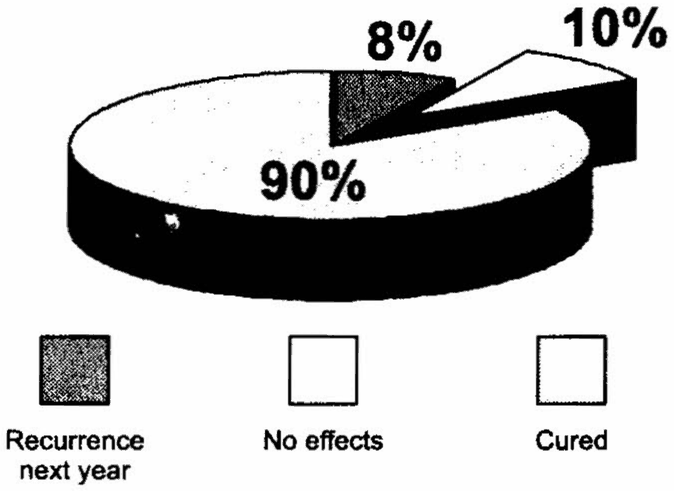
Preliminary observations in the field showed that Chitosal-Apis® Liquid used in the spring efficiently controls chalkbrood (Fig.1.). The liquid was found to have no effect in only 10% of the colonies and a recurrence appeared next spring in only 8% of the colonies in which symptoms of chalkbrood disappeared after the treatment in the previous year. Autumn treatment was much more effective. The signs of chalkbrood disappeared completely after just two applications of the preparation under study. Moreover, in only 2% of the treated colonies did chalkbrood reappear in the spring next year. In non-treated colonies chalkbrood persisted for the whole period of observation.
DISCUSSION
This study on the effectivenes of Chitosal-Apis® Liquid in controlling the natural causes of chalkbrood showed that it is possible to use this preparation in apiaries. The active ingredients of the preparation acted as fungistatic by preventing both the germination of spores and the multiplication of fungal hyphaea. They also acted as a fungicidal agent because they destroyed completely the infectious factor. Moreover, Chitosal-Apis® Liquid appeared to be non toxic and was well tolerated by the bee colony at concentrations that effectively suppressed the invading fungus, and the prepartion was easy to apply in apiaries. The in vitro efficacy of the examined preparate was also very high. This effectiveness against Ascosphaera apis was confirmed by field studies in colonies naturally infected with chalkbrood. Therefore, it can be reasonably assumed that Chitosal-Apis® Liquid is a potent antifungal preparate easy to apply in bee colonies. It is worthy of note that in treated
strona 176colonies the development of brood, the queen’s egg laying and the behaviour of worker bees were not disturbed.
It is very interesting to note the modulation of cellular immune responses of bees by chitosan. In this way, the treatment reduces the susceptibility of the brood to A. apis infection caused by the depression of antiinfectious protective immunity (Gliński et al.2000)
The treatment of chalkbrood with Chitosal-Apis® Liquid was not supported by sanitary and hygienic manipulations. Hence, because of the good effects of the use of Chitosal-Apis® Liquid by itself in treated colonies, sanitary and hygenic manipulations could be avoided.
When chemicals are introduced into the bee colonies, they often contaminate the honey, the pollen loads and even the wax. As a result contamination creates a threat for consumers of honey, pollen and propolis. Thus, from an hygenic point of view, the dangers of residual chemicals and drugs in bee products to consumers are important. (Gliński 2000). Chitosan-derivatives in this respect are safe for consumers, because a) they are obtained from chitin which is a natural product commonly found in nature, b) Chitosal-Apis® Liquid is applied in apiaries in spring and in autumn, at a time when market honey has been removed from the bee hives and it cannot come to contact with this preparation.
CONCLUSSIONS
- Chitosal-Apis® Liquid is virtually non toxic for brood and worker bees both in laboratory tests and in examinations in bee colonies.
- Chitosal-Apis® Liquid appeared to be very effective in laboratory studies and in treatment of chalkbrood in infected honey bee colonies. Bee colonies should be treated in spring or in autumn without any sanitary or hygenic manipulations (shaking, disinfection).
REFERENCES
Gliński Z. (2000)- Immunosupresyjne i immunotoksyczne działanie skażonych produktów pszczelich na organizm człowieka. Medycyna Wet., In press
Gliński Z., Chmielewski M. (1983)- Effects of environmental conditions on Ascosphaera apis. I. The effect of temperature and relative humidity on growth and sporulation of A. apis. Annls.UMCS, s.DD, 38: 1-7.
Gliński Z., Chmielewski M. (1983)- Grzybica otorbielakowa czerwia pszczoły miodnej – metody leczenia. Nowości Wet., 13: 5-12.
Gliński Z., Chmielewski M. (1992)- Preliminary observation of chalkbrood control using coumarins of plant origin. XXV Annual Meeting of the Society for Invertebrate Pathology, Heidwelberg, 16-25 August 1992.
strona 177Gliński Z., Chmielewski M., Kauko L. (2000)- Chitosan a potent natural stimulator of insect immune system. Proceedings The 1st European Scientific Apicultural Conference, Puławy, Poland, Sept. 2000, 74-75.
Gliński Z., Osipowski T. (1984)- Obserwacje nad wpływem nystatyny i zabiegów hodowlano-sanitarnych na zwalczanie grzybicy otorbielakowej czerwia pszczoły miodnej. Annls UMCS, s.DD, 39:217-226.
Gliński Z., Rzedzicki J., Wolski T., Kauko L. (1988)- Perspektywy zwalczania grzybic pszczoły miodnej z uwzględnieniem immunomodulacyjnych efektów leków przeciwgrzybiczych. Annls.UMCS, s.DD, 53: 201-216.
Gliński Z., Wolski T., Chmielewski M. (1988)- Badania „in vitro” nad aktywnością przeciwgrzybiczą wyciągów z arcydzięgla lekarskiego (Archangelica officinalis Hoffm.) w stosunku do Ascosphaera apis. Medycyna Wet. 44: 552-556.
Litchfield G.T., Wilcoxon F. (1949)- A simple method of evaluating the dose-effect experiments. J.Pharmacol.Exp.Ther. 96:99.
Rembold H., Lackner B., Geistbeck I. (1974)- The chemical basis of honeybee, Apis mellifera, caste formation. Partial purification of queen bee determination for royal jelly. J.Insect Physiol. 20:307.
Shimanuki H., Knox D.A. (1999)- Bee health and international trade. Rev.sci.tech.Off.int.Epiz.,19(1):172-176
Stark J., Gliński Z. (1996)- Defence strategies of the honey bee (Apis mellifera L.) against hostile organisms. Apiacta, 31:6-16.
Wolski T., Gliński Z., Buczek K., Wolska A. (1997)- Możliwości leczenia grzybic ekstraktami roślinnymi. Herba Pol. 43: 47-52.
Wolski T., Gliński Z., Kawka S. (1992)- Próby zastosowania chityny i chitozanu w leczeniu grzybicy otorbielakowej. II.Sem.Chutyna/Chitozan, Gdańsk 19.11.1992, Referaty i abstakty MIR, 59-61.
NOWA METODA ZWALCZANIA GRZYBICY OTORBIELAKOWEJ CZERWIA PSZCZOŁY MIODNEJ Z ZASTOSOWANIEM PREPARATU CHITOSA-APIS® PŁYN
Gliński Z., Chmielewski M.
Streszczenie
Mechanizm działania większości substancji o działaniu przeciwgrzybiczym polega na zaburzeniu biosyntezy ergosterolu w komórce grzyba. Pochodne chityny, które cechuje aktywność przecigrzybicza, najprawdopodobniej powodują zmiany w przepuszczalności błon strzępki grzyba, czego efektem jest zahamowanie wzrostu oraz śmierć komórki. Chitosal-Apis® Płyn, który jest mieszaniną 2-acetamido-2-deoxy-β-D-glucose and 2-amino-deoxy-β-glucopyranose w 1% roztworze kwasu salicylowego, nie tylko hamuje
strona 178wzrost grzyba, ale powoduje śmierć komórki Ascosphaera apis -czynnika etiologicznego grzybicy otorbielakowej czerwia pszczoły miodnej.
Preparat jest nietoksyczny dla czerwia i pszczół. Bardzo dobre efekty terapeutyczne uzyskano stosując Chitosal-Apis® Płyn na wiosnę w formie oprysku czerwia i pszczół oraz w jesieni w formie dokarmiania na zimę. Zarówno w trakcie leczenie jak i po jego zakończeniu nie obserwowano niepożądanych efektów. Ze względu na fakt, że Chitosal-Apis® Płyn zawiera jako substancje czynne produkty pochodzenia naturalnego (pochodne chityny, kwas salicylowy) dawka lecznicza jest mała oraz leczenie jest przeprowadzane po odwirowaniu miodu towarowego, produkty pszczele pochodzące z leczonych rodzin nie stanowią zagrożenia dla zdrowia konsumentów.
Słowa kluczowe: Chitosal-Apis® Płyn, grzybica otorbielakowa, pszczoła miodna.
Errata — błędy druku znalezione podczas digitalizacji
- s. 171: „patogenic” → pathogenic
- s. 172, tab. 2: „Occurence” → Occurrence
- s. 172, tab. 2: „Areobasidium” → Aureobasidium
- s. 172, tab. 2: „S.elipsoideus” → S.ellipsoideus
- s. 173: „crustacaean” → crustacean
- s. 173: „aquaeous” → aqueous
- s. 173: „fouranocoumarins” → furanocoumarins
- s. 173: „Sabouraud,s” → Sabouraud’s
- s. 175: „effectivenes of” → effectiveness of
- s. 175: „hyphaea” → hyphae
- s. 175: „prepartion” → preparation
- s. 176, 3×: „hygenic” → hygienic
- s. 176: „CONCLUSSIONS” → CONCLUSIONS
- s. 176, piśmiennictwo: „Heidwelberg” → Heidelberg
- s. 177, piśmiennictwo: „Chutyna” → Chityna
- s. 177, piśmiennictwo: „abstakty” → abstrakty
- s. 177, tytuł polski: „CHITOSA-APIS” → CHITOSAL-APIS
- s. 177, streszczenie: „przecigrzybicza” → przeciwgrzybicza
- s. 178, streszczenie: „w trakcie leczenie” → w trakcie leczenia