

EFFECT OF THE ACTIVATION OF THE BEE Osmia rufa L., Megachilidae ON THE EMERGING DYNAMICS OF IMAGINES AND THEIR SURVIVAL RATE
tekst: Karol Giejdasz, Zdzisław Wilkaniec
Pszczelnicze Zeszyty Naukowe, Rok XLII, 1998 — Karol Giejdasz, Zdzisław Wilkaniec
strona 265PSZCZELNICZE ZESZYTY NAUKOWE Rok XLII, Nr 1 1998
Karol Giejdasz, Zdzisław Wilkaniec
Department of Useful Insects Breeding, Faculty of Biology and Animal Husbandry, August Cieszkowski University of Agricultural in Poznań Wojska Polskiego 71C Str., 60-625 Poznań, Poland.
Summary
Studies on the dependence between the activation term of Osmia rufa bee and the emerging dynamics of imagines and their survival rate were carried out in laboratory conditions. The insects cocoons were activated at 28°C in an incubator. The emerged insects were kept in small isolators in which they were fed honey syrup or sugar syrup. The experiment has shown that in result of the delay in the activation term, the period of insects awaking was shortened and their speed of emerging was accelerated, but the survival rate of the insects decreased. Independent of the term of awaking, the percentage of the whole emerged insects was approximate in the particular experimental tests.
Keywords: Osmia rufa L., activation, emerging, survival rate.
INTRODUCTION
The bee Osmia rufa L. is a typical spring species, giving one generation in the year. In natural conditions , the period of its active life and reproduction can start in the I decade of April and it can last until the III decade of June. Already in September, in the cocoons there are imaginal forms that hibernate in this form (Wójtowski 1979).This property characteristic of the bionomy of this bee permits its earlier activation, i.e. the acceleration of the emerging of males and females by providing the cocoons with an adequate temperature (Wilkaniec, Ruszczyński 1994). It particularly important when we want to use the bees for the pollination of early flowering plants, grown under cover (greenhouses, plastic tunnels). Besides, the activation of insects in controlled conditions, even in the time of their natural awaking, permits to obtain a great number of insects in a short time.
In 1997, an experiment was carried out investigating the effect of different terms of Osmia rufa L. activation on the percentage of emerged full-grown insects, their emerging dynamics, and their survival rate. The objective of the this study was to define in order to prepare the insects to the introduction into
strona 266the flowering plants in case the bees are to be used for the pollination of these plants.
METHODS
The experimental material in form of bee cocoons originated from the breeding station of this bee on experimental areas of the Department in Stobnica conducted since 1996 according to the methods elaborated by Wójtowski and Wilkaniec (1978). From the moment of the beginning of the experiment to the moment of the activation of insects, the nests settled by the bees in the particular terms were kept in e cooler at 2-4°C (Wójtowski et al. 1991). For each test in experiment, 200 cocoons were taken from the nest pipes and they were placed on Petri dishes in an incubator at 28°C. The emerging insects were removed every day from the incubator, the number of males and females was counted and they were transferred to two isolators, keeping the number of both sexes in even proportion. The isolators constituted separate experimental groups in each experimental test differing by the method of insect feeding. In one group (isolator), the insects were given honey syrup, and the other group, they were fed sugar syrup. The isolators had the form of cubicoids made of plexi glass and measuring 25cm x 25cm x 40cm. In the front wall, they were provided with a sleeve of polyethylene gauze permitting an access to their interior, and the upper walls were made of plastic net for ventilation purposes. Petri dishes were placed inside as feeders artificial nests of reed pipes were hung to provide shelter to the insects. The activation of insects for particular experimental tests was carried out 6 times in 14-day intervals ( 28.II.1997, and then on 14.III; 1.IV; 14.V; 28.IV; 12.V). The insects in isolators were kept in laboratory conditions at about 24°C. The day length stimulated by artificial light was extended to 12 hours (from 6:00 to 18:00). The lighting was at the same time a source of warmth. The insects were supplied food every second day, and the dead individuals were removed and counted. The insects were kept in the isolators for 4 weeks. After this period, the surviving individuals were counted and the survival rate of females was calculated. The survival rate of males was defined after two and three weeks on the basis of the number dead individuals.
RESULTS
The percentage of the emerged insects in the particular terms amounted on the average to 81.2%, always with the supremacy of males giving a mean value of 50.7% of all emerged insects (Table 1).
strona 267Table 1 Percentage of insects emerged from cocoons. Procent owadów wygryzionych z oprzędów.
| Test / Próba | Date / Data | Females / Samice | Males / Samce | Total / Razem |
|---|---|---|---|---|
| I | 28.II | 23 | 55 | 78 |
| II | 14.III | 16.5 | 64.5 | 81 |
| III | 1.IV | 38.5 | 41 | 79.5 |
| IV | 14.IV | 33.5 | 44.5 | 78 |
| V | 28.IV | 36.5 | 47 | 83.5 |
| VI | 12.V | 38 | 52 | 90 |
| Mean – Średnio | 31 | 50.7 | 81.7 |
The high sex differentiation of insects emerged in testes 1 and 2 is probably the result of a random selection of cocoons during their removal from the nest pipes. The term of insects awaking probably had no influence on the percentage of emerged insects. from 22% to 11% of cocoons remained unemerged due to different reasons and was within the limits reported by other authors (Chorbiński, Wilkniec 1998). The length activation counted from the moment of the placing of cocoons into the incubator to the moment when the firs emerged insects appeared was the longest in the first term both for females and males, but it decreased with the delay of insects awaking (Table 2). It seems that in test IV the insects reached the minimal time of activation .The length of the emerging period counted from the moment the first individuals appearance to the moment of the emerging of the last males and females was the greatest in the first term, and it decreased in the successive tests. The last time for emerging was needed by insects awaked on the fourth and fifth terms, and one can believe that this period does not become shorter with further delays. The short period of females emerging in the second term resulted from the small number of females emerging in that test. The total time of females and males activation was 5 to 14 days, similarly as reported by Wójtowski (1979); it decreased with the delay of the awaking of insects; in the fifth and sixth tests, the time was the same (Table 2).
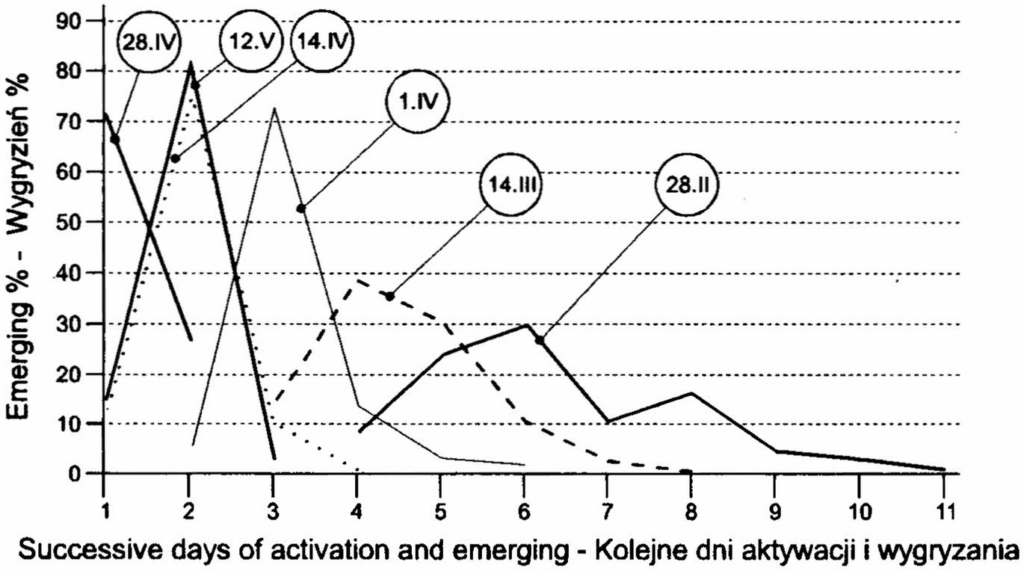
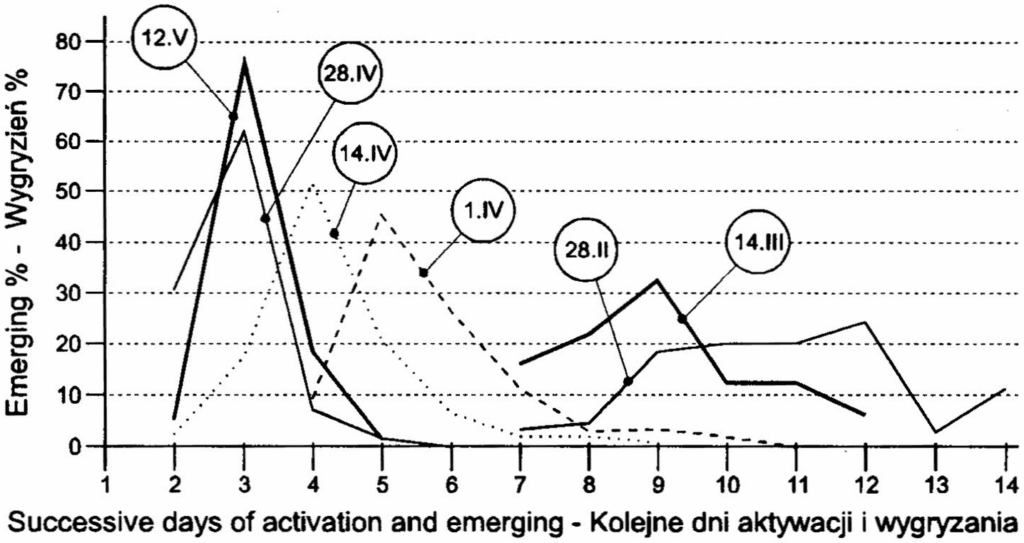
The dynamics of female and males emerging in the first and second term is similar (Fig.1,2). The insects emerged rather at an uniform rate in a longer period of time. The maximum of emerged males in the first term falls to the third day of emerging, while the maximum of females falls to sixth day. On the other hand, in the second term, the respective values fell to the second and the third day. Starting with the third term of activation, the rate of emerging grows, the insects reach their emerging maximum already in the second day (Except for males in test V and females in test IV). In males who emerged more
strona 268dynamically, the peak of emerging in the further successive emerging terms was over 70% of all males. In females, it was lower and oscillated between 45 and 74%. The percentage of emerged females after the reaching of the maximum was significant and exceeded 20%, except for test V.
Table 2 Length of the activation and emerging periods Długość okresu aktywacji i wygryzania się owadów
| Test / Próba | Date / Data | Activation period(days) — Okres aktywacji (dni): Males / Samce | Activation period(days) — Okres aktywacji (dni): Females / Samice | Emerging period(days) — Okres wygryzania(dni): Males / Samce | Emerging period(days) — Okres wygryzania(dni): Females / Samice | Total / Razem |
|---|---|---|---|---|---|---|
| I | 28.II | 3 | 6 | 8 | 8 | 14 |
| II | 14.III | 2 | 6 | 6 | 6 | 12 |
| III | 1.IV | 1 | 3 | 5 | 7 | 10 |
| IV | 14.IV | 0 | 1 | 4 | 7 | 8 |
| V | 28.IV | 0 | 1 | 2 | 4 | 5 |
| VI | 12.V | 0 | 1 | 3 | 4 | 5 |
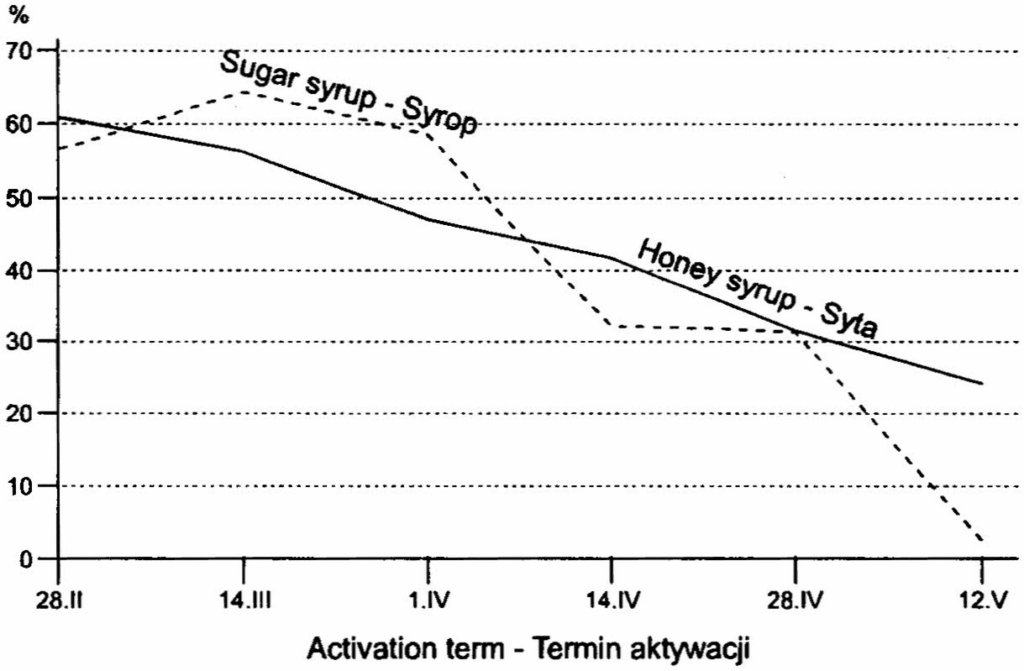
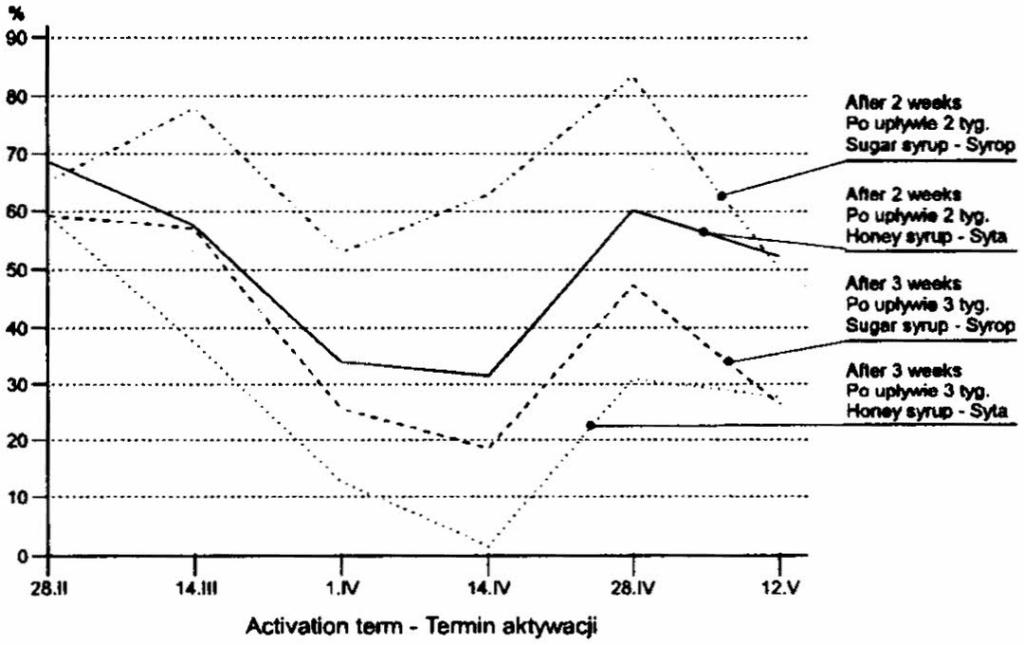
The survival rate of female and males that were determined separately for both feeding groups was not influenced in any significant degree by the type of diet, although in case of males, the sugar syrup proved to be slightly more favourable. The females activated in the last term and fed the sugar diet almost all died within 4 weeks. Insects activated still later lived short and that decided about the end of the experiment. The survival rate of females during the time
strona 269of the experiment, from the end of February to the second decade of June, fell by about 40% , the males showed an increased survival rate in test V, however, their survival was generally shorter than that of females (Fig.3, 4) as it is the case in natural conditions as well (Wilkaniec 1991).
CONCLUSIONS
- The different proportion of sexes emerged in particular experimental tests is probably the result of random selection of cocoons for activation during their removal from the nest pipes.
- Both the length of the activation period and the emerging process of imaginal forms of Osmia rufa from the cocoons depend strictly on the term of placing the cocoons into the incubator. The total time of both these periods was different for the particular tests of the experiment ranging from 5 to 14 days.
- The survival rate of males and females depends on term of their activation. The delay of the activation period in relation to the emerging term in natural conditions shortens the survival period and it is particularly clearly visible in case of females.
REFERENCES
Chorbiński P., Wilkaniec Z. (1998)- Wstępna analiza posekcyjna materiału powylęgowego pszczoły murarki ogrodowej (Osmia rufa L., Megachilidae). Mat. Konf. ISiK Oddział Pszczeln. PTN:8-9.
Wilkaniec Z., Ruszczyński W. (1994)- Wykorzystanie pszczoły murarki ogrodowej do zapylania truskawki w uprawie sterowanej i jej wpływ na plonowanie i jakość owoców. Mat. Konf. Poznań SITO-NOT:25-28.
Wilkaniec Z. (1991)- Możliwości zastosowania Osmia rufa L. (Apoidea, Megachilidae) w zapylaniu niektórych roślin uprawnych. Rocz. AR w Poznaniu, 229:173-179.
strona 271Wójtowski F., Wilkaniec Z. (1978)- Hodowla i użytkowanie pszczół samotnic osiedlonych w pułapkach gniazdowych . AR w Poznaniu Zakł. Upowszechn. Postępów w Roln.
Wójtowski F. (1979)-Spostrzeżenia nad biologią i możliwościami użytkowania pszczoły murarki- Osmia rufa L. (Apoidea, Megachilidae). *Rocz. AR w Poznaniu,*111:203-208
Wójtowski F., Wilkaniec Z., Szymaś B. (1991)- Próby reintrodukcji wybranych gatunków dziko żyjących pszczołowatych (Apoidea) w warunkach intensywnej gospodarki rolnej. Rocz. AR w Poznaniu, 229:181-192.
WPŁYW TERMINU AKTYWACJI PSZCZOŁY MURARKI OGRODOWEJ (Osmia rufa L., Megachilidae) NA DYNAMIKĘ WYGRYZANIA SIĘ IMAGINES I ICH PRZEŻYWALNOŚĆ
Karol Giejdasz, Zdzisław Wilkaniec
Streszczenie
Pszczoła samotnica murarka ogrodowa jest gatunkiem typowo wiosennym, dającym jedno pokolenie w roku. W warunkach naturalnych okres jej aktywnego życia i reprodukcji może zaczynać się w I dekadzie kwietnia i trwać do III dekady czerwca. Już we wrześniu w oprzędach (kokonach) znajdują się formy imaginalne, które w tej postaci zimują. Powyższa właściwość charakterystyczna dla bionomii tej pszczoły pozwala na wcześniejszą aktywację, czyli przyspieszenie wygryzania się, samców i samic poprzez umieszczenie oprzędów w odpowiedniej temperaturze. Ma to szczególne znaczenie, gdy chcemy wykorzystać wygryzające się pszczoły do zapylania roślin wcześnie kwitnących, uprawianych pod osłonami (szklarnie, tunele foliowe).
W 1997 roku przeprowadzono badania nad wpływem różnych terminów aktywacji murarki ogrodowej na procent wygryzionych owadów dorosłych, dynamikę wygryzania się z oprzędów oraz ich przeżywalność w zależności od rodzaju podawanego im pokarmu.
Uzyskane wyniki wskazują, że procent wygryzionych owadów w stosunku do liczby oprzędów był zbliżony w poszczególnych terminach i wynosił od 78,0% do 90,0%. Długość okresu aktywacji, wyrażona w dniach liczonych od umieszczenia oprzędów w cieplarce do wygryzienia się pierwszych owadów, jak i długość okresu wygryzania się owadów z oprzędów, od wygryzienia się pierwszego owada do ostatniego, była zróżnicowana dla płci oraz dla terminów aktywacji (budzenia). Łączny czas aktywacji i wygryzania się owadów z oprzędów był najdłuższy w pierwszym terminie (28 lutego) i wynosił 14 dni, a najkrótszy w przedostatnim terminie (28 kwietnia) i ostatnim (12 maja) – 5 dni.
Doświadczenia wykazały, że zarówno termin aktywacji, jak i stosowana dieta nie miały większego wpływu na przeżywalność samców, którą określano po 2 i 3 tygodniach od wygryzienia się ostatniego samca w danej próbie, a po 4 tygodniach tylko nieliczne pozostały przy życiu. Natomiast samice żyły dłużej i przeżywalność ich określano po upływie 4 tygodni. Stwierdzono, że termin aktywacji miał wpływ na przeżywalność samic, gdyż opóźnianie terminu budzenia wpływało na zmniejszanie procentu przeżywalności samic. Natomiast nie stwierdzono wpływu rodzaju żywienia na omawianą cechę.
Słowa kluczowa: Osmia rufa L., aktywacja, wygryzanie, przeżywalność.
Errata — błędy druku znalezione podczas digitalizacji
- s. 266: „in e cooler” → in a cooler
- s. 266: „1.IV; 14.V; 28.IV” → 1.IV; 14.IV; 28.IV
- s. 267: „in testes 1 and 2″ → in tests 1 and 2
- s. 267: „Wilkniec” → Wilkaniec
- s. 267: „the firs emerged” → the first emerged
- s. 271, streszczenie: „Słowa kluczowa” → Słowa kluczowe