

EFFECT OF DIFFERENTIATED NEST TUBES ON THEIR SETTLEMENT BY THE SOLITARY BEE OSMIA RUFA L. (MEGACHILIDAE)
tekst: Zdzisław Wilkaniec, Karol Giejdasz, Monika Fliszkiewicz
Pszczelnicze Zeszyty Naukowe, Rok XLIV, Nr 2, 2000 — Zdzisław Wilkaniec, Karol Giejdasz, Monika Fliszkiewicz
strona 311PSZCZELNICZE ZESZYTY NAUKOWE Rok XLIV, Nr 2 2000
Zdzisław Wilkaniec, Karol Giejdasz, Monika Fliszkiewicz
Department of Useful Insects Breeding, Faculty of Biology and Animal Husbandry, August Cieszkowski Agricultural University of Poznań, Wojska Polskiego 71C Str., 60-625 Poznań, Poland
Summary
The females of solitary bee Osmia rufa L., build their brood cells in nest tubes with different diameters. In our experiment the tube diameter ranged between 5 and 9 mm, and the number of the brood cells in a single tube oscillated between 4 and 13. The sex structure being the subject of investigations is influenced by the diameter of he nest tube and by the number of brood cells build in the given tube. The increase of the tube diameter and the number of brood cells are connected with the increase of the number of females and decrease of the number of males. A balance of sexes (sex ratio 1:1) was obtained in nest tubes with diameter of 6.5-6.9 mm.
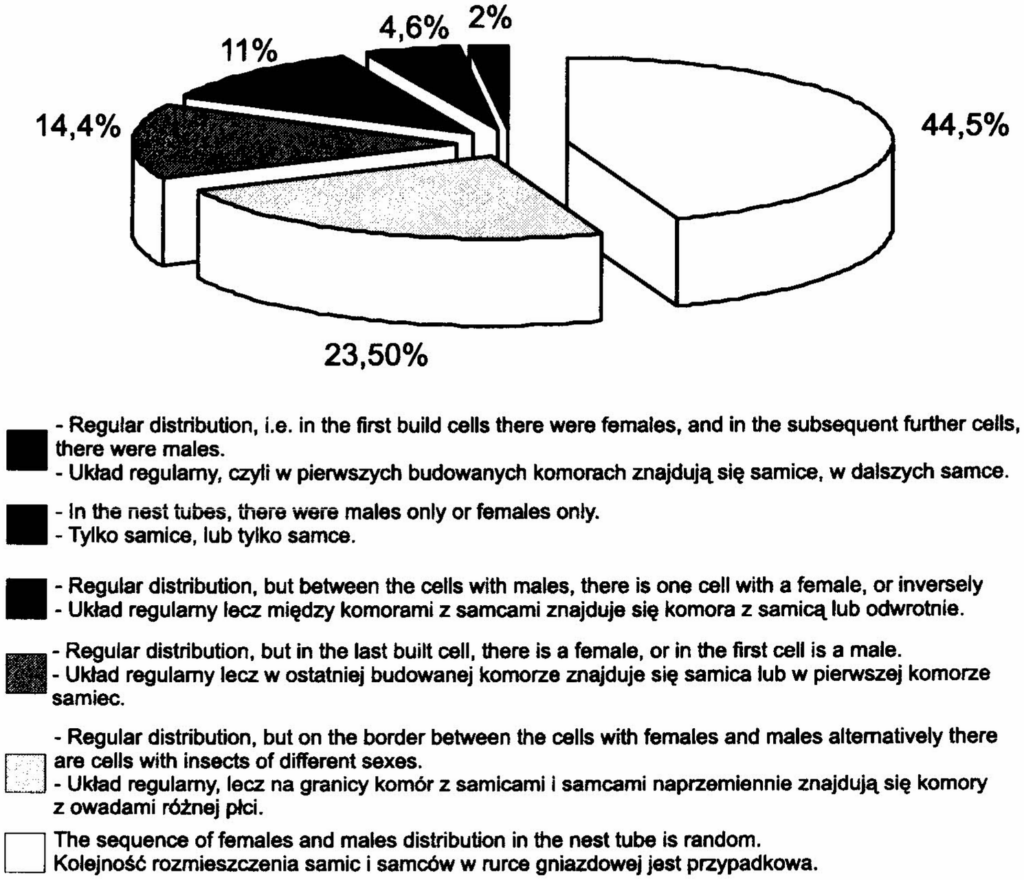
In slightly less than one half of the nest tubes (44.5%) settled by Osmia rufa L., there occurred a regular distribution of sexes i.e. in first successively build brood cells, there were females, and the further cells were occupied by males. In 23.5% of nest tubes , there were males only (19.6%) or females only (3.9%). In 32% of nest tubes, other irregularities were found.
Keywords: Osmia rufa L., sex ratio, nests, brood cells.
INTRODUCTION
In the recent years, a high interest in the solitary bee of the genus Osmia Pz. has been observed all over the world. It refers both to the bionomy, ethology, the breeding methods and the utilisation of these bees in the pollination of cultivated plants . The well-known and scientifically elaborated species include Osmia rufa L. (Tasei 1973a, 1973b, Wójtowski, Wilkaniec 1978, Wójtowski 1979, Wilkaniec, Radajewska 1997, Giejdasz, Wilkaniec 1998). However, in spite of series of scientific works referring to this species, there exist many unknown or not fully explained aspects of this bee’s life. Among others, this problem includes the effect of the nest tube diameters utilised by the female for the construction of brood cells and the number of brood cells in the nest tube on the sex ratio of the insects and distribution of females and males in the brood cells build by the females in the nest tubes. The above mentioned problems are the objectives of the present work.
strona 312METHODS
The experimental material originating from our own breeding conducted according to methods elaborated earlier (Wójtowski, Wilkaniec 1978) included adult insects of the solitary bee Osmia rufa L. in cocoons obtained from nest tubes settled in 1998, i.e. in the year preceding the presented experiment. Settled artificial nests made of common reed stalks were transferred in February 1999 to a cold store where they were kept at 2°C to the moment of the beginning of the experiment and throughout the period of its duration (from May to June) extending in this way the period of the winter diapause of the insects. Nest tubes with different diameters were sampled for analyses. Their internal diameters were measured with a slide calliper at the outlet of the tube with an accuracy of 0.1 mm, then the tubes were cut lengthwise, the cocoons were removed from the brood cells and counted. Each cocoon was placed separately in an opening made in a cork plate provided with a net stuck at the bottom side and it was marked with a note saying from which tube and brood cell it originated. The cork plates with the cocoons in the openings were covered with xerographic foil and placed in an incubator at 26°C. When the bees emerged from the cocoons, they were taken out from the incubator, placed individually into phials and put to sleep with ethyl acetate. Subsequently, on the basis of morphological differences, the sex of the insects was identified. Cocoons, from which the insects did not emerge, were cut lengthwise, and if there were dead imaginal forms of the insects, their sex was identified as well. A total of 153 settled nest tubes were analysed including 1270 brood cells from which 456 females and 521 males were obtained.
Since in some nest tubes there were females or males only, the mathematical calculation of the quotient for the particular observations (of the nest tubes) was not possible, therefore, the sex ratio was expressed by the difference of females to males. Data referring to the effect of the diameter of the nest tube and the number of brood cells on the sex structure were subject to the regression analysis. In order to carry out a one-factor analysis of variance comparing the dependence of the mean number of females, males, and the difference of females to males on the nest tube diameter in 0.5 mm intervals.
RESULTS
The obtained results subject to regression analysis indicate that the diameter of the nest tube and the number of brood cells contained in the tubes influenced the sex structure in the group of the investigated insects and it was expressed by the coefficient of determination R-sq=38.0% (p<0.05). With the increase of the diameter of the nest tube and the increase of the number of brood cells, the female to male difference grows (i.e. the number of females increases and the number of males decreases) in the investigated intervals
strona 313(tube diameters: 5-9 mm, number of brood cells in tube: 4-13). The regression analysis carried out separately for females and males indicated that the nest tube diameter and the number of brood cells in the tube have a greater influence on the number of females (R-sq=48.9%) than on the number of males (R-sq=27.7%).
The mean results obtained for a single nest tube with an average diameter of 6.96 mm are the following ones: number of cells- 8.36; number of females- 2.98; number of males- 3.43; the difference of females to males – -0.45.
With the increase of the nest tube diameter, the number of females grows, while the number of males decreases. The mean number of females and males in the intervals of nest tube diameters 5.0-5.4 and 5.5-5.9 mm was significantly different than the mean number of females and males in the intervals 6.5-6.9; 7.0-7.4; 7.5-7.9; 8.0-8.4 and 8.5-8.9 mm. Statistically significant differences were also recorded between the mean number of females in the interval 6.0-6.4 mm and in the intervals 7.5-7.9; 8.0-8.4 and 8.5-8.9 mm. On the other hand, only the mean number of males in the interval 6.0-6.4 mm was significantly different than the mean number of males in the interval 8.5-8.9 mm (Table 1).
Table 1. Mean number of females and males in the nest tube depending on its diameter Średnia liczba samic oraz samców w rurce gniazdowej w zależności od jej średnicy
| Diameter Średnica | N | Females – Samice: Mean Średnia | Females – Samice: StDev Odch. stand. | Males – Samce: Mean Średnia | Males – Samce: StDev Odch. stand. | Females – Samice / Males – Samce: Mean Średnia | Females – Samice / Males – Samce: StDev Odch. stand. |
|---|---|---|---|---|---|---|---|
| 5.0-5.4 | 15 | 1.07 c | 1.71 | 4.87 a | 1.60 | – 3.80 c | 2,81 |
| 5.5-5.9 | 19 | 1.21 c | 1.51 | 5.00 a | 1.67 | – 3.79 c | 2.67 |
| 6.0-6.4 | 19 | 2.00 bc | 2.11 | 4.11 ab | 1.76 | – 2.11 bc | 3.57 |
| 6.5-6.9 | 22 | 3.14 ab | 2.10 | 3.14 bc | 1.39 | 0.00 ab | 3.16 |
| 7.0-7.4 | 21 | 3.10 ab | 1.87 | 2.76 bc | 1.61 | 0.33 ab | 2.83 |
| 7.5-7.9 | 24 | 3.92 a | 2.06 | 2.79 bc | 1.69 | 1.13 a | 3.11 |
| 8.0-8.4 | 19 | 4.42 a | 2.06 | 2.90 bc | 1.15 | 1.53 a | 2.43 |
| 8.5-8.9 | 14 | 4.79 a | 1.81 | 2.07 c | 1.82 | 2.71 a | 3.19 |
p<0,05
In the nest tubes with diameters between 6.5 and 6.9 mm, the mean difference of females to males per one nest tube equalled zero. The mean difference of females to males was the smallest in tubes with diameters between 5.0 and 6.4 mm and it was significantly different from the mean difference of females to males in tubes with a diameter over 7.5 mm, the latter
strona 314difference being the highest one in the mentioned intervals of tube diameters (Table 1).
In 44.5% of the investigated nest tubes a regular distribution of sexes was found, i.e. in the first built brood cells there were females and in the subsequently built cells there were males . In 23.5% of nest tubes there were males only (19.6% of tubes), or females only (3.9% of tubes). A different sequence of the occurrence was found in 32% of nest tubes (Fig.1).
DISCUSSION
Many authors call attention to the dependence of the sex structure in Osmia rufa L. on the diameter of nest tubes where the female builds its brood calls. Wójtowski (1979) reported that from tubes with 5-6 mm diameter,
strona 315there developed a greater number of males, and it is convergent with the results obtained in our studies where the sexes were balanced in the intervals 6.5-6.9 mm, and the supremacy of females was found in the intervals above 7.5 mm. The latter data differ from those presented by Wójtowski (1979) who reported that in tubes of 8 mm diameter the sex balance was maintained or there was a supremacy of females . Also Wilkaniec, Giejdasz (1999) reported that the supremacy of females over males was visible in intervals above 8 mm diameter. However, those authors analysed in their work greater intervals of tube diameters (1 mm intervals). Kristjansson (1992) believes that the sex ratio of Osmia rufa in natural habitats is 1:1, and it depends on the diameter of nest tubes, on weather and on the temperature. Tepedino, Torchio (1982) who investigated Osmia lignaria propinqua, another a univoltine and early-spring species, report that sex ratio expressed by the male: female quotient oscillates in that bee between 0.8:1 and 3:1. However, the ratio 1.8:1 is accepted by them as the optimal one and it depends on the diameter of the nest tube, on the weather and habitat conditions. The same authors (1989) observed that the females of Osmia lignaria propinque build their brood cells is tubes with different diameters and that in narrower tubes more males developed. On the other hand, Maeta (1978) believes that when the female of Osmia has a choice, it selects nest tubes with a diameter corresponding to the bee’s body dimensions. There is a general belief that in the first brood cells build by the Osmia rufa female, fertilised eggs are laid and females develop from them, while in the final brood cells, unfertilised eggs are found and they develop into males (Tasei 1973b, Wójtowski 1979). In the present work, the authors have shown that the „regular distribution,,, as it has been called, occurs in 44.5% of nest tubes. In 19.6% of nest tubes, females only were found, and in 3.9% of nest tubes, there were males only. In 32% of nest tubes, there was a different distribution of sexes.
CONCLUSIONS
- The sex ratio of Osmia rufa L. depends on the diameter of nest tubes in which the females build their brood cells and on the number of cells in the tube.
- When Osmia rufa is bred for plant pollination, artificial nests built of tubes with diameters over 7.5 mm should be used. It will guarantee the supremacy of females which are more effective plant pollinators.
- When breeding for reproduction is the aim the nests should consist of tubes with diameters from 6 mm to 7 mm maximum, because this limit permits to obtain a 1:1 sex ratio insuring the proper reproduction.
- In slightly less then one half (44.5%) of the nest tubes settled by Osmia rufa L., there occurs a natural distribution of sexes, i.e. in the first built brood cells there are females and in the subsequent ones there are males.
REFERENCES
Giejdasz K., Wilkaniec Z. (1998- Effect of activation of bee Osmia rufa L., Megachilidae on the emerging of imagines and their survival rate. Pszczel. Zesz. Nauk. 42, 1: 265-271.
Kristjansson K. (1992)- Development of solitary bees as crop pollinators. in Bees for pollination. Proceedings of an EC workshop, Brussels, Belgium, 2-3 March 1992; Commission of the European Communities, Divisiion for the Coordination of Agricultural Research 91-109.
Maeta Y. (1978)- Comparative Studies on the Biology of the Bees of the Genus Osmia of Japan, with Special Reference to Their Managements for Pollinations of Crops (Hymenoptera: Megachilidae). Bull. Tohoku nat. Agricult. exp. St. 57: 1-221.
Tasei J.N. (1973a)- Le comportment de nidification chez Osmia cornuta Latr. et Osmia rufa L. (Hymenoptera: Maegachilide). Apidologie 4: 195-225.
Tasei J.N. (1973b)- Observation sur le development d’Osmia cornuta Latr. et Osmia rufa L. (Hymenoptera: Maegachilide). Apidologie. 4: 295-315.
Tepedino V. J., Torchio P.F. (1982)- Temporal variability in the sex ratio of non-social bee, Osmia lignaria propinqua: extrinsic determination or the tracking of an optimum. Oikos 38: 177-182.
Tepedino V. J., Torchio P.F. (1989)- The influence of nest-hole selection on sex ratio and progeny size in Osmia lignaria propinqua (Hymenoptera: Maegachilide). Annals of the Entomological Society of America 82, (3): 355-360.
Wilkaniec Z., Radajewska B. (1997)- Solitary bee Osmia rufa L. (Apoidea, Megachilidae) as pollinator of strawberry cultivated in an unheated plastic tunnel. Acta Hort. 439, 1: 489-493.
Wilkaniec Z., Giejdasz K. (1999)- Wpływ średnicy rurek gniazdowych na wielkość oprzędów i płeć pokolenia potomnego pszczoły murarki ogrodowej Osmia rufa L. Pszel. Zesz. Nauk. 43, suplement do nr 1. :119-121.
Wójtowski F. (1979)- Spostrzeżenia nad biologią i możliwościami użytkowania pszczoły murarki- Osmia rufa L. (Apoidea, Megachilidae). Rocz. AR Pozn. 111. 26: 203-208.
Wójtowski F., Wilkaniec Z. (1978)- Hodowla i użytkowanie pszczół samotnic osiedlonych w pułapkach gniazdowych. Instr. wdroż. AR Poznań. 1-10.
strona 317WPŁYW ZRÓŻNICOWANIA RUREK GNIAZDOWYCH SZTUCZNYCH GNIAZD NA EFEKT ZASIEDLANIA ICH PRZEZ PSZCZOŁĘ SAMOTNICZĄ OSMIA RUFA L., MAEGACHILIDAE
Wilkaniec Z., Giejdasz K., Fliszkiewicz M.
Streszczenie
Celem przeprowadzonych badań było ustalenie wpływu średnicy rurki gniazdowej oraz liczby komór lęgowych na strukturę płci u Osmia rufa L. oraz wzajemnego rozkładu płci owadów w poszczególnych komorach lęgowych.
Materiał doświadczalny stanowiły owady dorosłe pszczoły murarki ogrodowej w oprzędach pozyskanych z rurek gniazdowych wykonanych z trzciny pospolitej, zasiedlonych w 1998 roku. Do badań wykorzystano rurki o zróżnicowanej średnicy (5-9 mm), którą mierzono suwmiarką u wylotu rurki z dokładnością do 0,1 mm. Po rozcięciu rurek, uwolnieniu oprzędów i ustaleniu ich liczby umieszczano je oddzielnie w otworach wykonanych w płytce korkowej z przyklejoną od spodu siatką i po przykryciu od góry folią kserograficzną umieszczano w cieplarce w temperaturze 26°C. Wygryzione z oprzędów owady usypiano i określano ich płeć, również owadów zamarłych w oprzędach. Łącznie przeanalizowano 153 zasiedlone rurki gniazdowe, z których na 1270 założonych komór lęgowych uzyskano 456 samic i 521 samców.
Na podstawie uzyskanych wyników ustalono, że istotny wpływ na strukturę płci u Osmia rufa mają średnica rurki gniazdowej i liczba zbudowanych w niej komór lęgowych. Wraz ze wzrostem średnicy i liczby komór lęgowych notowano wzrost liczby samic i spadek liczby samców.
Średnie uzyskane wyniki dla pojedynczej rurki gniazdowej o przeciętnej średnicy 6,96 mm wynoszą: liczba komór- 8,36, liczba samic- 2,98, liczba samców- 3,43, różnica samic do samców wynosi- -0,45.
W niespełna połowie rurek gniazdowych (44,5%) zasiedlonych przez Osmia rufa L. występuje układ regularny, tzn. w pierwszych kolejno budowanych przez samicę komorach lęgowych znajdują się samice, a w dalszych samce. W 23,5% rurek gniazdowych znajdowano same samce (19,6%) lub tylko samice (3,9%). W 32% rurek gniazdowych występował inny nieregularny układ samic i samców.
Uzyskane w niniejszej pracy wyniki mogą być wykorzystane w praktyce podczas hodowli pszczoły murarki ogrodowej. W hodowli prowadzonej w celu wykorzystania pszczół do zapylania roślin, należy używać sztucznych gniazd zbudowanych z rurek o średnicy powyżej 7,5 mm, co w populacji gwarantuje przewagę samic, będących efektywniejszymi zapylaczami roślin. Hodowle reprodukcyjne zaś powinny posiadać gniazda z rurek o średnicy od 6 mm, lecz nie większej niż 7 mm, gdyż jest to granica pozwalająca uzyskać strukturę płci 1:1 gwarantującą prawidłowa reprodukcję.
Słowa kluczowe: Osmia rufa L., struktura płci, gniazda, komory lęgowe.
Errata — błędy druku znalezione podczas digitalizacji
- s. 311: „of he nest” → of the nest
- s. 314: „brood calls” → brood cells
- s. 315: „propinque” → propinqua
- s. 315: „is tubes” → in tubes
- s. 315: „less then” → less than
- s. 316, piśmiennictwo: „Divisiion” → Division
- s. 316, piśmiennictwo: „comportment” → comportement
- s. 316, piśmiennictwo: „development” → développement
- s. 316, piśmiennictwo 3×: „Maegachilide” → Megachilidae
- s. 316, piśmiennictwo: „Pszel.” → Pszczel.
- s. 317, tytuł polski: „MAEGACHILIDAE” → MEGACHILIDAE
- s. 317, streszczenie: „prawidłowa” → prawidłową