

DIASTASE AND GLUCOSE OXIDASE ACTIVITIES IN MILKWEED (ASCLEPIAS SYRIACA L.) AND ROBINIA (ROBINIA PSEUDACACIA L.) HONEY
tekst: Zsuzsanna Szél, Ágnes Kardos-Neumann, Enikő M. Szalai, Katalin Turi
Pszczelnicze Zeszyty Naukowe, Rok XLIV, Nr 2, 2000 — Zsuzsanna Szél, Ágnes Kardos-Neumann, Enikő M. Szalai, Katalin Turi
strona 319PSZCZELNICZE ZESZYTY NAUKOWE Rok XLIV, Nr 2 2000
Zsuzsanna Szél, Ágnes Kardos-Neumann*, Enikő M. Szalai, Katalin Turi
Institute for Small Animal Research, Gödöllő, 2100 P.O.B.: 417., Hungary
- Central Food Research Institute, Budapest, 1022 Herman Ottó u. 15., Hungary
Summary
Enzymatic activity plays a very important role in honey to determine biological changes during hydrolysis of sugars. The main source of enzymes is the nectar of flowers and pollen that is present in honey. Enzymes are generally present in pharyngeal glands of bees: the diastase enzyme (mainly consists of α- and β- amylase) which converts starch to glucose and glucose oxidase which transforms glucose into gluconic acid. The diastase activity and hydroxymethylfurfural content are widely recognised parameters in evaluating of freshness of honey.
Diastase and glucose oxidase activities were determined in 9 samples of milkweed honey and in 10 samples of robinia honey. The milkweed honey samples were originated from the middle part of Hungary and the robinia honey samples from a different area of the country. These samples, except one, were extracted in 1999 and were not heated.
Mean value for diastase number was 23,32 (14,03-34,11) in milkweed honey, and 16,28 (12,53-20,35) in robinia honey. Mean value for glucose oxidase was 3,67 nmol unit/g/min (0-9,66) in robinia honey and 6,59 (0-16,99) in milkweed honey. It seems that the two honey types could be separated by diastase and glucose oxidase activity.
Keywords: honey, enzyme, diastase, glucose oxidase.
INTRODUCTION
Enzymes are complex proteins that bring about many processes and reactions. The enzymes in honey are almost totally added by bees, though some traces of plant enzymes may be present.
Diastase (α- and β-amylase) which destroy starch is also added to nectar by bees during ripening. Diastase activity is a parameter of honey quality control used as an indicator of storage conditions and heating, although this enzyme of fresh honeys varies considerably. So it would be suited for the determination of the origin of honey (White 1992).
The glucose oxidase can oxidise small amounts of glucose to gluconic acid and to hydrogen peroxide. It has antibacterial properties in diluted honey, because the enzyme reaction proceeds only in diluted honey. The wound
strona 320healing properties of honey are partly attributed to the presence of this enzyme. There are some factors which block the liberation of hydrogen peroxide, e.g. enzyme catalase or ascorbic acid.
MATERIAL AND METHODS
In this study 10 robinia (Robinia pseudacacia L.) and 9 milkweed (Asclepias syriaca L.) honey samples from different areas of Hungary were examined. Samples, except one, were extracted in 1999 and they were stored in room temperature. One sample was extracted in 1998 and it was heated at 40°C.
Diastase activity was measured photometrically following Schade-White-Hadorn method (Hungarian Standard 6943/6-81) and expressed in DN (diastase number from Gothe). One diastase unit is the enzyme activity of 1 g of honey, which can hydrolyse 0,01 g of starch in one hour at 40°C (Vit, Pulcini 1996).
Glucose oxidase was measured by Sigma method: modification of Bergmeyer method (Anon 2000). Honey glucose oxidase was prepared by three phase partitioning method (Szamos 1992) directly subsequent dilute buffer solution (pH =5,1). After that, o-dianisidine and peroxidase were added and the obtained colour was measured photometrically at 500 nm at 35°C for 10 minutes. The activity of this enzyme was expressed in nmol unit/g/min.
Semiquantitative screening procedure for peroxide accumulation was applied using a Merckoquant peroxide test strip (no. 110081, Merck, Darmstadt, Germany) according to Kerkvliet (Kerkvliet 1996). The activity of glucose oxidase is in direct proportion to hydrogen peroxide. The obtained value, multiplied by five, gives the amount of hydrogen peroxide accumulation in micrograms per g honey per hour at 20°C.
RESULTS
Diastase number and glucose oxidase activity for samples used in this study is demonstrated in Table 1. The average DN in the case of robinia honey was 16,28 which is similar to the result (17,83) of another Hungarian researcher (Kerekes 1996). The DN in the milkweed honey was higher (23,32), because milkweed nectar is thinner than robinia nectar and bees need more time to concentrate this nectar and add more enzyme to it. There was one sample (11. milkweed) which was from 1998 and it was heated one time. It has the smallest DN and also the smallest glucose activity. Heating and extended storage can attenuate the level of both of these enzymes.
strona 321Table 1 Diastase and glucose oxidase activity in milkweed and robinia honey Aktywność diastazy i glukozooksydazy w miodzie z trojeści amerykańskiej i robinii akacjowej
Robinia honey – Miód z robinii akacjowej
| Honey samples / Próbki miodu | DN (diastase activity) / LD (aktywność diastazy) | Glucose oxidase activity (nmol unit/g /min) / Aktywność glukozooksydazy (nmol/g/min) | Peroxide test value / Test peroksydazowy |
|---|---|---|---|
| 2 | 15,35 | 1,16 | 3 |
| 6 | 15,00 | 2,35 | 1 |
| 8 | 20,35 | 0,00 | 0 |
| 24 | 15,89 | 1,15 | 3 |
| 28 | 19,73 | 9,66 | 10 |
| 32 | 19,65 | 8,70 | 10 |
| 34 | 14,73 | 1,22 | 1 |
| 41 | 16,04 | 4,10 | 3 |
| 46 | 14,05 | 5,31 | 3 |
| 49 | 12,53 | 3,04 | 3 |
| Min. | 12,53 | 0,00 | |
| Max | 20,35 | 9,66 | |
| x̄ | 16,28 | 3,67 | |
| SD | 2,53 | 3,31 |
Milkweed honey – Miód z trojeści amerykańskiej
| Honey samples / Próbki miodu | DN (diastase activity) / LD (aktywność diastazy) | Glucose oxidase activity (nmol unit/g /min) / Aktywność glukozooksydazy (nmol/g/min) | Peroxide test value / Test peroksydazowy |
|---|---|---|---|
| 11 | 14,03 | 0,00 | 0 |
| 14 | 21,66 | 7,72 | 3 |
| 15 | 22,16 | 16,35 | 10 |
| 16 | 19,86 | 3,40 | 3 |
| 19 | 34,11 | 12,82 | 10 |
| 26 | 26,90 | 0,36 | 10 |
| 27 | 18,63 | 6,15 | 3 |
| 36 | 28,03 | 6,80 | 3 |
| 37 | 24,52 | 6,67 | 3 |
| Min. | 14,03 | 0,00 | 0 |
| Max. | 34,11 | 16,35 | 10 |
| x̄ | 23,32 | 6,59 | |
| SD | 5,89 | 5,35 |
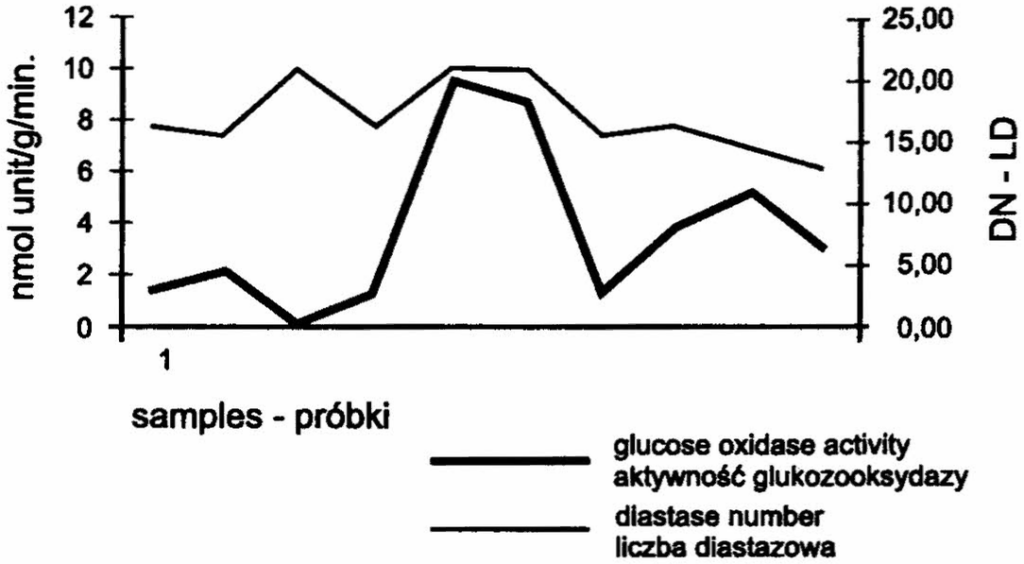
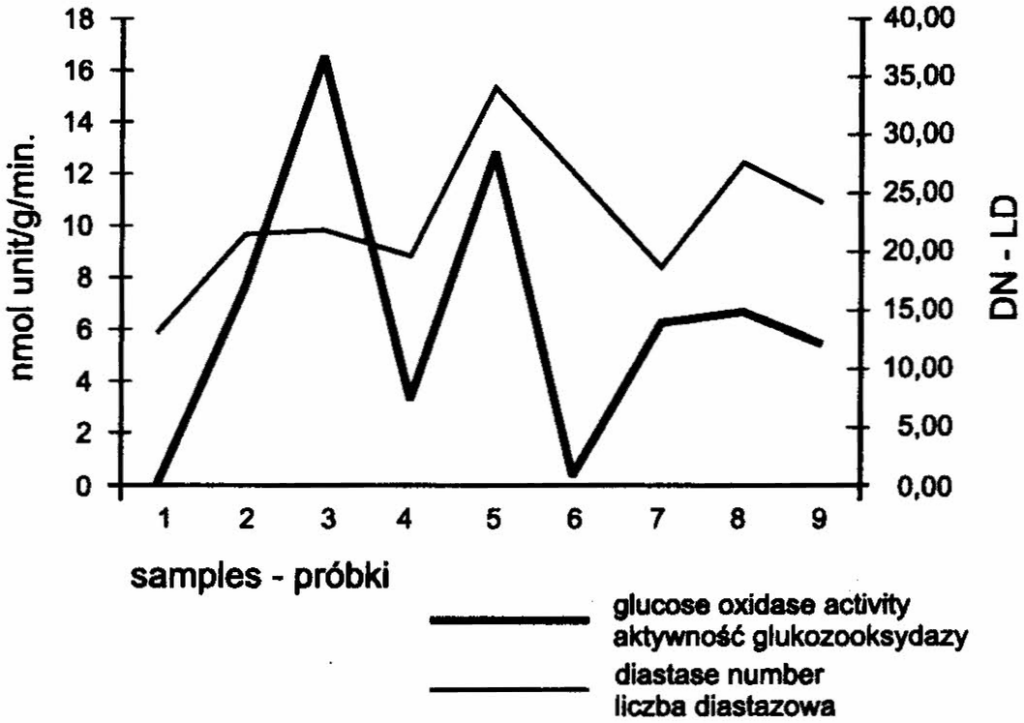
The difference between glucose oxidase activity of the two honey types was not very significant.
The correlation coefficient was counted between the DN and the glucose oxidase activity in robinia (0.38) and the milkweed honey (0,42). These were not significant correlations although both these enzymes are produced in the pharyngeal glands of bees. (Figure 1.,2.)
Correlation between Sigma Chemical Company (Anon, 2000) method and the semiquantitative procedure was 0,92 for robinia honey and 0,53 for milkweed honey.
strona 323CONCLUSIONS
Different honey types have different enzyme activation values, although these are influenced by many factors (catalase, ascorbic acid, temperature, etc.). The milkweed honey had higher diastase and glucose oxidase activity because it is thinner than robinia nectar and bees need more time to concentrate this nectar and to add more enzyme to it.
Using a peroxide test strip is a very simple procedure for measuring activity of glucose oxidase and can be used to estimate the antibacterial properties of the honey.
REFERENCES
Anon (2000)- Glucose oxidase preparation. Biochemicals and reagents Catalog, Sigma Aldrich Company: 464.
Hungarian Standard 6943/6-81.
Kerekes L. (1996)- Quality and qualification of honey. Journal of Food Investigations, Budapest, XLII. Vol. 3: 204-211.
Kerkvliet J. D. (1996)- Screening method for the determination of peroxide accumulation in honey and relation with HMF content. J. Apic. Res., 35(3/4): 110-117.
Szamos J. (1992)- Purification of horseradish peroxidase by three-phase partitioning (TTP). Acta Alimentaria, Budapest, 21 (3-4): 253-260.
Vit P., Pulcini P. (1996)- Diastase and invertase activities in Meliponini and Trigonini honeys from Venezuela. J. Apic. Res., 35(2):57-62.
White, J. W. (1992)- Honey. In: Dadant: The hive and the honey bee. 869-918.
AKTYWNOŚĆ DIASTAZY I GLUKOZOOKSYDAZY W MIODZIE Z TROJEŚCI AMERYKAŃSKIEJ (ASCLEPIAS SYRIACA L.) I ROBINII AKACJOWEJ (ROBINIA PSEUDACACIA L.)
Szél Z., Kardos-Neumann Á., Szalai E.M., Turi K.
Streszczenie
Aktywność enzymów w miodzie odgrywa bardzo ważną rolę. Decyduje o jego właściwościach biologicznych i składzie. Ważnym źródłem enzymów miodowych jest nektar i pyłek kwiatowy. Generalnie jednak enzymy takie jak: diastaza (składająca się z α-amylazy, katalizująca reakcję hydrolizy skrobi) i glukozooksydaza (katalizująca reakcję utleniania glukozy do kwasu glukonowego), pochodzą z gruczołów gardzielowych
strona 324pszczoły. Aktywność diastazy oraz zawartość hydroksymetylofurfuralu to powszechnie uznane parametry świeżości miodu.
W niniejszych badaniach oznaczono aktywność diastazy i glukozooksydazy w 9 próbkach miodu z trojeści amerykańskiej i 10 próbkach miodu z robinii akacjowej. Miód z trojeści pochodził ze środkowej części Węgier, a z robinii akacjowej z różnych rejonów tego kraju. Próbki miodu, z wyjątkiem jednej, zebrano w 1999 r i do czasu analizy nie były ogrzewane.
Średnia aktywności diastazy (LD) wynosiła 23,32 i wahała się od 14,03 do 34,11 w miodzie z trojeści amerykańskiej oraz 16,28 (12,53 – 20,35) w miodzie z robinii akacjowej. Średnia aktywność glukozooksydazy wynosiła 3,67 nmol/g/min (0,00 – 9,66) w miodzie z robinii akacjowej i 6,59 (0,00 – 16,99) w miodzie z trojeści amerykańskiej. Wydaje się, że te dwie odmiany miodu można odróżniać na podstawie oznaczeń aktywności diastazy i glukozooksydazy.
Słowa kluczowe: miód, enzymy, diastaza, glukozooksydaza.